What This Blog Covers
Diwali revenue growth is easy to report and hard to trust, since a sale-season lift can just as easily reflect pulled-forward demand as genuine incrementality. This blog uses United Colors of Benetton’s Diwali campaign, a 10,000+ SKU catalog segmented by stock and conversion data into four budget tiers, to show how to structure a festive campaign so its ROI gain is measurable and real, not a seasonal illusion. The result was a 12% CTR improvement, 4% CVR uplift, and 26% ROI growth, at consistent investment levels across the catalog.
Quick Answer: Proving incrementality in a Diwali campaign requires segmenting the catalog by live stock and conversion performance before allocating budget, not after. United Colors of Benetton identified roughly 8,000 to 10,000 advertising candidates from a 100,000-unit stock pool, split budget into four tiers based on product role (branded search winners, attention-getters, high-converting low-traffic items, and long-tail), and timed lower-discount promotions to avoid direct competition with heavy discount events. That structure delivered a 12% CTR gain, 4% CVR uplift, and 26% ROI growth at consistent spend levels, which is what makes the lift measurable rather than assumed.
Table of Contents
Why Diwali Revenue Growth Is Easy to Report and Hard to Trust
Every brand that runs a Diwali campaign can point to a revenue increase afterward. Festive demand is real, and most of it would show up in some form regardless of the specific campaign structure behind it. The harder question is how much of that lift is incremental, meaning it would not have happened without the specific advertising decisions made.
This is the gap between a campaign that reports strong numbers and one that proves them. Benetton’s catalog, more than 10,000 active SKUs, made this distinction unavoidable: with a range that large, uniform treatment guarantees that some spend goes toward products that were going to convert anyway, inflating the top-line number without reflecting real incrementality. The festive readiness planning that should precede any Diwali campaign starts with exactly this question.
Start With Stock Data, Not a Media Plan
The Benetton team began with live Stock on Hand data and conversion performance across roughly 100,000 units, not a creative brief or a channel plan. From that pool, they identified 8,000 to 10,000 genuine advertising candidates, products worth putting budget behind, rather than assuming the full catalog deserved equal treatment.
This inverts the usual campaign-planning order. Instead of deciding a budget and then figuring out what to advertise, the stock and performance data decided which products were even eligible for spend in the first place.
Four Tiers, Four Different Jobs
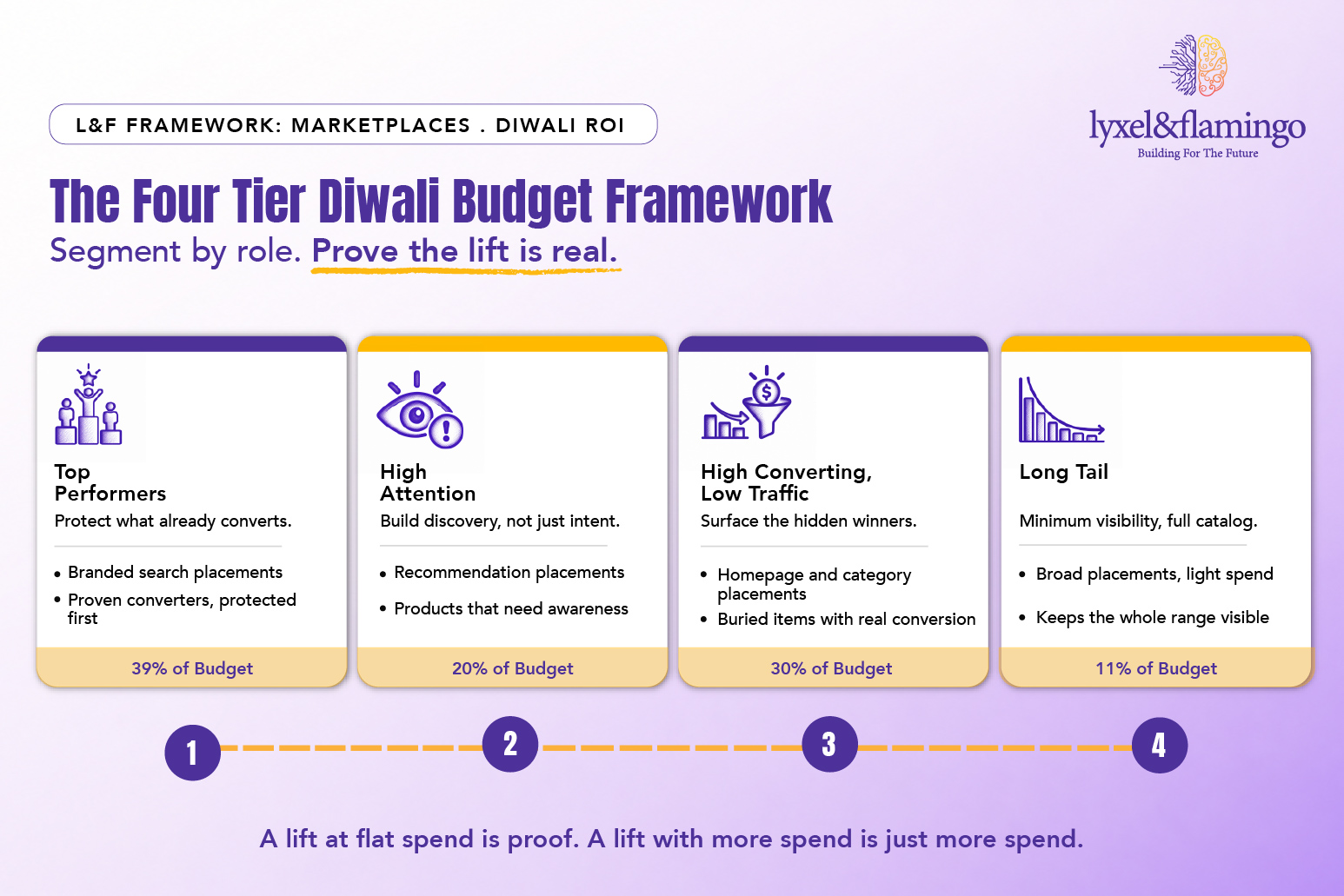
The core insight behind the segmentation was that within a catalog of 10,000 SKUs, some products are built to convert and some are built to capture attention, and treating them the same wastes both. The team split budget into four tiers: 39% to top performers through branded search, 20% to high-attention products via recommendation placements, 30% to high-converting, low-traffic items through homepage and category placements, and 11% to long-tail products.
Each tier had a distinct job. Branded search protects the SKUs already converting reliably. Recommendation placements build awareness for products that need discovery, not just search intent. Homepage and category placements catch high-converting items that would otherwise stay buried in a 10,000-SKU catalog.
Timing: When Not to Compete on Discount
One of the less obvious decisions in the strategy was timing lower-discount products for regular, non-peak periods, specifically to avoid competing head-on during the heaviest discount events. This kept those products visible without forcing them into a price war they were never positioned to win.
This timing discipline matters for exactly the reason buy-box and inventory planning matters during festive season: the goal is not to be everywhere at once. It’s to be positioned where a given product actually has a competitive chance. It is the same discipline behind reserving premium placements for proven intent only, the approach covered in the sale-event playbook for premium brands, and behind protecting ROAS itself once CPCs start climbing, covered in defending ROAS through the festive bidding war.
What the Results Actually Prove
The headline numbers, a 12% CTR improvement, a 4% CVR uplift, and a 26% ROI increase, are meaningful on their own. What makes them evidence of incrementality rather than seasonal noise is that they were achieved at consistent investment levels across the full catalog, not through a budget increase that could explain the lift on its own.
That is the actual test for incrementality: if ROI grows without spend growing proportionally, the gain came from better allocation, not more money chasing the same demand.
Applying This to a Smaller Catalog
A brand with 500 SKUs instead of 10,000 can still apply the same logic at a smaller scale. Start with which products are genuinely in stock and converting well, split budget into a handful of tiers based on each product’s role, and resist the instinct to spread spend evenly just because the catalog is smaller and easier to cover.
The scale of Benetton’s catalog made the waste of uniform treatment obvious. Smaller catalogs have the same waste; it is simply harder to see without segmenting first. Whatever the catalog size, the result is only worth reporting if it shows up in the marketplace KPIs a CXO should actually be tracking during festive sales, not just in a single end-of-campaign revenue number.
Framework Explained
- Start with stock, not spend: Live inventory and conversion data should decide which products are even eligible for budget.
- Segment by role, not category: A product’s job (protect, discover, surface, maintain) matters more than which category it sits in.
- Time around discount events: Lower-discount products should avoid competing head-on during the heaviest promotional windows.
- Judge ROI against spend, not in isolation: A lift with flat investment is evidence of incrementality; a lift with proportional spend growth is not.
United Colors of Benetton achieved a 12% CTR improvement, 4% CVR uplift, and 26% ROI growth on a catalog of over 10,000 active SKUs during Diwali, at consistent investment levels. The strategy segmented the catalog into four budget tiers based on live stock and conversion data rather than treating the range uniformly. Read the full Benetton case study.
Key Takeaways
- Revenue growth during Diwali is easy to report; proving it is incremental, not just seasonal, requires holding spend levels constant while measuring the lift.
- Starting a festive campaign with stock and conversion data, rather than a media plan, determines which products actually deserve budget.
- Segmenting a large catalog into tiers by product role protects proven converters while still surfacing hidden high-potential items.
- Timing lower-discount products away from peak discount events keeps them visible without forcing an unwinnable price competition.
CXO Takeaway
The question worth asking after any festive campaign is not “did revenue go up.” It is: would this revenue have shown up anyway, at the same spend level, without our specific campaign structure?
Benetton’s numbers hold up to that question because the ROI gain came from allocation discipline, not from spending more.
If your festive campaigns are still treating a large catalog uniformly, Lyxel&Flamingo can build the stock-first segmentation framework that delivered 26% ROI growth for Benetton, at flat investment.
Frequently Asked Questions
Even a few hundred SKUs benefit from tiering. The core principle, segment by role and stock status rather than treating the catalog uniformly, applies regardless of scale; larger catalogs simply make the waste of not doing it more visible.
A media plan built before checking stock risks advertising products that cannot fulfill demand, wasting spend on out-of-stock or low-availability items. Stock data should filter the eligible product pool before any creative or channel decisions are made.
Compare the ROI gain against the change in spend. If ROI grows while investment stays flat or grows less than proportionally, as it did for Benetton, the gain reflects better allocation rather than simply more budget chasing the same seasonal demand.
They get buried by competitors offering steeper cuts, wasting the impressions spent on them. Timing those products for non-peak periods keeps them visible in a less competitive environment instead.