What this blog covers
Festive sale budgets on Amazon and Flipkart need to scale well beyond normal daily spend, and scaling the number alone rarely scales the return. This piece covers how to pace budget across the sale window rather than simply raising the cap, where Amazon and Flipkart budgets should diverge rather than mirror each other, and how to tell defensive spend from genuine growth spend before the ACOS report forces the question.
Quick Answer: Scaling marketplace ad budgets for a festive sale without wasting spend comes down to three disciplines: pacing the increased budget against the actual shape of sale-day demand rather than spreading it evenly, treating Amazon and Flipkart as genuinely different auctions with different competitive dynamics rather than mirroring one budget split across both, and separating defensive spend (protecting Buy Box and branded search) from growth spend (capturing new category demand) so neither quietly crowds out the other. Brands that scale budget against a plan built this way typically hold blended ACOS closer to baseline than brands that simply raise the cap and react once performance slips.
Table of Contents
- Why Scaling Spend and Wasting Spend Look Identical at First
- Pacing the Spend Across the Sale Window, Not Just Raising the Cap
- Where Amazon and Flipkart Budgets Should Not Mirror Each Other
- The Defensive Spend Trap: Protecting Share vs Buying New Demand
- The Festive Budget Scaling Framework
- What to Review Daily Once the Sale Is Live
- Key Takeaways
- CXO Takeaway
Why Scaling Spend and Wasting Spend Look Identical at First
A brand doubling its daily Amazon and Flipkart budget for a festive sale sees order volume rise almost immediately, since more impressions and more bids naturally produce more clicks and more sales. That early signal looks like success, and it’s genuinely ambiguous: the same curve shows up whether the extra spend is capturing real incremental demand or simply bidding up an auction that was already going to convert at a lower cost.
The gap only becomes visible a few days in, once blended ACOS across both platforms starts drifting upward while order growth flattens. By then, a meaningful share of the scaled budget has already gone toward incremental clicks that cost more without buying proportionally more revenue, the same silent margin erosion that shows up on the P&L line well after the ad dashboard first flagged it. Part of that scaled budget is also quietly wasted when it lands on a listing that hasn’t passed its own creative audit, since no amount of pacing discipline recovers a sale a weak product page was never going to convert.
Pacing the Spend Across the Sale Window, Not Just Raising the Cap
A multi-day festive sale rarely distributes demand evenly across its calendar. Day one and the final forty-eight hours before the sale closes typically carry the heaviest traffic and the sharpest competitive bidding, while the middle days see a genuine, predictable lull. A budget spread evenly across every sale day runs out on the slow middle days and sits underspent exactly when demand peaks.
Pacing budget against this actual demand shape, front-loading day one for the opening surge, holding a reserve for the closing 48-hour push, and deliberately pulling back mid-sale, captures more of the highest-intent traffic without raising total spend at all. This is the same logic behind Amazon and Flipkart’s festive-season inventory and Buy Box planning: the calendar has a shape, and the budget plan should match it rather than ignore it.
Where Amazon and Flipkart Budgets Should Not Mirror Each Other
Treating Amazon and Flipkart as a single combined ad budget, split by a fixed ratio decided once at the start of the season, misses how differently the two platforms’ auctions actually behave during a festive rush. Amazon’s Sponsored Products and Sponsored Brands auctions typically see earlier, steeper CPC inflation as sophisticated sellers raise bids well ahead of the published sale dates, while Flipkart’s ad inventory and competitive density shift on a somewhat different rhythm tied to its own event calendar and category mix.
A brand running the identical budget split and identical bid strategy on both platforms is almost always overpaying on one and under-investing on the other at any given moment in the sale. Reviewing each platform’s CPC and conversion trend independently, rather than managing to one blended number, is what catches this early enough to reallocate mid-sale. Amazon Seller Central and Flipkart’s own seller dashboard remain the most direct sources for that platform-specific read, ahead of any blended third-party report.
The Defensive Spend Trap: Protecting Share vs Buying New Demand
Defensive spend, budget used purely to protect Buy Box position or branded search rank against a competitor bidding on the brand’s own name, is a real and necessary cost during a festive rush. CPCs spike in near lockstep across an entire category once the sale calendar opens, and a brand that skips defensive bidding entirely can lose Buy Box or branded search rank to a competitor for the exact days that matter most.
The trap is letting defensive spend grow without a cap, where it quietly consumes a larger and larger share of the total budget while doing nothing to capture new category demand. A brand should know, in real time, what share of today’s spend went toward defense versus growth, since an ACOS report blending the two together hides which lever is actually underperforming. Consistent measurement and reporting are important disciplines in auction-based advertising; the Interactive Advertising Bureau’s standards and guidelines provide broader industry guidance on advertising measurement.
Strong review signals also do quiet defensive work of their own: Amazon reviews can be a hidden goldmine for sellers, helping build trust and improve conversion. Better listing credibility can support organic performance and reduce the pressure to rely entirely on paid visibility.
The Festive Budget Scaling Framework
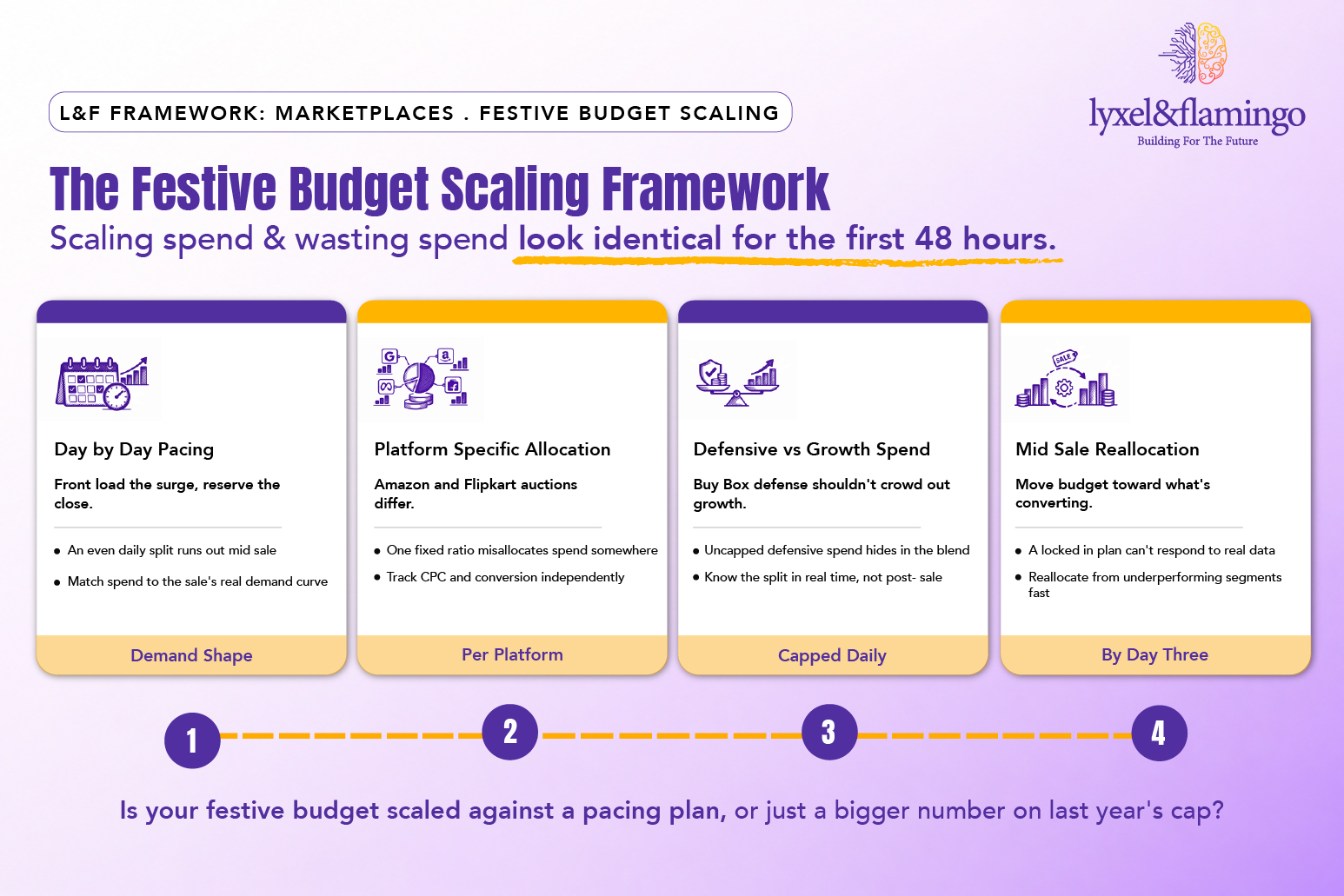
The table below breaks festive-season marketplace ad scaling into the four disciplines that separate genuine growth spend from wasted spend.
Framework Explained
Day-by-Day Pacing: matches spend to the actual shape of sale-day demand, rather than an even daily split that runs out mid-sale and sits idle on the slow days.
Platform-Specific Allocation: respects that Amazon and Flipkart auctions behave differently during a festive rush, so a single blended budget ratio consistently misallocates spend on one platform or the other.
Defensive vs Growth Spend: needs a visible, separate line item, since defensive spend is necessary and still easy to let grow unchecked at the expense of genuine demand capture.
Mid-Sale Reallocation: is what turns a static budget plan into a responsive one, moving spend toward whatever is actually converting once real sale-day data starts coming in.
CAPABILITY NOTE: Lyxel&Flamingo’s third-party marketplace team builds and paces festive-season ad budgets across Amazon and Flipkart as part of ongoing marketplace engagements. In ASICS’s AMS launch work, disciplined budget pacing and bid strategy grew AMS-attributed sales by 100% over a year while cutting ACoS by 60% within three months. Read the full ASICS case study.
What to Review Daily Once the Sale Is Live
Once the sale calendar opens, a brief daily check matters more than the pre-sale plan itself: blended and platform-specific ACOS against the prior day, the defensive-versus-growth spend split, and whether any single SKU or campaign is consuming a disproportionate share of budget without a matching revenue return. The marketplace KPIs every CXO should actually track during festive sales gives the fuller dashboard this daily check should sit inside.
Catching a pacing problem on day two, while there’s still budget and sale days left to correct it, is worth considerably more than a clean post-mortem once the sale has already closed. This pacing discipline is the mechanical half of festive advertising; Lyxel&Flamingo’s guide to defending ROAS through the festive bidding war covers the related disciplines of bid control, dayparting, SKU prioritisation, and brand defence that help determine what a paced budget should actually be buying in each phase.
Key Takeaways
- Scaling spend and wasting spend produce an identical early signal, order volume rising, which hides the real gap for several sale days.
- Pacing budget against the actual shape of sale-day demand captures more high-intent traffic than an even daily split.
- Amazon and Flipkart auctions behave differently during a festive rush and rarely deserve one identical budget ratio.
- Defensive spend protecting Buy Box and branded search is necessary, and needs an explicit cap to avoid crowding out growth spend.
- A brief daily review during the live sale catches a pacing problem while there’s still time and budget left to fix it.
CXO Takeaway
Is your festive-season ad budget scaled against an actual pacing plan, or just a bigger number applied to last year’s daily cap? The brands that protect ACOS through a festive rush usually built their pacing, platform split, and defensive-spend cap before the sale calendar opened, then reviewed it daily once live. Lyxel&Flamingo’s third-party marketplace team builds this exact scaling plan ahead of festive season.
Frequently Asked Questions
This varies heavily by category, though the bigger lever is rarely the total number alone, it’s whether that larger budget is paced against the sale’s actual demand shape rather than spread evenly across every day.
Rarely a safe assumption. The two platforms’ auctions behave differently during a festive rush, so tracking each platform’s CPC and conversion trend independently, rather than managing to one blended split, typically protects ACOS better.
There’s no universal number, though it should be an explicit, capped line item reviewed daily, since uncapped defensive spend is one of the most common ways festive budgets quietly overspend without buying new demand.
As early as day three, once enough real sale-day data exists to see which segments are converting efficiently and which are consuming budget without a matching return.