When an ecommerce brand migrates off legacy infrastructure onto a modern cloud-hosted platform, security posture does not simply improve by default; it changes shape, with new responsibilities shifting to the brand and new categories of misconfiguration risk appearing. This blog walks through what genuinely changes about security during a platform migration, using the security-conscious discipline behind a real Magento-to-Shopify migration as an adjacent reference point, and lays out what an ecommerce team should verify before, during, and after moving off legacy infrastructure.
Quick Answer: Moving off legacy ecommerce infrastructure changes security in three specific ways: the shared-responsibility model shifts, with the platform provider securing more of the underlying infrastructure while the brand remains responsible for configuration, access control, and app-level security; new categories of misconfiguration risk appear, since cloud platforms are flexible enough to be set up insecurely even when the underlying infrastructure is secure; and data migration itself is a security-sensitive event requiring integrity checks, not just a functional transfer. Brands should treat a platform migration as a security review moment, not assume the new platform is automatically more secure simply because it is newer.
Table of Contents
- Why “Newer Platform” Does Not Automatically Mean “More Secure”
- The Shared-Responsibility Model Most Brands Do Not Fully Understand
- Misconfiguration: The New Risk Category That Replaces Old Ones
- Data Migration as a Security Event, Not Just a Technical One
- What to Verify Before, During, and After Migration
- Framework Explained
- Key Takeaways
- CXO Takeaway
Why “Newer Platform” Does Not Automatically Mean “More Secure”
A modern cloud-hosted ecommerce platform generally does invest more in underlying infrastructure security than an aging, self-managed legacy system: patch cadence, infrastructure hardening, physical data center security. That is a genuine improvement, and it is also only part of the picture.
The platform provider securing its infrastructure does not automatically mean the brand’s specific implementation is secure. Access controls, app permissions, and configuration choices remain the brand’s responsibility on any platform, legacy or modern, and a migration that focuses purely on functional parity can carry those configuration gaps straight into the new environment.
The Shared-Responsibility Model Most Brands Do Not Fully Understand
Cloud platforms generally operate on a shared-responsibility model: the provider secures the underlying infrastructure, while the brand remains responsible for how it configures access, permissions, and app integrations on top of that infrastructure. Many teams migrate under the implicit assumption that moving to a reputable platform transfers most security responsibility to that provider, which is not how the model actually works. NIST’s cloud computing guidance lays out this shared-responsibility split in more technical depth, independent of what any single cloud platform’s own marketing says about it.
This gap matters most in exactly the areas a migration project tends to move quickly through: who has admin access to the new platform, which third-party apps get connected during setup, and what default permission levels those apps receive. A security-conscious migration treats these as explicit decisions, not defaults left unexamined, exactly the kind of discipline behind Kenstar’s Magento-to-Shopify migration, which is worth noting as an adjacent example of migration rigor rather than a dedicated cybersecurity engagement in its own right.
Misconfiguration: The New Risk Category That Replaces Old Ones
Legacy infrastructure tends to fail through neglect: unpatched software, outdated protocols, infrastructure nobody has maintained properly in years. Modern cloud platforms largely eliminate that specific failure mode. They introduce a different one instead: misconfiguration, since flexible, feature-rich platforms are easy to set up in ways that are functionally fine, yet security-loose.
This includes overly broad access permissions granted during setup for convenience, third-party app integrations given more data access than they actually need, and default settings left unreviewed because the migration team was focused on getting the store functionally live rather than auditing every configuration choice along the way.
Data Migration as a Security Event, Not Just a Technical One
Moving customer records, order history, and payment-adjacent data from one platform to another is, functionally, a large-scale data handling event with real security implications, not just a technical transfer to verify for completeness. This includes ensuring data is encrypted in transit during the migration itself, that access to the migration process is tightly controlled, and that the receiving platform’s data handling meets the same, or better, standards as the system being replaced.
This is the same discipline behind treating a migration’s data integrity check as a security checkpoint, verifying that customer data arrived completely, correctly, and without unauthorized exposure during the transfer window, not simply confirming the record counts match.
What to Verify Before, During, and After Migration
Before migration: audit current access permissions and data handling practices so the team knows exactly what is being carried forward versus left behind. During migration: control and log who has access to the migration process itself, and verify data is encrypted in transit. After migration: conduct a full access and configuration review of the new platform rather than assuming default settings are appropriately secure, and run a vulnerability assessment on the new environment before treating the migration as complete. CISA’s cloud security guidance is a useful independent reference for what a post-migration configuration review should actually check, beyond what any single platform vendor recommends.
This three-phase discipline turns a migration from a purely functional project into one that also closes, rather than inherits or recreates, security gaps.
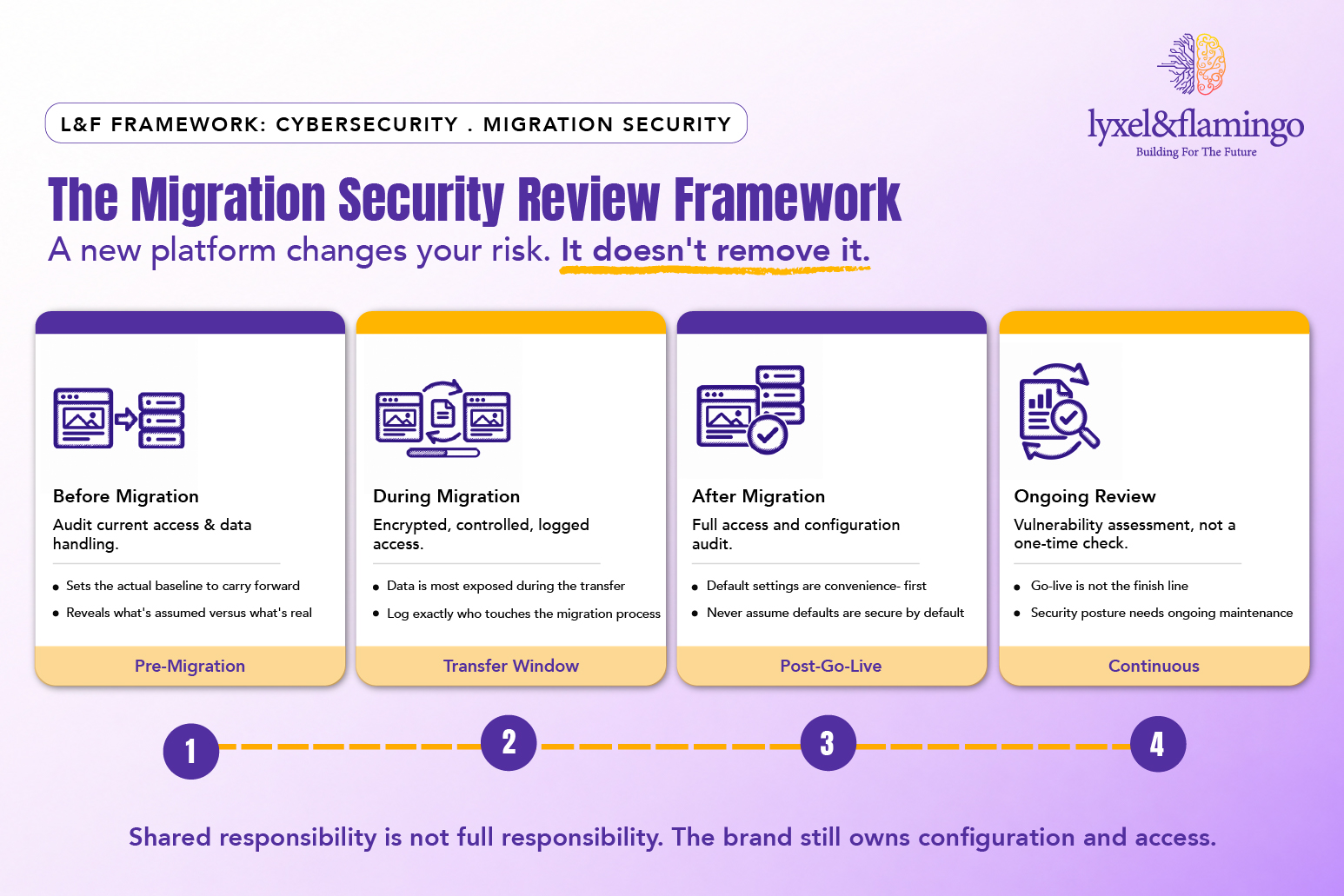
Framework Explained
- Shared responsibility is not full responsibility: The platform secures its infrastructure; the brand still owns configuration, access, and app permissions.
- Misconfiguration is the new failure mode: Flexible modern platforms replace legacy neglect risk with the risk of insecure, convenience-first setup choices.
- Data migration is a security event: Encryption in transit and controlled migration access matter as much as confirming the data arrived complete.
- Security review is a migration phase, not an afterthought: Planning it in from day one closes gaps instead of carrying them into the new environment.
Kenstar’s Magento-to-Shopify migration is cited here as an example of security-conscious migration discipline, including SEO-equity preservation and structured data handling, adjacent to, yet distinct from, a dedicated cybersecurity engagement. It should not be read as a cybersecurity-specific case study; Lyxel&Flamingo does not yet have a public case study isolating post-migration security posture results specifically.
Key Takeaways
- Moving to a modern cloud platform improves underlying infrastructure security. It does not automatically secure the brand’s specific configuration, access controls, and app integrations.
- The shared-responsibility model means the brand remains accountable for exactly the decisions a fast-moving migration project tends to rush through.
- Misconfiguration, not neglect, is the primary new risk category on modern platforms, often introduced through convenience-first setup choices.
- Data migration itself should be treated as a security-sensitive event, with encryption in transit and controlled, logged access to the migration process.
CXO Takeaway
The question worth asking before signing off on the next platform migration is not “is the new platform secure.” It is: have we reviewed our own configuration, access, and app permissions on the new platform, rather than assuming the provider’s security covers our specific setup?
A migration is a rare opportunity to close accumulated security gaps. Skipping the review carries them forward instead.
If your next platform migration does not yet include a defined security review phase, Lyxel&Flamingo can build that checklist alongside the migration plan itself. The same data-handling discipline matters well beyond the migration window itself, exactly the gap DPDP Act compliance for ecommerce was written to help brands close- and misconfigured access controls carried into a new platform are frequently the same gap exploited in the kind of attacks covered in phishing simulations and employee training.
Frequently Asked Questions
The underlying infrastructure typically is better maintained and patched. The brand’s specific configuration, access controls, and app permissions on top of that infrastructure are not automatically more secure, and depend entirely on how the migration and setup were handled.
Auditing third-party app permissions granted during setup. Apps connected quickly to get functionality live often receive broader data access than they actually need, and this frequently goes unreviewed after go-live.
Both ideally: a pre-migration audit of what is being carried forward, and a post-migration vulnerability assessment of the new environment before considering the migration fully complete.
The same principles apply regardless of scale. A smaller brand’s migration involves fewer systems to review. The shared-responsibility gap and misconfiguration risk exist at any size regardless.