What This Blog Covers
This blog diagnoses the structural failure that keeps well-written content invisible to AI citation logic, and provides a practical four-stage rewriting framework for fixing it without adding a single word of new content. The approach has driven 765% AI Overview visibility growth and a 47% organic transaction lift for L&F clients, not from new content, from a different sequence.
QUICK ANSWER: Answer-first writing means placing the direct, citable response to your page’s central question in the opening 50 words, before context, background, or keyword preamble. AI systems extract the most answer-dense passage on a page. If that passage is buried in paragraph three, the system cites a competitor whose content is more immediately useful. The fix is sequencing: reorder what you already have before adding anything new.
Table of Contents
- The Problem: Why Great Content Gets Zero AI Citations
- Why Does AI Reward the Opening, Not the Most Expert Passage?
- How Do You Know If Your Content Has This Structural Failure?
- 50-Word Test: Common Opening Patterns and Their AI Citation Outcomes
- Before and After: What Does the Answer-First Rewrite Actually Change?
- The Answer-First Edit Model: How to Fix the Sequence in Four Stages
- The Framework Explained
- Client Proof Point
- Key Takeaways
- The CXO Takeaway
The Problem: Why Great Content Gets Zero AI Citations
Most existing content libraries were built for traditional SEO: open with context, establish authority through background, and eventually deliver the answer somewhere in the body. That approach worked when Google was ranking the page on keyword signals and domain authority. It fails when an AI retrieval system is deciding which passage to extract and cite.
The failure is structural rather than qualitative. A page can be authoritative, well-sourced, genuinely expert, and completely uncitable by an AI system, purely because its most answer-dense sentence lives in the seventh paragraph. A retrieval system does not read to the end. It extracts what it finds in the opening, and if that opening is context rather than content, the citation goes elsewhere.
This gap is the most consistent pattern L&F observes across brand content audits. The pages earning AI citations are not always the most knowledgeable or the most comprehensive. They are consistently the ones whose content is most immediately useful in the first paragraph. The gap between a cited page and an uncited page is often not expertise: it is sequence.
Why Does AI Reward the Opening, Not the Most Expert Passage?
Retrieval-augmented generation systems and large language models scan a page for the passage most likely to satisfy a specific query. The logic is closer to extraction than to evaluation. The system identifies the passage that most directly answers the question, pulls it, and attributes it to the source. It does not evaluate which page is most knowledgeable overall.
Opening paragraphs carry disproportionate weight in this process because they signal what the rest of the page is about. A page that opens with three sentences about why content quality matters, then moves into the history of the topic, then delivers the answer in paragraph five, presents itself to a retrieval system as a page about why content quality matters. The answer it contains may never be reached before the system moves on.
This creates a specific and fixable problem, and it sits inside the broader set of citation signals covered in the GEO complete playbook: answer-first structure is the most immediately controllable variable in that set, which is why every GEO programme starts here.
How Do You Know If Your Content Has This Structural Failure?
The 50-Word Test is a diagnostic, not a rewrite. It takes ninety seconds per page and produces a clear verdict on whether a page has the structural failure or not.
Read only the first 50 words of the page’s body copy. Not the headline. Not the meta description. The first 50 words of what a crawler or retrieval system would treat as content. Then ask one question: if an AI system read only this passage, would it have a complete, citable answer to the question the page’s title implies?
If the first 50 words contain an explanation of why the topic matters, a statement of how widely recognised the problem is, or an invitation to keep reading, the answer is no. The page has the structural failure. The actual answer is somewhere below, and a retrieval system is unlikely to find it before citing a page that states it clearly in its opening.
Running this test across an existing content library takes a few hours for a mid-sized site. It is check number 17 in the AI Visibility Self-Audit for exactly this reason: most teams discover the majority of their highest-traffic pages fail it, since they were written for a reading pattern that AI retrieval does not follow.
50-Word Test: Common Opening Patterns and Their AI Citation Outcomes
Before and After: What Does the Answer-First Rewrite Actually Change?
The rewrite is an editing exercise, not a content creation exercise. The answer already exists on most pages. The work is to locate it, move it to the opening, and ensure the supporting argument follows rather than precedes it.
Before: Typical Existing Opening
“In today’s digital landscape, brands are increasingly finding that content quality matters more than ever. As AI-powered search tools gain adoption, the question of how to maintain visibility has become a priority for marketing leaders. Understanding the factors that influence whether a brand appears in AI-generated answers requires examining several key principles…”
This opening tells the reader that visibility matters. It does not answer anything. An AI retrieval system scanning this page will not find a citable answer in the first 50 words.
After: Answer-First Rewrite
“Answer-first writing places the direct response to a page’s core question in the opening 50 words, before context or preamble. AI systems extract the opening passage first. Pages that bury their answer in paragraph three or four consistently lose citations to competitors whose content is more immediately useful, regardless of which page is more authoritative overall.”
The same core argument now opens the page. The supporting context and brand depth follow. Nothing is deleted. The sequence is different, and so is the citation outcome.
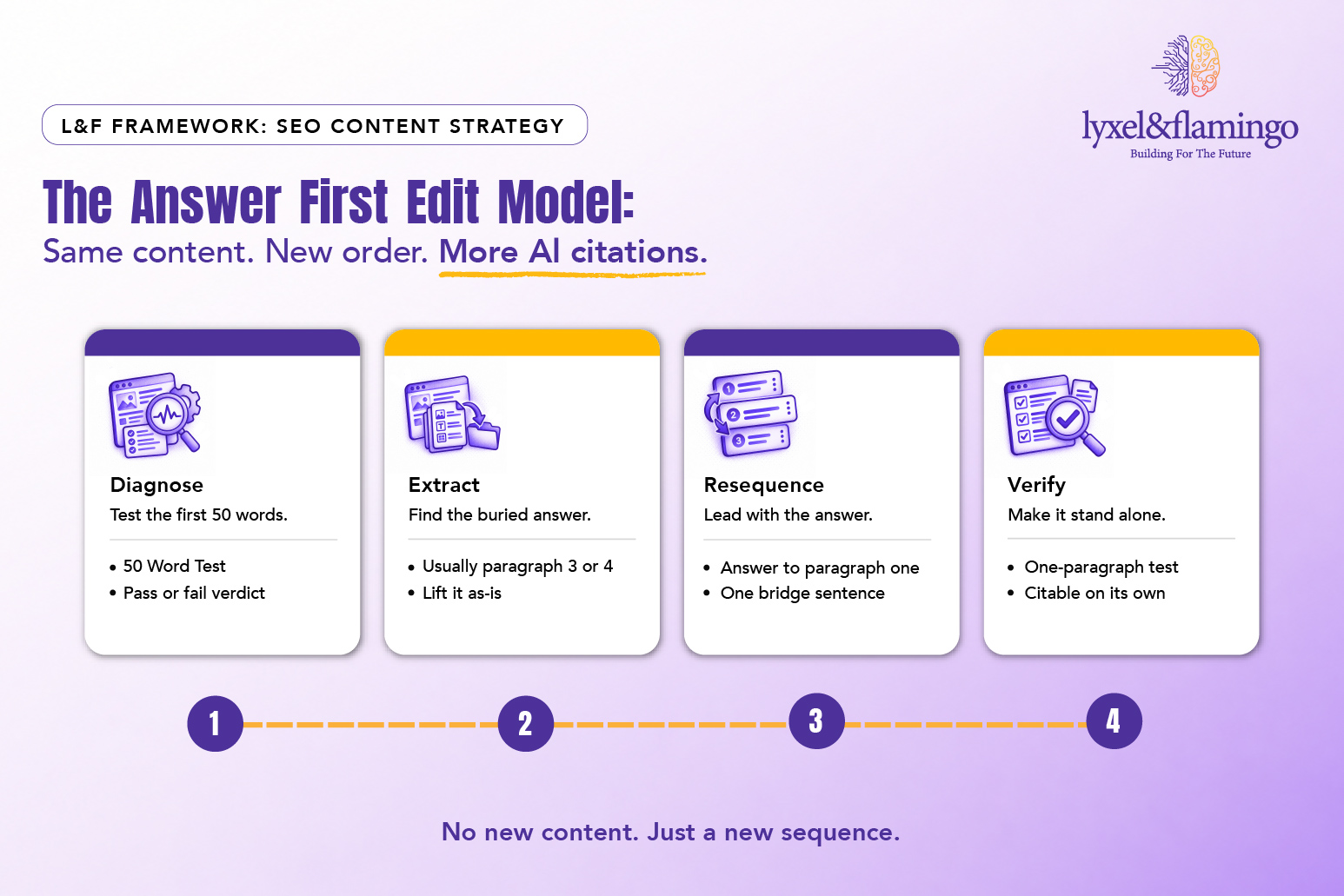
The Answer-First Edit Model: How to Fix the Sequence in Four Stages
The Framework Explained
- Diagnose: This step separates pages with the structural failure from pages that are already answer-first. Most teams are surprised how many of their highest-traffic pages fail the test, since the openings were written as narrative entry points rather than citable statements. The diagnosis takes ninety seconds per page and produces a clear list: pages with the problem, pages without it. It is the step most teams skip because they assume their content is direct. It rarely is.
- Extract: The answer already exists on most pages. The task is not to create it, the work is to find it. Common locations are the third or fourth paragraph, the summary section, or inside a block of supporting evidence written to arrive at the point rather than state it directly. Extracting it without editing it first reveals whether the language is genuinely direct or still wrapped in the framing of an argument.
- Resequence: Moving the extracted answer to the opening is the core edit, and it is consistently faster than it sounds. Most pages need only a single bridge sentence between the opening answer and the argument that follows. The rest of the page typically remains intact. This sequence change alone moves pages into AI citation range within a few months of re-indexing, no new content commissioned, no new topics researched.
- Verify: The final check applies the one-paragraph test: a genuinely answer-first opening should be self-contained enough that an AI system reading only that paragraph would have something worth citing. If the passage requires the rest of the page to make sense, it is still preamble. The verify step catches this before the page goes live rather than in a citation audit three months later.
Client Proof Point
Kurlon, one of India’s largest sleep brands, had its content rebuilt with answer-first structure as the primary change: page introductions and FAQ modules resequenced to place citable answers in the opening position rather than the conclusion. Measured across seven months (March–October 2025) via Google Search Console and GA4:
765% growth in AI Overview visibility · 600% increase in brand mentions across AI surfaces · 40% rise in organic sessions.
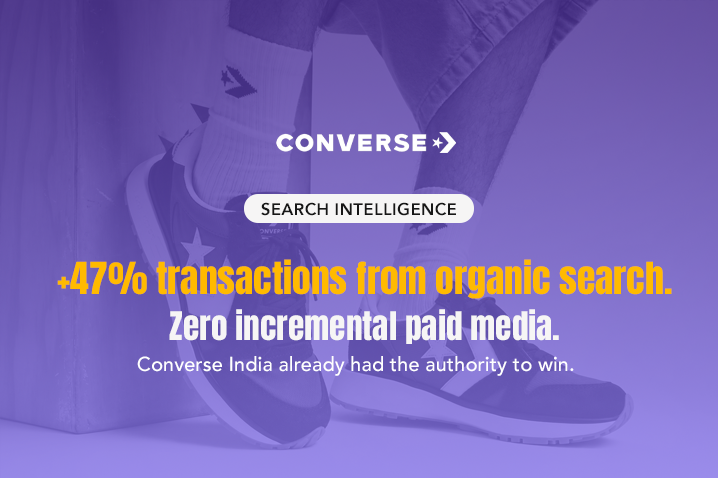
Converse‘s organic growth programme built answer-first FAQ sections specifically for AI extraction, placing each answer in the first sentence of the response. This contributed to a 47% rise in organic transactions and 32% organic revenue growth across six months (Jan–Jun 2026). (L&F client work, SEO and GEO, verified on lyxelandflamingo.com.)
Key Takeaways
- The most common reason AI systems skip your content is structural, not qualitative: the answer is buried rather than opening the page.
- The 50-Word Test is a fast, in-house diagnostic: read only the first 50 words and ask whether a retrieval system would find a complete, citable answer.
- The rewrite is a sequencing exercise. The answer already exists on most pages. Moving it to the opening, before context and supporting argument, is the edit.
- Kurlon’s 765% AI Overview visibility growth and Converse’s 47% organic transaction lift both involved answer-first restructuring as a core programme element, not additional content volume.
- The verify step: the one-paragraph test catches preamble disguised as answers before a page is published or indexed.
The CXO Takeaway
Answer-first writing is the highest-leverage edit available on an existing content library precisely because it requires no new research, no new topics, and no new writers. It requires a content audit that identifies the structural failure and an editing pass that corrects it. The brands being consistently cited by AI systems did not all start with the best content. Many started with the same content as their competitors, structured differently. That structural difference is the compounding advantage.
Frequently Asked Questions
Complete enough to stand alone, typically between 40 and 80 words. Fewer than 40 words often under-explains the point to the point of ambiguity. More than 100 words starts to read as a second paragraph of context rather than a direct answer. The 50-word ceiling in the test is a diagnostic tool, not a prescription for how long the opening should be.
Moving content within a page is a much lower-risk change than deleting or replacing it. Existing keyword signals remain in place. Clearer structure generally benefits both traditional ranking and AI citation rate. Update the published date only when content has genuinely changed, which a resequencing edit does constitute.
Priority pages first. Start with the 15 to 20 pages covering your highest-intent queries, those are where a structural fix has the highest immediate return. Extend to the full library once the process is established and the team can apply it consistently across the content programme.
That is a signal to split the page rather than force a single opening onto multi-topic content. A page covering five separate questions is five pages that were never written. Each one, written with a focused question and an answer-first opening, is more citable and more rankable than the combined page it came from.