
Budget planning season forces a specific question that most SEO teams have not answered cleanly: how much of next year’s search budget should shift toward AI-search visibility rather than traditional ranking work? This blog lays out a practical allocation framework based on category exposure to AI Overviews, current citation visibility, and the cost of closing that gap, rather than an arbitrary percentage rule. It also breaks down what GEO work actually costs across engines, since that number is what most budget conversations are missing.
Quick Answer: There is no universal percentage that should move from SEO to GEO in 2027. The right allocation depends on how exposed a brand’s core categories already are to AI Overviews and chatbot answers (higher exposure categories justify heavier GEO investment), how visible the brand currently is in AI citations relative to competitors, and the actual cost of closing that visibility gap across engines like ChatGPT, Gemini, and Perplexity. Brands in high zero-click categories should treat GEO as a growing, dedicated allocation rather than a rounding error inside the existing SEO line.
Table of Contents
- Why “Move 20% of Budget to GEO” Is the Wrong Question
- Start With Category Exposure, Not a Fixed Ratio
- What GEO Work Actually Costs Across Engines
- Measuring the Visibility Gap Before Allocating
- A Practical Allocation Framework
- Revisiting the Split Quarterly, Not Annually
- Framework Explained
- Key Takeaways
- CXO Takeaway
Why “Move 20% of Budget to GEO” Is the Wrong Question
A fixed percentage rule feels convenient during budget planning season. It ignores that GEO exposure varies enormously by category. A brand selling a considered, comparison-heavy purchase sees far more of its category queries answered inside an AI Overview or chatbot response than a brand in a category where AI engines rarely attempt a direct answer.
Applying the same allocation ratio across both cases either wastes budget on a category where GEO barely matters yet, or dramatically underfunds a category where it already does, a gap the L&F team has repeatedly seen in early budget conversations with brands entering this space.
Start With Category Exposure, Not a Fixed Ratio
The first input to any allocation decision should be how often a brand’s core category queries already trigger an AI Overview, chatbot answer, or AI-generated comparison. Categories with high comparison intent (electronics, skincare, appliances, financial products) tend to show this exposure earlier and more heavily than categories built on low-consideration, habitual purchases.
This is not a one-time assessment. Category exposure to AI-generated answers is expanding steadily, which means the exposure audit that justified last year’s allocation may already be understating this year’s real number.
What GEO Work Actually Costs Across Engines
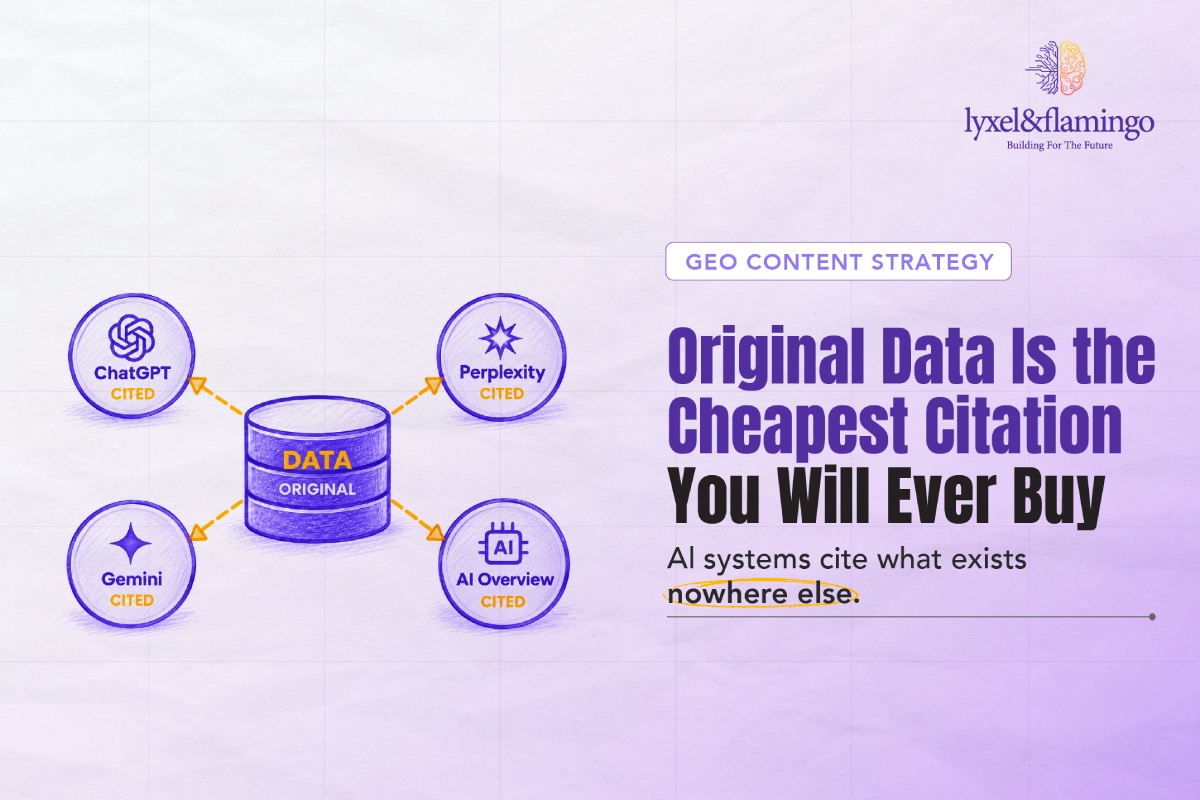
Budget conversations frequently stall because the actual cost of GEO work, structured data implementation, entity clarity audits, ongoing citation monitoring across engines, was never clearly modeled. Different engines also demand different levels of investment: the cost of visibility across four major AI engines varies significantly, since each has its own citation logic and data sources.
Treating GEO cost as a single blended number, rather than breaking it down by engine and by the specific technical work required, is one of the most common reasons GEO budgets get underfunded relative to the effort actually needed.
Measuring the Visibility Gap Before Allocating
Before deciding how much budget to move, a brand needs a baseline: how often does it currently get cited in AI-generated answers for its core category queries, compared to its two or three closest competitors? A brand with strong traditional SEO rankings and near-zero AI citation visibility has a wide gap that budget alone will not close quickly, since the underlying data and content work has to happen first.
This baseline should use the same terminology discipline the L&F team applies across GEO, AEO, LLM SEO, and AIO: different names for the same underlying discipline, measured the same way regardless of which term a given stakeholder prefers.
A Practical Allocation Framework
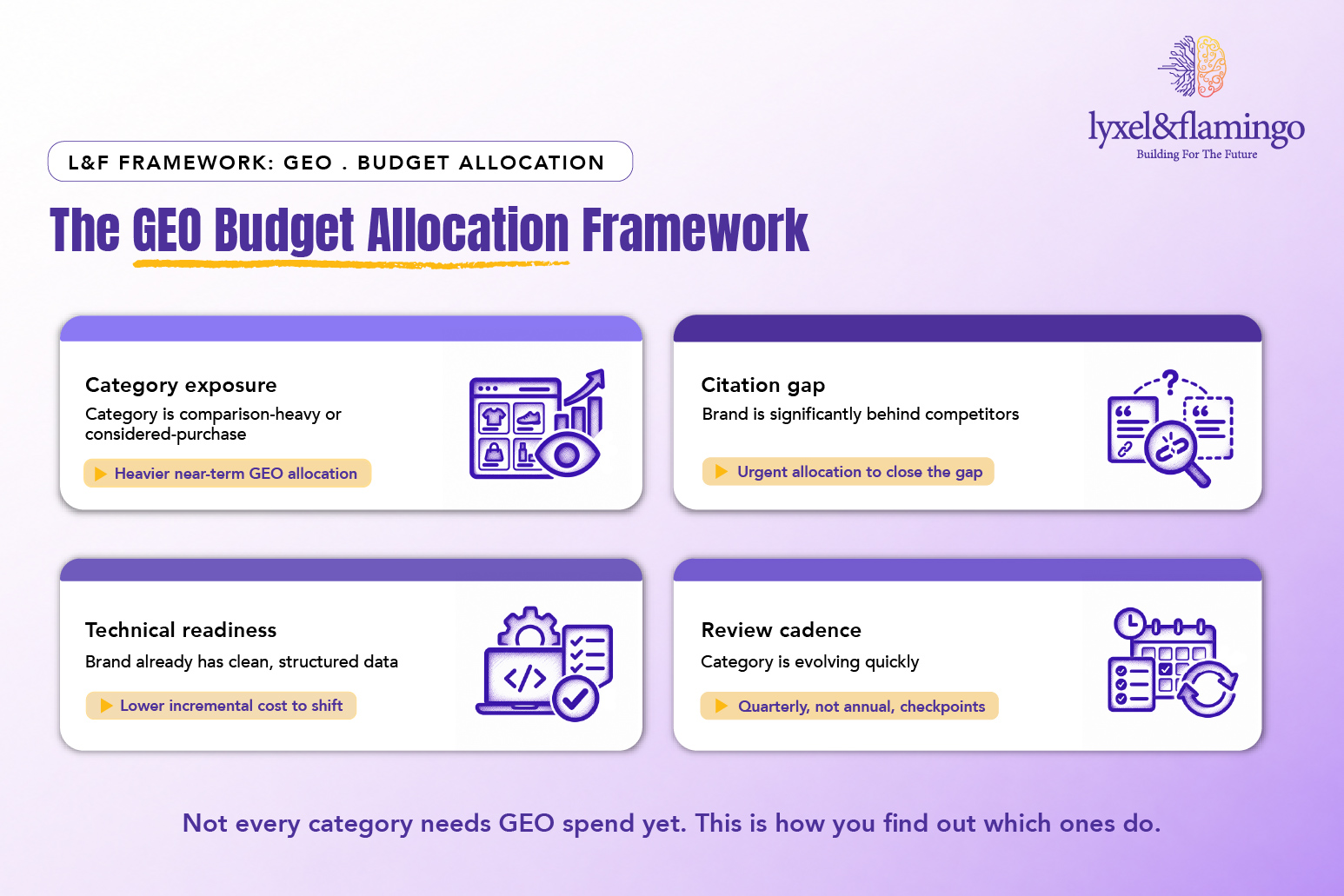
Rather than a fixed percentage, allocate based on three weighted factors: category exposure (how often AI engines answer directly in this category), competitive citation gap (how far behind the brand is versus close competitors), and technical readiness cost (how much structured-data and entity work is required to close that gap).
A brand with high category exposure, a wide citation gap, and low technical readiness needs the heaviest near-term GEO allocation. A brand with low category exposure and strong existing technical hygiene can move more slowly and let the SEO-to-GEO shift happen gradually as category exposure grows.
Revisiting the Split Quarterly, Not Annually
Category exposure to AI-generated answers is moving quickly enough that an allocation set once during annual planning will likely be stale by the second quarter. Building a quarterly checkpoint into the budget process, rather than treating GEO allocation as a set-and-forget line item, keeps the split responsive to how fast a given category is actually shifting.
This does not mean constant budget churn. It means the underlying exposure and gap data gets refreshed often enough that the next reallocation decision is based on current reality, not a snapshot from the previous planning cycle.
Framework Explained
- Exposure drives urgency: Categories where AI engines already answer directly deserve the heaviest near-term reallocation.
- Gap drives size: The wider the brand’s citation gap versus competitors, the larger the initial investment needs to be to close it.
- Readiness drives efficiency: Brands with existing structured data spend less to convert SEO investment into GEO visibility.
- Cadence protects the budget: Quarterly reassessment prevents an allocation from going stale in a fast-moving category.
GEO READINESS NOTE Because GEO budget allocation is a planning framework rather than a delivered campaign, there is no single case study with a final ROI number to cite here. What grounds this framework is the agency’s direct experience modeling AI-search visibility costs across engines and running citation-gap audits for brands entering this planning cycle for the first time.
Key Takeaways
- A fixed percentage rule for SEO-to-GEO budget shifts ignores how much category exposure to AI-generated answers actually varies.
- Category exposure, competitive citation gap, and technical readiness cost are the three factors that should actually drive allocation.
- GEO cost varies meaningfully by engine, which means a single blended cost estimate tends to understate the real investment required.
- Because category exposure is shifting quickly, allocation should be revisited quarterly rather than set once during annual planning.
CXO Takeaway
The question for 2027 planning is not “what percentage goes to GEO.” It is: how exposed is our core category to AI-generated answers right now, and how wide is our citation gap versus the competitors already investing here?
Brands that answer that question with real data will allocate correctly. Brands that guess a round number will either overspend on a low-exposure category or underfund a category that is moving faster than their budget assumed.
If your 2027 planning still treats GEO as a rounding error inside the SEO budget, Lyxel&Flamingo can run the exposure and citation-gap audit that turns this into an evidence-based allocation instead of a guess.
Frequently Asked Questions
Rather than a benchmark percentage, start with a category exposure audit: check how often your top twenty core-category queries already trigger an AI Overview or chatbot answer. That number is a far more reliable starting signal than any industry-wide average.
Generally alongside it, at least for now. Traditional search rankings still drive significant traffic and revenue for most brands; GEO investment protects and grows the share of demand increasingly mediated by AI-generated answers.
This varies by how large the starting technical readiness gap is. A brand with clean existing data and a narrow citation gap can see movement faster than a brand starting from unstructured product data and no prior AI-citation presence.
The risk is not a gradual decline, it is a compounding one: competitors who are already visible in AI-generated answers accumulate citation history and model trust that becomes harder to displace the longer the gap persists.