
What This Blog Covers
AI visibility has been sold, this year especially, as something mysterious a specialist vendor must diagnose. Most of it is not. The gap between a brand that gets cited by ChatGPT and Gemini and one that doesn’t usually comes down to a short, checkable list: can the content be crawled, is it structured so an answer engine can parse it, does it actually answer the question a buyer is asking, and does the brand carry visible signals of expertise. Here is that checklist, scoped deliberately to what a team can audit on its own site before calling anyone.
Quick answer: An AI-visibility self-audit covers four areas: crawlability and technical access, structured data and schema, content built to directly answer questions, and visible authority signals. Most brands fail on the same handful of checks, thin or missing FAQ content, no schema markup, and pages written to persuade rather than to directly answer a question, all of which are fixable without a specialist retainer.
Table of Contents
- Why Most AI Visibility Problems Are Self-Diagnosable
- The Four Areas That Decide AI Citation
- Where Most Brands Actually Fail
- The AI Visibility Self-Audit Model: four areas, each with what to check and why it matters
- The Framework Explained
- A Real Audit Result: What Disciplined Execution Looks Like
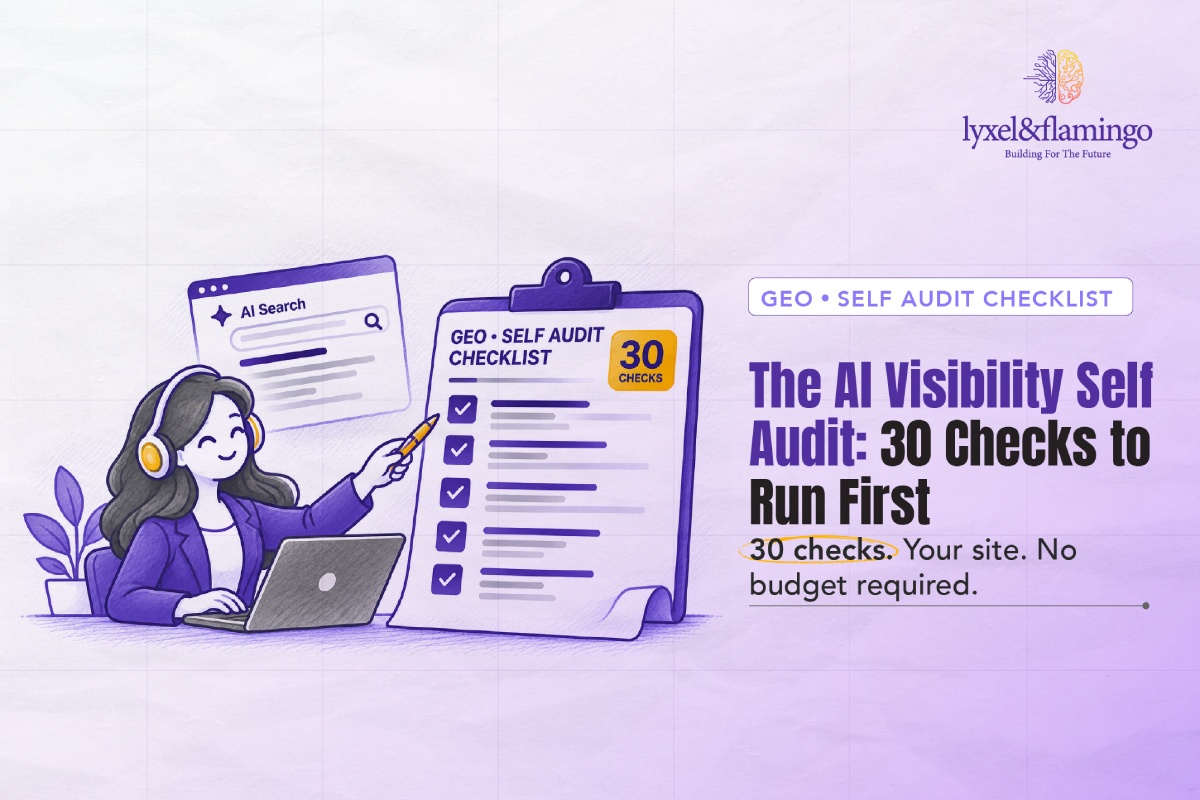
- Going Deeper: The 30-Point Checklist
- Key Takeaways
- The CXO Takeaway
- The Question to Sit With
- Closing
Why Most AI Visibility Problems Are Self-Diagnosable
AI search optimisation gets pitched as a black box, a discipline so new and so opaque that only a specialist vendor can tell a brand what’s wrong. In practice, the majority of what determines whether ChatGPT or Gemini cites a brand is the same technical and content hygiene that has decided organic rankings for a decade, applied with slightly different priorities.
That means most of the diagnostic work is something a marketing team can do itself, this week, without new tooling. The checklist below is scoped exactly to that: what’s checkable without a specialist, so the specialist conversation, if one is still needed afterward, starts from an informed position rather than a blank one.
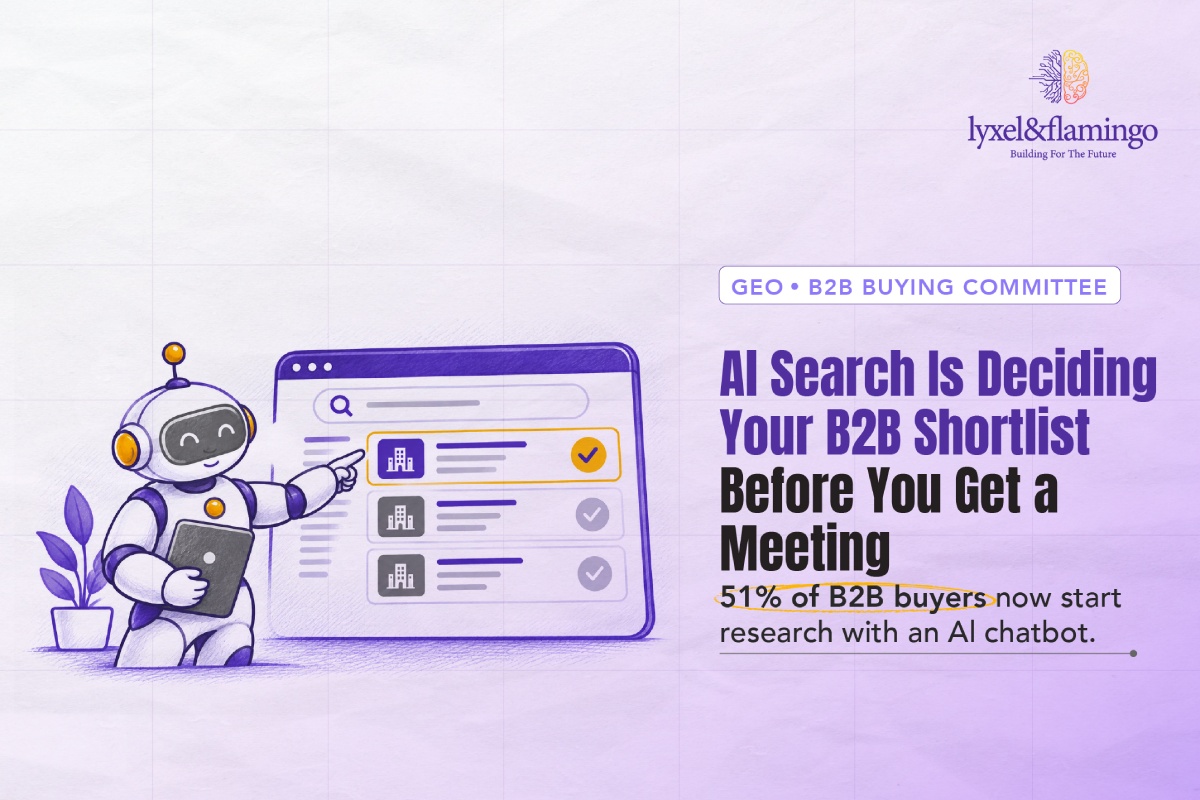
It matters because AI search is already deciding B2B shortlists before a human researcher gets involved, so a brand invisible to these checks is invisible at the exact moment a buyer is deciding who to call.
The Four Areas That Decide AI Citation
Crawlability comes first, because none of the rest matters if an AI crawler can’t reach the content at all. Structured data comes second: schema markup gives an answer engine explicit, machine-readable confirmation of what a page is and what it says, reducing the guesswork a language model would otherwise have to do. Content structure is third, whether a page states its answer plainly near the top rather than burying it under three paragraphs of brand scene-setting. Authority signals close the list: named authors, credentials, case studies and reviews that give an AI system, and a human buyer, a reason to trust the answer it just extracted.
Each of these fails independently and fails silently. A brand can rank well organically and still be functionally invisible to an AI answer engine, because organic rank rewards backlinks and domain authority in ways an LLM’s citation logic does not weight the same way.
Where Most Brands Actually Fail
The same handful of gaps recur across almost every audit L&F runs. FAQ content is either missing entirely or too thin to be useful, despite FAQ sections being among the highest-value content types for AI extraction. Schema markup is absent or incomplete, particularly Organization and Product schema, on pages that would otherwise be strong citation candidates. And core pages are written to persuade a human who’s already interested, brand story first, proof points buried, rather than to directly answer the specific question a first-time researcher, human or AI, actually has.
None of these are expensive fixes. They are attention and discipline fixes, exactly the kind that a structured self-audit surfaces faster than a vague sense that “AI visibility needs work.”
Left unaddressed, gaps like these are usually what’s actually behind a traffic drop that gets blamed on AI by default. Here’s how to tell the difference.
The AI Visibility Self-Audit Model: four areas, each with what to check and why it matters
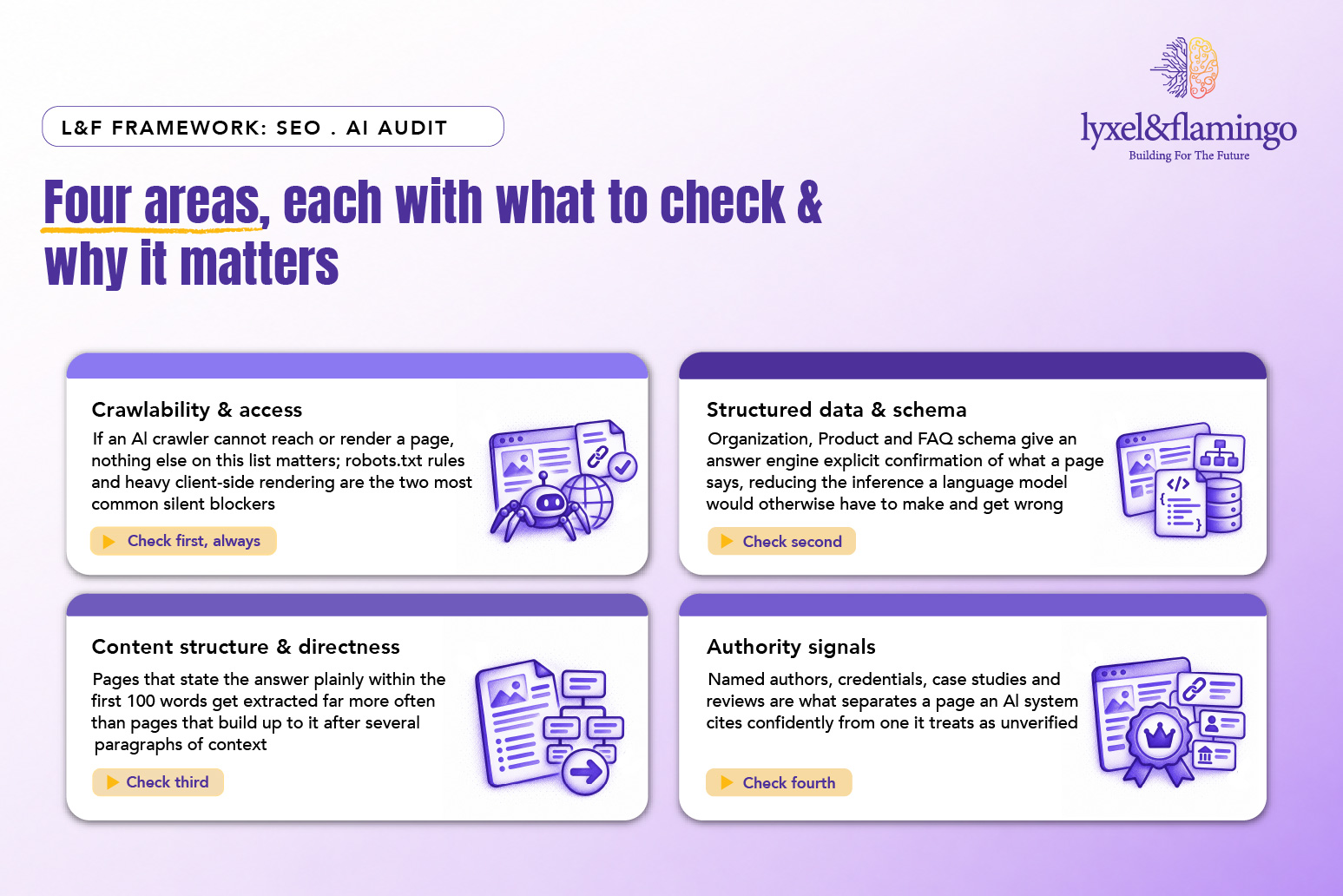
The Framework Explained
-
Crawlability & access:
This is the check that decides whether the other twenty-nine even apply, which is exactly why it belongs first and why skipping it wastes every hour spent on the rest of the audit. A robots.txt file blocking GPTBot or Google-Extended, a page rendered entirely client-side with no server-rendered fallback, or a paywall an AI crawler cannot pass, each one quietly removes a page from consideration before a single word on it is ever evaluated for quality. The failure mode here is particularly dangerous because it produces no error message and no obvious symptom, a brand simply never appears, and without checking crawl logs directly, there is no way to distinguish “we were evaluated and rejected” from “we were never seen at all.” Fix this first, because every other improvement made downstream of a blocked crawler is invisible effort. -
Structured data & schema:
Schema is the single highest-leverage technical fix on this entire list, and also the most commonly half-implemented. A brand with Organization schema and no Product or FAQ schema is giving an answer engine confirmation of who it is while withholding the exact structured confirmation of what it sells and what it answers, the two things a buyer’s query is actually about. The evidence on schema’s direct causal effect on citation rate is genuinely mixed; a widely cited late-2024 Search/Atlas study found no strong correlation. The honest read is that schema functions as infrastructure rather than magic: it does not guarantee a citation, and its absence still removes a layer of machine-readable confidence that makes every other signal on the page work harder than it should have to. -
Content structure & directness:
This is where most well-intentioned content quietly sabotages itself. A product or service page that opens with a mission statement, moves through a company history, and only states what the offering actually does three scrolls down, is optimised for a human who has already decided to stay and read. An AI system extracting an answer to a specific query does not have that patience, and functionally, neither does a first-time human researcher skimming five tabs at once. The fix is not to strip out brand voice; it is sequencing: state the direct answer first, in plain language, then build the case for why that answer is the right one. Pages rewritten this way consistently start appearing in answer-engine citations within a few months, without a single new word of content added, purely from resequencing what was already there. -
Authority signals:
This is the check that separates a citation an AI system makes once and a citation it keeps making. Answer engines increasingly weight signals of verifiable expertise, a named author with real credentials, a specific case study with real numbers, a review volume that suggests other people have actually validated the claim, over generic, unattributed marketing copy. A page with no byline, no proof, and no third-party validation gives a language model nothing to anchor confidence in beyond the words themselves, and confidence is exactly what decides whether an uncertain system chooses to cite a source or route around it entirely. This is also the one area on the list that compounds over time rather than being a one-time fix: authority signals accumulate, and a brand that starts building them consistently pulls further ahead of a competitor who treats this as optional with every case study, every credential, every verified review published.
A Real Audit Result: What Disciplined Execution Looks Like
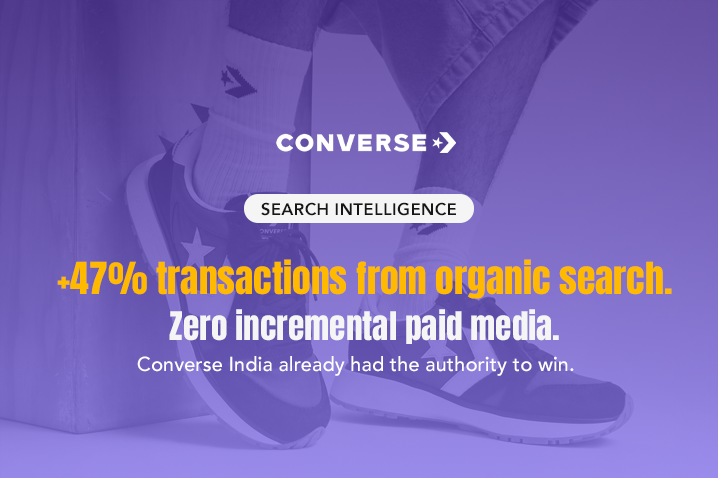
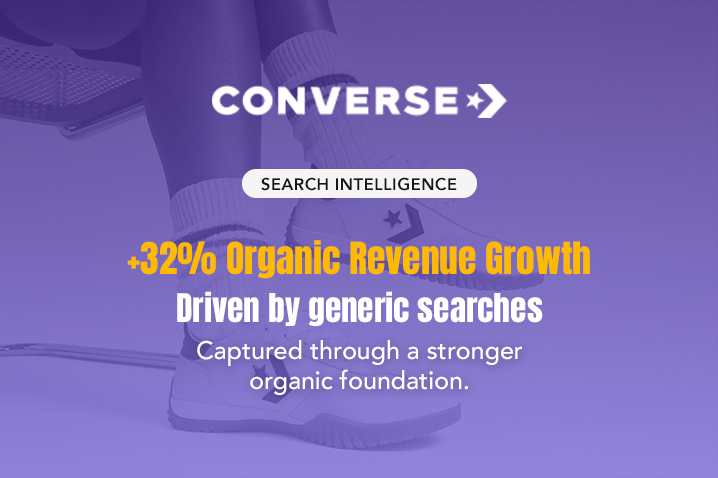
Converse‘s organic growth programme shows exactly what this checklist looks like executed with discipline rather than left half-done. Over a seven-month window, the team mapped 130 high-intent keywords representing roughly 1 million monthly searches, built a dynamic metadata framework across every product detail page, added structured FAQ sections and deepened category content specifically to support AI answer engines, and implemented comprehensive Organization, Product, FAQ and Website schema alongside page-speed fixes. The result: organic transactions rose 47%, revenue rose 32%, and average search position improved 37%, gains built on exactly the crawlability, schema, and content-structure fundamentals this audit checks for, not on any single tactic in isolation.
Our SEO and GEO services team runs this exact audit, plus the fixes it surfaces, for brands who want the diagnosis before committing to a retainer.
Going Deeper: The 30-Point Checklist
Run this self-audit before commissioning any external AI-visibility engagement. Score each section honestly; most brands pass fewer checks than they expect.
Crawlability & Access (checks 1-8)
- Does robots.txt explicitly allow GPTBot, ClaudeBot, PerplexityBot, and Google-Extended?
- Do core pages render meaningfully without JavaScript, or is there a server-rendered fallback?
- Are any high-value pages sitting behind a login wall or paywall that an AI crawler cannot pass?
- Does the XML sitemap include every page a brand wants cited, updated on a regular cycle?
- Do server logs show any AI-bot crawl activity at all in the last 30 days?
- Are canonical tags correctly set, avoiding duplicate or conflicting versions of the same page?
- Is page load time under 3 seconds on a mid-range mobile connection?
- Are there any broad noindex directives accidentally applied to pages meant to be visible?
Structured Data & Schema (checks 9-16)
- Is Organization schema implemented and validated on the homepage?
- Is Product or Service schema implemented on every core offering page?
- Is FAQPage schema implemented on pages with genuine question-and-answer content?
- Is Website schema present, including sitelinks search box markup where relevant?
- Does schema markup pass validation with zero critical errors?
- Are review or rating schema markups present where genuine reviews exist?
- Is author or Person schema present on content with a named, credentialed writer?
- Has schema been re-validated since the last major site update?
Content Structure & Directness (checks 17-23)
- Does each core page state its direct answer within the first 100 words?
- Do FAQ sections address the actual questions buyers ask, not just brand-friendly ones?
- Is there a dedicated, well-structured page for every high-intent comparison query in the category?
- Are headings descriptive and specific, rather than generic labels like “Our Approach”?
- Is pricing or cost information stated somewhere on the site, even as an indicative range?
- Has content been refreshed or re-dated within the last 12 months on priority pages?
- Is there original data, a statistic, a study, a benchmark, that a source cannot find written anywhere else?
Authority Signals (checks 24-30)
- Are case studies published with specific, verifiable numbers rather than vague claims?
- Do core content pieces carry a named author with visible credentials?
- Is there a visible, dated “last reviewed” or “last updated” signal on key pages?
- Are client names and logos, where permission allows, visible and current?
- Is the brand mentioned or cited on any third-party sites, press, or industry publications?
- Do reviews exist on at least one credible third-party platform, and are they recent?
- Would a stranger, reading only this page, believe the company is who it claims to be?
Key Takeaways
- Most AI-visibility gaps are self-diagnosable: crawlability, schema, content directness, and authority signals cover the vast majority of what decides citation.
- Crawlability has to be checked first, since a blocked AI crawler makes every other fix on the list invisible effort.
- Schema is the highest-leverage technical fix on the list and also the most commonly half-implemented, especially Product and FAQ schema.
- The Converse programme shows this checklist executed with discipline: 47% organic transaction growth and 37% search-position improvement in 7 months, built on crawlability, schema and content-structure fundamentals together, not any single tactic.
- The 30-point checklist below is designed to be run internally, in an afternoon, before any specialist conversation starts.
The CXO Takeaway
For a CXO, the value of a self-audit is less about the fixes it surfaces and more about what it protects against: paying a vendor to diagnose a problem the internal team could have found itself in an afternoon. Most AI-visibility retainers earn their fee in execution and ongoing measurement, not in the initial diagnosis. Running this checklist first turns any external conversation into one about implementation speed and depth, rather than starting from zero.
The Question to Sit With
The question worth sitting with is not whether your AI visibility needs work. It’s how many of these thirty checks you could actually pass today, without asking anyone else to look.
Closing
Lyxel&Flamingo runs this exact audit, and the execution behind it, for brands ready to move past diagnosis. Want a second set of eyes on your results? Start that conversation with L&F →
Frequently Asked Questions
For a mid-sized site, a focused team can work through all thirty checks in three to four hours. Larger, multi-market sites take longer proportional to the number of core pages being audited.
Crawlability, specifically whether AI crawlers are being blocked by robots.txt or heavy client-side rendering. It's the most common silent failure and the one that makes every other fix invisible until it's resolved.
Yes, treated as infrastructure rather than a guarantee. A late-2024 study found no strong correlation between schema and citation rate. Schema still gives an answer engine explicit confirmation that reduces the guesswork every other signal on a page has to do.
The four areas apply equally. The specific content, comparison pages, pricing transparency, FAQ depth, differs by category. The underlying checks, crawlability, schema, directness, authority, don't change.
Recurring, ideally quarterly. AI crawler behaviour, schema requirements and what counts as strong authority signalling all shift as the underlying models and their retrieval methods change.