What This Blog Covers
A multi-market launch fails more often from over-localizing than under-localizing. This covers what genuinely needs to change per market, what should stay standard across all of them, and how to structure one platform that serves multiple countries without a full rebuild each time.
Quick Answer: What needs to change per market: payment methods, language and currency, regulatory and compliance content, and delivery/logistics logic. What should stay standard: core checkout architecture, the design system, inventory and order management logic, and the underlying commerce platform itself. Treating every market as a full rebuild instead of a configuration of a shared core is the most expensive mistake in multi-market expansion.
Table of Contents
The Over-Localization Trap
The instinct when entering a new market is to treat it as a fresh build, new team, new stack, new design decisions from scratch, because the market itself feels unfamiliar. That instinct is expensive and usually unnecessary. Most of what makes an ecommerce platform work, checkout logic, inventory management, the core design system, has nothing to do with which country it’s serving.
The over-localization trap shows up as duplicated engineering effort, inconsistent brand experience across markets, and a maintenance burden that scales linearly with every new country instead of getting more efficient as the platform matures.
What Genuinely Needs to Be Local
Payment methods are non-negotiable per market. A checkout that only accepts cards will underperform badly in markets where local payment methods, bank transfers, regional wallets, cash-on-delivery, dominate actual purchase behavior.
Language, currency and regulatory content also need genuine localization, not machine translation applied to English copy. Tax disclosure requirements, consumer protection language, and even basic things like address format all vary by market in ways that carry real legal weight, not just a preference. The W3C’s internationalization guidelines are a useful baseline for exactly which parts of a site genuinely need market-specific handling versus a simple translation pass.
Delivery and logistics logic is the fourth genuine localization need. Shipping zones, carrier integrations, and delivery time expectations differ enough between markets that this layer needs to be market-specific even when everything else is shared.
What Should Stay Standard
Core checkout architecture, the sequence and structure of the buying flow itself, should stay the same across markets even as the specific payment methods within it change. Rebuilding the flow logic itself per market is where most of the wasted engineering effort happens.
The design system, typography, spacing, component library, should also stay standard. A brand’s visual identity doesn’t need to change per country, and maintaining a single design system across markets is what keeps the brand experience consistent as it scales.
Inventory and order management logic, and the underlying commerce platform itself, are the clearest candidates for a shared core. These are the parts of the system with the least connection to local market behavior and the highest cost if duplicated.
The Multi-Market Platform Framework
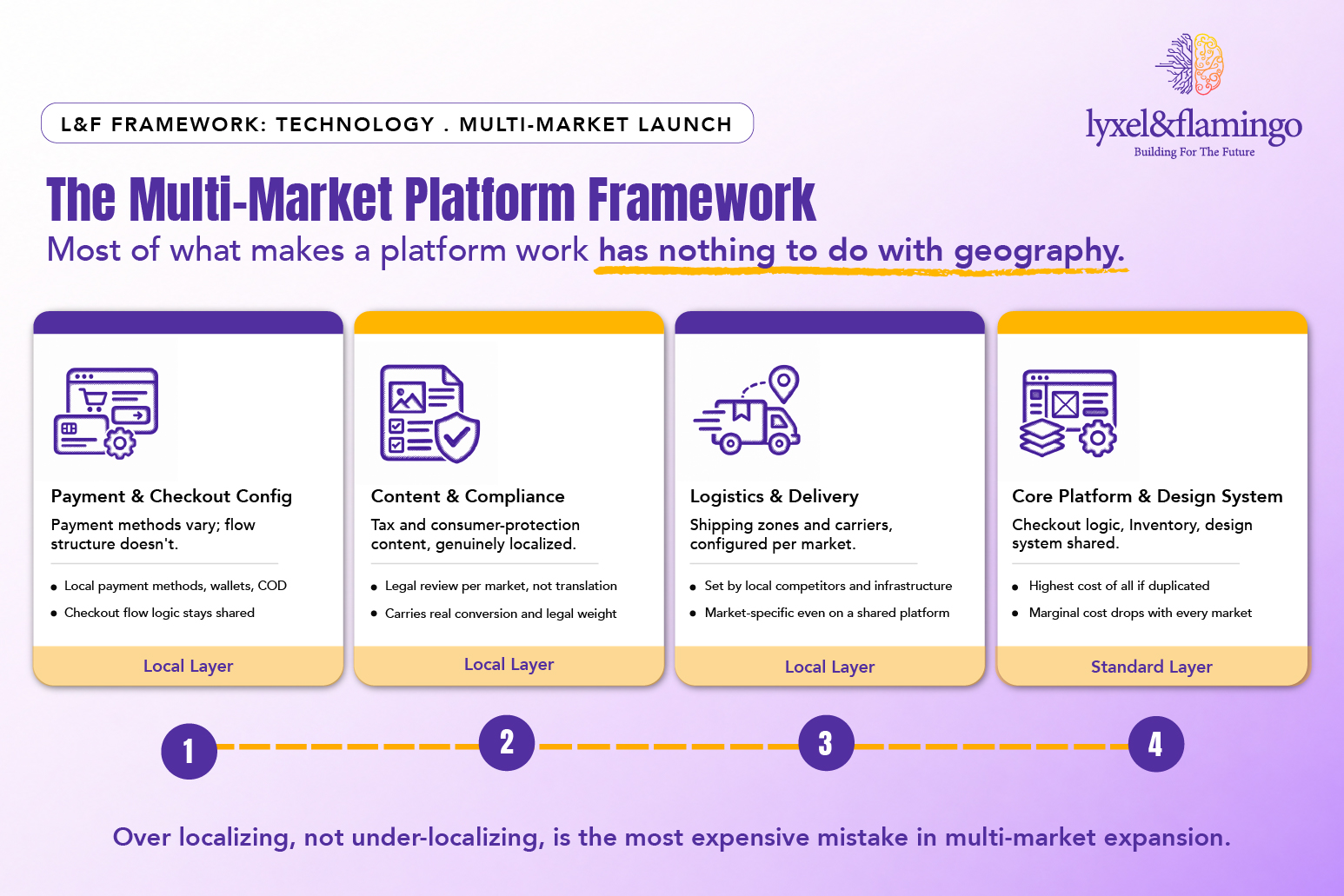
Framework Explained
Payment & Checkout Config: This is the layer with the clearest ROI for localization, since payment method mismatch directly and immediately costs conversion in a new market.
Content & Compliance: This isn’t optional or stylistic, tax and consumer-protection requirements carry legal weight and need market-specific legal review, not a translation pass.
Logistics & Delivery: Shipping and delivery expectations are set by local competitors and local infrastructure, which makes this layer inherently market-specific even on a shared platform.
Core Platform & Design System: This is where the real efficiency gain lives, every market launched on the same core platform reduces the marginal cost of the next market instead of repeating the full build cost.
Sequencing a Second-Market Launch
Start by auditing the existing platform against the four-layer framework, identifying what’s currently hardcoded to the first market that needs to become configurable. This audit alone usually reveals more accidental market-specific logic buried in the “standard” layers than teams expect.
Launch the second market with the local layers configured, deliberately minimal, payment methods and compliance content done properly, logistics kept simple, then expand logistics sophistication once real order volume provides data to optimize against, rather than guessing upfront.
What a Real Multi-Country Build Looks Like
Pizza Pizza Mexico’s build with Lyxel&Flamingo created an online ordering experience built for the Mexico market specifically, the kind of build where getting the local layer right, payment methods, language, delivery logic, mattered far more than rebuilding the platform from scratch. Coffee Island’s mobile app and website build shows the same principle applied across a multi-location footprint, a shared core experience configured, not rebuilt, at every new location. The existing Shopify Markets: how to use one Shopify store to sell globally post covers the platform-specific mechanics of this approach, and is a useful technical reference alongside it; this one is the architectural principle behind why it works.
Checkout architecture is one of the clearest examples of what should stay standard across markets, since the sequence and structure of the buying flow has far more to do with conversion psychology than geography. The checkout tax: how milliseconds of latency are quietly draining D2C revenue covers why that shared checkout layer deserves its own performance scrutiny regardless of which market is loading it.
Key Takeaways
- Payment methods, compliance content and logistics genuinely need to be local; checkout architecture, design system and platform core should stay standard.
- Over-localizing is a more common and more expensive mistake than under-localizing.
- Audit for accidentally market-specific logic hiding in what should be the shared core before launching a second market.
- Launch new markets with minimal, properly done, local configuration, then expand based on real order data.
CXO Takeaway
A multi-market expansion budget should fund local payment, compliance and logistics work properly, not a duplicate platform build. The efficiency gain of a shared core compounds with every new market added after the second one.
If your team is planning a second-market launch, has anyone audited which parts of the current platform are accidentally hardcoded to the first market?
Talk to Lyxel&Flamingo’s technology team about structuring a multi-market platform that scales efficiently instead of rebuilding for every new country.
Frequently Asked Questions
Payment methods, language and currency, regulatory and compliance content, and delivery and logistics logic. These carry real conversion and legal weight that a shared platform can’t absorb.
Core checkout flow architecture, the design system, and inventory and order management logic. These have little connection to local market behavior and are the most expensive to duplicate.
Entering an unfamiliar market feels like it warrants a fresh build. Most of what makes a platform work has nothing to do with geography, and rebuilding it per market creates unnecessary cost and brand inconsistency.
Audit the existing platform for hardcoded first-market logic, then launch with local payment and compliance done properly, logistics kept simple, expanding based on real order data rather than upfront assumptions.