What this blog covers
India’s Digital Personal Data Protection (DPDP) Act is set to change how brands collect, manage and use customer data for digital marketing. With full compliance due by May 2027, marketers must rethink retargeting strategies, CRM uploads, audience segmentation and personalised advertising. The biggest challenge is no longer collecting customer data but proving that every record has valid, purpose-specific consent. The blog explains how the DPDP Act affects the entire marketing journey, from data collection and identity matching to campaign activation and measurement. It also highlights the readiness gap among Indian businesses, potential penalties for non-compliance and the importance of consent management. Through Lyxel&Flamingo’s Consent-to-Conversion Stack, it outlines four essential layers: clear consent notices, purpose-based data records, controlled audience activation and retention management. Finally, it shares five practical steps marketers should take before the May 2027 deadline to protect customer data, maintain compliant retargeting and build sustainable first-party data strategies.
Table of Contents
- What Is the Digital Personal Data Protection Act?
- The Problem: Indian Marketing Stacks Were Built to Collect, Not to Remember Why
- Why Consent Now Decides Audience Size
- The Evidence: How Ready Indian Businesses Really Are
- The Lyxel&Flamingo Framework: The Consent-to-Conversion Stack
- What This Looks Like Inside a Real Marketing Team
- 5 Things to Do Before the May 2027 Deadline
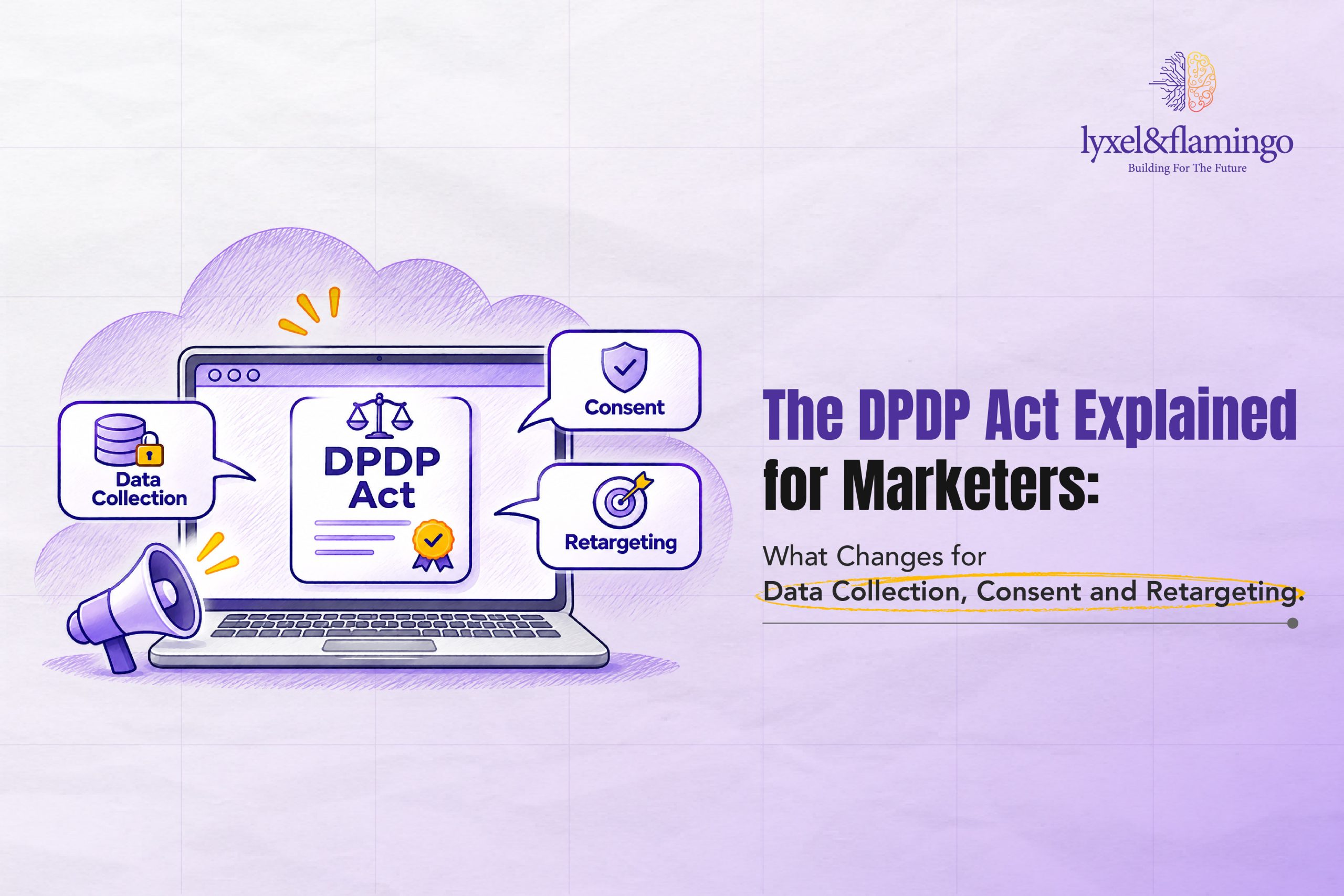
Under India’s new privacy regime, consent stops being a legal checkbox and becomes the single largest input into how much of your audience you are allowed to reach again.
From May 2027, the Digital Personal Data Protection Act will limit every Indian brand’s retargeting audience to the people who gave specific, informed consent for that exact purpose. That turns the consent screen into a media asset, and very few marketing teams have started treating it as one.
The compliance clock has already been running for a year. The DPDP Rules were notified on 14 November 2025 with an eighteen-month window for phased compliance, and Consent Manager registration opened in November 2026, with full operational compliance due on 12 May 2027. Yet inside most Indian companies, the conversation still sits with legal and IT, while the people who own pixels, CRM uploads and lookalike audiences watch from the sidelines.
Here is the view from inside the media plan. DPDP Act compliance will not punish brands that collect less data. It will punish brands that collected data without recording why they collected it. The first group can keep retargeting, because their purpose is documented and defensible. The second group may find large parts of their audience lists unusable on the day enforcement begins, no matter how much data sits in the warehouse.
What Is the Digital Personal Data Protection Act?
The Digital Personal Data Protection Act, 2023, is India’s first comprehensive law on how organisations collect, use, store and erase digital personal data. It treats the brand as a Data Fiduciary, the customer as a Data Principal, and every agency or martech vendor handling data for the brand as a Data Processor. The DPDP Rules 2025 convert the Act into operating procedures, covering consent notices, breach reporting, retention and children’s data.
It matters to marketers because the Act offers no broad “legitimate interest” basis of the kind GDPR allows. Most marketing uses of personal data will therefore rest on consent, and that consent must be tied to a stated purpose. Among all the data privacy laws in India, the DPDP Act India framework is the one that reaches directly into the media plan, which makes it the defining rulebook for data privacy in digital marketing.
The Problem: Indian Marketing Stacks Were Built to Collect, Not to Remember Why
Picture a mid-sized D2C brand coming out of the festive season. It holds phone numbers and emails from sale checkouts, a newsletter pop-up, a WhatsApp opt-in, a scratch-card contest and a lead form on Instagram. The same customer often sits in four of those lists at once. Not one of them records which purpose that person agreed to, or which version of the privacy notice they saw.
That brand is not careless, and its setup is entirely typical. Indian performance marketing grew up in a decade where first-party data collection was measured by volume, and the only question that mattered was whether a record could be matched on Meta or Google. Purpose was never a field in the CRM.
The readiness data confirms how widespread this is. In EY India’s January 2026 analysis of more than 150 professionals, nearly 81% of organisations had not updated or drafted DPDP-aligned privacy policies, and more than 83% had not begun comprehensive implementation. Marketing rarely features in those projects, even though marketing generates most of the consumer data a brand holds.
The trap here is subtle and easy to miss. Teams assume that data collected before the deadline stays usable after it. But the DPDP Act consent requirements apply to processing, not just collection. If you keep using a record for retargeting after May 2027, you need a valid consent for that use.
The risk for Indian marketers is not that they hold too much customer data. It is that they cannot prove what each record was collected for.
Why Consent Now Decides Audience Size
To see why the Digital Personal Data Protection Act changes audience economics, and why customer data protection now sits inside the media plan, follow a single customer through a standard retargeting chain. There are four links: capture, identity, activation and measurement. The Act touches every one of them.
- Capture: A pixel, SDK, or form collects data. Under the Act, the brand must give a notice that itemises the personal data and the specific purpose, and every Data Fiduciary must issue a separate consent notice that is clear and easy to understand. Section 6 of the Act requires consent to be free, specific, informed, unconditional and unambiguous, given through a clear affirmative action. Pre-ticked boxes and bundled “I agree to everything” banners sit badly with that standard.
- Identity: The hashed email or phone number becomes the key that links a customer across platforms. That key is personal data, so the purpose attached to it travels with it.
- Activation: This is where most brands are exposed. When a customer withdraws consent, the Act requires the brand to stop processing and to make its Data Processors stop as well. In practice, that means a withdrawal must flow from your CRM to every custom audience on Meta, every Customer Match list on Google and every WhatsApp broadcast segment. Withdrawal also has to be as easy as giving consent, so a buried unsubscribe link will not hold up.
- Measurement: Server-side tracking, offline conversion uploads and Conversions API events all move personal data. They need the same purpose basis as the ad that preceded them.
A useful way to think about it: under the Act, consent works like a lease, not a purchase. You rent a customer’s data for a named purpose, and the lease ends when the purpose is served, or the customer walks away.
Two more rules sharpen the edges for marketers. The Act bars tracking, behavioural monitoring and targeted advertising directed at children, and verifiable consent from a parent or guardian is required whenever a child’s data is involved. And large platforms face hard retention limits: e-commerce, social media and gaming platforms above set user thresholds must delete inactive users’ data after three years, with 48 hours’ advance notice, and must notify the Data Protection Board of a breach within 72 hours.
| Marketing activity | How it usually works today | What changes under the DPDP Act | What to fix |
| Website pixels for retargeting | Fire on page load, consent implied | Needs a purpose-specific consent where identifiers link to a person | Consent-gated tag firing |
| CRM uploads to Meta and Google | Full list uploaded on schedule | Only records consented for advertising can be used | Filter uploads by purpose tag |
| Lookalike or similar audiences | Seeded from the whole customer base | Seed lists inherit the consent status of every record | Rebuild seeds from consented records |
| WhatsApp and SMS promotions | Opt-in captured once, used forever | Withdrawal must stop processing quickly and simply | One-tap opt-out synced to all lists |
| Contest and lead forms | Data reused across campaigns | Purpose stated at capture limits later use | Separate toggles per purpose |
| Agency and vendor access | Shared logins, loose contracts | Brand stays accountable for processors | Processor agreements with deletion SLAs |
| Under-18 audiences | Targeted with age filters | Targeted ads and behavioural tracking barred | Age gating and exclusion lists |
Under the Digital Personal Data Protection Act, every audience list is only as valid as the weakest consent record inside it.
The Evidence: How Ready Indian Businesses Really Are
Penalties under the Act reach up to ₹250 crore for failing to maintain reasonable security safeguards. The same framework sets ceilings of ₹200 crore for failing to notify breaches, ₹200 crore for violations involving children and ₹50 crore for other breaches of the Act or Rules. For a marketing team, a leaked lead list from a contest microsite can trigger the security and breach clauses together.
About 77% of Indian organisations are not equipped to adopt privacy technologies such as consent management. EY’s survey also found that 76.4% cite limited access to subject-matter expertise and 45.3% face budget limits. Consent infrastructure is the piece marketing depends on most, and it is the piece companies feel least able to build. For most teams, the DPDP Act for businesses is less a legal update than an infrastructure project.
Consumer, retail and e-commerce companies lead DPDP readiness, yet only about half have started. That sector sits ahead of technology services at 38.8% and financial services at 34.7%, according to the same EY study. Leading the pack still means one in two consumer brands has not begun, in the category that holds the most shopper data.
Organisations must retain personal data, traffic data and processing logs for at least one year. Deloitte’s breakdown of the phased timeline also places notices, consent, breach reporting and retention in the final phase due on 12 May 2027. Marketing teams will need audit-ready consent logs, not just a cookie banner, which is where DPDP Act compliance becomes a marketing deliverable.
The audience at stake is 290 million to 300 million online shoppers, and Gen Z makes up 40% to 45% of them. Every one of those shoppers becomes a Data Principal with a right to withdraw. For brands whose growth depends on younger, digital-first buyers, customer data protection is now a growth variable, not an IT line item.
The Lyxel&Flamingo Framework: The Consent-to-Conversion Stack
At Lyxel&Flamingo’s Media Operations practice, we treat the DPDP Act and digital marketing planning as a media problem first and a legal problem second. Legal teams decide what the law permits a brand to do. Marketing teams decide whether the permitted audience is large enough to grow on. We call the operating model the Consent-to-Conversion Stack, and the order of its layers matters.
- Notice Layer: make consent worth giving. Rewrite every consent notice in plain language, one purpose per toggle. Separate “order updates” from “offers on WhatsApp” from “personalised ads on social media”. The Act lets customers access notices in English or any language in the Eighth Schedule, so test Hindi and regional versions where your buyers live.
- Purpose Ledger Layer: give every record a reason. Attach a purpose tag, a timestamp and the notice version to every customer record at the moment of capture. This single field decides whether a record can enter an ad platform later. In our work with D2C and retail brands, this is the most under-invested layer and the one with the fastest payoff, because it turns an undifferentiated database into a sortable, defensible asset.
- Activation Gate Layer: let only consented data reach media. Filter every Customer Match upload, custom audience sync and lookalike seed by purpose tag. Build a withdrawal pipeline that pushes opt-outs to Meta, Google and WhatsApp within a defined window. Write the same window into every agency and vendor contract, because the brand stays accountable for what its processors do.
- Retention Clock Layer: plan for expiry before it happens. Set automatic expiry rules for every consent purpose. Run re-permission campaigns before consents lapse, and build the 48-hour pre-deletion notice into your CRM journeys if your platform crosses the user thresholds. A brand that asks again, politely and with a reason, keeps more of its audience than one that loses it silently.
The sequence of these layers is deliberate. A brand that builds activation gates before it has a purpose ledger ends up with gates that have nothing to check against.
What This Looks Like Inside a Real Marketing Team
When COVID-19 lockdowns shut stores, and search volumes fell, ASICS India came to Lyxel&Flamingo and Google to stretch its marketing budget in a category shoppers suddenly saw as non-essential. Instead of buying more reach, we built the campaigns on ASICS’s own first-party data collection, creating micro-conversion actions and audience lists from user behaviour in Google Analytics and remarketing to shoppers who had added items to their carts during the lockdown months.
- 2x revenue generated
- 14x increase in ROAS
- 39% overall reduction in cost per sale
- 102.31% increase in product views
The lesson for the DPDP era is direct and slightly uncomfortable. Every one of those gains came from audience lists built on first-party behaviour, which is exactly the data the Act now places behind purpose-specific consent. This campaign ran before the DPDP Rules existed, so repeating it today would mean consent-tagging those cart and micro-conversion audiences before they ever reached Google. The performance case for first-party data has not weakened at all; what has changed is the proof of consent that has to sit behind every audience.
5 Things to Do Before the May 2027 Deadline
- Map every data entry point within the next 30 days. List each form, pixel, SDK, WhatsApp opt-in, QR code and offline capture, then note the purpose stated at each one. Most brands find two or three capture points nobody owns.
- Split single “I agree” consents into purpose-level toggles. Keep transactional messages, marketing messages and personalised advertising as separate choices. Remove pre-ticked boxes from every form, including old landing pages still indexed on Google.
- Quarantine untagged CRM records from ad uploads. Any record without a purpose tag should not enter Customer Match or custom audiences until it has been re-permissioned. Start the re-permission journey now, while you still have time to test messaging.
- Rewrite agency and martech contracts as processor agreements. Specify deletion timelines, breach alerts fast enough to support your 72-hour report to the Board, and audit rights. Your agency’s mistakes become your liability under the Act.
- Rebuild measurement on consented signals only. Pass consent status into server-side events, Conversions API and offline conversion uploads, so measurement stays lawful without going dark. Consented first-party data collection becomes the fuel for both targeting and attribution. This is where the DPDP Act and digital marketing planning meet attribution, and it needs both teams in the room.
Conclusion
The Digital Personal Data Protection Act does not end retargeting in India. It ends retargeting built on records nobody can explain. Brands that redesign consent as a value exchange, and wire it into every audience sync, will enter May 2027 with smaller lists and stronger ones. Under the DPDP Act India regime, that trade is worth making early. Brands that wait will discover the size of their real audience on the worst possible day.
If you want to know how much of your current audience would survive a DPDP audit, speak to our Media Operations team about a consent-to-conversion readiness review. For related reading, see how to fix your data layer before it costs you revenue, how collaborative ads on Amazon, Flipkart and Meta change data sharing between brands and retailers, and how to link campaigns to business-wide marketing ROI metrics.
Frequently Asked Questions
The Digital Personal Data Protection Act is India's law governing how digital personal data is collected, used and erased. Among the data privacy laws in India, it is the one that applies most directly to email, WhatsApp, CRM uploads and retargeting.
The DPDP Rules were notified in November 2025 with an eighteen-month phased timeline. Consent Manager registration began in November 2026, and full obligations on notices, consent and breach reporting apply from May 2027.
Yes, as long as each person in the audience has given valid consent for advertising use. Retargeting built on untagged or bundled consents is where the legal risk sits.
Consent must be free, specific, informed, unconditional and given through a clear affirmative action, with a plain-language notice for each purpose. Customers must also be able to withdraw as easily as they agreed.
Penalties go up to ₹250 crore for security failures and ₹200 crore for breach notification or children's data violations. Other breaches of the Act or Rules can attract up to ₹50 crore.