
What this blog covers
Influencer marketing and performance marketing are no longer two separate jobs. Creator content now moves across discovery, consideration, and conversion, often from the same post. This blog explains the shift towards creator-led full-funnel marketing and why brands need to rethink separate budgets, teams, reporting, and campaign goals. It looks at how the traditional funnel breaks down when creator content can generate awareness, drive branded searches, bring site visits, and support purchases at the same time.
The blog also shares 2026 research around social discovery, creator trust, marketing measurement, and India’s growing influencer economy. Lyxel&Flamingo’s Creator Performance Loop brings the approach together through three steps: Signal Capture, Amplification Split, and Cross-Stage Attribution. The blog also covers a real campaign example and five practical changes brands can make before their next creator brief. The key point is simple: creator content should be planned and measured as a full-funnel asset, not treated only as an awareness tactic.
Table of Contents
- What Is Creator-Led Full Funnel Marketing?
- Why Your Influencer Budget and Your Performance Budget Are Struggling
- Why the Funnel Stopped Being Linear?
- The Evidence: What the 2026 Data Really Shows
- The Lyxel&Flamingo Creator Performance Loop
- What This Looks Like in a Real Campaign
- 5 Things to Do Before Your Next Campaign Brief
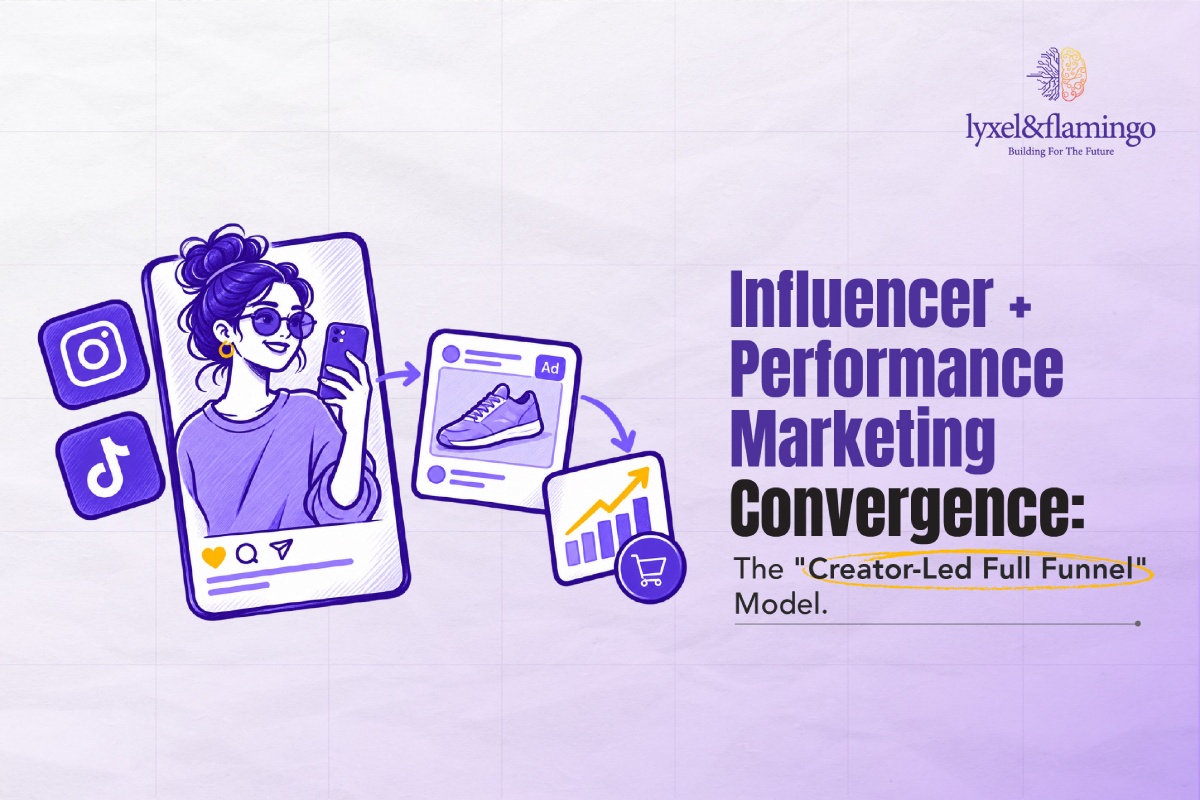
Most brands still keep influencer and performance marketing in separate budgets, teams, and dashboards. That made sense earlier, but creator content works differently now. One campaign can build awareness, drive clicks, and generate sales, so separating them creates unnecessary gaps.
The line between “brand content” and “performance content” has mostly disappeared, and creators sit right in the middle of that collapse. A single creator video now gets clipped for organic reach, boosted through paid media, repurposed as a static ad, and tracked against a conversion goal, all within the same week. Brands running these two functions in isolation are leaving measurable revenue on the table, and the newest research from marketing’s biggest names backs that up. This shift sits inside a bigger move towards creator-led full-funnel marketing, where every channel is built to work together instead of chasing its own isolated metric.
What Is Creator-Led Full Funnel Marketing?
Creator-led full-funnel marketing is an approach where creator content is built and distributed to work across every stage of the buying journey, not just the awareness stage. A single piece of creator performance marketing content gets used organically for discovery, amplified through paid media (this is paid influencer marketing) for consideration, and optimised for direct conversion at the bottom of the funnel, all from the same asset.
This matters right now because attention has consolidated on creator platforms, and the old habit of treating influencer marketing as a brand-awareness line item is quietly starving performance teams of some of their best-converting creative. Brands that keep the two disciplines apart are, in effect, running half a strategy twice.
Want to build a stronger influencer marketing strategy from the ground up? Read this blog: The Ultimate Guide to Building a Successful Influencer Marketing Strategy
Why Your Influencer Budget and Your Performance Budget Are Struggling
Here’s what happens inside most mid-to-large marketing orgs, and it’s rarely on purpose. The brand team signs a creator for a campaign, gets a nice piece of content, posts it, and calls it done. Meanwhile, the performance team tests ad creative that looks nothing like what the creator made, because nobody told them it existed. Two teams, two briefs, two sets of KPIs, one wasted asset.
We’ve seen this exact pattern across FMCG and D2C briefs. The creative that performs best in paid media is often the influencer content nobody thought to feed into the media plan. Bain & Company’s July 2026 research on marketing measurement found that only 41% of marketers feel adequately equipped with the data, tools, and capability to connect their marketing activity to business outcomes, which is a direct symptom of exactly this kind of disconnected planning. When influencer output and performance media sit in separate workflows, nobody can prove what drove the sale, and budget conversations turn into guesswork instead of evidence.
The brands still treating influencer marketing as a reach tactic and performance marketing as a separate conversion tactic are measuring two halves of the same customer journey with two different rulers.
Why the Funnel Stopped Being Linear?
The classic funnel, awareness at the top, consideration in the middle, conversion at the bottom, assumed a straight path. A customer saw a TV ad, then a display banner, then clicked a search ad, then bought. Creator content doesn’t move through a channel like that at all. It moves through a feed, and a feed doesn’t respect funnel stages.
A single reel from a creator can simultaneously do a discovery job (someone sees it cold, no brand intent at all), a consideration job (someone searches the brand afterwards because they half-remember it), and a conversion job (someone clicks straight through via a shoppable tag). All three things can happen from one post, sometimes within minutes of each other. That’s the structural reason a linear budget split between “influencer” and “performance” breaks. The content itself refuses to sit in one funnel stage.
BCG’s June 2026 research on brand discovery gives this a name worth paying attention to: research-led journeys. Their data shows over 50% of Gen Z and millennial purchase journeys now run through research before a decision, and social platforms are where a large chunk of that research happens, with 90% of consumers who engage with social content ranking it among their top five most influential touchpoints. That’s not top-of-funnel behaviour in the old sense. That’s a consideration and validation behaviour, happening on the same platform, often through the same creator, that used to be filed under “awareness only.”
Here’s how the two models compare side by side:
| Linear Funnel Model | Creator-Led Full Funnel Model | |
| Content ownership | Split by team (brand vs. performance) | One asset, multiple deployments |
| Measurement | Channel-siloed metrics | Cross-stage attribution |
| Creator role | Awareness/reach only | Discovery, consideration, and conversion |
| Budget structure | Two separate line items | One integrated creator-performance budget |
| Optimisation signal | Impressions and engagement | Full-funnel conversion lift |
Nano and micro creators are where this shows up hardest. Cannes Lions 2026’s marketing signals report, published by McKinsey in June 2026, noted plainly that nano-creators are now outperforming celebrity reach in many categories, and that creators are “shaping the full funnel, across discovery, consideration, driving conversion, and building loyalty.” That is a direct statement from one of the most cited strategy firms in the world that the funnel-stage boundaries around creator-led advertising no longer hold up. It also explains why creator-led full-funnel marketing is showing up in more brand strategy decks this year than it did even twelve months ago.
Curious how full-funnel thinking changes performance marketing ROI specifically? Read this blog: How to Maximise Performance Marketing ROI with Full-Funnel Thinking in 2025
The Evidence: What the 2026 Data Really Shows
Full-funnel behaviour is now the default, not the exception, in how consumers use creator content. BCG’s June 2026 report on brand discovery found that 97% of internet users are active on social platforms monthly, and 22% of research-led purchase journeys specifically use social media for information gathering before a decision. That places creator content squarely in the middle of the funnel, not just at the top.
Marketers are structurally unequipped to prove what’s working. Bain’s July 2026 marketing-finance research found only 41% of marketers feel adequately equipped with the data and tools to connect performance to business outcomes, even as roughly 70% of both marketing and finance leaders expect performance investments to pay back within months or quarters.
India’s influencer economy is growing fast enough that ad hoc structures won’t scale with it. IBEF’s June 2025 report projected a 25% growth rate for India’s influencer marketing industry in 2025, alongside a notable shift where 72% of brands now favour long-term creator collaborations over one-off partnerships, a structural sign that brands are building repeatable systems rather than one-off content.
Creators are already outperforming traditional ads on trust and mid-funnel metrics, not just reach. IBEF’s reporting on Kantar research found that 67% of Indian consumers trust influencer recommendations more than traditional advertisements, and influencer-led ads showed a 15% lift in brand favorability compared to 12% for standard digital ads, plus a 57% probability of driving immediate impact.
Even Gartner is telling brands to stop chasing raw engagement volume from creators. Gartner’s Marketing Predictions 2026, released in December 2025, forecasts that influencer budgets will shift toward verified creator authenticity and content trustworthiness rather than high engagement numbers alone, a direct response to AI-generated content and deepfake risk diluting what “engagement” even means.
The Lyxel&Flamingo Creator Performance Loop
At Lyxel&Flamingo’s Full-Funnel Marketing practice, we use a three-stage model to turn a single piece of creator content into an asset that earns its keep across the whole journey. We call it the Creator Performance Loop, and unlike a lot of frameworks in this space, it’s built around one asset moving through three jobs rather than three separate assets built for three separate jobs.
- Signal Capture: Before a creator brief goes out, define what “performance” means for this specific content: is it a search lift, a site visit, a shoppable click, a branded query increase? Most briefs skip this and default to reach, which means nobody can later say whether the content worked. In our experience running creator briefs across FMCG and D2C accounts, brands that write a measurable outcome into the brief before shooting starts see cleaner attribution data within the first two weeks of a campaign.
- Amplification Split: Once content is live organically, decide within 48 to 72 hours which pieces get paid amplification and which stay organic. Not every creator asset deserves media spend. The ones worth boosting are usually the ones with unusually high organic saves or shares relative to views, which is a stronger conversion signal than raw view count.
- Cross-Stage Attribution: Track the same piece of content against discovery metrics (reach, saves), consideration metrics (branded search lift, site visits), and conversion metrics (clicks, purchases) simultaneously, rather than assigning it to one funnel stage and measuring only that. Most brands skip this step entirely, and it’s the one that proves creator ROI to a finance team asking hard questions.
The second stage, amplification split, is consistently the most under-invested step we see. Brands either boost everything (wasting spend on weak assets) or boost nothing (leaving strong organic performers under-distributed). Getting that decision right in the first three days of a campaign is where most of the efficiency gain sits, and it’s the difference between a loop that just produces content and one that produces influencer-led growth.
Not sure which creator tier fits your budget and goals right now? Read this blog: From Nano to Mega: Choosing the Right Influencer Tier for Maximum ROI in 2025
What This Looks Like in a Real Campaign
A consumer durables brand came to us running influencer and performance marketing as entirely separate workstreams, with two different agencies handling each. Their influencer content was getting solid engagement, but the performance team had no visibility into which creators or formats drove site traffic. We rebuilt their creator brief process around the Creator Performance Loop and folded both budgets into one integrated media plan.
Branded search volume moved noticeably within weeks of shifting to unified creator briefs, a signal the brand had never been able to trace back to specific creators before. Cost per acquisition on paid amplification improved once spend followed organic performance signals instead of follower count. Creator renewal decisions got faster and more confident, based on cross-stage attribution data instead of engagement alone.
The results made one thing obvious: the creators who performed best on pure engagement weren’t always the ones driving conversions, and without a shared measurement system, the brand had been renewing the wrong partnerships for over a year.
5 Things to Do Before Your Next Campaign Brief
- Write a measurable outcome into every creator brief, not just a content deliverable. Specify whether you’re measuring branded search lift, site visits, or direct conversions before the shoot happens, not after the content is live.
- Merge your influencer and performance reporting into one dashboard. Even a shared spreadsheet updated weekly beats two teams pulling numbers from separate platforms and never comparing them.
- Set a 72-hour rule for amplification decisions. Watch organic performance for the first three days, then decide which assets get paid media support based on saves-to-views ratio, not follower count.
- Prioritise long-term creator relationships over one-off bookings. Repeat creators build audience trust that compounds, and IBEF’s 2025 data shows brands are already moving in this direction, with 72% now favouring long-term collaborations.
- Ask every creator partner for raw content variants, not just the final edit. Performance teams need multiple cuts and formats to test in paid media, and getting these at the time of shoot saves a reshoot later.
Conclusion
The brands still budgeting influencer marketing and performance marketing as separate line items are running an outdated model against a funnel that no longer behaves in a straight line. Creator content is already doing discovery, consideration, and conversion work simultaneously, whether or not a brand’s org chart is built to measure it that way. The ones who restructure their briefs, budgets, and reporting around a single creator-led full funnel now are building a measurement advantage that gets harder to catch up to every quarter it’s left unaddressed.
Speak to our Full-Funnel Marketing team about auditing how your current creator and performance budgets overlap, and where the gaps are costing you attribution clarity.
Frequently Asked Questions
A traditional influencer marketing strategy treats creator content as a brand awareness tool, measured mostly on reach and engagement. An influencer performance marketing strategy treats the same content as an asset tracked and optimised across discovery, consideration, and conversion stages, often with paid amplification layered on top of the organic post.
Yes, but only if the content is chosen for amplification based on performance signals, not follower count. BCG's 2026 research shows 90% of consumers who engage with social content rank it among their top five influential touchpoints, which makes paid influencer marketing a reasonable spend when it's backed by actual organic performance data rather than a guess.
Track the same creator asset against three separate metric sets at once: reach and saves for discovery, branded search lift and site visits for consideration, and clicks or purchases for conversion. Most brands only track one of these, which is why full-funnel influencer marketing often gets underreported as a bottom-funnel tactic when it's working across all three the whole time.
As soon as more than one creator or campaign is running per quarter. Below that volume, informal tracking works fine. Above it, splitting influencer and performance budgets without shared measurement starts costing real attribution clarity, based on what we've seen across FMCG and D2C accounts running multiple concurrent creator partnerships.
Creator content carries a trust signal a standard ad doesn't. IBEF's Kantar-sourced data found 67% of Indian consumers trust influencer recommendations over traditional advertising, and influencer ads showed a 15% brand favorability lift against 12% for digital ads. That trust gap is why creator content, when amplified correctly, tends to convert differently than a straight paid placement built from scratch.