
What This Blog Covers
Most D2C brands spend months perfecting the path to checkout and almost no time on the ninety seconds right after it. That gap is where repeat customers are actually won or lost. The post-purchase window, order confirmation through delivery and first use, gets far less design attention than the pre-purchase funnel, even though it does more to determine repeat purchase rate. This covers where the post-purchase gap actually costs brands retention, and what closing it looks like in practice.
Quick Answer: The highest-leverage post-purchase moments are the order confirmation (set explicit delivery expectations, not a vague range), the delivery experience itself (proactive updates, not just a tracking link nobody checks), and the first-use moment (a clear next step, not silence until the next marketing email). Brands that redesign these three moments typically see measurable gains in repeat purchase rate within one to two quarters, without touching acquisition spend at all.
Table of Contents
Why Post-Purchase Gets Underinvested
Marketing budgets are built around acquisition because acquisition is where spend directly, visibly drives revenue. Post-purchase experience sits in an organizational gap, not quite marketing, not quite operations, not quite customer service, and gaps like that tend to get the least deliberate design attention even though they’re fully within a brand’s control.
The irony is that post-purchase is cheaper to improve than acquisition. It doesn’t require more ad spend, it requires redesigning moments that already happen for every single customer, whether or not anyone is paying attention to them.
The Three Moments That Actually Matter
Order confirmation is the first moment a customer checks after buying, often within minutes, and a vague delivery window (“5 to 10 business days”) reads as uncertainty rather than honesty, even when it’s accurate.
The delivery experience itself is the second, and it’s where most brands go quiet, handing the relationship off entirely to a tracking link the customer has to remember to check rather than proactively communicating.
First use, the moment the product actually arrives and gets opened, is the third and most neglected. This is the single highest-leverage moment to earn a repeat purchase, and most brands do nothing here beyond the transactional delivery notification.
What “Good” Looks Like at Each Moment
At confirmation, a specific delivery window beats a vague one every time, even if the specific window is a few days wider than the vague range would suggest. Certainty beats optimism.
During delivery, proactive status updates, out for delivery today, a short delay with a reason, outperform a passive tracking link because they remove the customer’s need to go looking for reassurance.
At first use, a short, well-timed follow-up, not a discount code: a genuine check-in, how to use the product, what to expect, an easy way to reach support, builds the kind of trust that a repeat-purchase discount alone doesn’t.
Post-purchase retention is only half the revenue story. The checkout leak covers the other half, the 15 to 20% of revenue many D2C brands lose between “add to cart” and “paid,” before a customer ever reaches the moments this framework is built around.
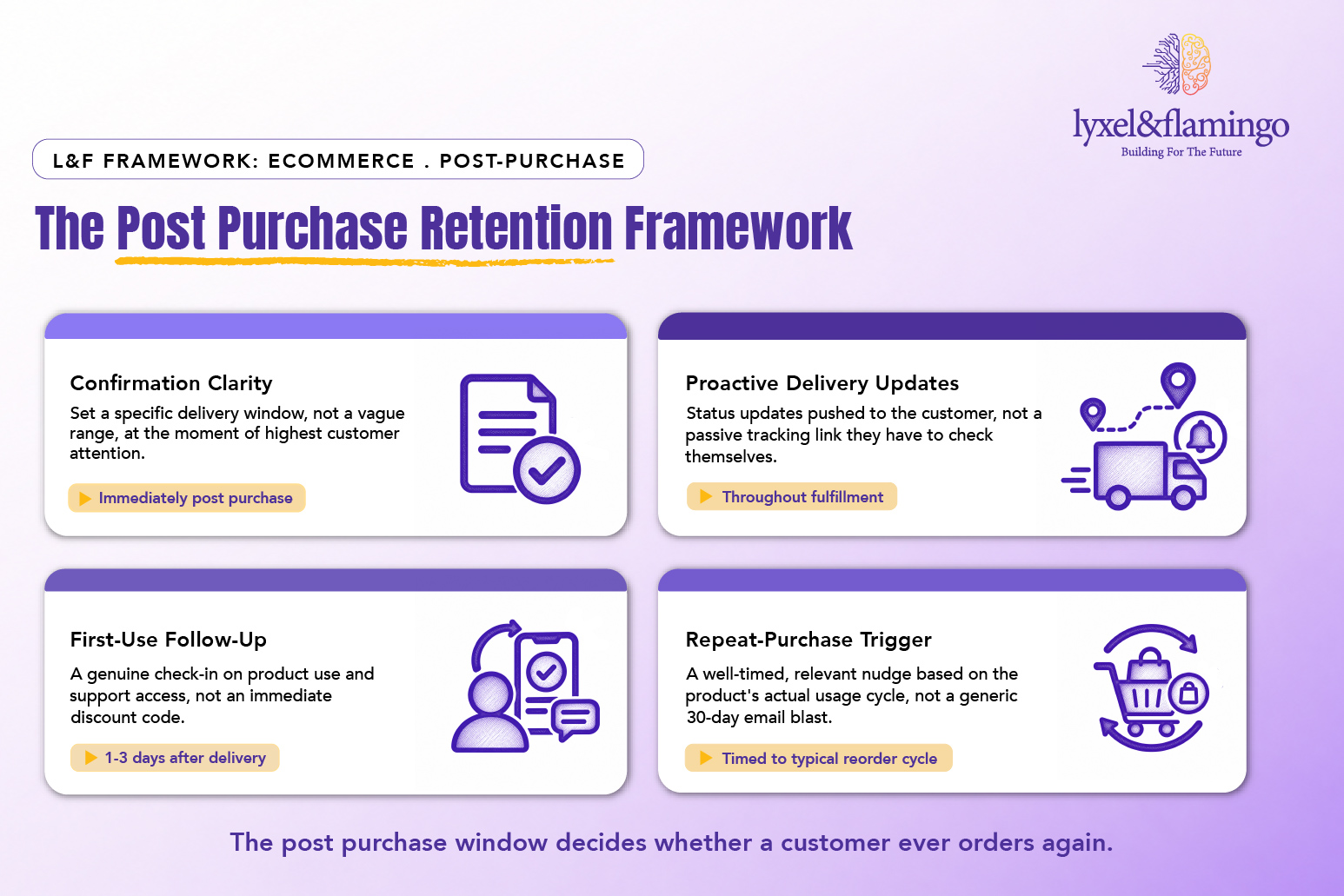
The Post-Purchase Retention Framework
Framework Explained
- Confirmation Clarity: this is the cheapest fix on the list, and often the highest-impact one, since it costs nothing beyond being more precise about a delivery window the brand already knows.
- Proactive Delivery Updates: removing the burden of checking status from the customer is a small operational lift with an outsized trust return.
- First-Use Follow-Up: leading with genuine usefulness rather than a discount code signals the brand cares about the customer’s experience with the product, not just the next transaction.
- Repeat-Purchase Trigger: timing this to the product’s actual usage cycle, not a generic calendar interval, is what separates a relevant nudge from noise the customer has learned to ignore.
Measuring the Impact
Repeat purchase rate within 90 days is the clearest metric to track against these changes, segmented by cohort so a brand can compare customers who experienced the redesigned post-purchase flow against those who didn’t.
Support ticket volume tied to delivery status questions is a useful secondary metric, since a drop here directly reflects whether the proactive updates are actually reducing customer uncertainty.
Where to Start This Quarter
Confirmation clarity is the place to start, since it requires no new tooling, just more precise language about something the brand already knows. Delivery updates and first-use follow-up can be sequenced in after, once the impact of the first change is visible in the data.
✓ CLIENT PROOF POINT The Body Shop’s work with Lyxel&Flamingo delivered 23% more orders and 10% sales growth, the kind of gain that compounds when the post-purchase experience gives customers a reason to come back rather than leaving that relationship to chance after checkout.
Key Takeaways
- Post-purchase experience is underinvested relative to how much it influences repeat purchase rate.
- Order confirmation, delivery updates and first-use follow-up are the three highest-leverage moments.
- Confirmation clarity is the cheapest fix and the right place to start.
- Track 90-day repeat purchase rate by cohort to measure the actual impact of these changes.
CXO Takeaway
Retention gains from post-purchase redesign don’t require new acquisition spend, they require redesigning moments that already happen for every customer. This is one of the few retention levers a brand fully controls without depending on media performance.
When was the last time someone on your team actually experienced your own post-purchase flow as a customer would?
Talk to Lyxel&Flamingo about redesigning the post-purchase moments that actually drive repeat purchase rate.
Frequently Asked Questions
It directly influences repeat purchase rate, arguably the most controllable retention lever a brand has, yet it typically gets far less deliberate design attention than the pre-purchase funnel.
Order confirmation. Replacing a vague delivery window with a specific one costs nothing and directly reduces the uncertainty that drives support tickets and anxiety at the moment of highest customer attention.
A genuine check-in on product use and support access builds more trust than an immediate discount code, which can read as transactional rather than caring about the customer’s actual experience.
90-day repeat purchase rate segmented by cohort is the clearest metric, alongside support ticket volume tied to delivery status questions as a secondary signal.