
Blog Summary
Quick commerce growth looks like a straightforward win until a CXO reads the whole P&L and finds the gain in one channel matched by a quiet slide in another. Some of that ten-minute demand is genuinely new; some of it is the same shopper, buying the same thing, on a faster and often costlier channel. Telling the two apart is one of the more important reads a brand leader can make right now, and this is a framework for making it honestly.
Table of Contents
The growth that came from your own shelf
A brand watches its quick commerce numbers climb and, reasonably, calls it success. Then someone lays the full picture side by side, and the rise on the ten-minute channel sits next to a softer line in modern trade or general trade: the supermarket shelf and the neighbourhood store that used to carry the same volume. The channel shift is real and industry-wide: reporting has noted modern trade growth coming under pressure as quick commerce rises. The uncomfortable possibility is that some of the celebrated growth did not come from new demand at all. It came from the brand’s own other shelves.
Quick Commerce Festive Rush: How Blinkit, Zepto, and Instamart Are Changing Diwali Shopping Behaviour
What cannibalisation means here
Cannibalisation is when a new channel wins sales that would have happened anyway on an existing one, rather than adding sales that would not have existed. It is not automatically bad; moving a shopper to a channel they prefer can protect a brand against a competitor doing it first, but it is very different from incremental growth, and treating one as the other leads a brand to over-invest in a channel that is quietly rearranging its sales rather than expanding them. The whole point of reading the signal is to know which kind of growth a brand is actually buying.
Signal one: Is the whole category growing?
The first question is the widest: is the total category expanding, or just redistributing? If a brand’s quick commerce sales rise while its total sales across every channel stay flat, the ten-minute growth is mostly movement, not expansion the same demand wearing a faster coat. If total sales rise alongside the quick commerce gain, some of it is genuinely new. Reading the channel in isolation hides this entirely; the signal only appears when a brand looks at the whole category at once.
MTA vs MMM vs Incrementality: Which Attribution Model Fits You
Signal two: New buyers or the same ones?
The second question is about who is buying. If quick commerce is bringing first-time buyers and new occasions a shopper who would not otherwise have bought, or a moment that did not previously convert the growth is additive. If it is largely the same loyal buyers shifting a purchase they would have made anyway to a more convenient channel, it is substitution. The buyer mix is one of the clearest tells, and it is knowable: a brand that reads new-versus-repeat behaviour across channels can usually see whether it is winning people or simply relocating them.
Signal three: What happened to the margin?
The third question is the one a CXO feels first: what did the shift do to the margin per order? Quick commerce often carries different economics from general and modern trade, so a sale that moved channels can arrive worth less even when the top line looks the same or better. If demand has shifted to a costlier channel without expanding, a brand can be growing its revenue and shrinking its profit at once. The margin read is what turns a channel-mix question into a business one, and it is the signal most easily lost when only the growth number is celebrated.
Reading the cannibalisation signal
Put together, three questions separate real growth from rearrangement: is the whole category growing, are these new buyers or the same ones, and is each order still worth what it was? None requires exotic data; all three require the discipline to look past the single rising channel to the whole picture behind it. The read is uncomfortable precisely because it can turn an apparent win into a more complicated truth, which is exactly why it is worth making.
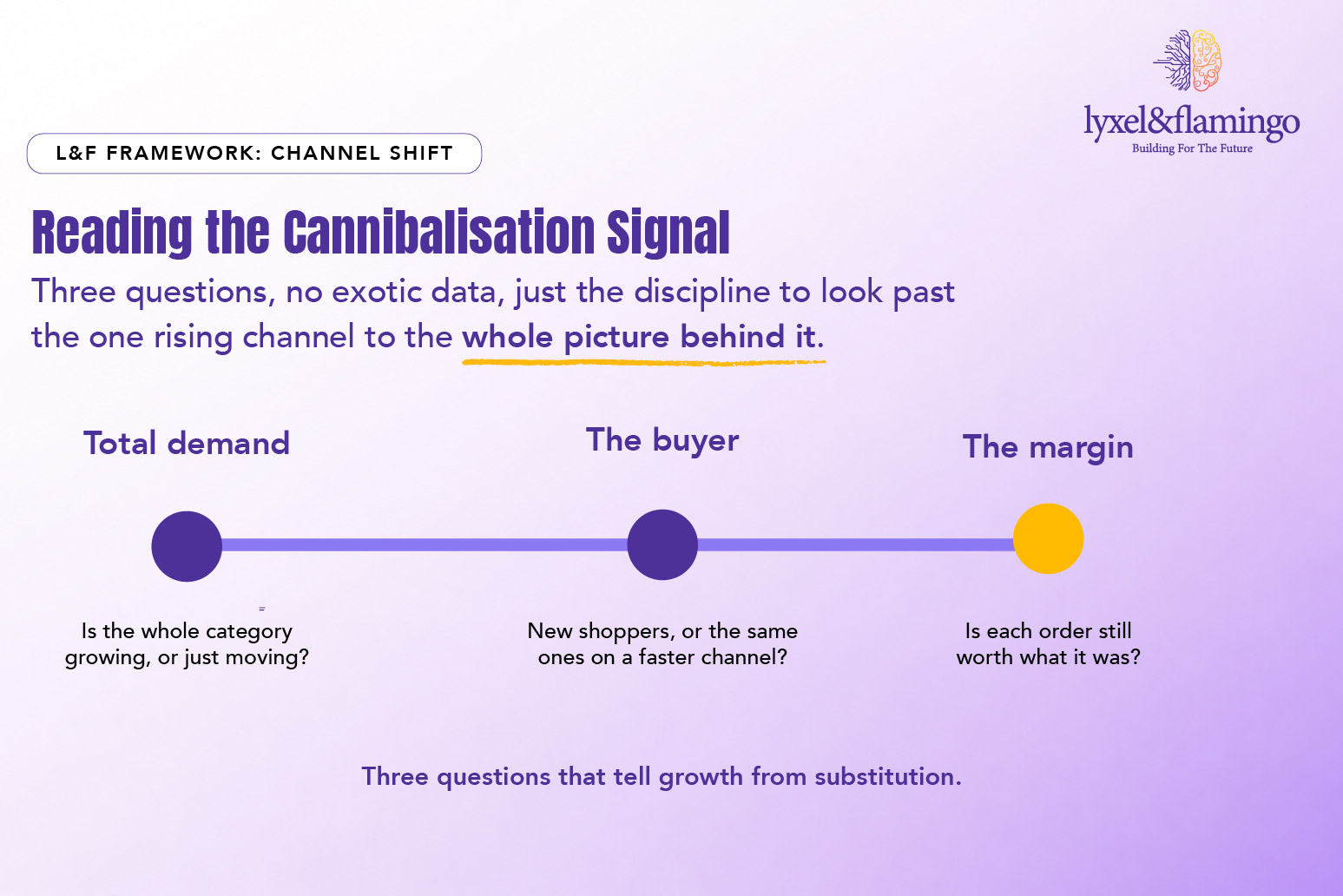
Reading the Cannibalisation Signal: Three questions that tell growth from substitution.
What to do once you know
Knowing the answer does not mean retreating from quick commerce; the channel is where a growing share of demand now lives, and ceding it to a competitor is its own kind of loss. It means investing in it with clear eyes: pricing and pack choices that protect margin on the faster channel, a deliberate view of which demand a brand is happy to move and which it needs to grow, and a plan that treats quick commerce as part of a whole rather than a number to maximise on its own. This is the same portfolio thinking that runs through growth across Amazon, Flipkart and Myntra applied to the channel mix rather than a single platform.
The reframe worth carrying is that not all growth is the same, and the most dangerous kind is the growth that looks like a win on one screen while quietly costing more than it adds across the others. So the question to sit with is not how fast your quick commerce sales are rising. It is whether that rise is new demand you created, or old demand you are now paying more to serve.
CLOSING
Reading the channel-shift signal honestly is a leadership discipline, and it is one Lyxel&Flamingo works through with brand teams, separating the quick commerce growth that expands a business from the growth that merely rearranges it. If you would like help reading what your own channel mix is actually telling you, our marketplace team would be glad to work through it with you. Start that conversation whenever you are ready.
Frequently Asked Questions
Partly - some demand is new, and some is the same shopper moving to a faster channel. Quick commerce growth is a mix of incremental demand and substitution from modern and general trade, and the two must be read apart.
By reading total category sales, the new-versus-repeat buyer mix, and margin per order. Growth is incremental when total sales rise and new buyers appear; it is substitution when only the channel changes.
No - moving a shopper to a preferred channel can defend against a competitor doing it first. Cannibalisation is a problem only when it shifts demand to a costlier channel without expanding the category.
Rarely - the answer is to invest with margin discipline, not to retreat. Ceding quick commerce to competitors is its own loss; the fix is protecting margin, not abandoning the channel.