What this blog covers
Shopify Markets lets one store sell in many currencies, languages and countries, so adding a twelfth currency takes minutes while making the twelfth market profitable takes planning. This playbook shows what one store with many currencies really means, why payments decide whether customers pay in their own currency (and why that matters for Indian entities, since Shopify Payments is unavailable in India), how to price each market deliberately, and which tax, duty and search settings hide inside every market. Founders get the Market-by-Market Ladder: Choose, Price, Pay, Prove.
Table of Contents
- What one store, many currencies really means in Shopify
- The payments catch that decides whether customers pay in their own currency
- Why pricing for each market is a decision, beyond a conversion rate
- The duty, tax and search settings that hide inside every market
- Shopify multi-currency international setup: the Market-by-Market Ladder
- The framework explained
- The 90-day launch plan for your first four markets
- Why you should launch four markets before twelve
- Key takeaways
- The CXO takeaway
Twelve currencies is a configuration. Twelve profitable markets is a strategy. Two very different projects.
Quick answer: With the right Shopify multi-currency international setup, one store can serve many markets, each with its own currency, language, domain or subfolder and catalogue, so a second storefront is rarely needed. The catch is payments: native local-currency checkout runs through Shopify Payments, which is unavailable in India, so Indian entities must plan the checkout currency separately. Choose markets on demand evidence, price each deliberately, settle tax, duties and payments before go-live, and prove profit per market every month.
What one store, many currencies really means in Shopify
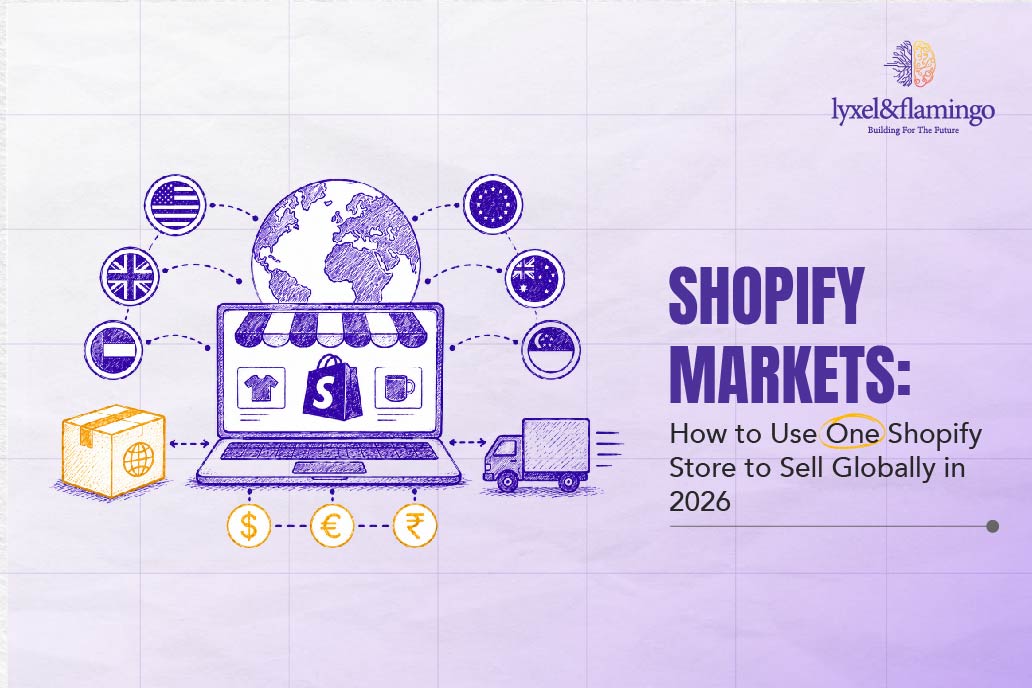
Shopify Markets is where a merchant configures how one store sells to different groups of customers. A market is a group of one or more regions, and each can carry its own currency, language, domain or subfolder, catalogue and theme tweaks. One store, one catalogue, one back office, many shoppers.
That is why a second storefront is rarely the answer. Separate stores double everything: two catalogues, two app stacks, two reports, two places to fix errors. A single store keeps inventory, content and analytics together, which matters more with every market you add. Complexity is the enemy of margin.
Our Shopify Markets guide covers the configuration steps, so this playbook focuses on the decisions around the settings: which markets to open, what to charge, how to collect payment and who owns tax. Settings follow strategy.
Start with a plain list: markets you serve today, markets already sending orders and markets you want. Next to each, write the evidence of demand: repeat visitors, search interest, enquiries. Evidence picks the first four.
The payments catch that decides whether customers pay in their own currency
Showing a price in local currency and charging in it are two different things. Shopify’s native multi-currency checkout runs through Shopify Payments, which is available in a limited set of countries. India sits outside that list today. That single fact reshapes the plan for an Indian entity.
The effect at checkout is concrete. With a third-party gateway, checkout reverts to INR, the international card is charged in INR and the customer’s bank handles conversion. Markets still localises presentation and prices, while the charge currency stays the store currency. A shopper who saw euros on the product page can meet rupees at the end.
Know your plan limits before promising anything. Shopify Plus versus Shopify explains what each plan adds. A higher plan may leave a payments limit untouched, so check each capability you need for international selling.
You have four practical routes. Each carries a cost and a customer-experience trade-off. Choose deliberately, and always tell customers which currency they will be charged in.
Four routes to local-currency selling on Shopify
Why pricing for each market is a decision, beyond a conversion rate
Automatic conversion is a starting point. A price that converts neatly from rupees can look odd locally: above a local competitor, below expectations, ending in an awkward figure. A UX friction audit per market shows where shoppers hesitate. Price is part of the experience.
Shopify lets you convert automatically with rounding rules or set manual price lists per market. Use manual lists for hero products and automatic conversion with rounding for the long tail, with price endings that match local habit. A rule beats an accident.
Cost to serve differs by market. Shipping, duties, taxes, returns and payment fees change the margin on the same product. Calculate landed cost and contribution margin per market before you set prices. Price from margin.
Test prices like pages. Shopify conversion optimisation sets the discipline: one change, one market, one hypothesis, one stopping rule, across a full purchase cycle.
The duty, tax and search settings that hide inside every market
Every market carries legal and tax questions that sit beyond the admin screen. On standard Markets, you stay merchant of record and own tax and duty compliance. With Managed Markets, a Global-e service becomes merchant of record, calculates and remits taxes and duties and guarantees landed cost at checkout, for a per-order fee. Confirm current fees with Shopify.
Decide who pays duties. Showing full landed cost at checkout, duties paid upfront, avoids nasty surprises at the door, provided the tooling calculates duties accurately. Leaving duties for delivery shifts the surprise onto the shopper. Pick one policy per market and say it plainly.
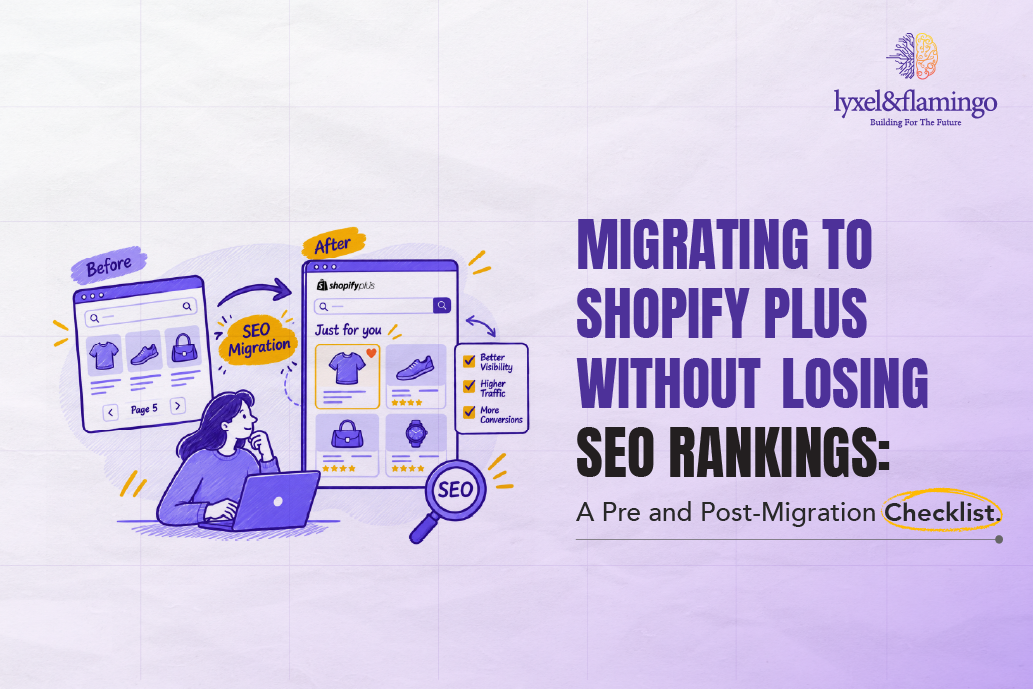
Search settings matter as much as tax. Shopify generates hreflang tags automatically for Liquid storefronts; subfolders share a domain’s authority, while separate domains need their own work. Our pre- and post-migration checklist for Shopify Plus shows how to protect rankings when URLs change, and the same care applies when adding markets. Think global, rank local goes deeper on international SEO.
Handle language properly. Translate the pages that carry the sale, product, cart and policies, and have a native speaker review them. Local language earns local trust.
Shopify multi-currency international setup: the Market-by-Market Ladder
Four decisions, taken in order for each market, turn a configuration into a business.
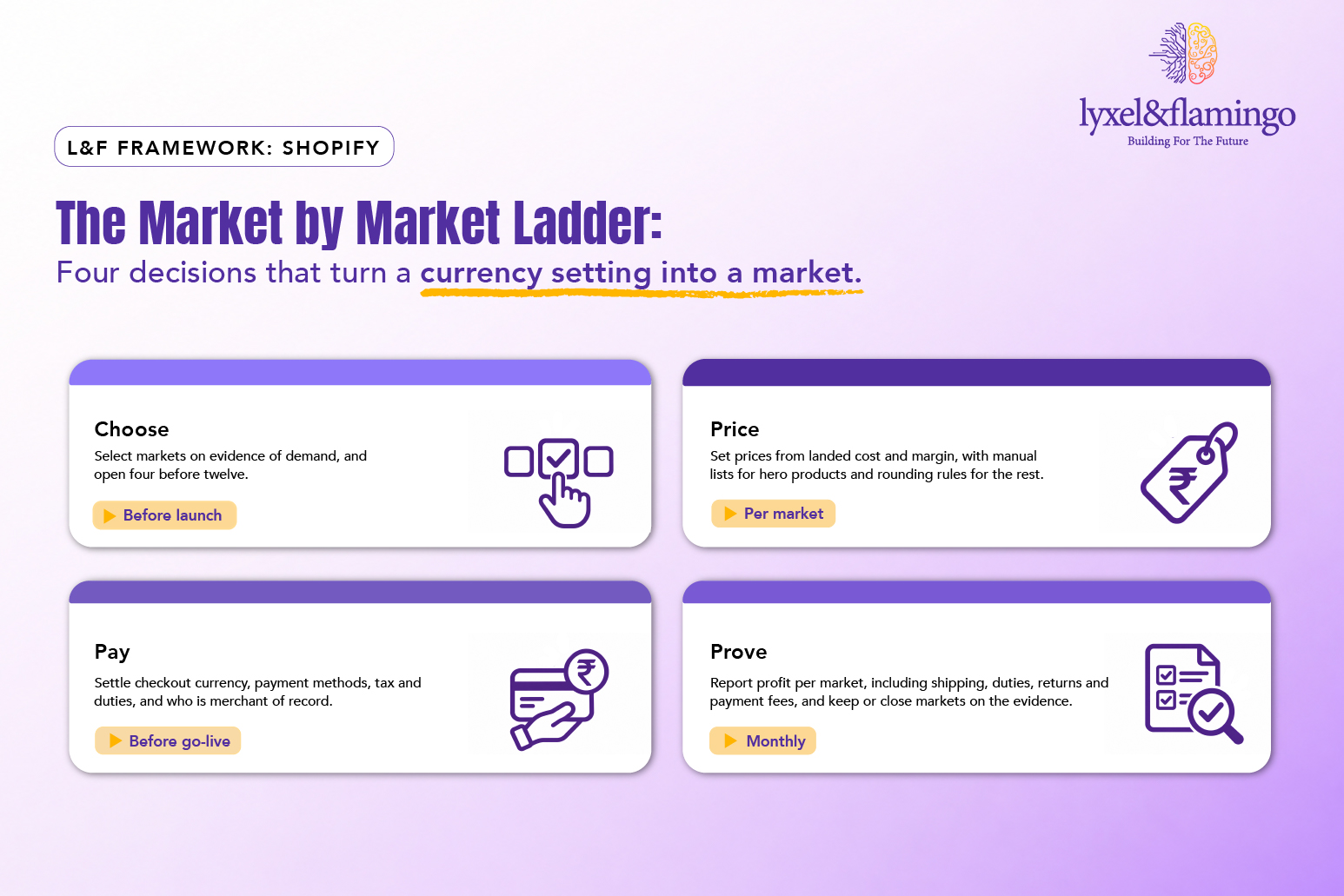
The framework explained
Choose: Pick markets on evidence. For each candidate, record repeat visitors, search interest, enquiries and existing orders, and estimate margin after shipping and duties. Open the top four, so you learn fast and fix problems before they multiply.
Price: Treat price as a per-market decision. Calculate landed cost and contribution margin, decide where manual price lists earn their effort, and set rounding and price-ending rules that match local habit. Test one change at a time.
Pay: Settle the money before go-live: charge currency, local payment methods, merchant of record, duty policy and tax handling. For an Indian entity, plan around the absence of Shopify Payments, and tell customers clearly what they will pay.
Prove: Report profit by market every month, including shipping, duties, returns and payment fees, against the target margin. Track conversion, order value and repeat rate by market and currency, and keep, change or close each market against the stop rule written before launch.
The 90-day launch plan for your first four markets
- Days 1 to 20: choose and check. Rank candidates by demand evidence and margin after shipping and duties, pick four, and confirm with your payments provider and Shopify which currencies customers can pay in. Decide merchant of record.
- Days 21 to 50: price and pay. Build price lists for hero products, set rounding rules for the rest, choose the duty policy, set up payments and tax per market, and translate and review the pages that carry the sale.
- Days 51 to 75: launch in sequence. Open markets one at a time, tag market and currency on every order, check hreflang and redirects, and test checkout end to end from each country.
- Days 76 to 90: prove. Report profit by market, compare with the stop rule, decide keep, change or close, and plan the next two markets from what you learned.
Why you should launch four markets before twelve
Twelve markets at once spreads attention across twelve sets of rules, customers and costs. Four gives enough variety to learn and few enough to manage. Learn on four. Then repeat.
Measure each market on its own. One goal, many funnels shows how correct tracking separates one market’s performance from another’s. Tag currency and market on every order and report profit alongside revenue. A currency is a segment.
Set a stop rule before opening any market: minimum order count, maximum return rate, target contribution margin, all by a set date. Miss the rule, change one thing, then decide. Closing a market is a legitimate outcome. So is doubling down.
Revisit the architecture as you grow. When many markets need very different experiences, headless commerce for enterprises shows what a custom front end buys and costs. Standard first, custom when the evidence demands it.
The Lyxel&Flamingo Shopify Plus team builds stores for brands selling across borders, from the MedicAir UK platform to Stanley India’s Shopify D2C launch.
Key takeaways
- One Shopify store can serve many markets, so a second storefront is rarely needed.
- Native local-currency checkout runs through Shopify Payments, unavailable in India, so Indian entities must plan checkout currency separately.
- Price each market from landed cost and margin, beyond a straight conversion of the home price.
- Decide merchant of record, duty policy and tax handling before go-live.
- Launch four markets before twelve and report profit by market every month.
The CXO takeaway
Ask your ecommerce lead for a one-page list of candidate markets, each with demand evidence and estimated contribution margin after shipping, duties and payment fees. Confirm with your payments provider and Shopify which currencies customers can actually pay in, and which they will be charged in. Decide merchant of record and duty policy per market. Approve four markets, each with a stop rule and review date, and put profit by market on the monthly scorecard.
The question for your next planning meeting: if you closed your three weakest markets tomorrow, which would you choose, and what evidence would you use?
Share your candidate markets with Lyxel&Flamingo and we will help you rank the first four.
Frequently Asked Questions
Yes, in configuration terms. Shopify Markets lets one store carry many markets, each with its own currency, language and catalogue. Native local-currency checkout depends on your payments set-up, so confirm which currencies customers can actually pay in, start with a few markets and add more as evidence builds.
For native multi-currency checkout, yes. Shopify Payments is unavailable in India, so Indian entities need another route, such as a managed merchant-of-record service or a display approach with the INR charge stated clearly. Confirm the current rules with Shopify before planning.
Subfolders such as /de keep authority on one domain and are simpler to maintain; separate country domains can add local trust at the cost of more set-up. Shopify generates hreflang tags automatically for Liquid storefronts. Pick one approach, apply it consistently and plan redirects carefully.
On standard Markets you remain merchant of record and handle tax and duty compliance, deciding whether customers pay duties at checkout or on delivery. With Managed Markets, a partner acts as merchant of record. Showing full landed cost at checkout usually reduces delivery surprises; take tax advice for each market.
Report profit by market, including shipping, duties, returns and payment fees, against a target contribution margin. Track conversion, order value and repeat rate by market and currency, set a minimum order count and deadline before launch, and review monthly.