What This Blog Covers
Most checkout failures during festive peaks aren’t code bugs; they’re capacity assumptions that held fine at normal volume and broke under load nobody tested for. This covers what actually breaks at 3x traffic, how to stress-test before the peak hits, and what a realistic pre-Diwali testing timeline looks like.
Quick Answer: At 3x normal traffic, the first things to fail are usually payment gateway timeout thresholds, inventory lock contention on high-demand SKUs, and third-party integrations like SMS/OTP services that weren’t provisioned for the spike. Load-test the full checkout path, not just the homepage, at least three weeks before your highest-traffic day, using traffic patterns modeled on last year’s actual peak, not a generic load estimate.
Table of Contents
Why Homepage Load Testing Isn’t Enough
Most teams load-test the homepage and product listing pages, because that’s where the traffic volume is most visible. Checkout is a smaller share of total traffic, so it gets a smaller share of testing attention, even though it’s the one part of the funnel where a failure directly costs a completed sale rather than just a slow page view.
Checkout also depends on more external systems than any other part of the site: payment gateways, inventory services, SMS/OTP providers, sometimes a separate fraud-check service. A homepage load test doesn’t touch any of these, which means the parts of the system most likely to fail under load are exactly the parts most testing plans skip.
What Actually Breaks at 3x Traffic
Payment gateway timeouts are the most common failure. Gateways have their own capacity limits and timeout thresholds, and a checkout flow that doesn’t handle a slow gateway response gracefully will show customers a failed transaction even when the payment actually went through, a problem that then generates support tickets and chargebacks on top of the lost conversion.
Inventory lock contention is the second common failure, specifically on high-demand, limited-stock SKUs. When many customers try to check out with the same low-stock item simultaneously, poorly designed inventory locking can either oversell the item or create a bottleneck that slows checkout for everyone in that queue, not just the customers after that SKU.
Third-party integrations round out the list. SMS and OTP services, address validation APIs, and fraud-check services are all provisioned based on normal-day volume by default, and a spike that isn’t communicated to those vendors in advance can hit rate limits exactly when you need them most.
Building a Realistic Load Model
A generic load estimate, like doubling last month’s average traffic, misses the actual shape of a festive spike. Real festive traffic arrives in bursts, tied to specific sale-start times, push notification sends, and influencer or ad campaign moments, not as a smooth curve.
The more useful model pulls last year’s actual peak-hour traffic data, if available, and layers this year’s expected growth on top of it, then tests against burst patterns rather than sustained average load. A system that handles sustained 3x traffic fine can still fail against a 10x burst in a five-minute window right after a sale opens.
The Pre-Diwali Stress-Test Framework
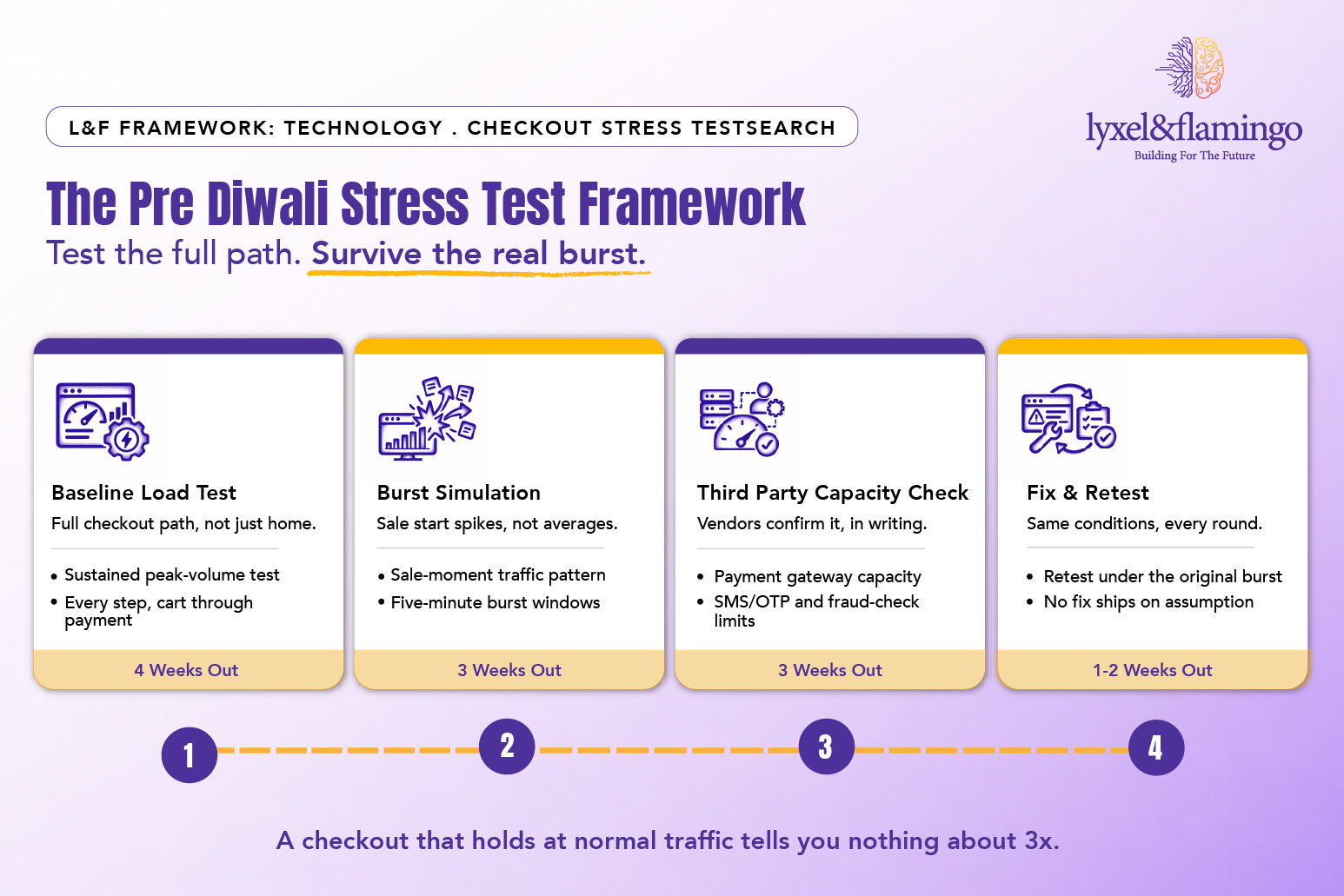
Framework Explained
- Baseline Load Test: Starting four weeks out leaves enough runway to find and fix issues without testing under deadline pressure, which tends to produce shortcuts instead of real fixes.
- Burst Simulation: Sustained-load testing and burst testing surface different failures, and skipping burst simulation is how a system that “passed” load testing still goes down in the first five minutes of a flash sale.
- Third-Party Capacity Check: A vendor’s own capacity limits are outside your direct control, which is exactly why they need to be confirmed explicitly rather than assumed.
- Fix & Retest: A fix that isn’t retested under the same burst conditions that found the original problem is an assumption, not a verified fix.
Fixing What the Test Finds
Most fixes at this stage are configuration and capacity changes, not full rebuilds: raising payment gateway timeout thresholds, moving to optimistic rather than pessimistic inventory locking for high-demand SKUs, and pre-negotiating rate limit increases with third-party vendors ahead of the peak.
The teams that get caught out aren’t usually the ones with the worst architecture. They’re the ones who found these issues in week one of the sale instead of week four before it. A gateway timeout fixed in week four is also worth revisiting through the lens of the checkout tax latency quietly drains: a flow that passes a burst test can still be losing orders to ordinary, everyday latency nobody flagged as a failure.
Security and capacity testing also tend to be scheduled separately when they should be coordinated, since a vulnerability that only appears under concurrent load is exactly what a pre-festive VAPT timeline is built to catch, and running the two in isolation means neither team sees the full picture.
A decoupled front end makes this kind of isolated, surgical fix possible in the first place; the practical payoff is covered in headless commerce ROI: what enterprises actually get back in year one. The same performance discipline, measured through Google’s own Core Web Vitals benchmarks, is worth checking on the checkout path specifically, since a site that passes vitals on its homepage can still fail them deep in checkout under load.
The Cost of Skipping This
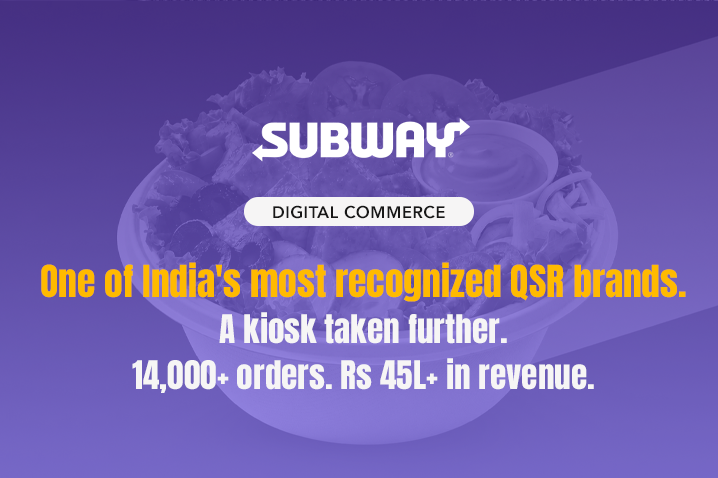
Subway India’s kiosk digital commerce work with Lyxel&Flamingo reduced a 20-question ordering flow down to 4 steps and processed over 14,000 transactions, the kind of result that depends on a checkout path that’s been genuinely tested at real volume, not just designed to look simple.
A simplified flow that hasn’t been load-tested is still a flow that can fail under burst traffic; the two problems, complexity and capacity, need to be solved separately.
Key Takeaways
- Payment gateway timeouts, inventory lock contention, and third-party rate limits are the three most common 3x-traffic failure points.
- A homepage load test tells you nothing about checkout capacity; test the full path.
- Model load against last year’s actual burst pattern, not a generic doubled-average estimate.
- Start baseline testing four weeks before peak, with time for a genuine fix-and-retest cycle before the sale opens.
CXO Takeaway
A checkout failure during peak festive traffic is a revenue event, not a technical inconvenience. Ask for the stress-test timeline and third-party capacity confirmations by three weeks before your highest-traffic day, not the week of.
If your checkout flow has never been tested against last year’s actual burst traffic pattern, do you know it will hold, or do you just hope it will?
Talk to Lyxel&Flamingo about stress-testing your checkout flow against realistic festive burst traffic before the peak arrives.
Frequently Asked Questions
Payment gateway timeouts are the most common, often because the gateway’s own capacity limits weren’t confirmed in advance, followed by inventory lock contention on high-demand SKUs.
No. Checkout depends on more external systems, payment gateways, SMS/OTP, fraud checks, than any other part of the site, and homepage load testing doesn’t touch any of them.
At least four weeks before your highest-traffic day, to leave time for a genuine fix-and-retest cycle rather than finding problems under deadline pressure.
Sustained testing checks whether the system holds at a steady elevated traffic level; burst testing checks whether it survives a sudden spike, like the first five minutes after a sale opens, which is a different failure mode entirely.