
Blog Summary
Big Billion Days rewards the Indian marketplace brands that finished the invisible work weeks before launch: catalogue, budget and stock, locked in July, not scrambled together in September. Brands that treat launch week as the starting line are already behind the ones who treated it as the finish line. This is the stage-by-stage playbook for running Flipkart Big Billion Days like the brands who win it, not the ones who react to it.
Table of Contents
- The Sale Decided Before It Starts
- What Running the Playbook Actually Protects
- Pre-Sale Cataloguing and Pricing: The Work Nobody Sees
- Ad Spend Pre-Loading: Buying the Discovery Window Early
- Day-of Buy Box Monitoring: Watching by the Hour, Not the Day
- Post-Sale Reconciliation: Closing the Loop Before the Next One Opens
- Where Myntra and Tata CLiQ Run a Different Clock
- The Big Billion Days Playbook: Four Stages That Decide the Sale Before the Banner Even Goes Live
- The Big Billion Days Playbook: Proof in Practice
- The Question to Sit With
- Closing
The Sale Decided Before It Starts
By the time Big Billion Days launches, the brands who will win the week have already finished the parts nobody sees. Catalogue, budget and stock were locked weeks earlier, and no amount of hustle during launch week rescues a brand that skipped that work. The banner going live is the least important moment of the entire sale.
It is the same pattern covered in “10 festive trends every brand should watch this season”: the brands ahead of the season were already ahead weeks before it started.
What Running the Playbook Actually Protects
This is not a checklist for its own sake. Each stage protects a specific failure mode: a catalogue error that stalls a listing mid-sale, a budget that arrives too late to matter, a Buy Box lost and never noticed, a settlement discrepancy that eats into next quarter’s numbers before anyone catches it. Running the stages in sequence is what keeps all four from happening at once, in the one week a brand cannot afford any of them.
It is the platform-specific execution layer of the broader festive readiness playbook, built to hold up once the sale is actually live.
Pre-Sale Cataloguing and Pricing: The Work Nobody Sees
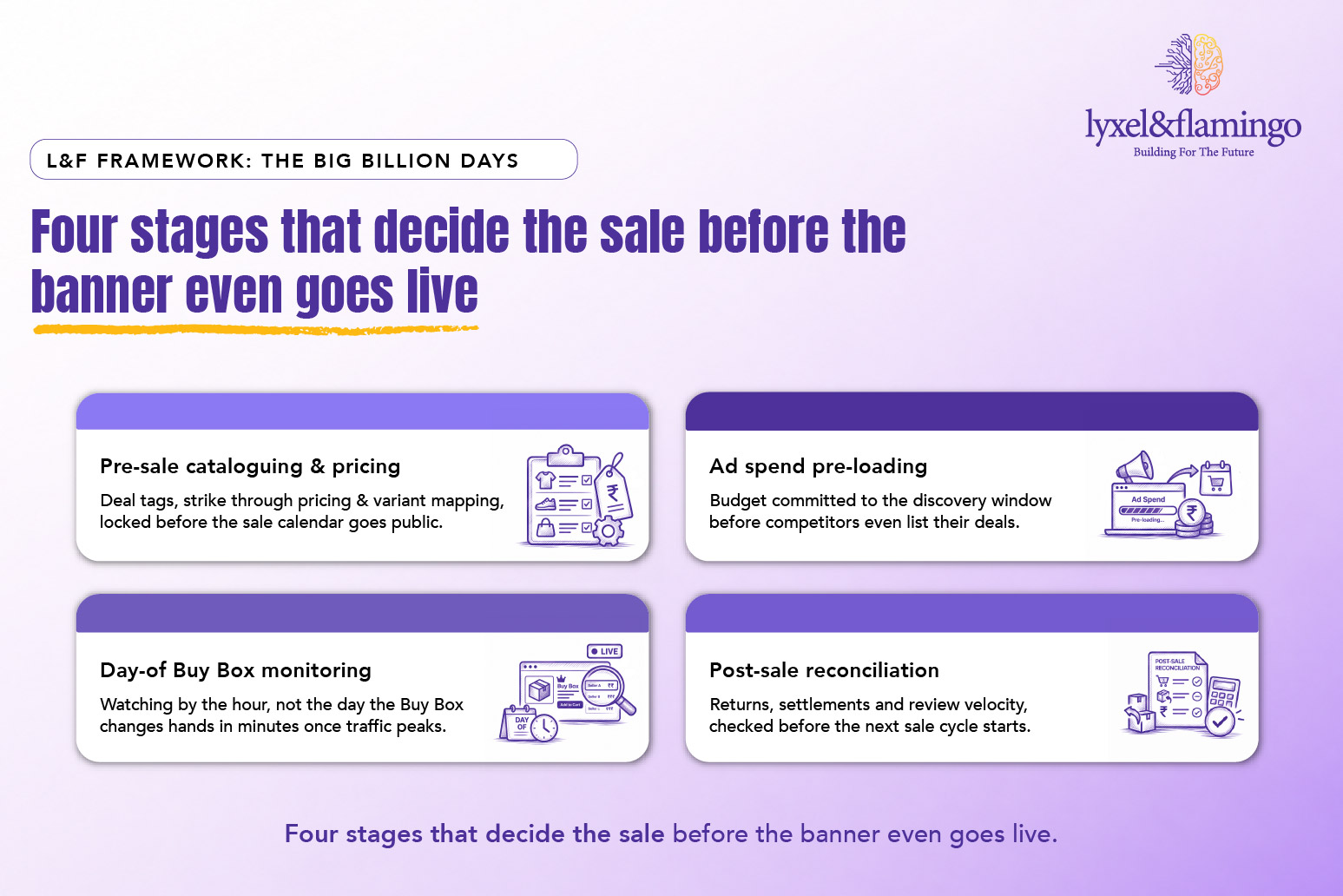
Deal tags, strike-through pricing and variant mapping, locked before the sale calendar goes public, not after. A catalogue error caught during launch week does not get fixed during launch week. It gets fixed after the traffic that would have converted has already moved on to a competitor’s listing.
The same pricing discipline, adapted for a different shelf, is set out in “pricing and pack sizes built for the ten-minute cart”.
Ad Spend Pre-Loading: Buying the Discovery Window Early
Budget committed to the discovery window before competitors even list their deals. Late spend does not buy the same traffic. It chases traffic that has already converted elsewhere, at a worse price, for a worse ROAS.
Our digital full-funnel marketing services team builds this pre-loading schedule alongside the catalogue and stock plan, not after it.
Day-of Buy Box Monitoring: Watching by the Hour, Not the Day
The Buy Box changes hands in minutes once traffic peaks, and it does not wait for a morning check-in to be won back. Hourly monitoring through the peak days is not excessive. It is the only cadence that matches how fast the Buy Box actually moves during Big Billion Days.
The same hourly discipline is what keeps quick commerce brands ahead in the quick commerce KPIs that matter: visibility measured by the hour, not the recap deck.
Post-Sale Reconciliation: Closing the Loop Before the Next One Opens
Returns, settlements and review velocity, checked before the next sale cycle starts. Skip this step and the same catalogue errors, the same budget timing mistakes and the same stock gaps show up again at the next event, funded at a bigger budget and defended with less excuse.
Reconciliation without a matching inventory and availability plan just repeats the same stock gaps at the next cycle.
Where Myntra and Tata CLiQ Run a Different Clock
Fashion and lifestyle marketplaces keep their own festive calendar, EORS included, and it rarely lines up exactly with Flipkart’s core event. The four-stage discipline above does not change for them. Only the dates do, and treating Myntra and Tata CLiQ as an afterthought to a Flipkart plan is how a brand shows up prepared for the wrong week on its second-largest channel.
Our Third-Party Marketplace management services team runs this exact playbook every festive season across Flipkart, Myntra and Tata CLiQ.
The Big Billion Days Playbook: Four Stages That Decide the Sale Before the Banner Even Goes Live
The Big Billion Days Playbook: Proof in Practice
CLIENT PROOF POINT: confirm sign-off before publish. Vega and Axor‘s helmet campaigns on Flipkart show the playbook holding well past the sale. Separate campaigns ran by price tier and feature set, higher bids went to the higher-ASP models, and a 60:40 PLA-to-PCA split kept competitor keywords in view alongside liquidation. From the October 2024 festive peak through April 2025, impressions grew 13.64%, clicks 32.02%, CTR 16.18%, orders 17.78%, ad revenue 24.53%, and ROI 65.98%. Momentum built during the festive window carried six months forward, not spent by December. (L&F client work, Flipkart, Festive Oct 2024 to April 2025.)
Our Third-Party Marketplace management services team runs this exact playbook every festive season across Flipkart, Myntra and Tata CLiQ.
The Question to Sit With
It is tempting to judge Big Billion Days by how the launch week itself went. The sharper judge is whether the work that decided the outcome was already finished before the banner appeared. So the question worth carrying into the season is not whether your team is ready for launch week. It is whether the catalogue, the budget and the stock were already locked before anyone outside the team even knew the sale was coming.
Closing
Running Big Billion Days as a four-stage sequence rather than a launch-week scramble is a discipline, and it is one Lyxel&Flamingo runs alongside brand teams every festive season. If you want a clear read on whether your catalogue, budget and stock are actually ready ahead of the calendar, our marketplace team can pressure-test your Big Billion Days plan before the banner goes live. Start that conversation with L&F →
Frequently Asked Questions
Weeks before the sale calendar goes public, not during launch week. Catalogue, pricing and budget decisions made after the banner is live are already too late to change the outcome.
Hourly through the peak days. The Buy Box changes hands in minutes once traffic peaks, and a daily check misses hours of lost visibility during the highest-traffic window of the sale.
No. Fashion and lifestyle marketplaces run their own calendar, including EORS, which rarely aligns exactly with Flipkart's core event, even though the same four-stage discipline applies.
Because unresolved catalogue errors, budget timing mistakes and stock gaps repeat at the next sale cycle if they are not reviewed. Reconciliation is how a brand avoids funding the same mistakes twice.