
What this blog covers
E-commerce personalisation is moving past product recommendations and first-name messages. By 2027, the bigger shift will be interfaces that change based on what shoppers are trying to do, how they browse, and where they hesitate. This blog explains why static personalisation is falling short and how adaptive UX can make shopping journeys more relevant without taking decisions away from customers. It looks at the growing role of AI in product discovery, checkout, recommendations, and shopping agents, while keeping trust at the centre of the experience. You will learn how behavioural signals, adaptive layouts, and clearer AI controls can work together across an e-commerce journey. The blog also introduces Lyxel&Flamingo’s Adaptive Experience Stack, covering signals, interface changes, and trust. It includes practical steps for brands preparing for 2027, from fixing checkout friction and improving product data to testing one focused adaptive journey before expanding further. The shift is already underway, so waiting may cost more than starting small.
Table of Contents
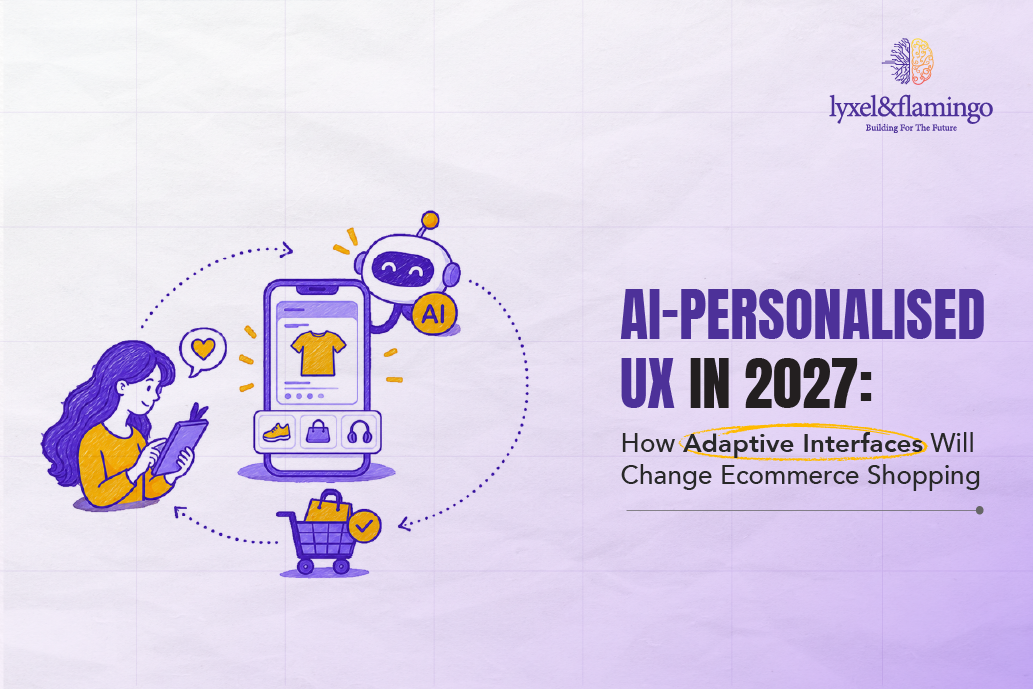
Only 11% of shoppers want AI to make the final call on what they buy. Yet almost a third are fine letting it narrow the choices down first. Gartner’s own 2026 consumer survey tells you almost everything about where AI-personalised UX stands today. It’s not about robots taking over the checkout button. It’s about interfaces that read a shopper’s intent, then rearrange themselves around it, one screen at a time.
Most e-commerce brands still mistake personalisation for better customer experience. A recommendation carousel here, a first-name email there, and the job feels done. But the results are getting harder to ignore. Personalisation now creates a poor experience for more than half of customers. The problem is not personalisation itself, but how brands use it. It happens because static, rule-based personalisation guesses wrong more often than it guesses right. More data alone will not fix this problem. It takes a different kind of interface, one built on Technology that can sense context and change shape in real time, not just swap out a product image.
What Is AI Personalised UX?
AI personalised UX is when an e-commerce interface changes its own structure, content, and flow based on real-time signals about one specific shopper, not a segment they’ve been sorted into. It’s different from a recommendation engine bolted onto a static page. The layout itself adapts: what shows up first, how the navigation is organised, even which questions get asked at checkout can shift from shopper to shopper.
This matters right now because the underlying pieces just became real. Google introduced its Universal Commerce Protocol in January 2026, giving AI agents a standard way to browse and buy across merchant catalogues. Once agents can read a storefront the same way a person does, that storefront has to be built for both audiences at once. That is the actual shift behind every conversation about ecommerce UX trends 2027.
The Problem With Personalisation Right Now
Here’s the uncomfortable part nobody puts in the pitch deck. Personalisation, the way most brands practice it today, is actively making customers regret their purchases. Gartner surveyed over 1,400 B2B buyers and consumers and found that personalisation created a negative experience for 53 % of them. Those same customers were 3.2 times more likely to regret the purchase, and 44 % less likely to buy from that brand again.
Think about what that means for AI personalisation in e-commerce as it’s currently built. Brands is pouring budget into engines that recommend products, time emails, and segment audiences, and over half the time it backfires at the exact moment that matters most: switching from browsing to buying.
The friction shows up in colder numbers too. Cart abandonment is running at 70.22% across fifty studies tracked by the Baymard Institute, a rate that has barely moved in a decade. Baymard also found that better checkout design alone can lift conversion by over 35 % for large sites. It’s not really about personalisation at all. That is an interface built for an average shopper who does not exist.
Most personalisation today treats every shopper as the same shopper wearing a different name tag.
Why Interfaces Are Becoming Adaptive – Not Just Personalised
Static personalisation and adaptive interfaces solve two different problems, and mixing them up is where most strategies go wrong. Static personalisation changes content: a banner, a product block, a subject line. Adaptive UX changes structure: the order of steps, the depth of information shown, even whether a chatbot or a search bar appears first.
Nielsen Norman Group put this shift plainly in a 2026 piece on outcome-oriented design, noting that designers now build adaptive frameworks that respond to individual goals instead of designing one interface for an average user. That is a genuine departure from a decade of UX orthodoxy built around personas and averages.
The infrastructure caught up faster than most marketers expected. Google’s Universal Commerce Protocol, launched at NRF in January 2026 with Shopify, Target, Walmart, and Etsy on board, gives AI agents a shared language to browse catalogues and complete checkout across merchants. Once an agent can transact the way a shopper does, every storefront effectively serves two users at once, a human and a machine reading on their behalf. An interface that only works for one of them is already behind. Consumers feel this shift too, whether they asked for it or not: the same Gartner research found 72 % say generative AI now shows up in their everyday browsing and app use, invited or not.
Three layers explain most of what’s changing underneath this shift:
- Signal layer: Real-time behaviour, device, location, and intent replace fixed customer segments as the main input.
- Adaptive layer: The interface itself restructures around those signals instead of only swapping creative content.
- Agent layer: Protocols such as UCP let AI shopping agents interact with the same storefront a human sees, just structured differently underneath the surface.
This is the actual mechanism behind the future of ecommerce personalisation, and it’s bigger than swapping in a smarter recommendation widget.
Want to see how this same shift plays out across completely different buyer types? Read this blog: UI/UX Is a Thinking Pattern, Not a Skin
What The AI Personalised UX Data Shows
- AI-driven personalisation is already worth 5 to 15 % in revenue for most retailers, and up to 25 % for the strongest performers. Research on gen AI personalisation found this lift comes mainly from moving beyond one-off campaigns into always-on, automated targeting.
- Only 11 % of US consumers are comfortable letting AI decide a purchase for them, even in low-stakes categories such as household goods. A survey of 322 shoppers found willingness climbs to 31 % when AI is only narrowing choices, not deciding outright. This is the clearest signal yet for how ai powered shopping journey design should work in practice: assist heavily, decide rarely.
- More than half of shoppers who used AI tools while shopping had to double-check the information those tools gave them. The same research, drawn from a separate poll of 846 consumers, found 54% verified accuracy themselves, and 62% said the AI tool ended up wasting their time.
- Better checkout design alone can raise conversion by 35.26 % on large ecommerce sites. That figure comes from a decade of usability testing at the Baymard Institute, and it’s a reminder that adaptive UX has to fix real friction, not just add a layer of AI on top.
The Adaptive Experience Stack: Lyxel&Flamingo’s Framework
At Lyxel&Flamingo, we approach this shift as three connected layers, not a single tool to bolt on. We call it the Adaptive Experience Stack, and it’s built specifically for brands moving from static personalisation toward true AI-driven user experience design.
- Signal Layer: Every session generates behavioural, contextual, and device-level signals: dwell time, scroll depth, referral source, even the time of day someone is browsing. Most brands out there already collect this kind of data. Very few structure it well enough to act on inside the interface itself, not just inside a dashboard nobody opens.
- Adaptive Layer: This is the layer where the interface responds in real time. Product grids reorder themselves, and filters change based on what a shopper has already ruled out. Checkout fields shrink or expand depending on payment method and device. In our work building storefronts for D2C and B2B brands, this layer is consistently the most underinvested part of the stack, and the one with the fastest visible impact once it ships.
- Trust Layer: Given that Gartner found over half of personalisation attempts backfire, and that Gartner separately found only 11 % of shoppers trust AI to decide a purchase, this layer is not optional. It means visible controls: why a recommendation showed up, an easy way to reset it, and a clear line between what AI suggests and what AI decides.
Skip the trust layer and adoption stalls before it starts. Research already flags this risk at scale: over 40 % of agentic AI projects are expected to be cancelled by 2027, mostly from unclear value or weak governance, not bad technology.
The brands that treat trust as a design layer, not a legal footnote, are the ones that will ship this well.
How This Plays Out In A Real Build
One of India’s largest dermatologist-backed skincare brands with a network of over 10,000 salon partners came to Lyxel&Flamingo’s Technology practice with a catalogue problem more than a personalisation problem. Hundreds of SKUs across skin types and concerns were sitting behind a search bar that made shoppers work too hard to find the right product.
The approach was not a recommendation plugin. Lyxel&Flamingo built smart, dynamic collections that reorganise the catalogue by skin type, concern, and category, giving a first-time buyer and an experienced salon partner two very different paths to the same shelf. Checkout was rebuilt as a streamlined three-step flow, aimed directly at the drop-off point Baymard’s research keeps flagging across the industry.
The migration itself ran with zero downtime across the full catalogue, customer base, and order history, a detail that matters more than it sounds since most platform migrations lose something in transit. The result is a storefront that behaves differently depending on who is shopping it and why, without ever feeling as if it were two separate sites bolted together.
Adaptive interfaces do not have to look futuristic to work. They just need to change what each shopper sees based on real intent.
Curious why more growth brands are moving their storefront to a managed Shopify setup? Read this blog: Why Growth Brands Choose Shopify
What To Do About This Before 2027
- Audit where your personalisation assists versus where it decides. Map every AI touchpoint on your site against Gartner’s finding that shoppers want help narrowing choices, not full autonomy hidden inside a black box.
- Fix checkout friction before adding AI on top of it. Baymard’s research shows real conversion gains come from checkout design itself. Layering AI onto a broken flow just makes the same mistakes faster.
- Get your product data ready for machine readers, not just human ones. Structured product feeds, clean schema, and consistent attributes matter more now that agents such as Google’s UCP can read a catalogue directly.
- Build one adaptive use case narrowly before scaling it everywhere. Pick a single high-traffic journey, such as product discovery or cart recovery, test it hard, then expand once it earns trust.
- Put a visible trust signal on every AI-driven interaction. A one-line explanation of why a recommendation appeared costs almost nothing to build and solves the exact problem Gartner’s research keeps surfacing.
Conclusion
AI personalised UX will not arrive as one big platform switch in 2027. It will show up as dozens of small structural decisions made over the next twelve months, most of them invisible to the shopper and obvious in the conversion numbers.
Brands that treat this as a technology upgrade will ship features. Brands that treat it as a shift in how interfaces think will build something competitors cannot copy quickly, because it is built into the architecture, not bolted onto a template.
The gap between those two groups is going to get harder to close the longer it stays open.
Talk to L&F about auditing your current shopping journey against where adaptive UX is heading next. For more on how UX itself needs to shift, read UI/UX Is a Thinking Pattern, Not a Skin, and see why growth brands are rethinking their storefronts on Shopify as this shift accelerates.
Frequently Asked Questions
It means a shopping interface that changes its structure and content in real time based on one shopper's signals, not a fixed segment. Think adaptive layouts and checkout flows, not just a "you might enjoy" carousel.
Personalisation usually changes content: banners, emails, product blocks. Adaptive interfaces change the structure itself, including navigation and checkout steps, based on real-time behaviour instead of a fixed template.
If your cart abandonment rate is above the 70 % industry average, or your personalisation feels generic despite the investment, that's a sign the interface needs to adapt, not just the content sitting on it.
Yes, but start with one journey, not the whole site. McKinsey's data shows a 5 to 15 % revenue lift from personalisation done well, and most of that gain comes from fixing a handful of high-traffic journeys first, not a full platform rebuild.
Not based on the data available right now. Gartner found only 11 % of shoppers want AI to decide a purchase outright, even though many are comfortable letting it narrow the choices first.