
What this blog covers
Every D2C brand faces the same foundational question at launch or at scale: invest in a powerful, enterprise-grade commerce platform, or run on a managed platform like Shopify and pour that energy into brand, product and experience instead? This blog makes the commercial case for Shopify from a CXO perspective not as a technology choice, but as a growth-strategy decision while being straight about where Adobe Commerce (Magento) is the better fit. It draws on L&F’s experience building on both Shopify and Adobe Commerce to offer a grounded, evidence-led view.
Table of Contents
- What is a managed storefront?
- Why this matters now
- The real pain points with the alternatives
- Framework: The Platform Decision – 5 CXO Criteria
- The Framework explained
- Real-world scenario: O3+ (from Magento to Shopify)
- Going deeper: Questions to ask before choosing a platform
- Key takeaways
- Closing thoughts
What is a managed storefront?
A managed storefront is a commerce platform, such as Shopify, where the service provider owns the infrastructure layer: hosting, security, CDN, uptime, and core platform updates. The brand owns the experience: design, content, integrations, and customer relationships. It is the commerce equivalent of flying business class rather than buying an aircraft; you still control where you go, but someone else maintains the engines. Shopify is the best-known managed platform, but it is not the only one: Adobe Commerce (Magento) offers a managed, enterprise-scale cloud tier: Adobe Commerce Cloud, as well. The real decision is therefore less “managed versus self-hosted” and more “managed simplicity versus enterprise power”, which is the axis this blog is really about.
Why this matters now
The D2C window is real but not indefinite. Consumer direct commerce is growing, but so is the cost of customer acquisition and the sophistication of competitor brands. The brands that win in this environment are the ones that reach market fast, iterate on experience quickly, and reserve engineering resources for differentiation rather than maintenance.
Speed alone has measurable commercial value. A 0.1-second improvement in mobile page load time lifts retail conversion by 8.4% and average order value by 9.2% (Deloitte/Google, Milliseconds Make Millions, 2020). A managed platform with a global CDN and optimised infrastructure delivers this performance baseline without a dedicated DevOps team, a significant structural advantage for brands at the £1m-£50m D2C revenue stage.
Meanwhile, the 70.19% average cart-abandonment rate (Baymard Institute, 2024) is a reminder that conversion problems are rarely infrastructure problems; they are experience problems. The question for a CXO is whether their engineering resource should be spent on keeping servers running, or on closing that abandonment gap.
The real pain points with the alternatives
- Custom builds consume engineering resource that should go to growth: Every hour your developers spend on platform maintenance, security patching, and hosting incidents is an hour not spent on personalisation, PDP optimisation, or checkout improvement.
- Self-hosted platforms require ongoing ownership of the infrastructure layer: Flexibility is valuable, but unlimited flexibility means unlimited responsibility. Security vulnerabilities, uptime events, and performance degradation become your team’s problem on a self-hosted build. (Adobe Commerce Cloud lifts much of this operational burden, but at an enterprise licence and implementation cost that only complex, high-volume businesses can justify.)
- Time to first sale is a competitive variable: A custom-built commerce infrastructure can take twelve to twenty-four months to reach production quality. A brand that launches on a managed platform in eight to twelve weeks has a material market advantage.
- Integration ecosystems take years to build from scratch: Payment gateways, email platforms, loyalty tools, analytics stacks, and fulfilment connectors are pre-built and maintained in Shopify’s ecosystem, not something you re-engineer for every new tool.
- Scale events expose infrastructure fragility: A brand that manages traffic spikes from paid campaigns or a TV appearance on a self-hosted platform faces a different risk profile than one on a managed platform designed for elastic traffic.
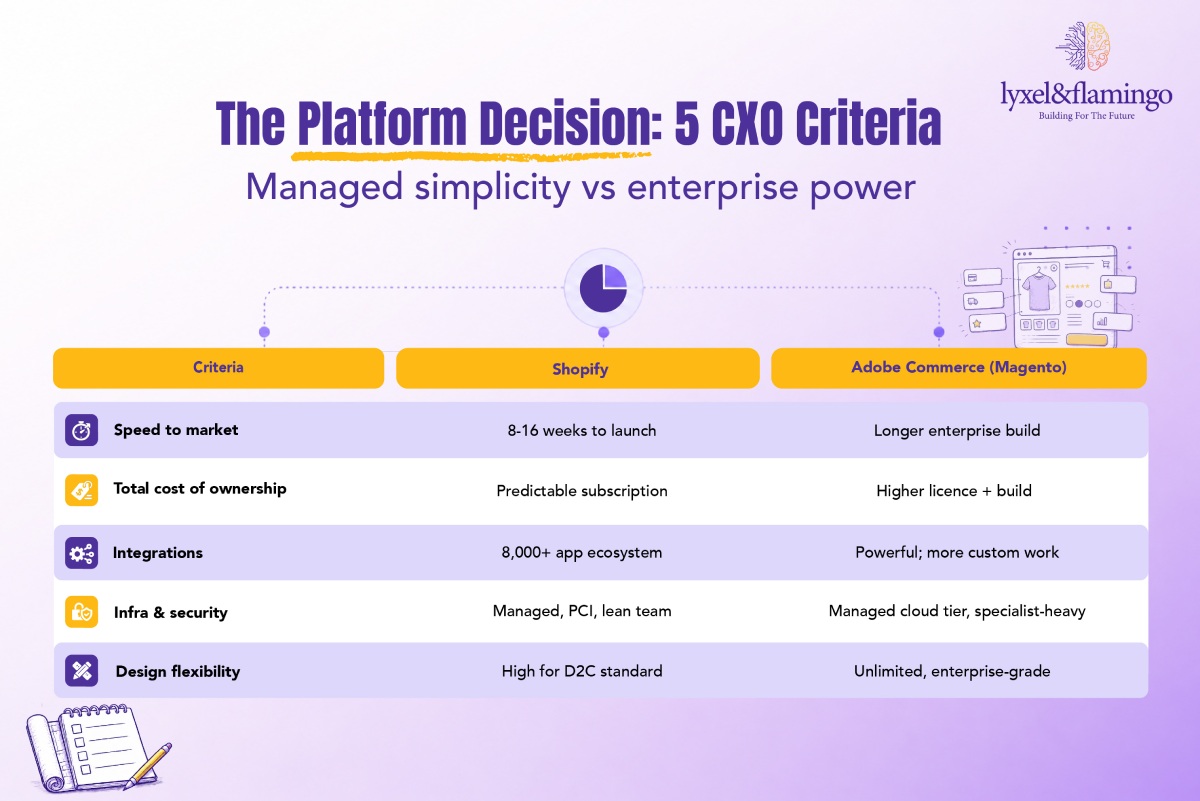
Framework: The Platform Decision – 5 CXO Criteria
Before committing to a platform, assess each of the following criteria against your brand’s current position and three-year growth ambition.
The honest answer for most D2C brands in the £500k-£50m revenue range is that Shopify wins on four of five criteria. The case for Adobe Commerce, whether self-hosted or on Adobe Commerce Cloud, strengthens when a brand has genuinely complex or B2B/B2C hybrid catalogues, existing ERP integrations that resist standard connectors, heavy customisation needs, or a large in-house engineering team whose time is better spent on the platform than on growth.
L&F builds on both. That is not a hedge; it is the basis for impartial advice.
The Framework explained
01. Speed to market: Time-to-first-sale is a competitive variable, not merely a project management metric. The eight-to-sixteen-week window a Shopify build enables translates directly into months of live trading, customer data collection, and iterative improvement that a competitor still building a custom platform has not yet started. For a D2C brand entering a market with an established incumbent, that testing advantage is difficult to overstate. The failure mode is treating launch as the destination rather than the starting line, but you cannot iterate on a platform that is not yet live.
02. Total cost of ownership: The sticker price of a self-hosted build is the development agency fee. The real cost includes hosting infrastructure, CDN contracts, security patching, module updates, DevOps resources (whether in-house or contracted), and the opportunity cost of engineering time diverted from growth to maintenance. A managed platform subscription fee looks higher on a spreadsheet; it is almost always lower on a profit-and-loss statement once those hidden costs are surfaced. A CXO applying this criterion should ask their agency for a five-year TCO model, not a build quote.
03. Integrations: Shopify’s 8,000-plus app ecosystem is not a convenience feature – it is a compound commercial advantage. Klaviyo for email, Meta and Google for acquisition, loyalty platforms, review tools, and fulfilment connectors are pre-built, maintained, and updated by their respective vendors. The alternative building and maintaining custom integrations for each tool in a bespoke stack – is not impossible, but it is an ongoing engineering commitment that grows with every new tool the marketing team wants to test. Brands that underestimate integration complexity are the ones who discover it mid-campaign.
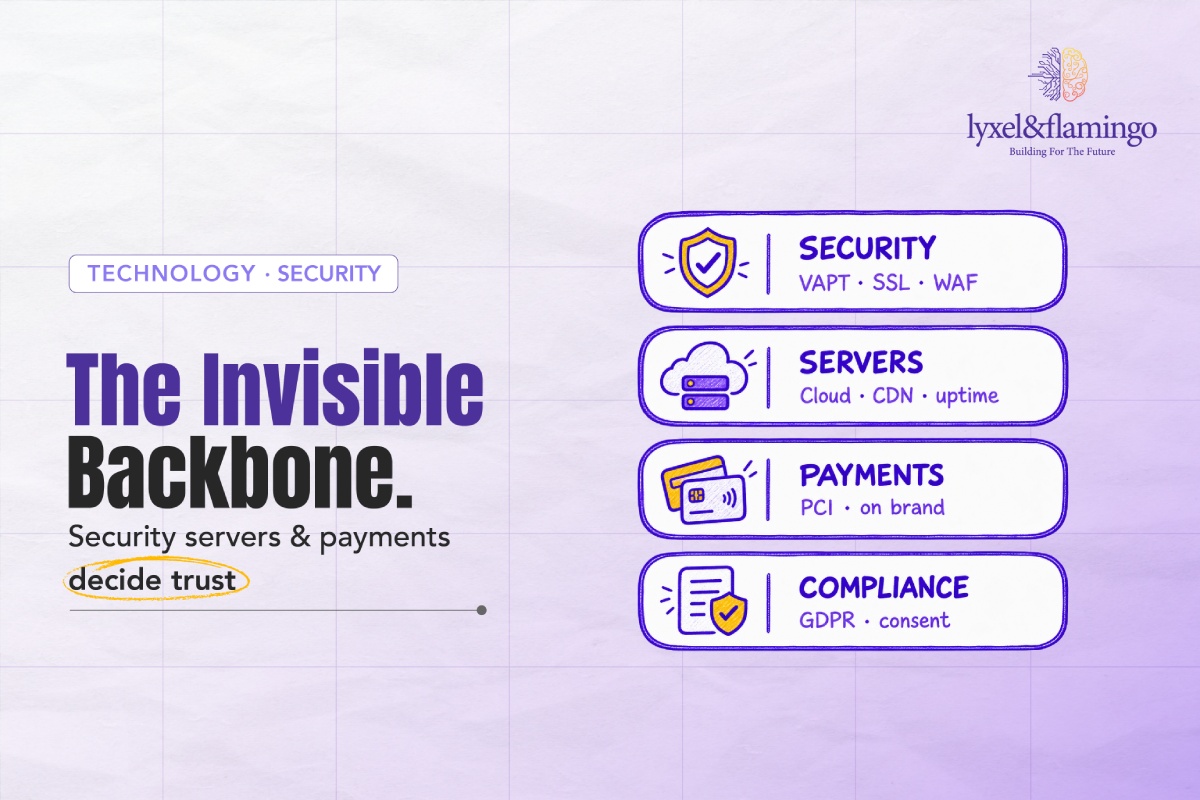
04. Infrastructure and security burden: PCI DSS Level 1 compliance, global CDN delivery, DDoS protection, and SSL management come included in Shopify’s platform fee. On a self-hosted build, these must each be procured, configured, and maintained. For a brand without a dedicated security engineer, this is not merely a cost question; it is a risk question. A security incident on a self-hosted build is the brand’s problem to resolve, in real time, during trading hours. For a brand on Shopify, it is Shopify’s problem. To be precise, Adobe Commerce Cloud is itself a managed, cloud-hosted environment that handles provisioning, patching, and much of day-to-day operations, so this is not a simple managed-versus-unmanaged contrast. The difference is that Shopify delivers this baseline to a lean team out of the box, whereas Adobe Commerce Cloud delivers enterprise-grade infrastructure that still assumes specialist developers and a larger operating budget to run well.
05. Design flexibility: Shopify’s Liquid templating and theme architecture support high-fidelity bespoke design across the vast majority of D2C use cases. The constraints that genuinely arise highly custom multi-region pricing logic, non-standard checkout transaction flows, deeply bespoke PDP architectures for complex technical products – are real but narrow. A CXO should ask whether their brand actually has those requirements, or whether it is hypothetically imagined complexity justifying a custom build. The failure mode is building for flexibility that is never used while bearing the full cost of an unrestricted platform.
Real-world scenario: O3+ (from Magento to Shopify)
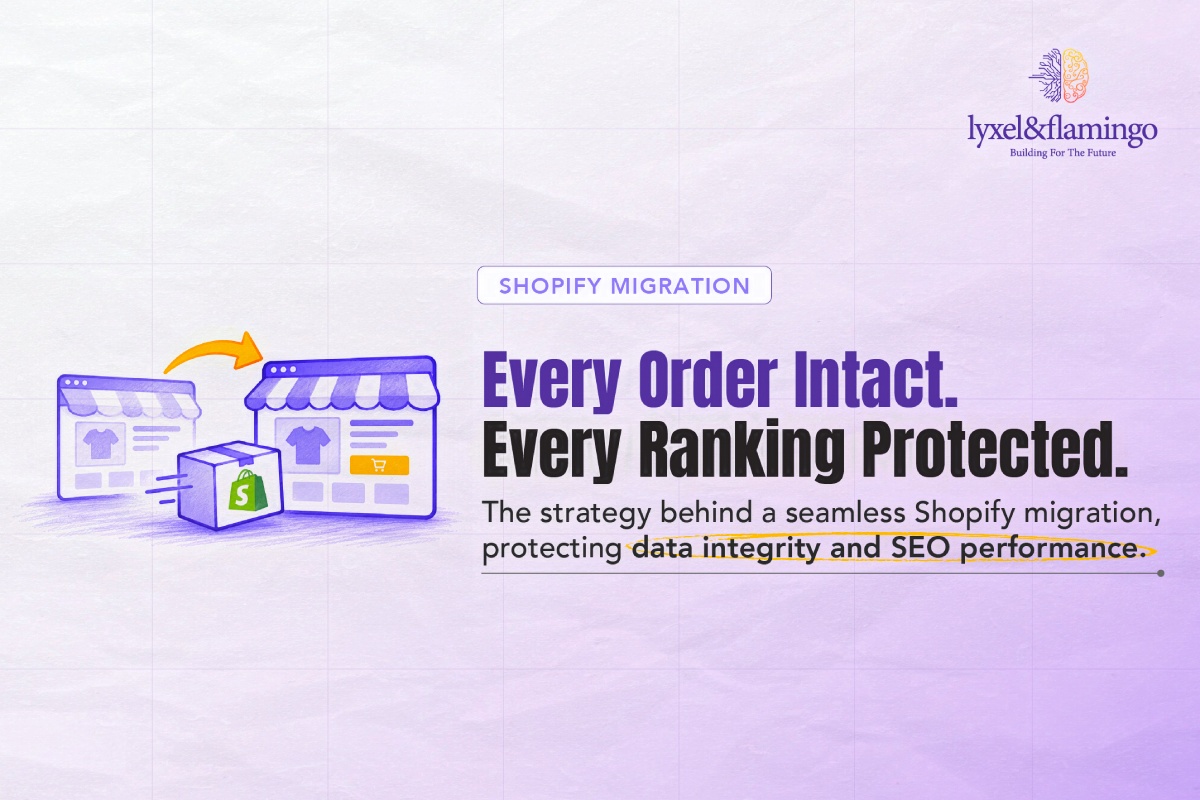
The managed-versus-bespoke decision is not abstract for O3+, India’s leading professional skincare brand; it lived both sides of it. O3+ ran a self-hosted Magento 2.0 storefront and was losing direct sales to marketplaces that undercut on price and dominated the sales calendar. L&F migrated the brand to Shopify, with a full 301-redirect migration to preserve its hard-won search equity, precisely so the team could stop maintaining infrastructure and start compounding growth on the experience.
The move paid back on exactly the criteria in the framework above. Freed from server, security, and patching overhead, the brand’s energy went into content, storytelling, and a faster, mobile-first shopping experience, and the storefront delivered 569% organic revenue growth, 160% growth in organic transactions, and 163% overall growth within six months, with a further 22X ROI from retention automation on top.
For most growth brands, that is the whole lesson: the point of a managed platform is not the platform; it is everything you get to do once you are no longer running the plumbing. (See more L&F e-commerce case studies.)
Going deeper: Questions to ask before choosing a platform
Use these questions with your agency partner before any platform commitment.
| Decision Factor | What This Reveals |
| What is our realistic timeline from brief to first transaction? | Whether speed-to-market is a constraint or a nice-to-have |
| How many custom integrations do we require in year one? | Whether the standard app ecosystem covers your stack |
| Do we have in-house DevOps capability, or are we buying it? | The real total cost of ownership of a self-hosted build |
| Will our ERP / fulfilment / PIM connect via standard connectors? | Whether bespoke integration work is unavoidable |
| What is our peak traffic scenario and how do we handle it? | Whether managed elastic infrastructure is a commercial necessity |
| Does our product catalogue require custom taxonomy or filtering logic? | Whether the platform’s native structure is sufficient |
Key takeaways
- Speed to market is a commercial variable, not just a project management one. An eight-to-twelve-week Shopify launch gives brands a testing advantage that compounded over twelve months is significant.
- Total cost of ownership on a self-hosted build includes DevOps, security, maintenance, and opportunity cost, not just the initial build fee.
- The Shopify app ecosystem (integrations with Klaviyo, Meta, Google, and AWS) is a structural advantage for brands who do not want to rebuild connectors from scratch.
- Most D2C brands in the £500k-£50m range are better served by a managed platform. Complex catalogue and ERP requirements are the key criteria that shift the decision.
- L&F builds on both Shopify and Adobe Commerce (Magento); the right recommendation depends on your brand’s specific complexity, not a platform preference.
Closing thoughts
The platform decision is ultimately a question of where a brand wants its scarce operational energy directed. Every hour spent maintaining infrastructure is an hour not spent on customer experience, conversion improvement, or brand differentiation. For most D2C brands without a large engineering organisation, non-standard ERP integrations, or catalogues of unusual complexity, Shopify resolves that allocation in their favour. The brands that will outgrow this frame are the exception, not the rule; and even they typically spend their early growth years on a managed platform and migrate only when complexity genuinely demands it. The decision should be made with that trajectory in mind, not in anticipation of edge cases that may never arise.
Frequently Asked Questions
Yes. Shopify Plus is purpose-built for high-volume D2C and enterprise commerce. Brands generating hundreds of millions in annual D2C revenue operate on Shopify Plus, with access to custom checkout, dedicated API capacity, and enterprise support a shift L&F unpacks in Why Global Brands Are Moving to Shopify Plus.
For the vast majority of D2C use cases, no. Shopify’s theme architecture and Liquid templating support bespoke design at a high level of fidelity. Constraints emerge at the enterprise edge - complex multi-region pricing, highly custom checkout flows - which is where Shopify Plus scripting and partner integrations address the gap.
It means L&F has completed Shopify’s partner certification programme and has a demonstrated track record of building and launching Shopify stores. It is a vetting credential not a commission arrangement that biases advice.
Shopify is PCI DSS Level 1 certified the highest level of payment security compliance. SSL, DDoS protection, and fraud analysis are included in the platform. For brands on self-hosted builds, these must be procured and maintained separately.
Yes - Adobe Commerce Cloud is a fully managed, enterprise-grade cloud platform, so “managed” is not unique to Shopify. The lean towards Shopify is not about hosting; it is about fit. For most D2C brands, Shopify delivers a fast, secure, integrated storefront in weeks with a lean team and predictable costs. Adobe Commerce - cloud or self-hosted - is built for genuine enterprise complexity (large or B2B/B2C hybrid catalogues, deep customisation, multi-site, heavy seasonal spikes) and rewards that with power, but demands more time, specialist engineering and budget. Choose Shopify for speed and simplicity; choose Adobe Commerce when your complexity genuinely requires it.
The vast majority of D2C brands never encounter a genuine Shopify ceiling. For the rare brand that does typically at enterprise scale with highly complex operational requirements migration paths to Adobe Commerce or custom architecture exist and are manageable. Starting on Shopify does not close that option.