
What this blog covers
Amazon Great Indian Festival and Flipkart Big Billion Days may begin around the same time, but they demand very different seller strategies. Amazon usually rewards review quality, conversion rates, and steady inventory planning across a longer sale period. Flipkart moves much faster, where competitive pricing, catalogue depth, and early inventory availability matter more. Brands that manage both platforms with one shared festive plan often face stockouts on one marketplace and slow-moving inventory on the other. GST 2.0 has also made pricing and tax documentation more important before festive discounts go live.
Table of Contents
- What Is Seller Readiness for GIF and BBD 2026?
- Most Sellers Are Preparing for a Festival That Doesn't Exist
- Why Amazon and Flipkart Reward Completely Different Seller Behaviour
- The Numbers Behind This Festive Season
- Introducing Lyxel&Flamingo’s Dual-Platform Readiness Stack
- What This Looks Like When Sellers Get It Right
- Your Festive Season Ecommerce Checklist
- Conclusion
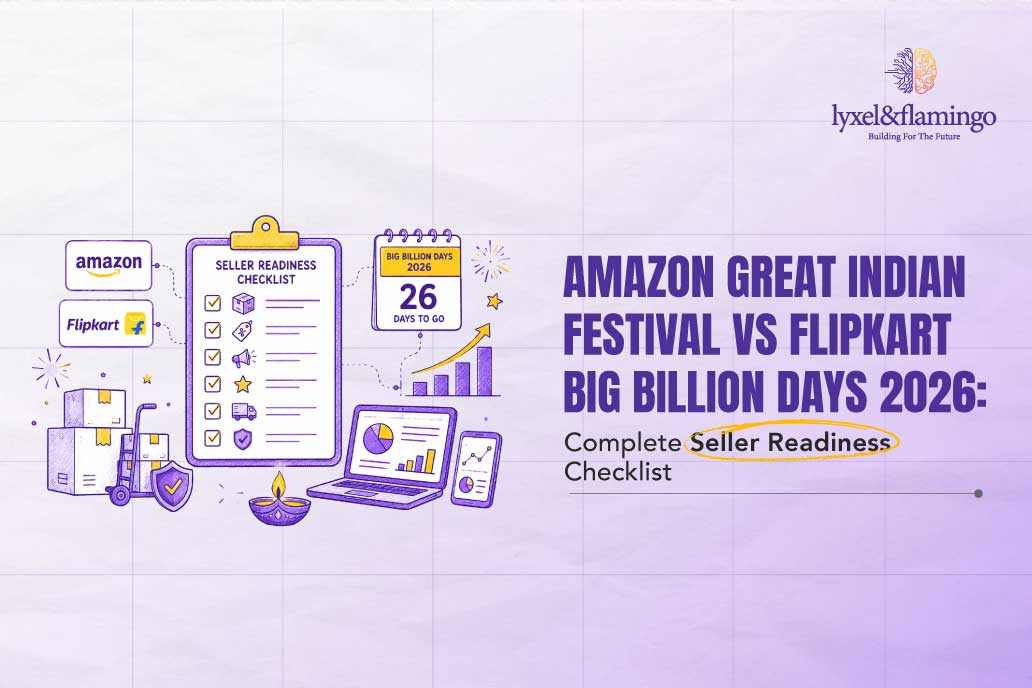
This blog explains why inventory allocation, advertising budgets, compliance, and ranking signals should be planned separately for each platform. It also introduces Lyxel&Flamingo’s Dual Platform Readiness Stack, a practical framework for festive selling. Sellers who prepare weeks in advance, instead of reacting after launch, improve visibility, protect margins, and create a stronger festive season across both marketplaces.
Amazon’s Great Indian Festival is expected to run for approximately 28 days in 2026, while Flipkart’s Big Billion Days is expected to last around 10 days, assuming both platforms follow last year’s pattern. This difference alone should influence how a seller plans inventory, advertising and staffing this year, yet most sellers continue to build a single festive calendar and apply it to both events. Across the Third Party Marketplaces accounts we manage for brands selling on Amazon and Flipkart simultaneously, this single planning decision is typically where the quarter begins to unravel.
Amazon Great Indian Festival 2026 and Flipkart Big Billion Days 2026 are not the same event wearing two different logos. One platform curates a smaller seller base and rewards conversion quality and review depth built up over months. The other runs on scale, with well over a million sellers competing on price and catalogue breadth in a much shorter window.
GST 2.0 also changed how both platforms expect sellers to document tax and pricing, live since last September, and neither company has said much publicly about how that interacts with festive-week discounting. Sellers who don’t separate the two strategies are usually the ones who run out of stock on one platform while sitting on unsold inventory on the other. Run the GIF vs BBD 2026 comparison side by side, even briefly, and the planning gap becomes obvious fast.
What Is Seller Readiness for GIF and BBD 2026?
Seller readiness for Amazon Great Indian Festival 2026 and Flipkart Big Billion Days 2026 means having inventory, pricing, tax documentation and ad budgets locked at least three to four weeks before either sale opens, planned separately for each platform’s ranking system and sale duration. It isn’t a generic pre-sale to-do list. It’s a platform-specific operating plan, built around the fact that Amazon’s ranking behaviour and Flipkart’s ranking behaviour reward different seller actions at different points in the sale.
Festive season seller preparation matters more in 2026 than it did in past years. GST 2.0’s rate changes, live since September 22, 2025, altered how input tax credit gets documented for many product categories, and both marketplaces have pushed sellers toward more detailed invoice reporting since. A seller who hasn’t reconciled pricing and tax paperwork before the sale opens will spend the first week of the festival fixing listings instead of selling on them.
Most Sellers Are Preparing for a Festival That Doesn’t Exist
Walk into most seller planning meetings in August, and you’ll hear some version of the same line: let’s get ready for the festive sale. Singular. One spreadsheet, one inventory buffer, one ad budget split evenly down the middle. Festive sale seller preparation usually breaks down right here, before either platform has even gone live.
Sellers who pour their whole ad budget and inventory buffer into day one on both platforms tend to burn through Amazon stock by week two, then watch Flipkart’s slower-building demand outpace whatever they held back for it. The problem isn’t under-preparing. It’s preparing for the wrong shape of demand.
Why Amazon and Flipkart Reward Completely Different Seller Behaviour
Any real Amazon vs Flipkart festive sale strategy starts by admitting the two platforms aren’t the same animal. The difference begins with how each one is built.
Amazon India runs a comparatively curated marketplace, with an estimated 218,000 active sellers competing for Buy Box placement through conversion rate, review depth, return rate and, increasingly, traffic pulled in from outside Amazon. That ranking behaviour, commonly called the A10 system, rewards sellers who’ve built trust signals over months, not ones who show up in September with a discount and nothing else.
Want to understand exactly how Amazon’s ranking system decides who wins the Buy Box, and how to work with it instead of against it? Read this blog: Amazon SEO in 2026: Ranking, Ads & Conversion Optimisation.
Flipkart operates at a different scale entirely. The platform reported over 1.4 million sellers ahead of its 2025 sale, with transacting sellers up 25% in the prior six months. Its ranking tools, Seller Hub and NXT Insights, lean harder on price competitiveness and catalogue depth, so a seller can enter Flipkart’s festive rankings much closer to the sale date than they can on Amazon. They’re also competing against far more listings for the same search term.
Then there’s tax, which barely anyone was talking about a year ago. GST 2.0’s move to a simplified 5% and 18% slab structure, effective September 22, 2025, cut freight and logistics tax to 5% but tightened how input tax credit needs to be documented. Both platforms now expect sellers to report shipping tax and invoice detail with more precision than before. Sellers still pricing off cost sheets built before the reform are losing margin they haven’t noticed yet.
Inventory forecasting has gotten harder too, not easier. Gartner’s 2026 guidance on retail forecasting notes that planning is shifting from static to continuous, with demand signals now changing daily instead of seasonally. A festive forecast built in July is already a little stale by September.
| Amazon Great Indian Festival 2026 | Flipkart Big Billion Days 2026 | |
| 2025 sale window | Sept 23 to Oct 20 (28 days) | Sept 23 to Oct 2 (10 days) |
| Early access | Sept 22, midnight, Prime members | Sept 22, 24-hour early access, Plus and Black members |
| Seller base | Roughly 218,000 active sellers (curated) | 1.4 million+ sellers (mass marketplace) |
| Ranking priority | Conversion rate, reviews, return rate, external traffic | Price competitiveness, catalogue depth, Seller Hub signals |
| Demand shape | Two waves: launch, then a pre-Diwali build | Front-loaded into the first 72 hours |
| Value-tier arm | Amazon Bazaar | Shopsy |
2026 dates are not yet officially confirmed by either company as of early August. Both are expected to follow the 2025 pattern closely, based on the last several years of historical timing.
The Numbers Behind This Festive Season
- India’s e-retail seller base has roughly tripled over the past five years, while shoppers have doubled to 290 to 300 million. Festive periods now account for close to one in four new shoppers acquired all year, with daily traffic during events like Big Billion Days running nearly triple the average, a trend we’ve tracked separately in how online marketplaces in India have scaled. For sellers, festive weeks are the single biggest new-customer acquisition window on the calendar, not just a sales spike.
- The 2025 festive season delivered India’s strongest ecommerce growth in five years, with combined GMV crossing ₹1.15 lakh crore (US$ 13.12 billion), up 20 to 25% year on year. Growth this sharp usually means platforms undersell their own forecasts rather than oversell them, which is exactly why under-stocking costs sellers more than over-stocking this year.
- Consumer financial confidence heading into the 2025 festive season outpaced the global average, with Deloitte’s Financial Wellbeing Index reading 110.3 against a worldwide benchmark of 103.6. Monthly spending intent rose from 2% in July to 4% by September, the kind of shift that turns browsing into actual carts once a sale goes live. Source: Deloitte India, Consumer Signals, 2025
- India’s ecommerce market is projected to grow at a 27% CAGR to reach roughly $163 billion by 2026, with quick commerce alone expanding at 110 to 130% CAGR. That’s pulling festive demand away from next-day delivery expectations and toward same-hour ones.
- Amazon’s 2025 festival pulled 276 crore customer visits, 70% from tier 2 and 3 cities; Flipkart’s drew 606 million visits in its first 48 hours alone, roughly a third from Gen Z shoppers. Festive demand in India isn’t a metro phenomenon anymore, and it skews younger than either platform’s year-round traffic.
Introducing Lyxel&Flamingo’s Dual-Platform Readiness Stack
This is the marketplace festive sale strategy we default to at Lyxel&Flamingo. We don’t run one festive plan across marketplaces, because one plan can’t serve two platforms that behave this differently. We use a four-layer model for brands preparing for both events at once. We call it the Dual-Platform Readiness Stack.
- Inventory Allocation Layer: Split stock by sale duration, not by revenue share. Amazon’s 28-day window needs deeper replenishment buffers held in reserve. Flipkart’s 10-day sprint needs stock front-loaded enough to absorb a 72-hour demand spike without breaking.
- Ranking Signal Layer: Amazon rewards conversion rate, review velocity and return rate, all built up over weeks. Flipkart rewards catalogue depth and price competitiveness, which can be adjusted much closer to the sale date. Treat these as two separate optimisation jobs. Don’t push one listing update to both platforms and call it done.
- Compliance and Pricing Layer: Reconcile GST 2.0 invoice and input tax credit documentation before festive pricing goes live, not during the sale itself. This is the layer brands skip most often, and it’s the one eroding margin on every order that ships without anyone noticing.
- Post-Sale Retention Layer: A 10-day sprint and a 28-day marathon leave shoppers in different states of purchase fatigue by the time they end. Flipkart buyers need faster remarketing. Amazon buyers, often still mid-festival for weeks, need a slower cadence entirely.
In our experience, the third layer, compliance and pricing, is consistently the most under-invested. Teams spend weeks perfecting creative and ad structure, then price festive discounts off a cost sheet nobody updated after the GST slabs changed. That’s the layer with the fastest fix and the biggest margin impact.
What This Looks Like When Sellers Get It Right
A personal care brand we manage across Amazon and Flipkart went into the 2025 festive season with one shared spreadsheet for both platforms. Partway through Big Billion Days, several of their fastest-moving SKUs were already out of stock, while those same SKUs were still running well behind forecast on Amazon, which had a good stretch of the festival left to go.
We rebuilt the plan around separate inventory curves, moved tax and invoice reconciliation well ahead of the sale, and split ad budget so Flipkart spend front-loaded into the opening window while Amazon spend paced out gradually across the full one. At the following peak event, under the same platform-specific approach:
- Stockouts on fast-moving SKUs came down sharply across both platforms.
- Amazon ad spend efficiency improved once budget pacing matched the platform’s longer demand curve instead of front-loading it like Flipkart’s.
- Flipkart order volume in the opening days pulled well ahead of the previous year, once inventory was pre-positioned for a sprint instead of a marathon.
The result wasn’t more spend. It was spend and stock finally matching how each platform behaves during its own sale, instead of borrowing an assumption from the other one.
Your Festive Season Ecommerce Checklist
This is the part sellers bookmark and reopen later. This is the seller readiness checklist ecommerce teams selling on both platforms need this year, and it’s split by platform on purpose. A shared list undersells exactly how different these two events are.
The Amazon Great Indian Festival 2026 Seller Checklist
These Amazon Great Indian Festival seller tips apply whether you’re a first-time seller or scaling an existing catalogue.
- Lock inventory buffers for a 28-day window, not a weekend. Amazon’s festival runs in waves. Hold back enough stock to cover a second demand spike closer to Diwali, not just the opening week.
- Front-load review and rating velocity before the sale, not during it. Amazon’s ranking system weighs review depth built up over time. Push for reviews in August, not late September.
- Audit external traffic sources before launch. Listings pulling visits in from outside Amazon, social, affiliate, search, currently get rewarded more under current ranking behaviour. Set this up ahead of the festival.
- Reconcile GST 2.0 invoice documentation for every SKU category before pricing goes live. Don’t let finance catch pricing errors in week two of the sale.
Want a ready-to-use checklist for Amazon’s other major event, Prime Day 2026? Read this blog: Amazon Prime Day 2026: The Checklist You Need to Win Visibility, Traffic, and Conversions.
The Flipkart Big Billion Days 2026 Seller Checklist
Think of this as your Flipkart Big Billion Days seller guide for the next several weeks, and this Flipkart Big Billion Days seller strategy 2026 has to account for the platform’s sheer scale.
- Front-load inventory and ad spend into the first 72 hours. Flipkart’s shorter window means the bulk of demand hits early. Being out of stock on day three costs more than being out of stock on day nine.
- Optimise catalogue depth and price competitiveness through Seller Hub before launch. Flipkart’s ranking tools reward sellers with more complete, more competitively priced catalogues, not just one polished listing.
- Plan for Shopsy separately if you sell in the value tier. Flipkart’s hypervalue platform runs its own festive dynamics and shouldn’t share a budget line with your core Flipkart listings.
- Staff support and returns for a shorter, sharper spike. A 10-day sale compresses complaint and query volume into a much smaller window than Amazon’s does.
Neither list works if it only gets finished the week the sale opens. Start both a minimum of four weeks out. That’s the backbone of any marketplace seller readiness checklist worth using this year.
Not sure your Flipkart listings are structured to pass QC and rank well before the sale? Read this blog: A Complete Guide to Creating a Product Listing on Flipkart (2026 Edition)
Conclusion
Amazon Great Indian Festival 2026 and Flipkart Big Billion Days 2026 will likely open within a day of each other, probably in the last week of September, and then behave almost nothing alike for the month that follows. Sellers who keep treating them as one event with two logins will keep losing margin to stockouts on one platform and dead inventory on the other. The ones who build separate inventory curves, ranking strategies and tax compliance now, weeks before either sale opens, walk away from both events ahead instead of just busy.
Consider this your festive sale seller guide India teams can act on this week, not after the sale has already started. If your team is managing both platforms and wants a second read on your current festive plan, Lyxel&Flamingo’s Third Party Marketplaces practice runs a free marketplace review before every major sale window.
Frequently Asked Questions
Amazon's event runs longer (28 days in 2025) and rewards sellers with strong reviews, conversion rates and external traffic. Flipkart's event is shorter and far more intense (10 days in 2025), rewarding price competitiveness and catalogue depth across a much larger seller base. The Amazon vs Flipkart festive sale comparison really comes down to pacing and ranking priorities, not just who's offering the bigger discount.
Neither company has confirmed official Amazon Flipkart sale dates 2026 as of early August 2026. Based on the 2025 pattern, both sales are likely to open around September 22 or 23, with Amazon's event running into late October and Flipkart's wrapping up within the first ten days of October.
Split inventory by how each platform's demand behaves, not by revenue split. Hold deeper reserve stock for Amazon's longer, wave-shaped demand curve, and front-load stock for Flipkart's sharper, shorter spike. Waiting until the sale opens to rebalance is usually too late to matter.
Yes, but not with one identical strategy stretched across both. Smaller sellers often do better going deep on one platform's ranking mechanics first, typically Amazon for review-driven categories or Flipkart for price-sensitive, high-volume ones, before splitting attention evenly across both.
GST 2.0's simplified 5% and 18% slabs, live since September 2025, changed how input tax credit gets documented and cut freight tax to 5%. Sellers still pricing off pre-reform cost sheets risk losing margin on every festive order without realising it, so reconciling this before the sale is now part of readiness, not an afterthought.