
What this blog covers
Quick commerce SEO is no longer just about uploading a product catalogue and waiting for shoppers to find it. Blinkit, Zepto and Instamart use a mix of product relevance, local availability, sales velocity and category signals to decide what shoppers see first. That makes quick commerce visibility very different from traditional Amazon or Flipkart SEO. A well-written title cannot save a product that keeps going out of stock in a high-demand dark store. This blog explains how brands can improve discoverability by fixing catalogue structure, category mapping, pack-size tagging and store-level availability before increasing ad spend. It also introduces Lyxel&Flamingo’s Q-Commerce Discoverability Stack, which connects catalogue quality, stock availability and sponsored campaigns to build stronger organic visibility. For FMCG and D2C brands, the key takeaway is simple: fix the product and supply signals first, then use paid media to build momentum instead of paying endlessly for visibility.
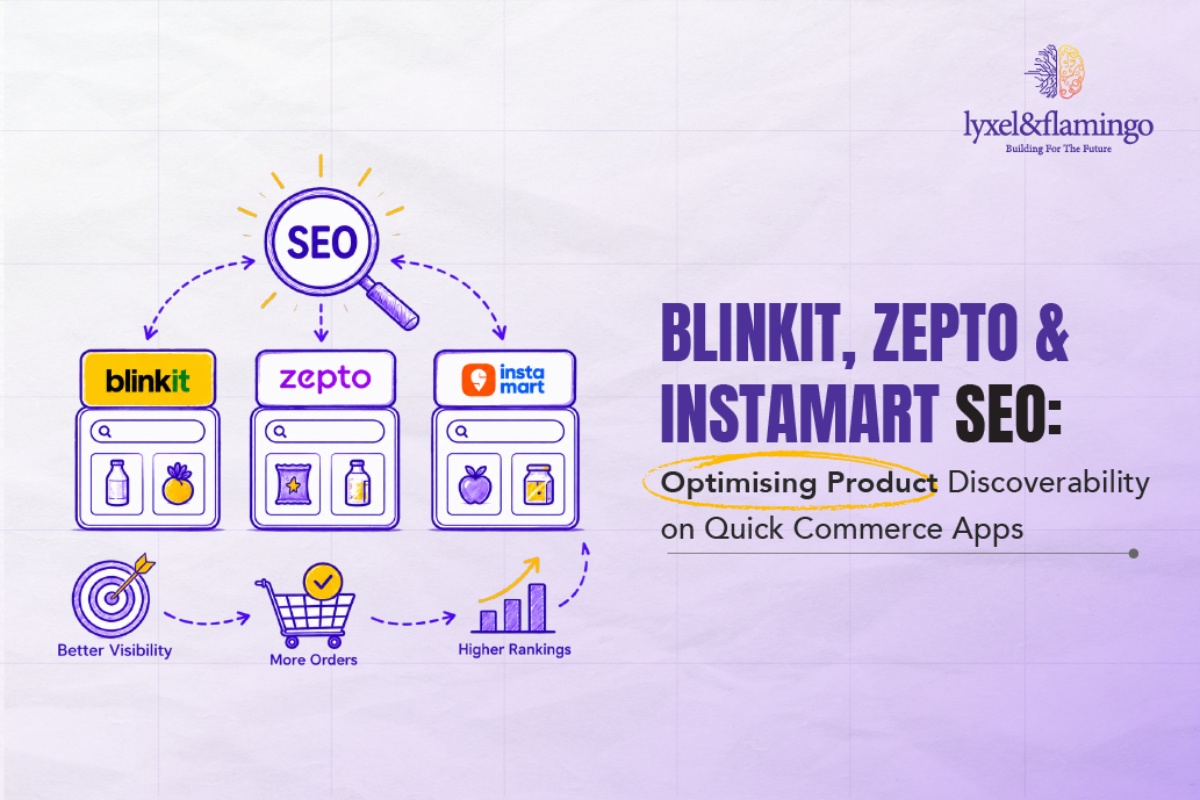
Blinkit, Zepto and Instamart decide which product a shopper sees first, and for most FMCG and D2C brands, that decision is already lost before a single rupee goes into an ad account. These three apps have grown into some of India’s most important third-party marketplaces, sitting right next to Amazon and Flipkart in how a brand plans distribution and reach today. Yet most teams still treat them as a directory listing instead of a search engine running on its own, with very specific rules.
That gap is where the real problem starts. Brands spend weeks perfecting their Amazon A+ content, then upload the same title and image set to Blinkit, and wonder why the product barely shows up in category search. Treating quick commerce SEO as an extension of Amazon or Flipkart marketplace SEO is where most catalogue teams go wrong first, and it is an expensive habit that compounds every festive season. The platforms reward stock, speed and sales history over keyword density, and most catalogue teams were never told that this shift even happened.
What Is Quick Commerce SEO?
Quick commerce SEO is the practice of optimising a product’s listing, its category placement, and the supply signals behind it (stock availability, fulfilment speed, sales velocity) so it ranks organically inside Blinkit’s, Zepto’s and Instamart’s own search and browse results. It isn’t quite the same discipline as product listing optimisation on Amazon or Flipkart, because the ranking engine here is hyperlocal by design. A product can sit at the top of a category on one street and disappear three kilometres away.
This matters right now because quick commerce has stopped being a side channel brands can hand off to an intern. India’s quick commerce sector is scaling toward $65 to $70 billion in gross merchandise value by 2030, and a brand invisible inside these apps is invisible at the exact moment a shopper decides to buy.
The Real Problem: Most Brands Are Optimising for the Wrong Signal
Here’s a scenario we see on repeat. A brand launches on Blinkit and Zepto with the catalogue it already built for its own website: generic titles, one hero image, no pack-size variants tagged separately. Three months in, half the priority SKUs barely appear when a real shopper types the category name into search. The team’s first instinct is almost always to raise the ad budget, and that instinct is usually wrong.
Quick commerce sessions last under five minutes on average, less than half the length of a typical e-commerce visit, yet they convert roughly eight times more often once a shopper finds the product. That short window means a brand gets one real shot at being seen before the session ends and the app closes. Spending more on ads inside a broken catalogue just buys back visibility that basic listing hygiene would have earned for free.
Meanwhile, the money pouring into the category keeps climbing regardless. Quick commerce advertising in India is on track to reach nearly ₹4,900 crore in 2026 across Blinkit, Zepto and Instamart combined, up from around ₹3,000 crore the year before. A large chunk of that spend is defensive, brands paying to appear where their own catalogue should’ve ranked them anyway. Most brands are paying quick commerce platforms to buy back visibility they could have earned for free.
Why Ranking Here Has Nothing to Do With Keywords and Everything to Do With Stock
Amazon’s ranking engine cares about keyword relevance, review velocity and years of national sales history. Quick commerce doesn’t work that way at all, and treating Blinkit SEO, Zepto SEO or Instamart SEO as a copy-paste extension of Amazon SEO is where most catalogue teams go wrong first.
Rank on these apps is computed per dark store, not nationally. A shampoo brand can hold the number one spot in a category in one neighbourhood and be invisible three suburbs away, purely because the nearest dark store ran out of stock overnight. Fill rate (the percentage of time a SKU is in stock and orderable at a given store) is the single biggest lever most brand teams ignore. Drop below roughly 90%, and the algorithm demotes the listing in that radius, no matter how well the title is written.
Each platform layers its own model on top of that baseline, and the differences matter more than most sellers realise:
| Platform | Inventory model | What drives rank |
| Blinkit | First-party, seller-led (since 2025) | Fill rate + sales velocity per dark store, category-team placement |
| Zepto | Vendor and purchase-order model | Hyperlocal demand match, hero-SKU concentration over wide catalogues |
| Instamart | Swiggy ecosystem cross-sell, Megapod format | Assortment depth, occasion-based search terms |
Blinkit moved to a first-party, seller-led model in 2025, meaning it controls pricing and inventory directly now, and category-team relationships matter for placement almost as much as the listing itself. Zepto still runs on a vendor and purchase-order model, where the brand supplies stock and Zepto’s own systems decide hyperlocal allocation, which rewards brands that concentrate on a few hero SKUs rather than a wide, thin catalogue. Instamart pulls a large share of its traffic straight from Swiggy’s food delivery base, and its larger-format dark stores reward assortment depth and occasion-led search terms such as party snacks or late-night cravings.
This shift isn’t unique to quick commerce, either. Search Engine Land’s coverage of Google’s own shopping results shows the same underlying pattern: product feeds and structured data now decide visibility more than plain keyword placement does. Gartner’s own definition of retail media networks already groups in-app search placement and sponsored listings under the same asset class, which is exactly what these three platforms are now monetising at scale. Quick commerce just runs that same logic on a ten-minute clock instead of a ten-day one.
Want to see how this same discoverability problem plays out on Amazon instead? Read this blog: Festive Season Marketplace SEO: Why Your Amazon Listing Is Already Losing the Diwali Race
What the Data Shows About Quick Commerce Visibility
The numbers make the case better than any framework can on its own.
- India’s quick commerce GMV has doubled annually since 2023, reaching $10 to $11 billion in 2025 and heading toward $65 to $70 billion by 2030.That’s roughly 45-50% of all incremental Indian e-retail growth over the next five years.
- Blinkit holds close to 48% of the quick commerce market, with Swiggy Instamart at around 24% and Zepto near 22%.
- Combined advertising revenue across the three platforms is projected to touch nearly ₹4,900 crore in 2026,up sharply from the year before.
- India’s FMCG sector posted 12.9% value growth in Q2 FY26, with e-commerce channels (quick commerce included) absorbing a growing share of that volume.
- Google and Deloitte’s joint research projects that quick commerce will become a $50 billion segment by 2030, with non-food categories driving 45% of that spend.
Put together, this isn’t a niche channel that brands can leave to whoever manages the marketplace uploads that week. It’s one of the fastest-growing pieces of Indian retail, and any serious quick commerce marketing strategy now needs the same rigour as a brand’s core e-commerce plan, not an afterthought bolted onto it.
The Q-Commerce Discoverability Stack: Lyxel&Flamingo’s Framework
At Lyxel&Flamingo’s Commerce Strategy practice, we’ve rebuilt catalogues for FMCG and personal care brands across Blinkit, Zepto and Instamart, and the brands that hold rank long-term all share the same three-layer structure. We call it the Q-Commerce Discoverability Stack.
Layer 1: Catalogue Signal – This is the closest thing to traditional product listing optimisation inside quick commerce: exact category mapping, keyword-rich titles that match how a shopper searches (not how a brand describes itself internally), compliant images, and every pack-size variant tagged as its own SKU instead of buried in a description. Get this wrong, and no amount of ad spend fixes it later.
Layer 2: Availability and Velocity – Fill rate needs tracking at the dark-store level daily, not the national average once a week, because a brand’s sales velocity in a SKU’s first few weeks on shelf is the strongest single predictor of where it settles long-term. In our own client work, this layer is consistently the most under-invested one. Teams obsess over ad creative while the store three kilometres from their highest-intent customers runs out of stock.
Layer 3: Compounding Coverage – Once fill rate holds above roughly 90% in a pincode, a short, time-boxed sponsored push can seed enough sales velocity to earn organic rank there, and the ad spend should step back once that rank holds on its own. This is the sponsored-to-organic flywheel, and it’s far cheaper than running paid placement indefinitely, quarter after quarter.
Brands that build all three layers stop treating quick commerce SEO strategy as a one-time setup task and start running it as an operating rhythm, reviewed at least every festive cycle, when category pages get restructured, and rank resets more often than most teams expect.
Want to know what happens once your listing actually starts ranking? Read this blog: Winning on Quick Commerce: How to Build High-Velocity, High-Conversion Funnels on Blinkit, Zepto & Instamart
What Changed When the Catalogue Got Fixed
A personal care brand in our Commerce Strategy portfolio came to us ranking outside the top 20 results for its core category on Blinkit, in three of its five launch cities, despite being fully stocked and live for months already.
We didn’t start with the ad account. We started with Layer 1 and Layer 2 of the Discoverability Stack: rebuilding titles around the terms shoppers search for, correcting category mapping that had placed two hero SKUs in the wrong sub-category entirely, and pushing fill-rate tracking down to the daily, dark-store level instead of the weekly national report the brand’s team had relied on before.
Organic category rank moved in its two priority metros within a single quarter. Cost per incremental order fell by close to a third once organic rank started carrying part of the load ads used to carry alone. Repeat-purchase rate on the platform rose because the product stayed visible between campaigns and not only during them.
None of this required a bigger budget. It required fixing the catalogue and the supply signal before spending another rupee trying to outbid the problem. That’s usually the cheapest fix available, and also the one most teams skip entirely.
5 Things to Do This Quarter Before You Increase Ad Spend
A working quick commerce SEO strategy starts with these five moves, not with a bigger media budget or a fresh round of creative, and not without first knowing exactly where your quick commerce product visibility breaks down, city by city.
- Audit your top 10 SKUs for real category-search visibility, city by city.Don’t just confirm the listing is live. Search the category the way an actual shopper would and see whether it even appears on the first screen.
- Fix backend category mapping and pack-size tagging before touching ad creative.Miscategorised or bundled SKUs cause more invisible-product problems than weak creative ever does.
- Track fill rate at the dark-store level, not the national average.A 92% national number can hide a 60% fill rate in your single highest-intent metro.
- Sequence sponsored spend to seed velocity, then step it back deliberately.A two-to-four-week paid push tied to a fill-rate floor earns organic rank faster than an always-on campaign, and costs less across a full quarter.
- Re-audit your listings every festive cycle, not once a year.Category pages restructure, and new attribute fields appear around big sale windows, and a static listing loses rank while nobody’s watching it happen.
Want to know which quick commerce numbers are worth tracking, and which just look good on a slide? Read this blog: The Quick Commerce KPIs That Matter (and the Vanity Ones That Don’t)
Conclusion
Quick commerce isn’t going to slow down long enough for a 2023-era listing to catch up on its own. Ad rates on these platforms already jump 40-50% above baseline during festive windows, and every quarter a catalogue stays unfixed, the cost of buying back the visibility it should have earned organically climbs right along with it.
The brands that treat their Blinkit, Zepto and Instamart catalogue as a ranking system, not a directory entry, are the ones still visible when that festive spike hits again. Everyone else ends up bidding against a problem their own catalogue created, and paying full price for the privilege.
If your team wants a clearer picture of where your SKUs are losing rank and why, Lyxel&Flamingo’s Commerce Strategy team runs a focused Quick Commerce Discoverability Audit that maps exactly that, city by city, as part of a coherent quick commerce marketing strategy rather than a one-off fix.
Frequently Asked Questions
Quick commerce SEO is the practice of optimising a product's listing and its underlying stock signals so it ranks organically inside Blinkit, Zepto and Instamart's search and category pages. Unlike traditional SEO, rank here is computed hyperlocally, per dark store, rather than nationally.
Amazon and Flipkart weigh keyword relevance, reviews and long-run national sales history heavily. Quick commerce ranking leans much harder on real-time, hyperlocal stock, so a product can rank first in one pincode and vanish three kilometres away the moment the nearest dark store runs out.
Start with fill rate and catalogue accuracy before touching ad spend, since an unstable or miscategorised listing won't hold rank regardless of budget behind it. Sales velocity in a SKU's first few weeks matters more than almost anything else a brand can directly control.
As soon as the SKU goes live, not after the first monthly sales report lands. Rank compounds early, so weak sales velocity in the first few weeks sets a baseline that only gets harder to shift the longer it stays unfixed.
Yes, arguably more so now than before. Combined ad revenue across the three platforms is projected to touch nearly ₹4,900 crore in 2026, so it's only going to get pricier to buy visibility that a fixed catalogue could have earned for free.