
What this blog covers
Why website security, server performance and payment infrastructure are not technical concerns but brand and revenue concerns and how the Trust Infrastructure Stack provides a practical model for CXOs to audit and strengthen the invisible backbone of their digital presence.
Table of Contents
- Digital trust infrastructure, defined: the layer customers only notice when it breaks
- Why Infrastructure Failure Is Now a Brand Event
- Where the Backbone Quietly Cracks
- Framework: The Trust Infrastructure Stack
- The Framework Explained
- Real-world scenario: Paras Health
- Going deeper: Infrastructure Health Checklist
- Key takeaways
- The CXO takeaway
Digital trust infrastructure, defined: the layer customers only notice when it breaks
Digital trust infrastructure is the combination of security architecture, server and hosting configuration, and payment systems that determine whether a user can interact with a brand’s digital presence safely, quickly, and without friction.
It is the layer of technology that users never consciously notice when it is working and that destroys trust instantly when it fails. A data breach, a three-second page load, or a payment that does not process are not technical incidents. They are brand events, with measurable commercial consequences.
Why Infrastructure Failure Is Now a Brand Event
The financial stakes of infrastructure failure are substantial and rising. The global average cost of a data breach reached USD 4.88 million in 2024, up 10% year on year and 70% of breached organisations reported significant business disruption (IBM, Cost of a Data Breach, 2024). That disruption is not limited to IT remediation: it includes lost revenue, regulatory penalties, reputational damage, and customer attrition that can persist for years.
On the performance side, the evidence is equally clear. A 0.1-second improvement in mobile page speed raises retail conversions by 8.4% (Deloitte/Google, Milliseconds Make Millions, 2020). And 53% of mobile visits are abandoned if a page takes longer than three seconds to load (Think with Google). For a brand spending heavily on paid acquisition, slow servers are a direct tax on marketing ROI: you pay to bring users in, and slow infrastructure sends them away before they convert, which is why infrastructure belongs on the CXO’s web-ROI ledger, not just the IT budget.
Where the Backbone Quietly Cracks
- Security as an afterthought: Most brands treat security as an IT responsibility that activates after an incident rather than a brand responsibility that prevents one. Pre-built platforms and shared hosting configurations are particularly vulnerable; they present a broad, predictable attack surface that sophisticated actors actively exploit.
- Infrastructure debt from legacy decisions: Shared hosting, outdated CMS platforms, and unpatched software accumulate over time. What was adequate three years ago is frequently exploitable today. Migrating is uncomfortable; a breach is far more so.
- Payment friction at the moment of conversion: A checkout experience that is slow, visually inconsistent with the rest of the brand, or that forces users to an unfamiliar third-party page destroys confidence at precisely the moment a customer is deciding to trust you with their money.
- No visibility into threats: Many organisations discover breaches months after the initial intrusion. Without active monitoring, the interval between compromise and detection is long enough to cause permanent data loss and significant liability.
- Speed-security tension: IT teams sometimes perceive security measures SSL configuration, WAF rules, and access controls as adding latency. In practice, modern implementations add negligible overhead. The tension is largely a false one, but it frequently delays action.
Framework: The Trust Infrastructure Stack
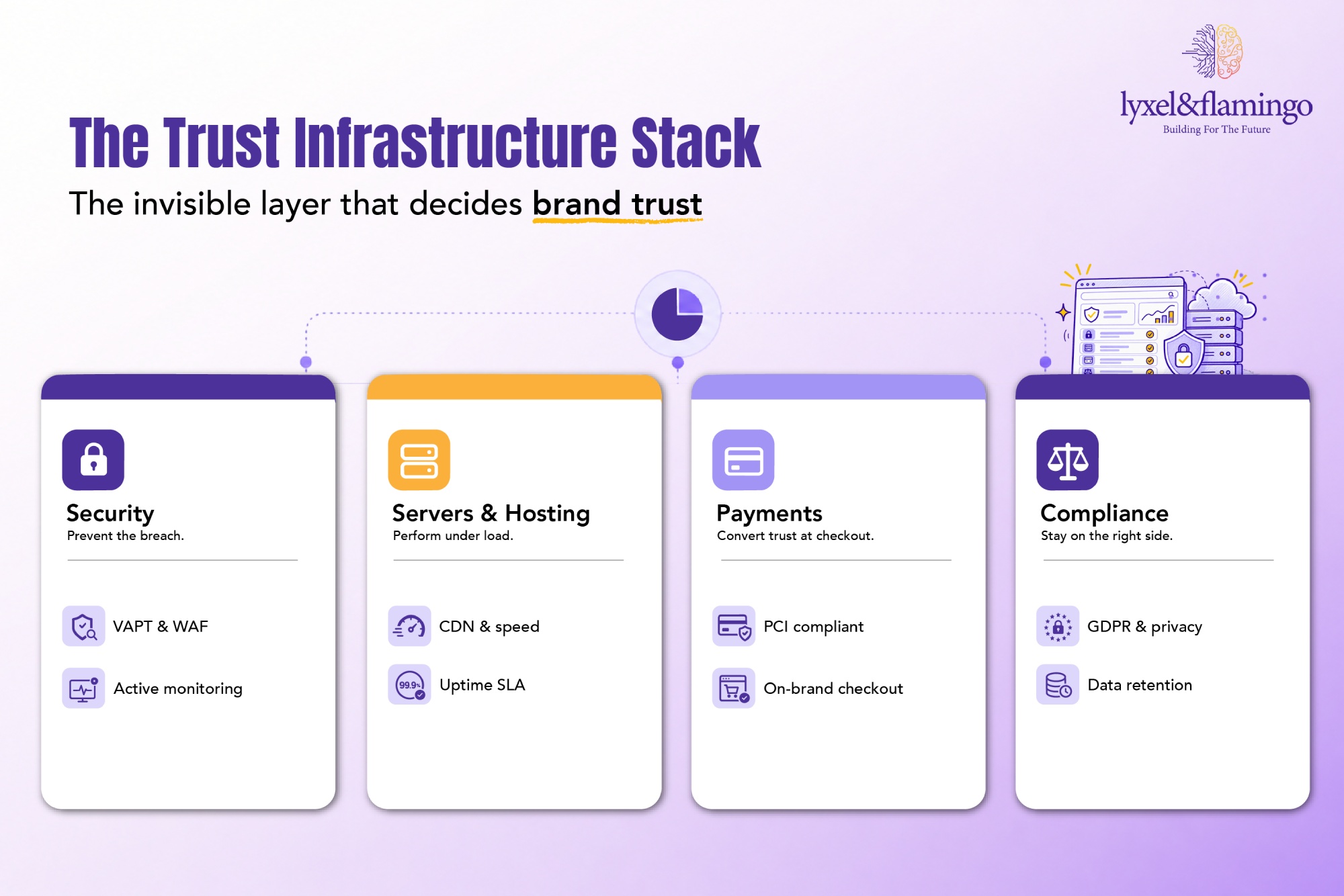
The Stack is deliberate in its ordering. Security is foundational: a compromised server cannot deliver a fast or trustworthy experience regardless of how well the other layers are configured. Servers and hosting determine the performance envelope within which everything else operates. Payments are where brand trust is converted or lost at the highest-value moment of the customer journey. Compliance provides the legal and regulatory wrapper that determines whether the entire stack can operate without external disruption.
Investing in the top of the Stack without addressing the foundation is a common and expensive mistake. Performance optimisation on a compromised server is futile. A beautiful checkout experience on a platform that fails PCI compliance is a liability.
The Framework Explained
Security: Is the layer that, when absent or inadequate, renders everything else on your digital property provisional. A brand that has invested in a polished UX, a high-converting checkout, and a sophisticated content strategy is building on an unstable foundation if its security architecture has not been tested. The specific interventions VAPT, SSL across all subdomains, WAF rules, access control policies, and active monitoring each address a distinct attack vector, and the absence of any one creates an exploitable gap. A CXO applying this layer should be asking not “have we done security?” but “when was our infrastructure last tested by someone whose job was to break it?” The failure mode is the assumption of security in the absence of evidence for it.
Curious how separating front-end from back-end changes your security posture? Read this blog: Headless Commerce for Enterprises: Speed, Flexibility and Global Scale
Servers and hosting: Translate directly into revenue in ways that are precisely measurable. A 0.1-second improvement in mobile page speed raises retail conversions by 8.4% (Deloitte/Google). Shared hosting chosen for its low cost imposes a performance ceiling that no amount of front-end optimisation can overcome, because the constraint is at the infrastructure level. Moving to dedicated cloud hosting with a CDN for static assets is not a technical upgrade; it is a conversion rate investment. The same is true of uptime SLAs: a server that is unavailable for four hours during a peak trading period is not an IT problem; it is a revenue event with a specific monetary value. A CXO should know their uptime SLA and the commercial cost of breaching it.
Payments: Is the layer where brand trust is most acutely tested, because it is the moment the customer is making an irreversible decision to commit. A checkout experience that redirects to a generic third-party page, loads slowly, uses visual design inconsistent with the rest of the brand, or fails to process payment without explanation does not just lose a transaction; it communicates that the brand is not trustworthy with financial information. The architecture decision of in-house versus third-party checkout carries brand implications beyond the technical ones: in-house checkout keeps the customer within the brand environment throughout the journey; third-party checkout introduces a trust handoff at the highest-stakes moment. PCI DSS compliance is the non-negotiable baseline; brand consistency at checkout is the commercial differentiator above that baseline.
Compliance: Is the layer that most organisations treat as a legal formality and most regulators are increasingly treating as a substantive governance test. GDPR, data localisation requirements, privacy policy obligations, and cookie consent frameworks are not bureaucratic exercises; they are the terms under which your organisation is permitted to collect, process, and retain the data that your digital business depends on. A compliance failure at scale – a privacy policy that does not accurately describe data practices, a cookie consent mechanism that does not obtain genuine consent – creates regulatory exposure that can materialise as fines, operational restrictions, and reputational damage simultaneously. A CXO cannot delegate this layer entirely to legal; it requires commercial decisions about data architecture and user experience that must be made at a leadership level.
Real-world scenario: Paras Health
Paras Health came to Lyxel&Flamingo with an urgent infrastructure problem. Running on a pre-built platform with a shared, predictable architecture, the organisation was experiencing frequent attacks – a situation that represents not only operational disruption but, in healthcare, a direct patient safety and data protection concern.
Lyxel&Flamingo rebuilt the entire digital infrastructure as a custom headless system: separate front-end and back-end, with separate databases – an architecture that dramatically reduces attack surface and eliminates the predictable vulnerabilities of monolithic pre-built platforms. The team implemented VAPT (Vulnerability Assessment and Penetration Testing) to identify and address weaknesses before launch. The outcomes were unambiguous: zero attacks since go-live, and website speed improved by 20%. In-house appointment booking replaced a third-party dependency, keeping patient data within the organisation’s own controlled environment, and HIS (Hospital Information System) middleware was integrated across multiple hospital sites.
This is the Trust Infrastructure Stack operating as designed: Security strengthened, server performance improved, payments internalised, compliance maintained within organisational control. The same phased, infrastructure-first logic underpinned the SRL / Agilus diagnostics programme, where the estate was migrated off BigRock shared hosting onto AWS dedicated hosting with a CDN and SSL across all properties, before online payment for test booking was layered on top – performance and security first, commercial capability second.
What actually makes a hospital website trustworthy to patients? Read this blog: A Patient Decides About Your Hospital Before They Ever Call You
Going deeper: Infrastructure Health Checklist
Use this checklist to audit your current position against the Trust Infrastructure Stack:
Security:
- VAPT conducted within the last 12 months, findings remediated
- SSL/TLS configured across all properties, including subdomains
- WAF (Web Application Firewall) active
- Access control policy reviewed principle of least privilege applied
- Active monitoring in place (SIEM, Rapid7 or equivalent)
- Incident response plan documented and tested
Servers and hosting:
- Hosting infrastructure reviewed; shared hosting eliminated for any production environment handling sensitive data
- CDN configured for static assets
- Uptime SLA agreed and monitored
- Core Web Vitals within green thresholds (LCP, CLS, INP)
Payments:
- Payment gateway PCI DSS compliant (PayU, Razorpay, Stripe, Pine Labs or equivalent)
- Checkout experience on-brand and hosted on-domain where possible
- Payment failure rate monitored and benchmarked
Compliance:
- Privacy policy current and accessible
- Cookie consent implementation reviewed
- Data retention policy documented
Key takeaways
- Infrastructure failure is a brand event, not just an IT event. A breach, a slow page, or a failed payment affects customer confidence, commercial outcomes, and regulatory standing simultaneously.
- The average breach now costs USD 4.88 million and disrupts 70% of affected organisations (IBM, 2024). Prevention through architecture and VAPT is significantly less expensive than remediation.
- The Trust Infrastructure Stack – Security, Servers, Payments, and Compliance provides a model for auditing infrastructure as a brand and commercial asset, not a cost centre.
- Headless architecture is an increasingly important security decision, not just a technical one. Separating front-end and back-end eliminates a broad class of vulnerabilities inherent in monolithic platforms, as the Paras Health rebuild demonstrated with zero attacks since go-live.
- Performance and security are not competing priorities. Modern cloud and CDN infrastructure delivers both simultaneously.
The CXO takeaway
The invisible backbone is invisible only until it fails, and when it fails, the consequences are immediate, public, and expensive. A data breach, a payment outage, or a site that loads in four seconds on mobile does not stay within the IT department; it reaches the customer, the press, the regulator, and the board simultaneously. The CXOs who treat infrastructure as a brand investment – who demand VAPT evidence, who insist on dedicated hosting before a launch, who review their payment experience as critically as their homepage – are not being technically conservative. They are protecting the commercial foundation on which every other growth initiative depends. The organisations that will scale most confidently in the next three years are those that built the invisible backbone well enough that it never becomes visible.
Frequently Asked Questions
Yes, Breaches, slow load times, and payment failures affect customer trust and conversion rates across every sector. The IBM breach data reflects a cross-industry average, no vertical is exempt.
Headless architecture separates the front-end (what users see) from the back-end (databases, APIs, business logic). This separation means an attack on the front-end cannot directly access the back-end, and vice versa. It also means that vulnerabilities in pre-built CMS platforms are far less exploitable.
Vulnerability Assessment and Penetration Testing. A VAPT engagement systematically identifies security weaknesses in your digital infrastructure both known vulnerability categories (assessment) and exploitable attack paths (penetration testing). It should be conducted at least annually and after any major infrastructure change.
Both models can be secure when correctly implemented. The advantage of in-house or on-domain payment handling is brand consistency and data control. L&F has integrated PayU, Razorpay, Paytm, Stripe, and Pine Labs across portfolio clients, the right choice depends on regulatory context, volume, and geography.
Frame it in commercial terms: breach cost avoidance (USD 4.88M average), conversion rate improvement from speed gains (8.4% per 0.1s improvement per Deloitte/Google), and payment failure rate reduction. These are board-level numbers.