
What this blog covers
A practical framework for the CXO Security Checklist for evaluating and demanding the right security standards from your digital infrastructure, informed by real client experience and the financial realities of breach of exposure.
Table of Contents
Security as a brand asset, defined: trust you can evidence
Website security as a brand asset is the strategic position that security investment is not merely a cost of operating digitally but a contributor to customer trust, brand equity, and commercial resilience. A brand that can demonstrate through architecture, certifications, and track record that its digital environment is safe is a brand that earns higher customer confidence, lower regulatory risk, and stronger commercial outcomes than one that cannot.
Conversely, a breach is a brand liability event. It does not stay within IT. It reaches the press, the regulatory authority, and the customer inbox. It affects customer acquisition cost, retention rates, and, in regulated sectors, operating licences.
Why Security Is Now a Board-Level Number
The financial exposure from inadequate security has never been higher. The global average cost of a data breach reached USD 4.88 million in 2024, a 10% increase year on year. Critically, 70% of breached organisations reported significant business disruption, not just financial cost, but operational paralysis, reputational damage, and customer attrition (IBM, Cost of a Data Breach, 2024).
These are not numbers that belong in an IT budget discussion. They belong in a risk register, a brand strategy conversation, and a board-level capital allocation debate.
The architecture of the web has also become more complex. Modern digital properties integrate multiple third-party services, payment gateways, CRM systems, and data platforms. Each integration point is a potential attack surface. The organisations that are breached are not, in general, organisations that made no security investment; they are organisations whose security architecture did not keep pace with the complexity of what they built.
Where Security Quietly Fails
- Security delegated entirely to IT: When security is framed as a technical responsibility rather than a brand responsibility, it is systematically underinvested. IT teams optimise for uptime and functionality; brand leaders should be demanding security standards as a condition of both.
- Pre-built platform vulnerability: Widely-used CMS platforms offer speed to launch but expose organisations to platform-wide vulnerabilities. A zero-day exploit in a widely-used plugin affects every site running that plugin simultaneously, including yours.
- No structured testing cadence: Many organisations have never conducted a formal VAPT engagement. They operate on the assumption that nothing has gone wrong, which is categorically different from knowing that nothing has gone wrong.
- Monitoring gaps: The average time between initial breach and detection is measured in months, not days. Without active monitoring, log analysis, anomaly detection, and intrusion alerts, a compromise can persist long enough to cause irreversible data loss.
- Incident response unpreparedness: When a breach occurs, the 24 hours immediately following determine the extent of the damage. Organisations without a documented, tested incident response plan consistently make the breach worse through delayed, uncoordinated responses.
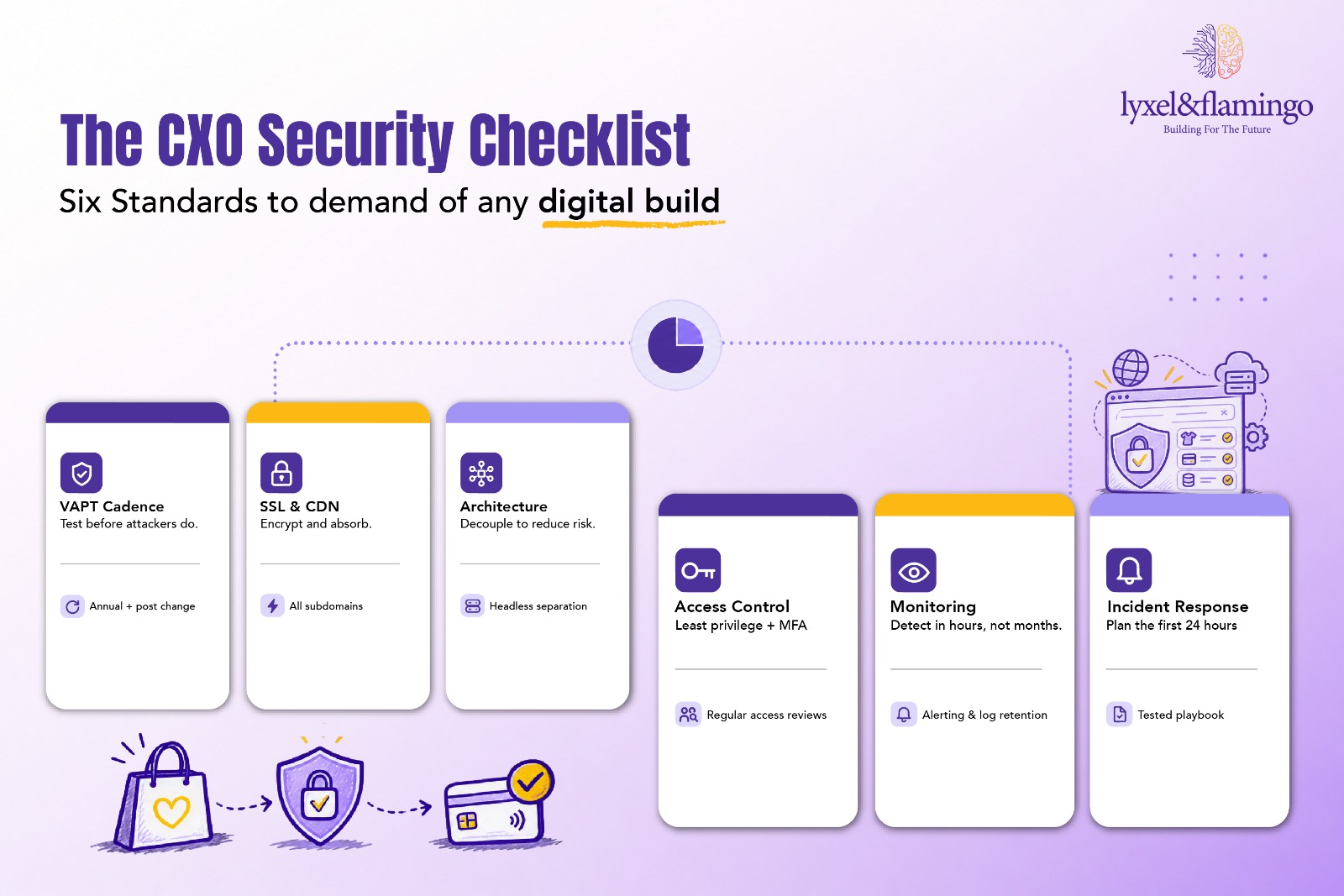
Framework: The CXO Security Checklist
This checklist is designed to be taken into conversations with your CTO, your agency, or your digital infrastructure partner. Each item is a question you should be able to answer or demand an answer to.
The digital property was running on a pre-built platform a configuration that offered rapid initial deployment but, in practice, presented a broad and predictable attack surface.
The attacks were frequent. The disruption to operations was significant. And in a healthcare context, the stakes extend beyond commercial damage: a compromised appointment booking system or patient record database carries patient safety and regulatory implications that no IT remediation can fully reverse.
L&F’s response addressed every layer of the CXO Security Checklist.
Architecture: The entire platform was rebuilt as a custom headless system separate front-end and back-end, with separate databases. This architectural decision eliminated the single-surface vulnerability of the pre-built platform. An attacker compromising the front-end presentation layer now has no pathway to patient data held in the back-end.
VAPT: A full Vulnerability Assessment and Penetration Testing engagement was conducted prior to go-live. Findings were remediated before any patient-facing functionality was activated.
Monitoring: Rapid7 tooling was implemented for active monitoring, providing ongoing visibility into threat indicators rather than retrospective log review after an incident.
Payments: In-house appointment booking was built directly into the platform, removing the third-party dependency that had previously created a data-handling gap. Patient data remained within the organisation’s controlled environment.
The outcomes: zero attacks since go-live, and website speed improved by 20%. The clinical and operational teams regained confidence that their digital infrastructure was not a liability.
This is security as a brand asset in practice. The absence of attacks is not a neutral outcome it is a competitive and commercial one. Patients book with confidence. Staff operate without disruption. The organisation’s regulatory standing is protected.
Going deeper: What to demand from your agency or IT team
When briefing a rebuild, a new launch, or an infrastructure review, these are the standards a CXO should be demanding in writing:
At project initiation:
- Security architecture documented before development begins – not retrofitted at the end
- Third-party dependencies (plugins, integrations) assessed for known vulnerability history
- Data classification completed what data is collected, where it is stored, who has access
Before go-live:
- VAPT conducted on staging environment; findings categorised and remediated
- SSL configured across all properties and subdomains
- robots.txt and sitemap.xml reviewed; no sensitive directories inadvertently exposed
- All admin accounts secured with MFA; default credentials changed
- Monitoring tools live and alerting verified
Many of these same checks fall under a technical website audit, which is worth running well before go-live rather than treating it as a one-time launch task
Ongoing:
- VAPT on annual cadence minimum, documented and findings tracked
- Access review quarterly; remove permissions for departed staff or redundant integrations
- Penetration test after any major platform change
- Incident response plan reviewed annually; communication protocol current
Questions to ask your agency:
- “Can you show us the VAPT report from your last equivalent engagement?”
- “What monitoring tools are you recommending, and what does the alerting configuration look like?”
- “If we are breached, what is your incident response protocol and what is our notification obligation?”
Agencies that cannot answer these questions confidently, or that treat security as an optional add-on rather than a foundational requirement, are not adequately qualified to handle a digital property that carries commercial or personal data.
Key takeaways
- Website security is a board-level brand issue. The USD 4.88M average breach cost and 70% business disruption rate (IBM, 2024) make infrastructure security a risk register item, not an IT line item.
- Architecture is the first security decision, not the last. Headless, decoupled architecture eliminates a broad class of vulnerabilities before any monitoring or testing is required.
- VAPT is not optional; it is the mechanism through which organisations distinguish between assuming they are secure and knowing they are secure. It should occur at minimum annually.
- Active monitoring (Rapid7 or equivalent) compresses breach detection time from months to hours. The difference between a two-month dwell time and a two-hour dwell time is the difference between a manageable incident and a catastrophic one.
- Security investment creates measurable commercial return: faster sites, higher customer confidence, regulatory protection, and the operational continuity that underpins revenue, as the Paras Health rebuild showed with zero attacks and a 20% speed gain.
The CXO takeaway
Security will not appear on the revenue dashboard until the moment it fails, and at that point, the cost of inaction is measured in millions, not budget lines. The CXOs who understand this are not the ones who ask their IT team whether the website is secure; they are the ones who demand evidence: VAPT reports, monitoring dashboards, architecture diagrams, incident response plans, and who treat the absence of that evidence as a commercial risk requiring immediate attention. The CXO Security Checklist in this blog is not an IT specification; it is a leadership standard. The brands that will sustain customer trust, regulatory standing, and operational continuity through the increasing complexity of the digital landscape are those whose leaders demanded the right things from their infrastructure partners before an incident made the demand urgent.
Frequently Asked Questions
Present the risk-adjusted cost of inaction: USD 4.88M average breach (IBM, 2024), plus regulatory fines, customer attrition, and reputational remediation costs that persist for years. Compare that to the cost of architecture, VAPT, and monitoring. The ROI case for prevention over remediation is substantial.
A vulnerability assessment systematically identifies known weaknesses in your infrastructure against catalogued vulnerability databases. A penetration test actively attempts to exploit those weaknesses to determine which are genuinely exploitable. Both are components of a full VAPT engagement; neither alone is sufficient.
By separating the front-end (presentation layer) from the back-end (data, APIs, business logic), headless architecture ensures that a compromise of one layer does not automatically grant access to the other. It also means the organisation is no longer dependent on the security posture of a third-party CMS platform.
Rapid7 is a leading cybersecurity platform providing vulnerability management, threat detection, and incident response tooling. L&F implements Rapid7 for clients requiring active, ongoing monitoring rather than periodic point-in-time assessments - the difference between a security alarm system and an occasional security audit.
At minimum, annually. Additionally, VAPT should be conducted after any major infrastructure change, platform migration, significant third-party integration, or following a security incident. For organisations in regulated sectors (healthcare, finance), more frequent cadences may be required by compliance frameworks.