
What this blog covers
Most app decisions start in the wrong place: a competitor launched one, or someone in a board meeting said “we need an app.” This blog gives you a structured, honest way to decide whether a mobile app will genuinely move your business, the App Value Test and shows, through two very different real builds, what an app looks like when the case is real versus when it becomes a line in your tech-debt register.
Table of Contents
An app is a habit, not a webpage
In business terms, a mobile app is a dedicated, installed software experience that lives on a user’s device, separate from the browser, running on native device capabilities, and able to work with or without a connection. A well-built website captures intent: someone searches, lands, and acts. An app does something different and harder: it earns a place on the home screen, and a reason to return to it. That act of return is where the value lives. An app that is opened once and forgotten is not a cheaper website; it is a more expensive one.
Why Most Apps Fail, and Why a Few Compound
The data makes apps look irresistible. Mobile apps convert at roughly 3x the rate of mobile web, and retail apps specifically see around 94% higher conversion rates alongside users viewing about 4.2x more products per session (Criteo/Button, 2024). Read quickly, that says “build an app.” Read carefully, it says something narrower: apps convert brilliantly for the users who keep opening them. The headline number is a survivorship story; it describes the winners, not the graveyard.
And the graveyard is large. The typical failure looks like this: a brand invests six or seven figures, launches to a flurry of downloads from existing loyal customers, and watches daily active use settle at 2-3% within six months. The app did not fail because it was badly built. It failed because the business never had the frequency, the reason-to-return, or the retention loop to sustain it – and no amount of engineering fixes a missing habit.
There is also a quiet India-specific truth here: for a large share of D2C and services brands, the honest answer is that a fast mobile site plus WhatsApp already does most of what an app would order, reorder, support, and notify at a fraction of the cost. Many brands would improve returns faster by fixing their website and messaging than by building an app they cannot sustain. The app is the right answer often enough to be tempting, and rarely enough to demand a real test first.
The real pain points
- Premature build: Investing in an app before the frequency or loyalty exists to justify it and discovering the 2% DAU problem only after launch.
- Feature bloat at launch: Cloning the entire website into an app rather than designing for the two or three jobs users actually do on mobile.
- No retention hook: The app gets downloaded out of curiosity, then sits unused because there is no loyalty mechanic, no exclusive value, no reason to come back.
- Misaligned ownership: The app is run as a marketing campaign when it needs product, engineering and CX jointly accountable for its whole life, not just its launch.
- Measuring the wrong thing: Celebrating downloads instead of the metrics that reflect real value: session frequency, repeat purchases and revenue-per-active-user.
Framework: The App Value Test
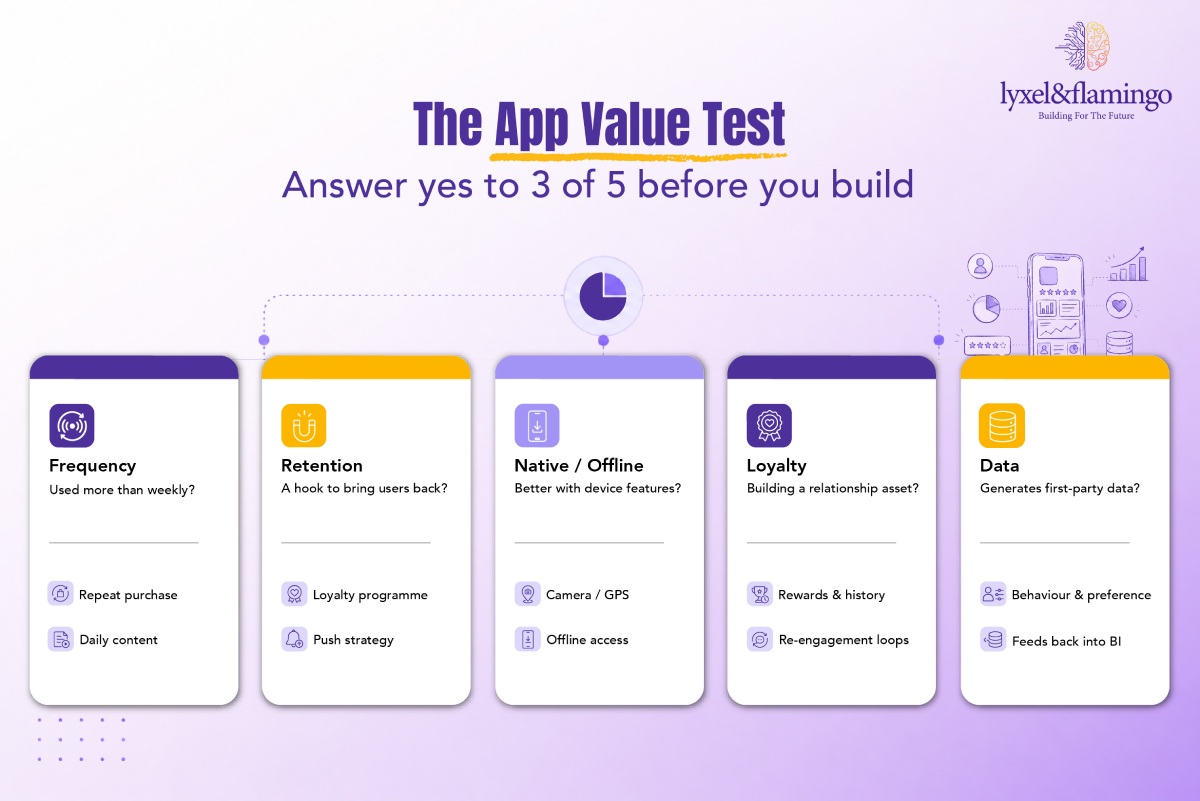
Before a single line of code is written, answer five qualifying questions. If you cannot say “yes” to at least three with evidence, not aspiration, the business case is not yet ready.
The Framework explained
01. Frequency: Is the single most decisive gate, and the easiest to fail honestly. A coffee chain whose customers buy four times a week has earned an app; an insurer whose customers renew once a year has no users; users will delete it between interactions, and the acquisition cost never recovers. The test is not “could someone use this weekly?” but “do they actually have a reason to?” Brands that fudge this discover the truth post-launch, when daily active users refuse to climb out of single digits no matter how good the UI is.
02. Retention: Turns frequency from a hope into a system. Novelty carries an app for the first fortnight; retention mechanics carry it to month six. A loyalty programme, a push strategy tied to genuinely useful triggers (order ready, price drop, restock), and members-only value are not phase-two features; they are the engineering of return. If you cannot describe your retention loop before development starts, the app will quietly decay, and no relaunch recovers a habit that was never designed in.
03. Native and offline features: Decide whether an app is genuinely better than a mobile site or merely equivalent at greater cost. Camera for scanning, GPS for location offers, Bluetooth for pairing, offline capability for field teams these justify the download. Without at least one of them, a PWA or low-code build often delivers 80% of the outcome for a fraction of the cost. The classic failure is a “native” app that uses zero native features a harder-to-update webpage wrapped in a store listing.
04. Loyalty: Is distinct from retention in a way that matters commercially. Retention is the mechanism; loyalty is the relationship it builds. This gate asks whether the app is accumulating something a user would hate to lose: a points balance, an order history, a saved set of preferences that makes switching to a competitor painful. Clear it, and you are building an asset that appreciates. Skip it, and you are building a transaction channel; a rival will empty the moment they undercut you on price.
05. Data: Is the gate most leaders underweight at briefing. A well-instrumented app produces a continuous stream of first-party behavioural signals: what users browse, dwell on, add and remove, which notifications they open, which feeds personalisation, product and attribution in ways web analytics and third-party cookies cannot. The failure mode is subtle: an app that captures rich behaviour but lacks the backend to route those signals into the systems that would act on them. The data potential exists; the plumbing to use it does not.
The test in the real world: Olympus and Taco Bell
The two strongest app cases L&F has built sit at opposite ends of the spectrum, which is exactly the point. An app earns its place through fit, not category.
Olympus – the internal-value app: Olympus, a global medtech leader, came to L&F with a problem that had nothing to do with consumers: field issues were slow to reach product teams, and the feedback loop between users and the brand was broken. L&F built the My Voice app for iOS and Android – a structured feedback and engagement platform whose data-driven backend routed insight straight to the right internal teams. It reached 85%+ user adoption and won the Olympus President’s Award, the company’s highest internal recognition. It cleared every gate: high-frequency professional use, retention through an ongoing feedback loop, offline capability for the field, a relationship-building purpose, and rich first-party data flowing back to product. Not every valuable app is consumer-facing.
Taco Bell – the consumer QSR engine: At the other end, Taco Bell India is the app as growth infrastructure. L&F built the Android and iOS app (and the website) to carry an aggressive expansion, clearing the test on every gate: high-frequency QSR ordering, a loyalty programme integrated via Xeno APIs, native GPS and geofencing for store-finder and live delivery tracking, POSIST POS synchronisation and Razorpay payments, all on a backend engineered for the 10x traffic spikes that promotions create. The outcomes are the proof, not the pitch: 8.5 lakh-plus users, orders scaled 2x, and infrastructure that supported a 5x store expansion to 150-plus live stores. That is what an app returns when frequency, retention, loyalty, and data are all genuinely present.
Between these two poles sit most businesses, and most of them are closer to “fix the website and messaging first” than to “build the app now.” The test tells you which you are.
Going deeper: The pre-build checklist
Before briefing an agency or internal team, walk through this:
- We have mapped the top three jobs users will do in the app, and they differ from what they do on the website
- We have a retention mechanic designed before development begins (loyalty, push, personalisation)
- We understand which native device features we will use and why they improve the experience
- We have a post-launch measurement framework: session frequency, retention rate, revenue-per-active-user
- We have allocated ongoing resources for updates, not just launch
- We have honestly reviewed whether a PWA or low-code build achieves 80% of the outcome at lower cost and documented why, if not
- We have internal ownership: a named product lead, not a committee.
Key takeaways
- An app earns its place when frequency, retention, native capability, loyalty and data are genuinely present, not when a competitor launches one.
- The 3x conversion advantage of apps (Criteo/Button, 2024) describes the winners; most apps die at 2-3% daily use because the habit was never there.
- Valuable apps are not only consumer-facing: Olympus’s internal My Voice app hit 85%+ adoption and a President’s Award by solving a real business problem.
- Taco Bell India shows what a well-built app compounds into: 8.5 lakh-plus users, orders scaled 2x, and infrastructure that carried a 5x store expansion.
- For many brands, a fast site plus WhatsApp beats an unsustainable app; fix the fundamentals before you build.
Closing thoughts
A mobile app is one of the most consequential digital decisions a CXO makes, not because of the build cost, but because of what it commits you to. Get it right, and it becomes a compounding asset: a direct, algorithm-free channel to your most valuable users, generating first-party data and deepening loyalty with every session. Get it wrong, and it sits in the store as evidence of a board decision that skipped the business rigour. The App Value Test exists to enforce that rigour before the invoice arrives. If you can answer “yes” to three of the five gates with evidence, the case is real. If you cannot, the more valuable conversation is about what has to change in the business first, and that conversation is always cheaper than the app that would have failed.
Frequently Asked Questions
There is no universal threshold - engagement rate matters more than reach. A business with 10,000 genuinely loyal, weekly-active customers has a stronger case than one with 500,000 occasional visitors.
Native delivers the best performance and device access. Hybrid frameworks like React Native and Flutter cut cost and time-to-market. A PWA is a third option worth weighing first. The right answer depends on which App Value Test gates you cleared and how central native features are.
Often, yes - especially paired with WhatsApp. A responsive site is the baseline expectation, not a lesser app. The two do different jobs: the site captures intent; the app builds the relationship. Only build the app when the test says the relationship is there to build.
For a scoped, well-briefed native app, typically four to six months from discovery to launch. Rushing discovery is the single most common cause of post-launch rework.
Beyond downloads: daily and monthly active users (DAU/MAU), session length, retention at day 1/7/30, revenue-per-active-user, and push opt-in rate. If you only track downloads, you will not see failure until it is expensive.