What This Blog Covers
Six major Google core updates ran in an 18-month window, AI Overviews now absorb a meaningful share of clicks before they happen, and most sites still carry technical debt nobody’s fully audited this year. When traffic drops, all three explanations are plausible at once, which is exactly the problem: blaming AI for a core-update loss wastes a quarter chasing the wrong fix, and blaming a core update for a technical own goal does the same in reverse. Here is the diagnostic framework that separates the three causes properly, with a real recovery story that shows what fixing the right one actually looks like.
Table of Contents
- The Question Every CEO Is Asking Right Now
- Why the Three Causes Get Confused Constantly
- The Diagnostic Checks That Actually Separate Them
- The Traffic-Drop Diagnostic Model: three checks, run in order, each one ruling out a cause
- The Framework Explained
- A Real Recovery: Fixing the Own Goal, Not Guessing at AI
- Key Takeaways
- The CXO Takeaway
- The Question to Sit With
- Closing
The Question Every CEO Is Asking Right Now
“Why is our organic traffic down” made Brainlabs’ list of the questions CEOs are actually asking their marketing leaders this year, and it’s not hard to see why. Six confirmed Google core updates ran across an 18-month window, one of them shifting roughly 80% of top results in its category. AI Overviews now trigger on a substantial share of queries. And most sites have quietly accumulated technical debt, deleted pages, broken redirects, a migration nobody fully verified, that nobody’s traced back to a specific traffic impact.
All three causes can produce the exact same symptom on a traffic chart: a downward line. That similarity is precisely what makes the wrong diagnosis so easy to reach for, and so expensive once a quarter’s been spent chasing it.
The AI-absorption piece of this is also reshaping something further upstream: AI search is now deciding who makes a B2B shortlist before a human researcher gets involved at all.
Why the Three Causes Get Confused Constantly
AI gets blamed by default because it’s the newest, most talked-about explanation, and blaming it requires no internal audit, no uncomfortable conversation about a rushed migration, no admission that a redirect chain broke six months ago and nobody noticed. A core update gets blamed next because Google’s own update calendar gives a ready-made, external explanation. An own goal is, understandably, the least attractive explanation to reach for first, and is consequently the one most often skipped over entirely, even when it’s the actual cause.
The result is a pattern that repeats across almost every traffic-drop conversation: the fastest, least uncomfortable explanation gets adopted, the team optimises for it, and three months later the real cause is still sitting there, unaddressed, because it was never actually the one investigated.
The Diagnostic Checks That Actually Separate Them
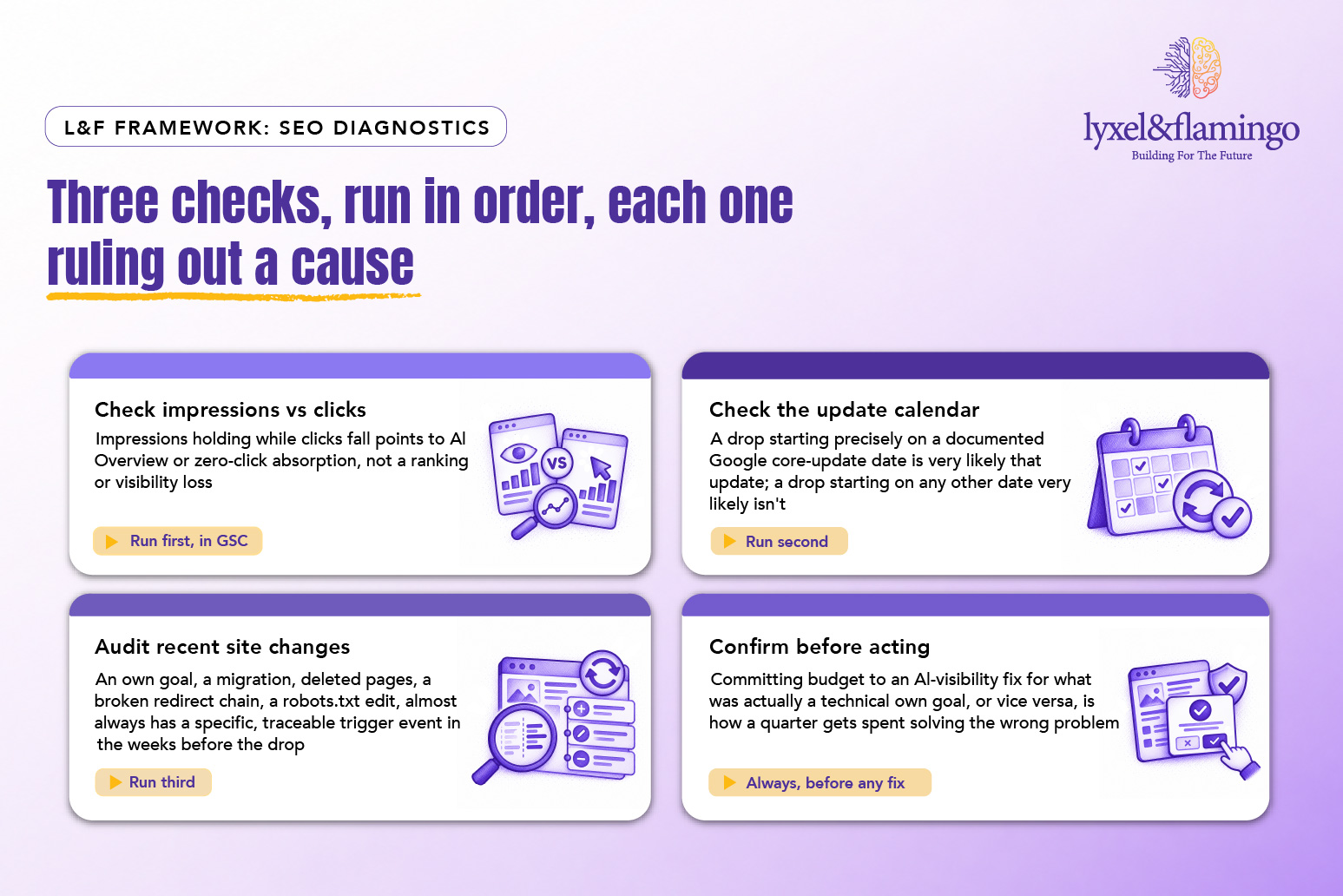
Separating the three causes takes three specific checks, run in this order because each one is faster to run and rules out more than the next. Check impressions against clicks in Search Console first: if impressions held steady while clicks fell, that’s AI absorption, not a ranking loss. Cross-reference the drop’s exact date against Google’s confirmed core-update calendar next: a drop that starts precisely on a documented update date is very likely that update, and a drop that starts on any other date very likely isn’t. Audit recent site changes last, deployments, content deletions, robots.txt edits, redirect chains, migrations, in the weeks immediately before the drop began, since an own goal almost always has a specific, traceable trigger event.
Running all three checks takes an afternoon. Skipping straight to a fix based on assumption, and being wrong, routinely costs a full quarter.
Once the cause is confirmed, the next problem is usually explaining it upward, here’s what a board-ready version of that report actually needs.
The Traffic-Drop Diagnostic Model: three checks, run in order, each one ruling out a cause
The Framework Explained
- Check impressions vs clicks: This is the fastest of the three checks and the one most teams skip entirely, going straight to a narrative instead of the data that would confirm or rule it out in minutes. Pulling Search Console’s impressions and clicks side by side, for the same query set, over the same period, answers a specific and testable question: is the brand still being shown, just not clicked, or has visibility itself actually fallen. The first pattern, steady or rising impressions against falling clicks, is close to direct evidence of AI Overview or zero-click absorption, the query is still surfacing the brand, an AI-generated answer is simply satisfying the searcher before a click happens. The second pattern, impressions falling too, rules AI absorption out almost entirely and points somewhere else. This single comparison, ten minutes of work in a tool every team already has access to, eliminates or confirms one of the three causes outright.
- Check the update calendar: Google confirms the start and end dates of every core update publicly, which makes this check almost mechanical once the drop’s own start date is pinned down precisely. A traffic decline that begins within a day or two of a confirmed update’s rollout start is very likely connected to it, particularly if the affected pages share characteristics, thin content, weak E-E-A-T signals, technical issues, common to what that specific update is known to target. A decline that starts two, four, six weeks before or after any confirmed update date almost certainly is not a core-update effect, whatever the timing coincidence might suggest to a team looking for the least uncomfortable explanation. Getting the date exactly right matters more than it sounds like it should, a drop misattributed to a nearby update sends the recovery effort chasing generic content-quality fixes when the real cause was something else entirely.
- Audit recent site changes: This is the check most often skipped, and it’s usually skipped for the same reason: it requires the team to look inward first, at deployments, deletions and configuration changes nobody flagged as SEO-relevant at the time. Reviewing the deployment log, the CMS change history, and Search Console’s coverage and redirect reports for the four to eight weeks immediately before the drop began surfaces the specific trigger far more often than teams expect. Pages deleted without 301 redirects, a robots.txt rule tightened for an unrelated reason, a migration that broke internal linking structure, a sitemap that stopped updating, these are exactly the kind of quiet, undramatic changes that produce a traffic chart indistinguishable from an algorithm penalty, and exactly the kind that a proper technical audit finds within hours once someone actually looks.
- Confirm before acting: The instinct after running the first three checks is to move straight to a fix. The discipline that actually protects a quarter’s budget is pausing one more beat to confirm the diagnosis holds up, checking that the evidence from all three checks points the same direction, before committing resources. A team that jumps to an AI-visibility overhaul because impressions looked flat in one quick glance, without confirming clicks genuinely fell against steady impressions and ruling out a concurrent core update, risks spending months rebuilding schema and FAQ content for a problem that was actually a broken redirect chain the whole time. The fix is rarely expensive once correctly diagnosed. Being wrong about which fix is needed is what actually costs the quarter.
A Real Recovery: Fixing the Own Goal, Not Guessing at AI
CLIENT PROOF POINT: confirm sign-off before publish. Sleepwell‘s organic programme began from a rankings gap rooted in exactly the kind of own-goal factors this diagnostic is built to catch: slow load times, unresolved UI/UX issues, and underlying technical SEO problems that had been quietly suppressing visibility. Rather than assuming the drop was algorithmic or AI-driven, the team addressed the technical hygiene directly, keyword research, meta optimisation, Core Web Vitals fixes, site speed improvements, alongside sustained off-page work. Over twelve months, top-10 keyword rankings grew 1950% by internal tracking and 231% independently verified by Semrush, with organic impressions up 84% and clicks up 47%. The recovery came from correctly diagnosing a technical own goal, not from chasing an AI-visibility fix that was never the actual problem. (L&F client work, SEO, 12-month result.)
Our SEO and GEO services team runs this three-check diagnostic before recommending any fix, so budget goes toward the actual cause.
Key Takeaways
- “Why is our traffic down” is one of the specific questions CEOs are asking marketing leaders right now (Brainlabs), and most teams still answer it with a guess rather than a diagnosis.
- Six confirmed Google core updates ran in an 18-month window, one shifting roughly 80% of top results in its category, making update-timing confusion a real and common risk.
- Checking impressions against clicks in Search Console is the fastest of the three diagnostic checks and rules AI absorption in or out in minutes.
- The own-goal check, auditing recent deployments, deletions and configuration changes, is the most commonly skipped step and often the actual cause.
- The Sleepwell recovery, 1950% top-10 keyword growth (231% per Semrush) over 12 months, came from correctly diagnosing a technical own goal rather than chasing an assumed AI or algorithm cause.
The CXO Takeaway
For a CXO, the cost of misdiagnosing a traffic drop is rarely the drop itself, it’s the quarter spent fixing the wrong thing while the real cause keeps compounding untouched. A team that blames AI for what was actually a broken redirect chain doesn’t just waste budget, it delays the actual fix by however long the wrong project takes to run its course and fail to move the number. The three-check diagnostic costs an afternoon. Skipping it costs a quarter, and sometimes the quarter after that too, before anyone circles back to check the original assumption.
The Question to Sit With
The question worth sitting with isn’t whether traffic is down. It’s whether anyone has actually run the three checks that would tell you why, before the team starts building a fix for a cause nobody’s confirmed.
Closing
Lyxel&Flamingo runs this three-check diagnostic before recommending any recovery programme, so effort goes toward the actual cause, not the most convenient explanation. Want a clear read on why your traffic actually moved? Start that conversation with L&F →
Frequently Asked Questions
Yes, and it's more common than teams expect. A core update can expose technical weaknesses that were already quietly present, so a drop is often partly algorithmic and partly an own goal that the update simply made visible.
Within the same week, ideally the same day the drop is confirmed as real and not a reporting or tracking artefact. The longer the delay, the harder it becomes to trace recent site changes back to a specific trigger date.
Generally yes, unlike a drop in clicks alone, a falling impression count usually does indicate reduced visibility rather than a format shift, and warrants investigating as a ranking or indexing issue.
Pages deleted or URLs changed during a redesign or migration without proper 301 redirects in place, which silently drops the authority and ranking history those pages had built up.
Usually yes. An own-goal fix, restoring a redirect, fixing a robots.txt error, is often technically straightforward once found. A core-update impact typically requires a broader content-quality and authority-building effort that takes longer to show results.