
What this blog covers
This is a practical decision guide to the three attribution methods every serious media team weigh: multi-touch attribution (MTA), marketing mix modelling (MMM) and incrementality testing. We define each in plain terms, show the question each is built to answer, compare them side by side, and give you a way to decide which fits your business, data and stage before explaining why the mature answer is almost always to blend all three rather than crown one winner.
Table of Contents
- Why 'which attribution model?' is the wrong first question
- Multi-touch attribution (MTA), in plain terms
- Marketing mix modelling (MMM), in plain terms
- Incrementality testing, in plain terms
- The decision guide: which fits you
- Why the answer is to triangulate, not choose
- A blend in practice
- Self-check: is your attribution fit for purpose?
- Key takeaways
- Closing
Why ‘which attribution model?’ is the wrong first question
Ask most teams which attribution model they use and you will get a single answer, defended like a football allegiance. That is the mistake. MTA, MMM and incrementality are not three answers to the same question; they are three different instruments, each built to measure something the others cannot see well.
The better first question is: what decision am I trying to make? If you are optimising a digital journey, you need a different tool than if you are setting next year’s budget or proving whether a channel caused sales at all. Getting this right matters because attribution is the layer that decides which campaign gets scaled and which gets cut; it sits at the heart of any modern measurement framework. Pick the wrong instrument, and you will confidently make the wrong call.
Multi-touch attribution (MTA), in plain terms
MTA tracks the individual touchpoints on a customer’s journey and distributes credit across them: first touch, mid-journey, last touch, rather than handing everything to the final click. At its best, it shows how channels hand off to each other and where the digital journey leaks.
Its strength is granularity: it can tell you that paid social introduced the customer, search re-engaged them and email closed them. Its weaknesses are serious and getting worse. MTA needs user-level tracking, which cookie deprecation and privacy changes have hollowed out. It is largely blind to offline touchpoints, brand-building and anything it cannot cookie. And because the data it does see is skewed toward trackable lower-funnel clicks, it still tends to over-credit the harvest. Useful for journey optimisation; dangerous as a whole-business truth.
Marketing mix modelling (MMM), in plain terms
MMM takes the opposite approach. Instead of tracking individuals, it uses aggregated, historical data: spend, sales, seasonality, price, distribution, even weather, and statistically estimates how each input drove the outcome over time. Because it works on aggregate data, it is privacy-safe by design and survives the death of the cookie untouched.
Its great strength is scope: MMM sees everything, including brand, offline, TV, and long-term effects that MTA is blind to, which makes it the right tool for high-level budget allocation and the brand-versus-performance split. Its weaknesses are speed and granularity; it typically refreshes monthly or quarterly, needs a long history to be reliable, and cannot tell you which specific ad creative to change tomorrow. It answers ‘where should the money go?’ far better than ‘what should I do this afternoon?’
Incrementality testing, in plain terms
Incrementality sidesteps the credit-assignment problem entirely and asks the only question that truly matters: what would have happened without this media? It answers it with an experiment: hold the media out from a matched control group (often a set of regions, hence “geo-lift”), run it in the test group, and measure the difference. That difference is the true, causal contribution. Done well, it is the gold standard, and the referee that settles arguments between the other two methods. We cover test design and pitfalls as part of the modern attribution stack.
Its limitation is practicality: You cannot run a clean experiment on every campaign, every week. Tests take time to design and read, and require enough scale to detect a real effect. So incrementality is best used surgically to validate your biggest bets and to calibrate the models you run continuously.
The decision guide: which fits you
Put the three side by side, and the choice stops being tribal and starts being about fit.
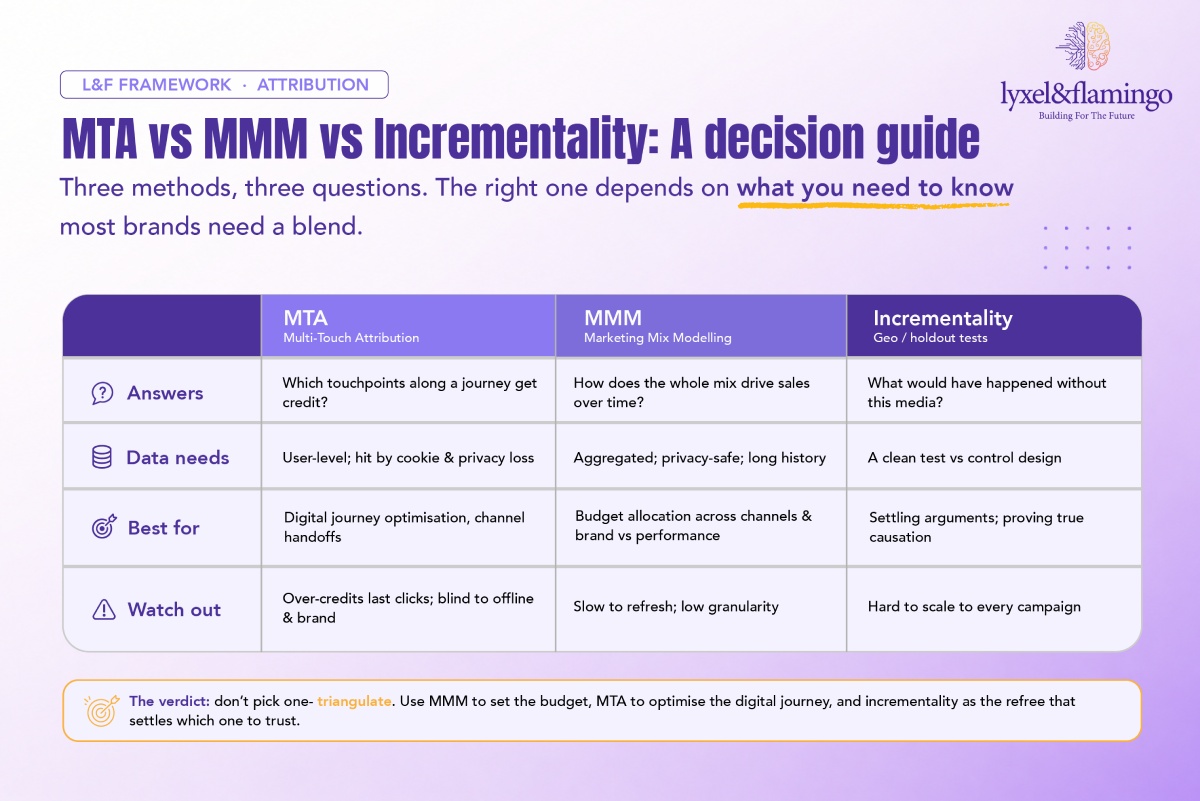
Framework: MTA vs MMM vs Incrementality three methods, three questions, one blended answer.
As a starting heuristic:
01. If your question is “How do my digital channels hand off and where does the journey leak?” Reach for MTA, but treat its numbers as directional, not gospel.
02. If your question is “How should I split budget across channels and between brand and performance?” Reach for MMM, especially if you have offline media or a long history.
03. If your question is “Did this actually cause sales, or would they have happened anyway?” Run an incrementality test and use it to check whatever the models are telling you.If you are a smaller or younger brand without the data history for MMM or the scale for clean tests, start with clean event data and a simple geo holdout on your biggest channel; it beats an over-engineered model built on thin data.
Why the answer is to triangulate, not choose
Each method has a blind spot that another covers. MTA is granular but privacy-hobbled and brand-blind. MMM is comprehensive but slow and coarse. Incrementality is causal but hard to scale. Lean on any one alone, and you inherit its blind spot as your strategy.
So the mature operating model triangulates: Use MMM to set the budget envelope, MTA to optimise the journey within it, and incrementality to validate and calibrate both. When a number survives all three lenses, you can take it to the board. This is exactly the logic behind blending MMM, incrementality and platform signals into one stack, and it is why “which model is best?” is the wrong question. The best model is the system.
Related Read: Marketing ROI Proof Points
A blend in practice
Two examples show triangulation earning its keep. For IndiGo, a brand-control incrementality design, the experimental method, not a click model, proved 48% incremental sales at the same ROAS. No multi-touch report could have produced that number, because the value was causal and partly brand-driven; only a holdout could isolate it, and it changed how the brand budget was defended.
For Diamond Chemistry, the question was a mix question about how to split investment across Google and Meta for a US B2B audience, and the answer came from reading the two platforms as one system rather than trusting each platform’s self-reported, last-click-flattered numbers. Blending the mix view with disciplined testing turned two competing platform dashboards into one coherent allocation decision. Different questions, different primary instruments, same principle: match the method to the decision, then cross-check.
Self-check: is your attribution fit for purpose?
Score your own setup, one point per yes:
- You can name which decision each of your attribution methods is meant to inform.
- You do not rely on a single model as the whole truth.
- Your budget-allocation decisions draw on MMM or an equivalent aggregate view.
- You run at least one incrementality or geo-lift test each quarter.
- You treat platform-reported (self-attributed) numbers as claims to verify, not facts.
- Your event data is clean enough to trust whatever model sits on top of it.
- Marketing and finance accept the same attribution outputs.
Five or more and your attribution is a system. Three or fewer and you are probably defending one model past its limits.
Key takeaways
- MTA, MMM, and incrementality answer different questions: journey credit, budget allocation, and true causation, respectively.
- MTA is granular but privacy-hobbled and brand-blind; MMM is comprehensive but slow and coarse; incrementality is causal but hard to scale.
- Match the method to the decision: MTA for journey optimisation, MMM for budget, incrementality to prove and calibrate.
- The mature answer is to triangulate all three, not crown one winner; a number that survives all three lenses is board-ready.
- Treat platform self-attribution as a claim to verify, and keep event data clean, or every model on top of it will lie.
For how these attribution signals roll up into the metrics leadership actually tracks, see Leading vs Lagging Marketing KPIs: The 4-S Signal Funnel for Full-Funnel Growth.
Closing
The search for the one perfect attribution model is a search for something that does not exist. Every method is a lens, and every lens has a blind spot. The teams that measure best are not the ones with the cleverest single model; they are the ones who stopped arguing about which instrument to trust and started using each for what it does well, cross-checking the answers, and steering by the picture all three paint together.
Want help building an attribution system, not just picking a model?
L&F designs the measurement stack the right mix of MMM, multi-touch, and incrementality on a clean data foundation for consumer brands across India and worldwide. We will map which method should drive which decision, and where your current setup is quietly lying to you. Talk to L&F about attribution and turn three models into one honest answer.
Frequently Asked Questions
Multi-touch attribution (MTA) works at the individual level, tracking a person's touchpoints and splitting credit across them, it is granular but needs user-level data and is blind to offline and brand. Marketing mix modelling (MMM) works at the aggregate level, using historical spend and sales to estimate how the whole mix drove results, it is privacy-safe and sees everything including brand and offline, but is slower and less granular. MTA optimises the digital journey; MMM allocates the budget.
It is more rigorous, but not a replacement. Incrementality answers the causal question, what would have happened without this media through a controlled experiment, so it is the closest thing to truth. But you cannot run a clean test on every campaign continuously, so it is best used surgically to validate big bets and calibrate the models (MTA and MMM) you run all the time. Think of it as the referee, not the whole game.
Usually the simplest rigorous option: clean event data plus a basic geo holdout on your biggest channel. MMM needs a long data history to be reliable, and granular MTA needs scale and tracking most young brands lack. A simple incrementality test on your largest spend line tells you more, more cheaply, than an elaborate model built on thin data. Add sophistication as your data and budget grow.
It kills the easy version. Cookie deprecation and privacy changes badly weaken user-level MTA, which depended on tracking individuals across sites and devices. That is exactly why the industry is shifting toward privacy-safe MMM and experiment-based incrementality, neither of which relies on third-party cookies. Attribution is not dead it is moving from tracking individuals to modelling aggregates and running experiments.
At least once a quarter on a major channel or bet, and whenever you are about to make a big allocation change. The goal is not to test everything constantly that is impractical but to keep a recent, causal read on your biggest spend lines and to recalibrate your continuous models against reality. A cadence of one well-designed test per quarter is enough to keep the whole system honest for most brands.
No, treat them as claims to verify, not facts. Each platform self-attributes using its own last-click-leaning logic, so if you add up what Meta, Google and every other platform claim, you will 'prove' far more sales than you actually made. Platform numbers are useful for in-platform optimisation, but for allocation and truth you need an independent view from MMM and incrementality that does not have a stake in the answer.
In a loop. MMM sets the budget envelope across channels and between brand and performance; MTA optimises the journey within the digital channels; incrementality tests validate whether the effects the models claim are real, and feed corrections back into both. Run continuously, this triangulation gives you allocation, optimisation and causal proof at once, which is why the modern answer is a blended stack rather than a single chosen model.