
What a Media Mix Really Is Once You Read It by Stage
The right media mix for a startup is the wrong one for a category leader. This blog gives a stage-based framework: startup, scaling, leader, and shows how boAt and Kurlon mixed media for their very different stages.
Table of Contents
- What Is This?
- Why the Wrong-Stage Mix Quietly Caps Your Growth
- The Four Ways a Media Mix Drifts Off Stage
- Framework: Growth-Stage Media Mix
- Inside the Mix: What Each Stage Fixes
- Common Pitfalls to Avoid
- How to Name Your Stage, Then Build the Mix
- What a Stage-Matched Mix Actually Feels Like
- Signals to Watch
- Same Agency, Opposite Mixes: boAt and Kurlon
- Score Your Own Media Mix: A Quick Self-Check
- Key Takeaways
- The Read That Everything Downstream Depends
What Is This?
A media mix is the allocation of budget across channels and funnel stages. The optimal mix is not fixed: it shifts with your growth stage. A startup proving demand, a scale-up lifting its ceiling, and a category leader defending share each need a different balance of reach, activation and retention.
- Startup: prove demand converts-narrow, activation-led, tight geographies.
- Scaling: add upper funnel to lift the demand ceiling, moving toward a 60/40 balance.
- Leader: defend share of search and retention with broad reach and brand.
The mix is not a channel list but a stage-based allocation: the same brand should look different in market at each phase of its growth, because the constraint it is solving for proving demand, lifting the ceiling, or defending share, changes as it scales.
Why the Wrong-Stage Mix Quietly Caps Your Growth
Because copying a leader’s mix at startup stage, or vice versa, wastes money. Growth comes from matching investment to your position: build mental availability as you scale, defend share of search once you lead (Ehrenberg-Bass Institute).
And because AI has changed what a small team can run: generative tooling lets scaling brands operate a broader, more upper-funnel mix affordably, worth up to 5-15% of marketing spend in productivity (McKinsey).
The most expensive mistake is a scaling brand running a startup’s activation-only mix. It looks efficient right up to the moment volume plateaus and CAC climbs: the tell-tale signature of a demand ceiling that no amount of bottom-funnel optimisation can lift. Matching the mix to the stage is what keeps growth compounding.
The Four Ways a Media Mix Drifts Off Stage
- The mix is inherited or copied, not matched to the brand’s actual stage.
- Scaling brands stay stuck in pure-activation mode and hit a demand ceiling.
- Leaders keep buying like challengers and let share of search erode.
- No trigger for when to add the next channel or funnel stage.
Framework: Growth-Stage Media Mix
Three Positions, Three Different Jobs
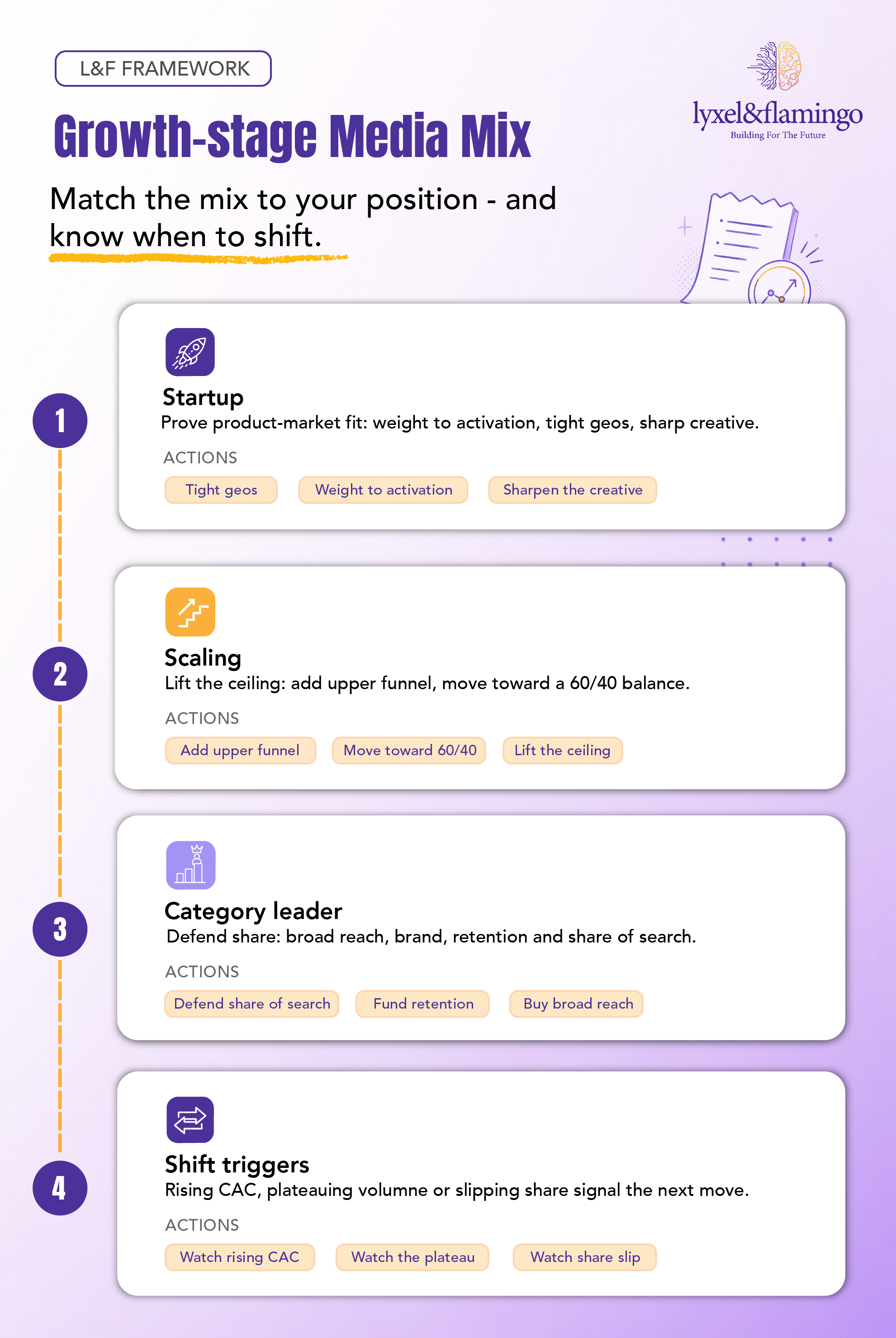
Match the mix to your position and know when to shift.
Inside the Mix: What Each Stage Fixes
01. Startup:
The problem it fixes: Startups copy a leader’s broad, brand-heavy mix and burn cash before proving demand converts.
How this layer solves it: The startup play spends narrow and deep tight geos, activation-led, sharp creative to prove the unit economics before widening the funnel.
In practice: At startup stage, keep geos tight and creative sharp, and prove that activation converts before you widen the funnel.
02. Scaling:
The problem it fixes: Scaling brands stay in pure-activation mode, hit a wall of expensive, exhausted demand, and mistake the plateau for a channel problem.
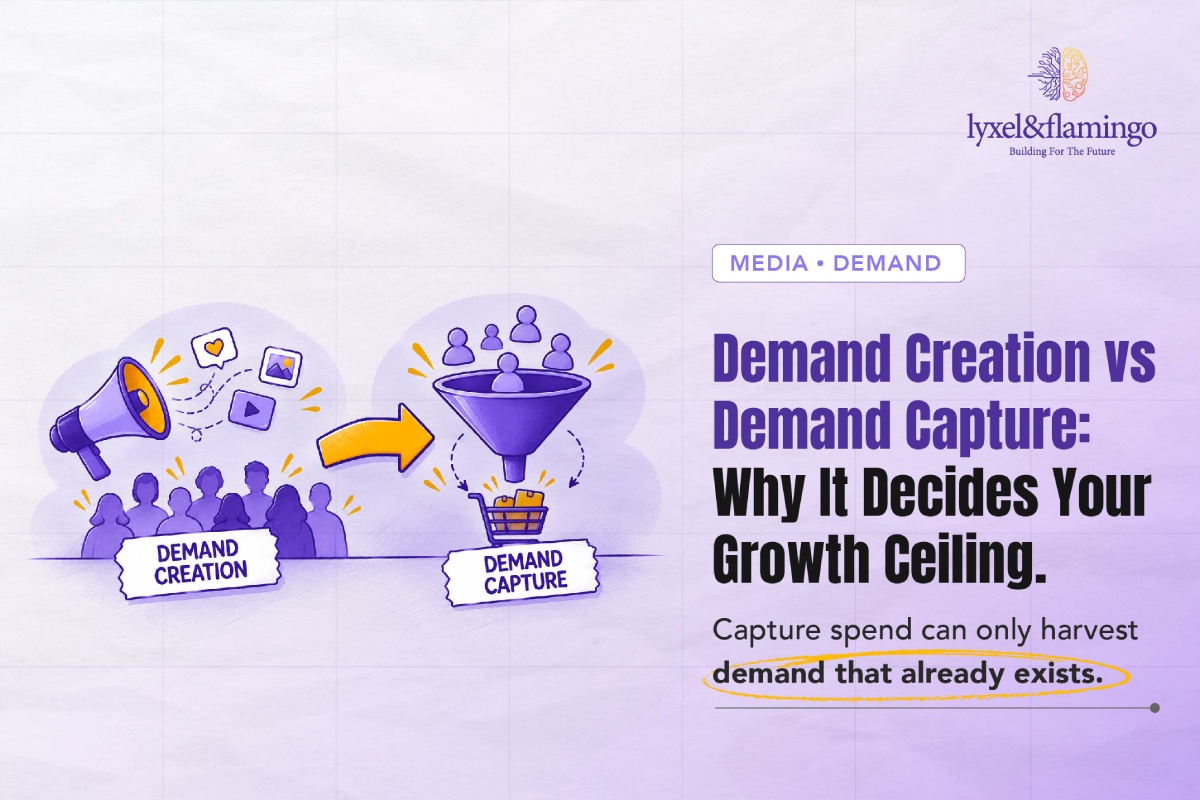
How this layer solves it: The scaling play adds upper funnel to lift the demand ceiling and moves toward a 60/40 balance, so there is more demand for activation to capture.
In practice: At scaling stage, fund a defined upper-funnel line and move toward 60/40: this is the moment most brands wrongly skip.
03. Category leader:
The problem it fixes: Leaders keep buying like challengers and let share of search erode to hungrier rivals.
How this layer solves it: The leader play shifts to defence: broad reach, brand and retention protecting the share of search and loyalty that others are attacking.
In practice: As a leader, protect share of search and retention budgets first; they are what challengers are actively attacking.
04. Shift triggers:
The problem it fixes: Teams change the mix on gut feel or not at all, missing the moment the stage has shifted.
How this layer solves it: Explicit shift triggers rising CAC, plateauing volume, slipping share, tell you exactly when to move to the next stage’s mix, so the decision is evidence-led.
In practice: Wire the triggers into your dashboard: rising CAC, plateauing volume, slipping share, so the shift is evidence-led.
Common Pitfalls to Avoid
- Running a scaling brand on a startup’s activation-only mix, then blaming the channel when volume plateaus.
- Adding upper funnel too early, before you have proven the unit economics convert.
- Leaders coasting on past reach while share of search quietly erodes to hungrier challengers.
- Changing the mix on gut feel, or not at all, instead of on defined triggers.
How to Name Your Stage, Then Build the Mix
Start by naming your stage honestly. If you are still proving that demand converts, you are a startup and should spend narrow and deep. If activation costs are climbing and volume is plateauing, you are scaling and have hit a demand ceiling. If you are defending a leading position, your job is to protect share, not just acquire.
Then build the mix that matches. A startup weights to activation in tight geographies with sharp creative. A scaling brand funds a defined upper-funnel line and moves toward a 60/40 balance to lift the ceiling. A leader shifts budget to broad reach, brand and retention, and actively defends share of search against challengers.
Finally, wire the triggers into your reporting so the next shift is evidence-led. Rising CAC, plateauing volume and slipping share of search are the market telling you the stage has changed. Review quarterly, but only move when a trigger fires: constant churn stops both the algorithm and the brand from ever building momentum.
What a Stage-Matched Mix Actually Feels Like
A well-matched mix is quietly boring in the best way: it fits the stage the business is actually in. A startup’s plan is narrow, sharp and activation-led; a scaling brand’s plan has a deliberate, funded upper-funnel line; a leader’s plan is broad and defensive. Nobody is copying a competitor, and nobody is running last year’s mix out of habit. The plan changes when the business changes, and not before.
The signals to watch are the stage-transition triggers. Rising CAC at steady creative quality and plateauing volume together mean you have hit a demand ceiling and need more upper funnel. Slipping share of search means a leader is under attack and should shift to defence. When those triggers are on the dashboard, the mix decision stops being a debate and becomes a read.
The payoff is that growth keeps compounding instead of stalling at a ceiling. The most common failure we see is a scaling brand running a startup’s activation-only mix for a year too long posting healthy ROAS while volume flatlines and CAC creeps up. Matching the mix to the stage is what turns that plateau back into a growth curve.
Signals to Watch
- CAC trend at steady creative quality.
- Volume plateau versus continued growth.
- Share of search (for leaders under attack).
- Upper-funnel funding as you scale.
Same Agency, Opposite Mixes: boAt and Kurlon
For boAt’s Nirvana launch, it was a scaling-stage play: build reach and consideration for a new line, hitting a 44% video view rate and lifting sub-brand search 42%. For Kurlon, a category incumbent, ran the leader’s mix full-funnel breadth that defended and grew share, ending in 25X revenue from Google. Same agency, opposite mixes, because the stages were opposite.
The reason the same agency ran opposite mixes is that boAt and Kurlon were solving opposite problems. boAt Nirvana needed to manufacture consideration for a line that did not yet exist, so reach and video led. Kurlon needed to defend and extend a category-leader position, so breadth across the funnel led. Copy either mix onto the wrong stage and the economics break.
The right mix connects to the rest of the system: it delivers the full-funnel media engine at your stage, decides your always-on vs burst phasing, builds mental availability as you scale, and turns into profitable performance at the bottom.
Score Your Own Media Mix: A Quick Self-Check
Score your operation. One point per yes.
- Stage
You can name your current stage: startup, scaling or leader, and your mix matches it.
- Ceiling
If scaling, upper funnel is funded to lift the demand ceiling.
- Defence
If leading, share of search and retention are actively defended.
- Triggers
Clear signals (rising CAC, plateau, share slip) trigger the next mix shift.
Key Takeaways
- There is no universal mix—match it to startup, scaling or leader stage.
- Scaling brands must add upper funnel or hit a demand ceiling.
- Leaders defend share of search and retention, not just conversions.
- boAt (scaling) vs Kurlon (leader): opposite mixes, both right for their stage.
The Read That Everything Downstream Depends
Before you argue about channels, agree on your stage. The mix follows from it. And watch the triggers: rising CAC and plateauing volume are the market telling you it is time to shift.
The stage you are in will change, and the mix should change with it, but only on evidence, never on impulse. The brands that scale cleanly treat the mix as a deliberate response to a named constraint, review it on a cadence, and move decisively the moment a trigger fires. Everything downstream: efficiency, growth, defensibility, depends on getting that read right.
Frequently Asked Questions
Look at demand: if you're proving it, you're a startup; if you're hitting a ceiling, you're scaling; if you're defending share, you're a leader.
When activation costs start climbing and volume plateaus: that's the demand ceiling, and only upper funnel lifts it.
Yes, but weighted toward defence, retention and share of search, not pure acquisition.
Yes, AI production makes a broader, upper-funnel mix affordable for smaller teams, worth up to 5-15% of spend in productivity (McKinsey).
Review quarterly, but only shift when a trigger fires. Constant churn prevents learning.
Running a scaling brand on a startup's activation-only mix. It looks efficient right up to the plateau, then CAC climbs and everyone blames the channel, when the real problem is a demand ceiling that only upper funnel can lift.
Review quarterly, but only shift when a trigger fires: rising CAC, plateauing volume, or slipping share of search. Constant churn stops the algorithm and the brand from building momentum; deliberate, trigger-based change keeps the mix matched to your stage.