What this blog covers
Marketplace brand protection rests on four habits: register the brand and control the catalogue data, monitor listings and sellers on a schedule, enforce through the platform’s reporting channels with solid evidence, and manage the review damage that follows. Early protection works better than late cleanup, as the Lotto Sport engagement on Myntra shows, where brand protection came in within the first week of the campaign. Clean listings also keep the product facts that search engines and AI assistants read accurate.
Quick Answer: Register your trademarks and enrol in each marketplace’s brand registry programme, build an authorised seller list and a content standard for every SKU, and monitor listings weekly for new sellers, price drops, content edits and suspicious reviews. Document every case with screenshots, order IDs and test purchases, report through the platform’s official forms, and escalate repeat offenders. Respond to damaged reviews with replacements and clear public replies, and keep your own site’s product data consistent so that engines have a trustworthy reference.
Table of Contents
Three Threats, Three Different Fixes
Hijackers are sellers who list against your product page, often with genuine or grey-market stock, and compete on price. They win sales and hand customers an experience you cannot steer.
Counterfeiters sell fake goods under your brand or a close copy. They create safety risks, returns and reputational damage, and they spread fast when a listing ranks well.
Listing tampering covers unauthorised changes to titles, images, bullets or specifications on your listing, whether by malice, by a competitor or by a careless reseller with catalogue access.
Each threat needs its own response. Hijackers call for authorised seller rules and pricing policy. Counterfeits call for trademark enforcement and test purchases. Tampering calls for access control and content monitoring. Our guide on winning the Amazon Buy Box explains why hijackers can take sales so quickly, and our piece on Amazon account suspension is a useful reminder that platform policies work in both directions.
Build the Foundation: Registration and a Catalogue Standard
Start before anything goes wrong. Register your trademarks in the markets where you sell, and enrol in the brand registry or brand protection programme of each marketplace. Registered brand owners usually receive better tools for reporting violations and for controlling product detail pages, and programme names and features differ by platform, so check the current rules.
Document the catalogue. Keep a master record for every SKU with the approved title, images, bullets, specifications, barcodes, pack sizes and weights. This record is your evidence when a listing changes, and your reference for fixing it.
Define your distribution rules in writing. List authorised sellers and distributors, state minimum advertised price policies where lawful, and require partners to follow content standards. Check pricing policies with your legal advisers, since rules vary by market. Make sure partners know how to report problems to you quickly.
Monitor on a Schedule
Monitoring turns surprises into routine. Check your top SKUs weekly and the long tail monthly, and set alerts where the platform or a monitoring tool allows them.
Watch for new sellers on your listings, sudden price drops below your policy, changes to titles, images or bullets, new variations attached to your parent listing, review spikes with unusual wording and complaints about quality or packaging that suggest fakes.
Use test purchases. Buy from suspicious sellers and inspect the product, packaging, batch codes and invoice. A test purchase gives you evidence that reports rarely have without it.
Make the process visible. A shared tracker with the date, SKU, seller, issue, evidence and status lets the team see patterns and avoid duplicate work. Our guide on marketplace KPIs shows how to add protection metrics, such as Buy Box share and time to resolve cases, alongside sales metrics.
Enforce With Evidence
Report through the marketplace’s official channels, and give each report clean evidence: your trademark registration, the listing URL, the seller name, screenshots with dates, test purchase photos and a short factual description of the violation. Reports that read like a checklist get processed faster than reports that read like a complaint.
Escalate in steps. Start with the platform’s reporting tool, follow up through your account manager or seller support if the platform offers one, and move to a formal legal notice for repeat or serious cases, with your lawyers involved. Keep copies of everything.
Keep the focus on facts and policy. Avoid public accusations or retaliation against sellers, since false claims can lead to penalties on your own account. Our guide on removing negative seller feedback on Amazon shows how disputes flow through the platform’s own processes.
Timing matters. The Lotto Sport case study, which covers the brand’s Myntra campaign during the 2025 festive season, reports that brand protection was introduced within the first week. The page presents it as one of several early moves, and it reports its own set of results, so treat it as an example of early protection and avoid reading any single result as caused by it alone. See the Lotto Sport case study for the full account.
Repair Reviews and Rank
Counterfeits and hijackers damage reviews, and reviews feed rank and conversion. When a bad experience traces back to another seller, document it and report it, then reply publicly in a calm, helpful way that points shoppers to the genuine product and your support channel.
Offer replacements or refunds to affected customers where you can verify the problem, and ask satisfied customers for reviews through the platform’s approved methods. Never buy or incentivise reviews in ways the platform forbids.
Use review text as intelligence. Complaints about packaging, missing parts or strange smells often point to fakes and sometimes to a grey-market batch. Our guide on Amazon reviews as a hidden goldmine shows how to read them for signals, and the piece on marketplace creative audits explains why a healthy listing needs both strong content and clean ownership.
Why Clean Listings Matter for Search and AI
Marketplace listings are among the sources that search engines and AI shopping assistants read about your products. A hijacked listing can show wrong prices, a tampered one can show wrong specifications, and a flood of bad reviews can colour how assistants describe the product.
Corrupted data spreads because engines compare sources. When your website, your authorised listings and the marketplace agree, confidence rises. When a rogue listing contradicts them, assistants may quote the wrong detail or skip the product. Our GEO playbook explains how consistent facts earn citations, and our piece on generative AI in online shopping shows how marketplaces use such systems.
Keep your own site as the reference. Google’s product structured data documentation explains how to mark up product facts, and Google’s page on AI features in Search says standard SEO fundamentals apply, so accurate, crawlable product pages remain the anchor.
The Brand Protection Framework
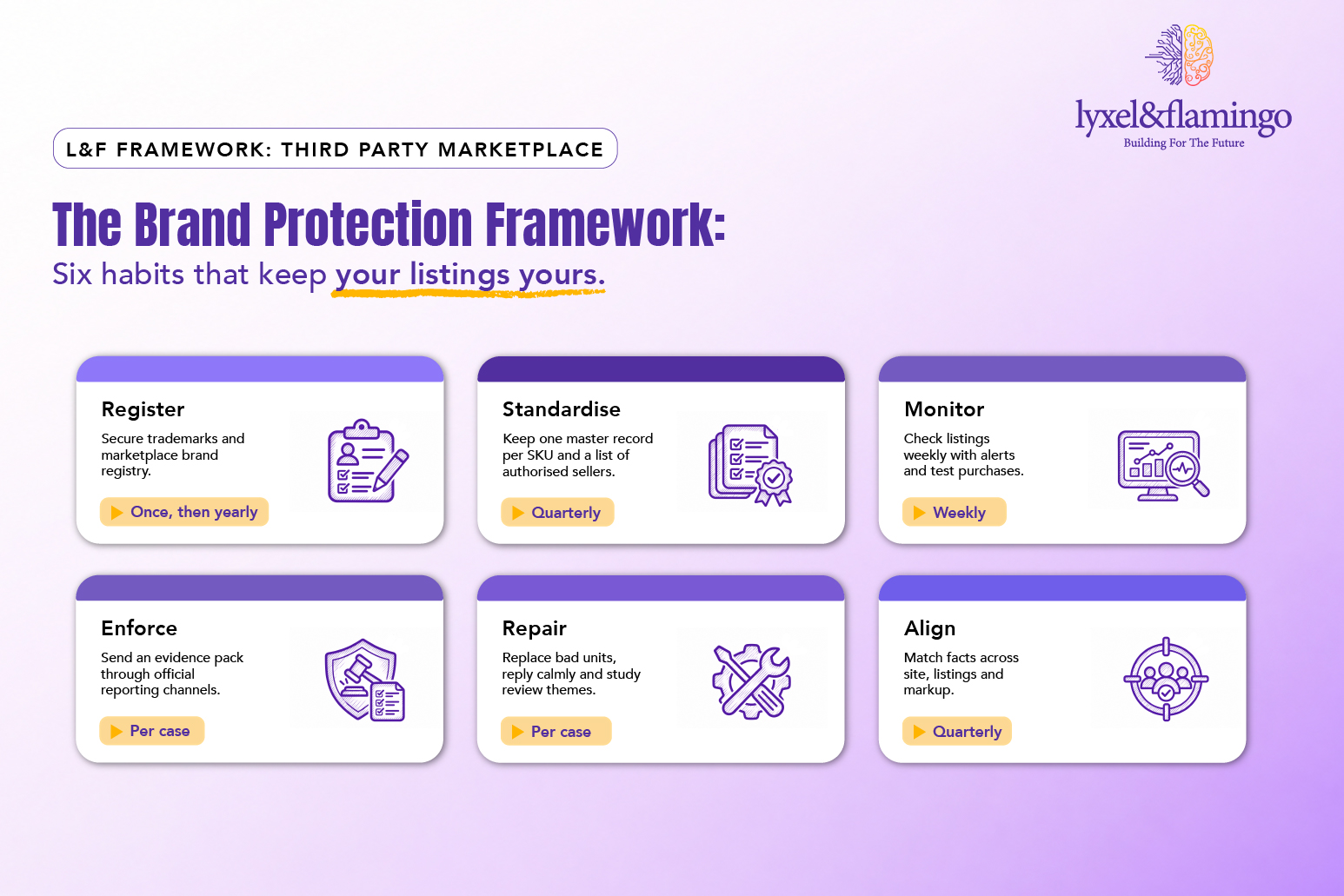
Framework Explained
Run the six steps as a standing routine. Early steps build your rights and records, and later steps use them when something goes wrong.
Step 1: Register. Secure trademarks and enrol in each marketplace’s brand registry. Enrolment unlocks reporting tools that general sellers cannot use. Check: every sales channel has an active registry entry.
Step 2: Standardise. Keep a master record for each SKU with titles, images, specifications and pack details, and a list of authorised sellers. Check: anyone on the team can say who may sell each product.
Step 3: Monitor. Check top listings weekly for new sellers, changed content and price drops, set alerts where tools allow and make test purchases when quality is in doubt. Check: a weekly log exists with dates and findings.
Step 4: Enforce. When you find a violation, send an evidence pack through the marketplace’s official reporting route, with screenshots, order records and proof of rights. Check: each case has an owner and a follow-up date.
Step 5: Repair. Replace faulty units, reply to affected reviews calmly and study review themes for product fixes. Check: review replies go out within a set number of days.
Step 6: Align. Keep facts identical across your site, listings and markup so shoppers, search engines and assistants see one version. Check: a quarterly audit compares the three sources.
CASE STUDY NOTE: In the Lotto Sport Italia engagement on Myntra, Lyxel&Flamingo introduced brand protection within the first week of the campaign, as one of several early moves described in the case study. Read the full Lotto Sport case study. The page publishes results for the whole programme, and none are attributed to brand protection alone.
Client Proof From Our Work
Brand protection pays when it starts early and stays steady. Both engagements below protected brand terms before widening reach.
The Lotto Sport case lists brand protection as one early action among several, so none of its results belongs to that step alone. The Body Shop figures carry zero period label.
Key Takeaways
- Hijackers, counterfeits and listing tampering are different threats that need different fixes.
- Register the brand, keep a master catalogue record and define authorised sellers in writing.
- Monitor weekly, use test purchases and keep a shared case tracker.
- Enforce through official channels with solid evidence, and escalate in steps.
- Clean listings keep product facts consistent for search engines and AI assistants.
CXO Takeaway
Could you list every seller currently on your top ten listings, and say which ones you authorised? If the answer is a shrug, monitoring is the first gap to close. Lyxel&Flamingo’s marketplace team builds brand protection into marketplace programmes from the start.
Frequently Asked Questions
A seller who lists against your existing product page, often competing on price and winning the Buy Box, with an experience you cannot steer.
Through the platform's official brand protection or reporting tools, with trademark proof, listing URLs, screenshots and test purchase evidence.
Enrol in the brand registry programme, limit who has catalogue access, keep a master record and monitor listings for edits.
It can, since corrupted listings feed wrong prices and specifications into the sources that assistants read, so clean, consistent data helps them answer correctly.