What this blog covers
Good repricing treats price as one lever with limits. Every SKU needs a margin-based floor, a ceiling tied to brand policy, a defined comparison set and rules that respond to stock, competitor availability and sales velocity. Guardrails such as change limits and cool-down periods prevent price wars, and measurement should track margin per unit and Buy Box share alongside revenue. Consistent pricing across your site and marketplaces also supports shopping answers that compare sources.
Quick Answer: Set a floor for every SKU that covers product cost, marketplace fees, fulfilment, returns allowance and a minimum margin. Compare only against relevant competitors, meaning similar offers with similar fulfilment and seller ratings. Use different rules for different situations: hold price when you own the Buy Box, move within a narrow band to win it back, and raise price when rivals sell out. Cap how often and how far prices can move in a day, review top SKUs by hand and track margin per unit, beyond sales alone.
Table of Contents
Why Repricing Tools Start Price Wars
A repricer reacts to competitor prices faster than any person can. Two repricers pointed at each other react to every move, and each cut triggers another. Without a floor, the loop continues until someone’s margin disappears.
Price also feeds visibility. Marketplace algorithms reward competitive prices, and our guide on how to win the Amazon Buy Box explains that price works alongside availability, fulfilment method and seller performance. Chasing the lowest number can win the Buy Box and still lose money, since the sale that costs more than it earns adds volume and subtracts profit.
The festive season sharpens the pressure. Our piece on defending ROAS in the festive bidding war describes how competitive intensity rises, and price rules built in advance protect a team from decisions made in panic.
Floors, Ceilings and the Margin Math
Start with the floor. For each SKU, add landed product cost, marketplace referral or commission fee, fulfilment and shipping cost, an allowance for returns and damages, advertising cost per unit if it applies, and the minimum margin you accept. The result is the lowest price at which a sale still makes sense.
Calculate floors by SKU, since fees and costs differ. A heavy item with high return rates needs a bigger buffer than a light item with steady demand. Store the floor in your catalogue and update it when costs, fees or exchange rates change.
Set a ceiling too. A ceiling stops the tool from raising prices to levels that damage brand perception or break a minimum advertised price policy. If you sell the same product on your own site, align the ceiling with that price.
Choosing Who to Price Against
A repricer needs a comparison set, and a careless one causes bad decisions. Match against offers that shoppers genuinely compare: the same product, a similar condition, comparable fulfilment speed and a seller rating in a similar range.
Exclude sellers who distort the signal. A brand-new seller without reviews and a rock-bottom price may be a loss leader, a counterfeit risk or a temporary glitch. Our guide on removing negative seller feedback on Amazon shows how sellers use the platform’s own channels for disputes, and chasing a doubtful seller with price rarely helps.
Distinguish retailers from sellers on the same listing. If the marketplace itself, or a large retailer, sells the product at a fixed price, you may choose to hold your own price and compete on service and availability.
Rule Types for Different Situations
One rule cannot fit every moment, so build a small set and assign each SKU to the one that suits it.
Hold: When you own the Buy Box and sales run well, keep price steady. Frequent changes add noise and gain little.
Match within a band: When you lose the Buy Box, move toward the competitor price in small steps, only down to your floor. Stop at the floor and look at other levers, such as fulfilment speed or availability.
Raise on scarcity: When competitors sell out, raise price gradually toward your ceiling, since demand has fewer places to go. Return to normal when they restock.
Velocity-aware: Link price to stock. When inventory runs low relative to sales, lift price to slow depletion, and when stock builds up, lower price to clear it. Our guide on festive season inventory and Buy Box strategy shows how stock and price work together.
Scheduled: Pre-set prices for known events, such as sale days, and return to normal afterwards.
Guardrails That Stop Runaway Loops
Guardrails keep automation safe. Limit how many times a price can change per day and how far it can move in a step, for instance a few percent at most in one step. Add a cool-down, so that after a change the tool waits before the next one.
Alert on anomalies: a price falling by a large share within an hour, a SKU sitting at its floor for days, or a sudden volume spike that suggests a pricing error. Pause the rule automatically when an alert fires and ask a person to look.
Review the top SKUs by revenue manually each week, and keep a log of rule changes. If you suspect a rival’s tool is reacting to yours, widen your band, lengthen your cool-down or hold price. Keep your pricing decisions independent: avoid discussing future prices with competitors, and check local competition law with your legal advisers if in doubt.
Price Consistency Beyond the Marketplace
Price is one of the first facts a shopper compares, and AI shopping assistants compare it too, across marketplaces, brand sites and retailers. When one source shows a price far from the others, assistants may favour the cheaper source, skip yours or show confusing answers. Our piece on generative AI in online shopping explains how marketplaces use these systems.
Keep your own site in line. Google’s product structured data documentation covers merchant listings, which depend on accurate price and availability, so a mismatch between markup and page can harm eligibility. Our GEO playbook explains why consistent facts across sources raise the chance of being cited.
Track results in terms that matter. Use margin per unit, contribution margin, Buy Box share, units sold and conversion rate together, as in our guide on marketplace KPIs for festive sales, and compare against a control group of SKUs on manual pricing where possible.
The Repricing Rule Framework
Framework Explained
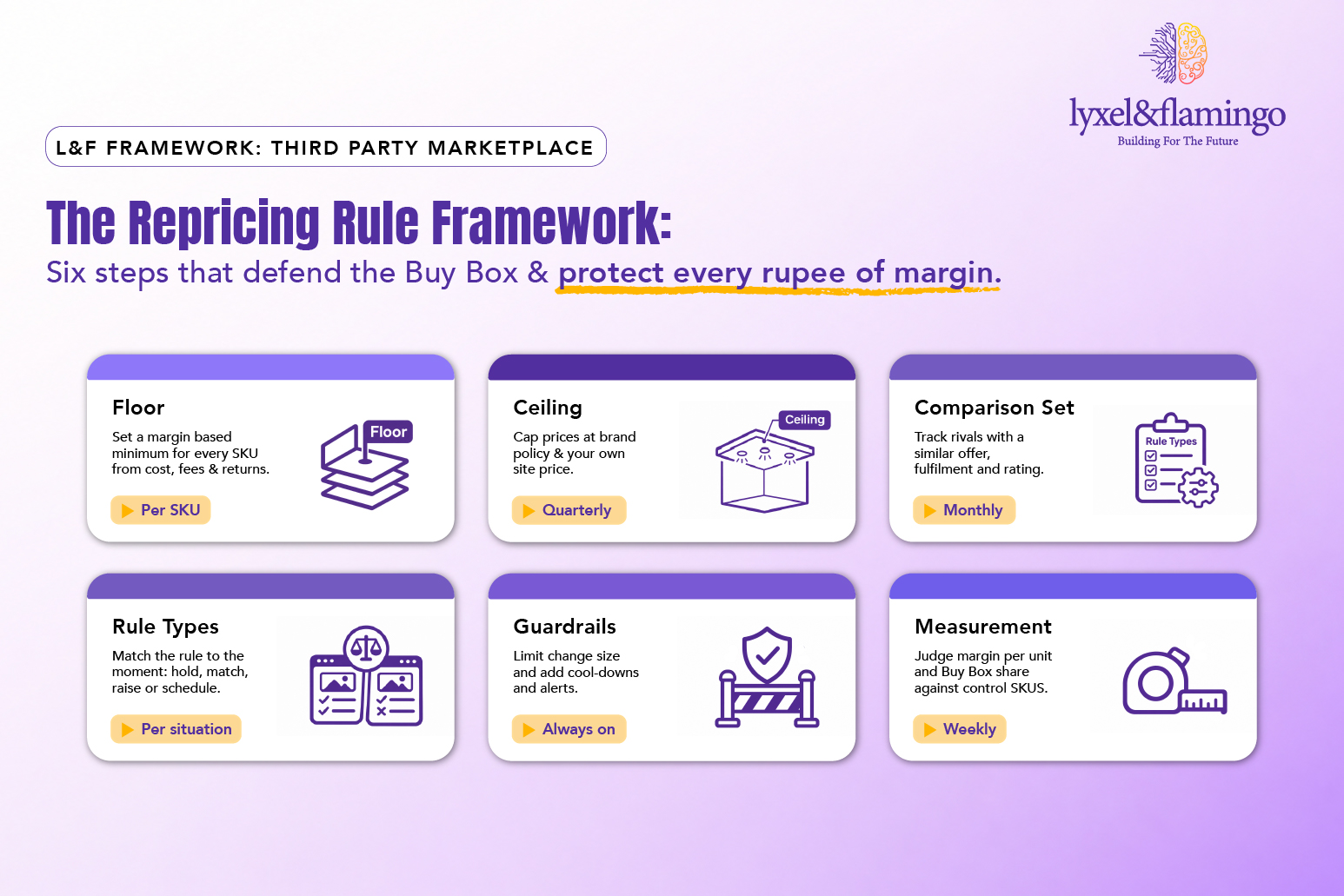
Run the framework in order. Each step has one job, one owner and one check, and the first two steps set the limits that every later rule must respect.
Step 1: Floor. Start with cost. Add landed cost, marketplace fees, shipping, expected returns and the minimum margin you accept, then set the lowest price the tool may ever show. Check: every SKU holds above its floor, even during a promotion.
Step 2: Ceiling. Set the highest price the tool may charge, tied to your own site price and any minimum advertised price. Shoppers compare across channels, so a marketplace price far above your site invites doubt. Check: ceilings are reviewed each quarter.
Step 3: Comparison Set. Choose the rivals that matter. Pick sellers with a similar offer, fulfilment method and rating, and exclude sellers with different stock or poor ratings. Check: the comparison set for each hero SKU fits on one page.
Step 4: Rule Types. Pick a rule for each situation: hold when you win already, match inside a band when you trail, raise when rivals run out of stock and use schedules for events. Check: every active rule has a written reason.
Step 5: Guardrails. Cap how far and how fast a price may move, add a cool-down between changes and send an alert when a price hits its floor. Guardrails stop two tools from chasing each other into a loss. Check: each price changes once at most inside the cool-down.
Step 6: Measurement. Judge rules on margin per unit and Buy Box share beside revenue, and keep a few control SKUs on manual pricing for comparison. Check: each rule reports a result against its control every week.
CAPABILITY NOTE: Lyxel&Flamingo’s marketplace team designs pricing, advertising and content strategy together as part of third-party marketplace engagements. This guide shares the working approach and points to related client engagements in the proof section.
Client Proof From Our Work
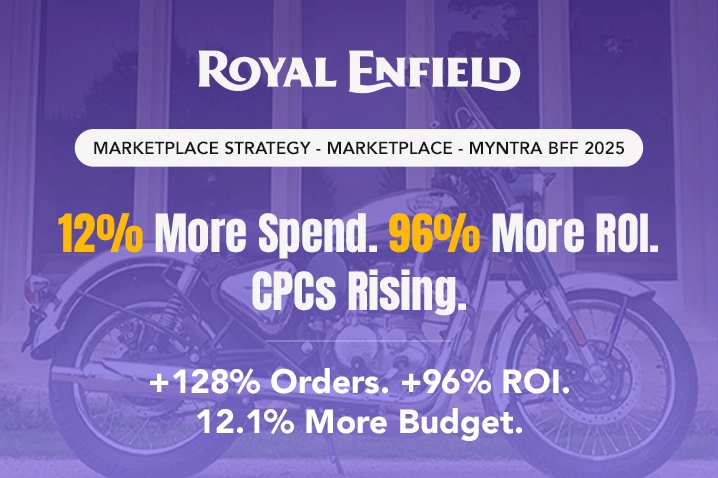
Repricing rules are one expression of a wider habit: spend and price only where the return is understood. These two marketplace engagements show that habit in budget form.
Neither case is a repricing programme, so read them as evidence of margin-aware marketplace management. Your own rules should publish a baseline, a period and a control group before anyone quotes a result.
Key Takeaways
- Repricing without floors, memory or a defined comparison set invites price wars.
- Build floors from cost, fees, returns and minimum margin for each SKU.
- Compare only against relevant offers, and use different rules for different situations.
- Cap change size and frequency, alert on anomalies and review top SKUs by hand.
- Keep price consistent across your site and marketplaces, since shoppers and AI assistants compare sources.
CXO Takeaway
What is the lowest price at which each of your top ten SKUs still makes the margin you need, and does your repricer know it? If the answer is unclear, the floor comes first. Lyxel&Flamingo’s marketplace team can build the rule set and the dashboard around it.