What this blog covers
GA4’s default channel grouping was not built with AI chatbot referrals in mind, so a meaningful and growing share of AI-driven traffic gets misclassified as Direct, quietly understating the impact of GEO work. This piece explains why the misclassification happens and how to fix it with custom channel groupings and referral exclusions, so AI-search traffic finally shows up as what it is.
Quick Answer: GA4 defaults to classifying traffic as Direct whenever it cannot confidently attribute a referrer or campaign parameter, which is exactly what happens with many AI chatbot referral links (some app-based AI clients strip referrer data, and others pass a referrer GA4’s default channel logic does not yet recognize as a distinct source). The fix is a custom channel grouping in GA4 that explicitly maps known AI referral domains (chatgpt.com, perplexity.ai, and similar) into their own channel, rather than letting them fall through into Direct or generic Referral buckets.
Table of Contents
- Why AI Traffic Ends Up in Direct
- The Referrer Data Problem, Specifically
- Building a Custom Channel Group for AI Referrals
- What This Does and Doesn’t Fix
- Cross-Checking Against Search Console’s AI Report
- Reporting This to Stakeholders Without Overstating It
- Framework Explained
- Key Takeaways
- CXO Takeaway
Why AI Traffic Ends Up in Direct
GA4’s Direct channel is, by design, a catch-all: any session GA4 cannot confidently attribute to a known source, medium, or campaign lands there. Historically this bucket mostly caught bookmarked links, typed URLs, and some email or app traffic missing UTM parameters.
AI chatbot referrals frequently fall into the same catch-all, not because they are inherently untrackable. It is because GA4’s default channel definitions were built before AI chatbots were a meaningful traffic source and have not yet been updated to treat them as their own category by default.
The Referrer Data Problem, Specifically
Some AI platforms pass a clean referrer header when a user clicks a citation link, which GA4 can technically capture. Others, particularly links opened from inside a native mobile app rather than a browser, strip or obscure that referrer entirely, and GA4 has no way to distinguish “an AI app stripped the referrer” from “a user typed the URL directly.”
This is not a GA4-specific limitation so much as a broader web-analytics problem with app-based referrers, however it compounds with GEO work in a particularly frustrating way: the traffic your GEO efforts are meant to demonstrably drive is exactly the traffic most likely to get miscounted. It also compounds unevenly by platform, since ChatGPT, Gemini and AI Overviews almost never cite the same source for the same query, so a channel group undercounting one engine’s app-based referrals can quietly skew which engine looks like it is driving more traffic than it actually is. The Interactive Advertising Bureau’s work on attribution standards is a useful outside reference for how the industry is thinking about measurement gaps like this one more broadly.
Building a Custom Channel Group for AI Referrals
The practical fix is a custom channel group in GA4 that explicitly checks the referrer or landing-page source against a known list of AI platform domains, such as chatgpt.com, perplexity.ai, gemini.google.com, and copilot.microsoft.com, before GA4 falls back to its default Direct classification. GA4’s own documentation on default channel groups explains exactly how that fallback logic works, which is the right starting point before overriding it with a custom definition. Where a platform does pass referrer data, this reliably reclassifies that traffic into its own “AI Referral” channel rather than folding it into Direct or a generic Referral bucket.
This is illustrative guidance rather than a fixed formula: the specific set of domains worth tracking will shift as AI platforms evolve, and it is worth revisiting the custom channel definition periodically rather than treating it as a one-time setup, the same ongoing-maintenance mindset covered in Search Console’s Generative AI report, which has its own separate, related measurement gaps.
What This Does and Doesn’t Fix
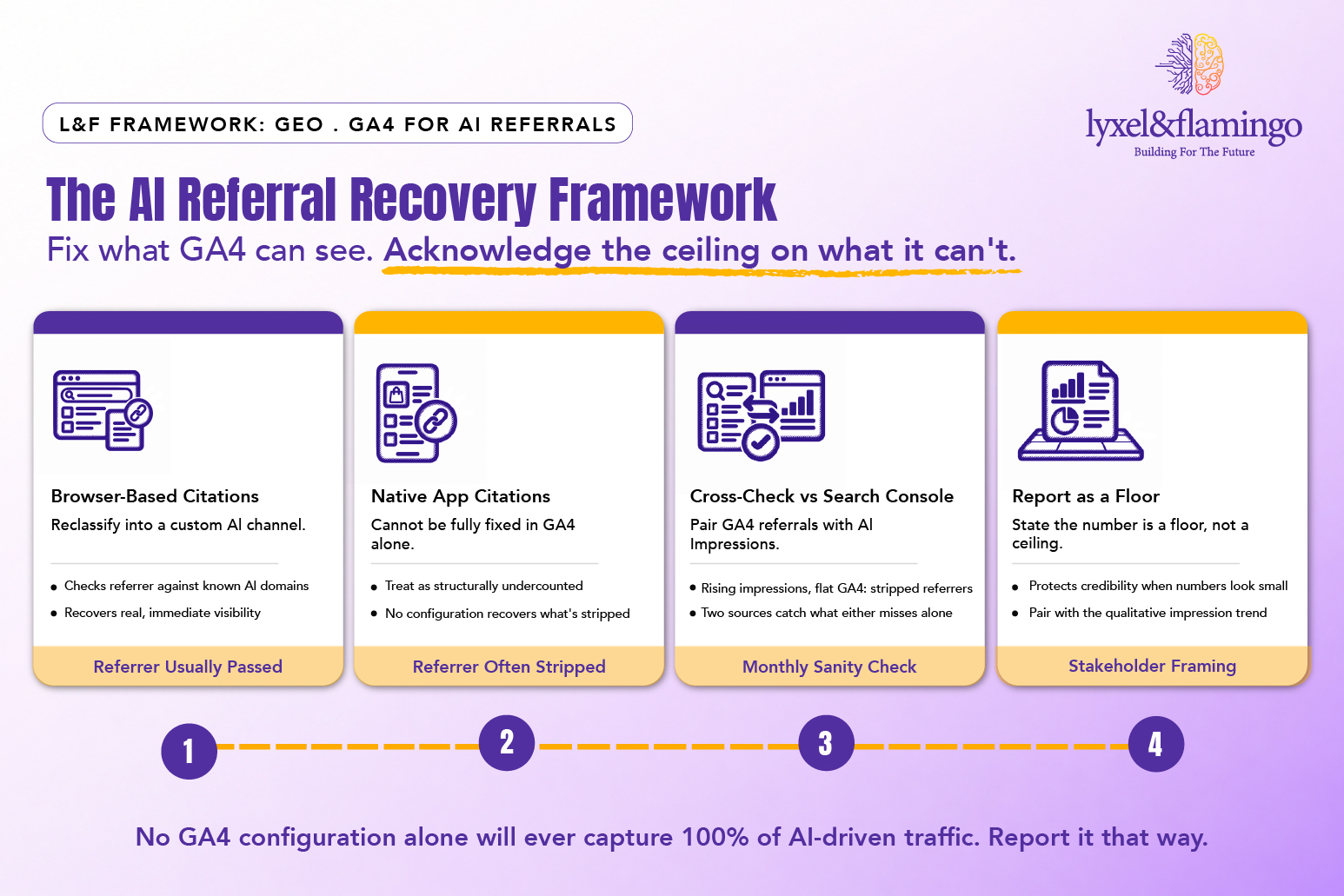
A custom channel grouping fixes classification for the AI referrals GA4 can actually see, meaning traffic where a referrer header survived the click. It does not fix the deeper problem: traffic from AI surfaces that strip referrer data entirely will still land in Direct no matter how the channel grouping is configured, because GA4 has nothing to classify against.
This gap matters when reporting results. A custom channel group will make previously hidden AI traffic visible and will very likely show growth, however it should never be presented as a complete count of all AI-driven traffic, only the portion GA4 can technically detect.
Cross-Checking Against Search Console’s AI Report
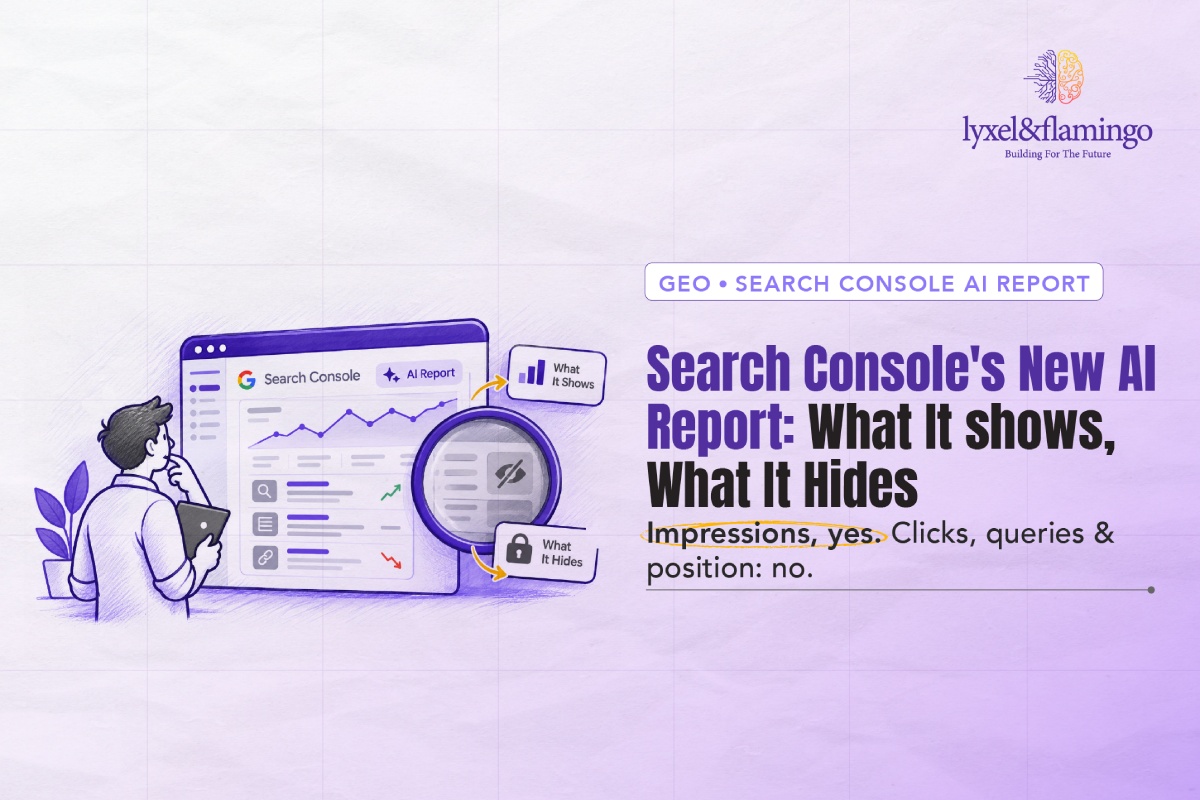
Search Console’s Generative AI performance report, covered in more depth in a companion piece on reading that report, shows impressions for pages cited in AI Overviews and AI Mode. Comparing pages with rising AI-impression counts in Search Console against pages seeing new “AI Referral” channel traffic in GA4 gives a useful, if imperfect, sanity check that the two data sources are telling a consistent story.
Where a page shows strong AI-impression growth in Search Console, yet no corresponding GA4 referral traffic, that is often a sign the referrer-stripping problem is affecting that specific traffic source, rather than a sign the citation is not happening at all.
Reporting This to Stakeholders Without Overstating It
When presenting AI-referral numbers internally, be explicit that the reported figure is a floor, not a ceiling: the true volume of AI-driven traffic is very likely higher than what the custom channel group captures, because of referrer-stripping on some platforms. This framing protects the credibility of the reporting when stakeholders inevitably ask why AI referral numbers look smaller than the citation volume Search Console shows.
Pair the GA4 number with a qualitative signal, such as the AI-impression trend from Search Console, so the full picture is not resting on a single, partially-blind metric. Torani’s SEO work with Lyxel&Flamingo and Converse’s organic performance gains both depended on exactly this kind of multi-source reporting discipline, since no single channel view ever told the complete visibility story on its own.
Framework Explained
- Fix what’s visible first: A custom channel group recovers the AI traffic GA4 can technically see, which is real, immediate value even though it is incomplete.
- Acknowledge the ceiling: Referrer-stripping on some AI platforms means no GA4 configuration alone will capture 100% of AI-driven traffic.
- Cross-check, don’t rely on one source: Pairing GA4’s AI Referral channel with Search Console’s AI impression data catches gaps either source misses alone.
- Revisit periodically: The list of AI platform domains worth tracking will keep changing as new AI search surfaces launch.
GEO READINESS NOTE This is general measurement guidance rather than a specific named client result, since referrer-stripping behavior varies by AI platform and account setup in ways that make a single case-study figure potentially misleading. Lyxel&Flamingo’s GA4 migration and analytics team builds these custom channel groupings as a standard part of GEO measurement setup across client accounts.
Key Takeaways
- GA4’s default channel logic frequently misclassifies AI chatbot referral traffic as Direct, understating the visible impact of GEO work.
- A custom channel group mapping known AI platform domains recovers traffic where a referrer header survives the click.
- Native-app AI referrals that strip referrer data cannot be fully recovered through GA4 configuration alone.
- Cross-checking GA4’s AI Referral channel against Search Console’s AI impression data helps validate that the two sources tell a consistent story.
- Report AI-referral GA4 numbers as a floor, not a complete count, to avoid overstating what the data actually captures.
CXO Takeaway
Is your GA4 reporting quietly hiding the AI-search traffic your GEO investment is actually generating? If your analytics stack was never rebuilt for how AI referrals actually behave, the growth may already be happening without your dashboards showing it. Lyxel&Flamingo’s GA4 migration team can rebuild the channel groupings to surface it.
Frequently Asked Questions
No. It captures AI referrals where the platform passes referrer data, which excludes some native-app-based AI citation clicks that strip referrer information entirely.
Start with the major consumer AI search and chat surfaces relevant to your audience, and review the list periodically, since new platforms and domain patterns emerge regularly.
No, UTM parameters are still the most reliable attribution method where you control the link. Custom channel groups address referral traffic you do not control, such as organic citation clicks.
Compare AI-impression trends in Search Console’s Generative AI performance report against GA4’s AI Referral channel; a rising impression trend with flat GA4 referral traffic is a signal of undercounting.