
What This Blog Covers
An Amazon product detail page gets one brief window to earn attention before a shopper’s thumb moves on to the next result. In that window, only a handful of elements actually register: the hero image, the title’s first few words, the star rating, and the price. Everything else on the page matters only if the shopper survives that first three seconds. Here is what actually decides that survival, and a real Amazon campaign that proves specific, evidence-led positioning outperforms discounting for attention every time.
Quick answer: In the first three seconds on an Amazon PDP, shoppers register four elements: the hero image and its first impression, the title’s clarity in its first 60 characters, visible social proof (star rating and review count), and price framed against a visible comparison. A PDP that gets these four right earns the scroll-through to bullets and A+ content. One that doesn’t loses the shopper before any of the rest of the page is ever read.
Table of Contents
- The Three-Second Window Every PDP Gets
- Why Most PDPs Waste It
- What Actually Survives the Scroll
- The Three-Second PDP Model: four elements a shopper decides on before reading anything else
- The Framework Explained
- A Real Campaign Built on Positioning, Not Discounting
- Key Takeaways
- The CXO Takeaway
- The Question to Sit With
- Closing
The Three-Second Window Every PDP Gets
A shopper scanning an Amazon search results page moves through a dozen listings in the time it takes to read this sentence. A product detail page that earns a click has already won a smaller, faster contest first, standing out in a thumbnail grid, and now has to win a second one just as fast: convincing a shopper who’s landed on the page that staying is worth their time.
That second contest is decided in roughly three seconds, before a single bullet point or A+ module gets read. Everything a brand wants to say about quality, craftsmanship or differentiation only gets heard if the page survives that opening window first.
Why Most PDPs Waste It
Most product pages spend their opening seconds on generic hero imagery, a product shot with no context, no scale, no evidence of who it’s for. The title buries the specific, searchable detail that actually matters, brand, size, key feature, under generic marketing language front-loaded instead. And social proof, star rating, review count, sits below the fold or gets rendered in small, easy-to-miss type, exactly the element shoppers are conditioned to look for first as a trust shortcut.
None of this is a content-quality problem in the usual sense. It’s a sequencing problem: the elements that actually decide a three-second verdict are frequently the ones treated as an afterthought in how a page gets built.
It compounds for a new listing specifically, since Amazon’s algorithm forms its ranking baseline from exactly this kind of early shopper behaviour, so a weak page costs more than the clicks it loses that first week.
What Actually Survives the Scroll
The PDPs that convert reliably share a structure, not a style. The hero image shows the product in believable use, with scale and context a shopper can immediately parse. The title leads with the specific noun a shopper searched for, not a brand tagline. Star rating and review count are visually prominent, not just technically present. And price is framed with a visible comparison, a strikethrough, a per-unit cost, a bundle value, giving a shopper an instant read on whether it’s a fair deal without requiring them to do the maths.
Get those four right and a shopper who was three seconds from bouncing scrolls instead, into the bullets, the A+ content and the reviews that were built to close the sale, once someone actually stays to read them.
Winning that scroll is only half the job, though, the copy underneath it still has to satisfy the shopper and the search algorithm reading the same words for very different reasons.
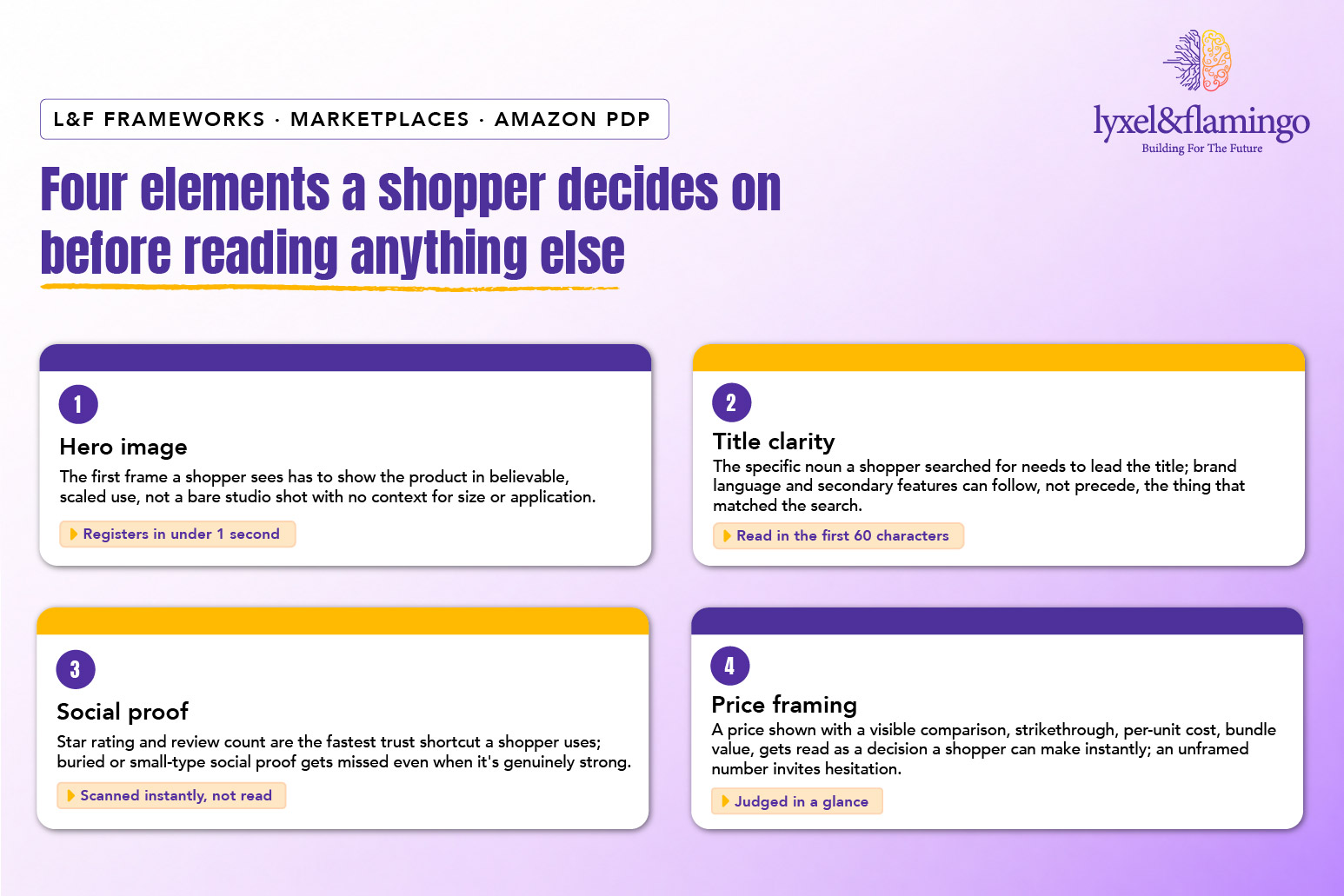
The Three-Second PDP Model: four elements a shopper decides on before reading anything else
The Framework Explained
- Hero image: This is the single frame that decides whether a shopper’s thumb keeps moving, and it happens faster than most brands budget creative time for. A hero image that shows the product against a plain white background, with no sense of scale, no context for how it’s actually used, forces a shopper to do interpretive work in a moment when they have no patience for it. A hero image that shows the product in a believable, scaled setting, in someone’s hand, on a shelf, in the room it belongs in, answers the shopper’s first unspoken question, is this the right size and the right fit for me, without requiring them to read a single word. Brands that treat the hero image as a formality, a legal requirement to have one, rather than the single highest-leverage creative decision on the entire page, are losing shoppers before the page has even had a chance to make its case.
- Title clarity: A title has roughly sixty characters of real attention before a shopper’s eyes move on, and most brands spend that budget on the wrong words. Leading with brand name and a marketing phrase, saving the specific product detail, the size, the material, the exact feature that matched the search query, for the back half of a title that’s already been truncated on mobile, is giving up the one chance to confirm to a shopper that this listing is precisely what they searched for. The fix is not clever copywriting, it’s sequencing discipline: put the noun the shopper typed first, the differentiating detail second, and the brand language wherever there’s room left over. This single reordering, tested repeatedly across categories, consistently improves click-through from search without changing a single fact about the product itself.
- Social proof: Star rating and review count function as a trust shortcut a shopper’s eyes are already trained to look for, largely independent of whatever else is on the page, and a listing that buries this signal is wasting social proof it already earned. A 4.6-star rating with 2,000 reviews, rendered small and positioned below other elements, gets processed far less confidently than the same exact numbers rendered prominently near the title and price, even though the underlying trust signal is identical. This is one of the cheapest fixes available on an entire PDP, since the data already exists, and simply making it visually unmissable, rather than technically present, is often the single highest-return five minutes a brand can spend on an underperforming listing.
- Price framing: Price is the one element every shopper checks, and an unframed number forces a moment of mental arithmetic that a framed one removes entirely. A price shown as a bare figure asks a shopper to independently judge whether it’s fair, against a memory of competitor pricing they may not have accurately retained. A price shown with a visible strikethrough from a higher reference price, a per-unit cost clearly stated for a multipack, or a bundle value spelled out explicitly, does that judgment for the shopper and removes the hesitation that ambiguous pricing creates. This is not about discounting the product, it’s about framing whatever the actual price is so a shopper can evaluate it in the same glance they’re already spending on the rest of the page.
A Real Campaign Built on Positioning, Not Discounting
✓ CLIENT PROOF POINT: confirm sign-off before publish. AMD‘s Amazon campaign shows what specific, evidence-led positioning delivers without leaning on discounting to win the three-second decision. Running a zero-discount strategy, entirely dependent on the strength of the listing’s own content and positioning to earn attention, new customer acquisition grew 200% and ROI improved 47%. The growth came from specificity, not price cuts, exactly the discipline a strong hero image, a precisely sequenced title and unmissable social proof are built to deliver at the exact moment a shopper is deciding whether to keep reading. (L&F client work, Amazon.)
Our Third-Party Marketplace management services team builds and tests PDP content structured to win the three-second decision before it optimises for anything further down the page.
Key Takeaways
- A shopper’s decision to keep reading a PDP or move on happens in roughly three seconds, before bullets or A+ content ever get read.
- Four elements decide that window: the hero image’s first impression, the title’s first 60 characters, visible social proof, and clearly framed pricing.
- Most PDPs waste the window on generic hero imagery, brand-first titles and undersized social proof, a sequencing problem more than a content-quality one.
- The AMD campaign shows evidence-led positioning can drive real growth, 200% new customer acquisition and 47% ROI improvement, without relying on discounting at all.
- Fixing the four elements in this model is often the highest-return, lowest-cost work available on an already-live, underperforming listing.
The CXO Takeaway
For a brand leader, the three-second window reframes where PDP investment should actually go. Most catalogue optimisation budget gets spent on A+ content and backend keyword work, both genuinely valuable, while the hero image and title, the two elements that decide whether any of that content ever gets read, get treated as a one-time setup task rather than an ongoing optimisation priority. The AMD result shows what’s possible when positioning gets the same rigour typically reserved for pricing and promotions.
The Question to Sit With
The question worth sitting with is not how good your A+ content is. It’s whether your hero image and title survive the three seconds a shopper gives them before either one gets read.
Closing
Lyxel&Flamingo builds and tests Amazon PDP content structured to win the three-second decision first. Want a clear read on which of your listings are losing shoppers before the page even gets a chance? Start that conversation with L&F →
Frequently Asked Questions
Social proof visibility, usually. It's the fastest and cheapest fix, since the review data already exists, and simply making it visually prominent rather than buried often shows a measurable click-through improvement within days.
The principle holds on both, though mobile compresses the window further since titles truncate sooner and hero images render smaller. Title sequencing matters even more on mobile as a result.
At minimum every six months, or sooner around major sale events, since shopper expectations and competitor imagery both shift and a hero image that worked a year ago can quietly start underperforming without an obvious signal.
It doesn't reduce the need for visibility spend. It improves what that spend returns. A shopper who clicks through from a sponsored placement onto a PDP that loses them in three seconds represents wasted ad spend regardless of how well-targeted the ad itself was.
Yes, with adjusted emphasis. Without review volume to lean on for social proof, the hero image and title carry even more of the three-second decision, making them the priority for a newly launched listing specifically.