
What This Blog Covers
A brand’s first quarter on Amazon isn’t a soft launch. It’s the window where Amazon’s own algorithm forms its earliest read on a listing, review velocity gets its critical first push, and Buy Box eligibility either gets established cleanly or has to be clawed back later against a harder baseline. Brands that treat the first 90 days as a checklist to complete, catalogue up, advertising on, done, consistently underperform brands that treat it as three distinct phases, each with its own priority. Here is that phased approach, and a real 90-day launch that shows exactly what disciplined sequencing delivers.
Quick answer: A strong Amazon onboarding runs in three phases across 90 days: foundation in the first 30 days (catalogue accuracy, brand registry, compliance), visibility building in days 31-60 (PPC seeding, review velocity, content completion), and demand capture in days 61-90 (bid discipline, organic ranking momentum, Buy Box defence). Brands that compress or skip a phase, especially foundation, tend to carry avoidable problems, weak reviews, incomplete content, inconsistent Buy Box, well past the first quarter.
Table of Contents
- Why the First 90 Days Aren't a Soft Launch
- What Gets Decided Early and Doesn't Reset Easily
- Where Most Launches Go Wrong
- The 90-Day Amazon Onboarding Model: three phases, each with its own priority and what it protects
- The Framework Explained
- A Real 90-Day Launch Built on Sequencing
- Key Takeaways
- The CXO Takeaway
- The Question to Sit With
- Closing
Why the First 90 Days Aren’t a Soft Launch
Amazon’s ranking algorithm forms an early, sticky impression of a new listing based on the first weeks of actual shopper behaviour, click-through rate, conversion rate, review velocity. A listing that launches with incomplete content, thin advertising and no review base is not just starting slowly, it’s teaching the algorithm a weak baseline that later effort then has to work against, not just build on.
That makes the first 90 days structurally different from every quarter that follows it. Getting the sequencing right here compounds. Getting it wrong creates a deficit that shows up in ranking, in Buy Box share, and in review credibility for far longer than the 90 days themselves.
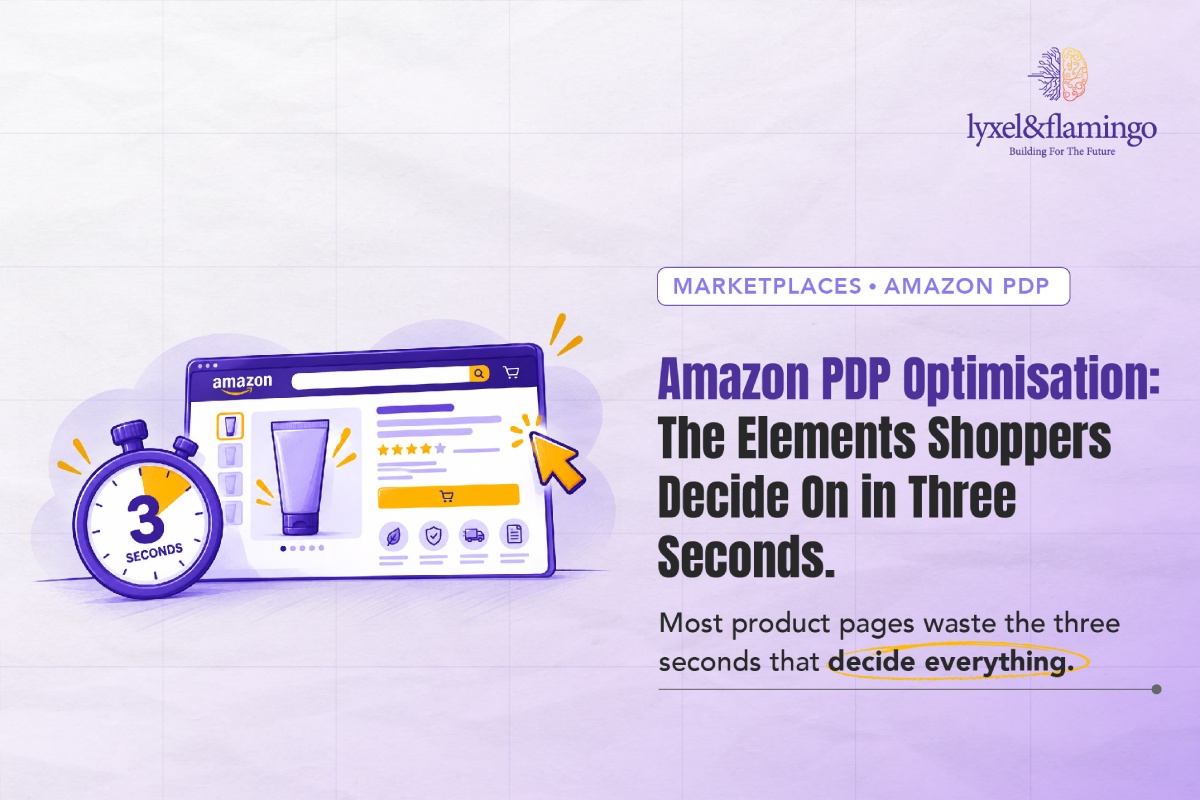
That early algorithmic impression is shaped just as much by the page itself, the elements a shopper decides on in the first three seconds feed straight into the same click-through and conversion signals the algorithm is reading.
What Gets Decided Early and Doesn’t Reset Easily
Review velocity is the clearest example. The first handful of reviews a listing earns disproportionately shape both its star rating and a shopper’s first impression of trustworthiness, and a slow, thin start is difficult to fully outrun later, even once volume eventually catches up. Buy Box eligibility works similarly: a brand that establishes clean pricing, fulfilment and account health discipline from day one holds Buy Box more consistently than one that has to repair a shaky account history after the fact.
None of this means the first 90 days need to be perfect. It means the sequencing, what gets prioritised in week one versus week nine, matters more than most launch plans account for.
Where Most Launches Go Wrong
The most common failure is compressing all three phases into week one: catalogue live, ads on, expecting momentum immediately, with no foundation-first discipline behind any of it. Incomplete or inconsistent product content goes live because launch pressure outweighs content QA. Advertising spend gets switched on before organic content and review credibility are strong enough to convert that traffic efficiently, burning budget on clicks a still-thin listing can’t yet close.
The fix isn’t slower. It’s sequenced, treating the first 30 days as genuinely different work from days 31 through 90, rather than the same launch checklist just running for longer.
Content completion in that first phase means writing for two different readers at once, the shopper and the search algorithm rarely want the same thing from the same words.
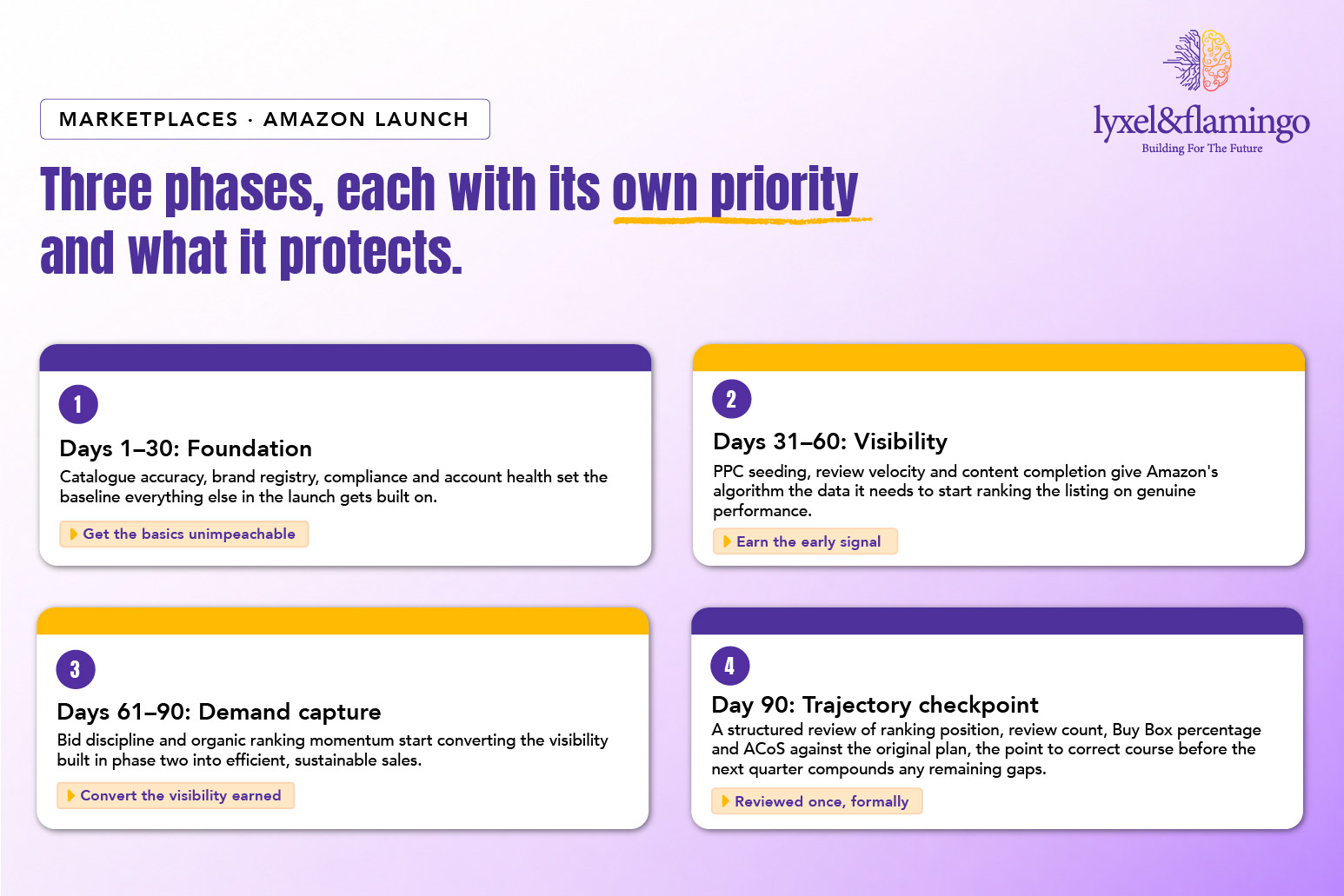
The 90-Day Amazon Onboarding Model: three phases, each with its own priority and what it protects
The Framework Explained
- Days 1-30: Foundation: The instinct in a new launch is to move fast on everything at once, and it’s exactly the wrong instinct for the first 30 days specifically. Catalogue accuracy, correct categorisation, complete backend search terms, accurate variations, sounds like basic administrative work, and it is, which is precisely why it gets rushed under launch pressure. But every one of these foundational elements is something Amazon’s own systems and a shopper’s own trust both check silently before anything downstream can perform well. Brand registry enrolment unlocks A+ content and brand protections that everything in phases two and three depends on having in place. A brand that skips or rushes this phase to get to advertising faster is building visibility on top of a foundation that has to be quietly rebuilt later, usually at a worse moment, mid-campaign, when the cost of fixing it is higher.
- Days 31-60: Visibility: This is the phase where a listing earns the data that Amazon’s algorithm uses to decide how much organic visibility it deserves going forward, and it is where review velocity specifically becomes urgent rather than optional. A listing with strong content and no reviews reads as unproven to a shopper, whatever its actual quality, and Amazon’s ranking systems weight early conversion signals heavily, meaning a slow start to reviews genuinely compounds into a slower climb in organic rank. PPC in this phase should be seeded deliberately, targeted enough to drive relevant traffic that’s likely to convert and generate a review, rather than broad enough to burn budget on volume that doesn’t. The goal here isn’t profitability yet. It’s generating the performance data phase three needs to work with.
- Days 61-90: Demand capture: By day 61, a listing should have enough review volume and content credibility that advertising spend starts converting efficiently rather than subsidising an unproven page. This is where bid discipline actually pays off, tightening targeting toward the keywords and placements that phase two’s data showed were converting, rather than continuing to spend broadly out of launch-phase habit. Organic ranking momentum, if phases one and two were sequenced correctly, should be visibly building by now, reducing how much of total sales needs to come from paid placement at all. A brand still spending like it’s week one at day 75 is usually a sign that phase one or two skipped a step, not that the category is simply harder than expected.
- Day 90: Trajectory checkpoint: Most launches never formally check their own trajectory against a plan, they simply keep running the same activities and hope the quarterly numbers land somewhere reasonable. A structured day-90 checkpoint, comparing actual ranking position, review count, Buy Box percentage and ACoS against what the 90-day plan projected, does something a running dashboard doesn’t: it forces an explicit decision about whether the next quarter continues the current approach or corrects a specific, identified gap. Skipping this step doesn’t just waste the insight, it lets a foundation-phase shortcut from week two keep quietly costing the brand well into month six, unnoticed because nobody stopped to formally check.
A Real 90-Day Launch Built on Sequencing
ASICS‘s Amazon Marketing Services launch shows what disciplined, phased sequencing delivers when the fundamentals are built in order rather than compressed into week one. Over a 90-day launch window, sales grew 100%, impressions reached 38 million, and ACoS dropped 60%, growth and efficiency improving together rather than trading off against each other, the exact pattern a foundation-first, phase-by-phase launch is built to produce. (L&F client work, Amazon, 90-day launch window.)
Our Third-Party Marketplace management services team runs structured, phased onboarding for every new Amazon launch, not a single day-one checklist.
Key Takeaways
- Amazon’s ranking algorithm forms an early, sticky read on a new listing from its first weeks of real shopper behaviour, making the first 90 days structurally different from later quarters.
- Review velocity and Buy Box eligibility both compound from early decisions and are difficult to fully reset once a listing starts with a weak baseline.
- The most common launch failure is compressing all three phases, foundation, visibility, demand capture, into week one instead of sequencing them.
- The ASICS launch shows what sequencing delivers together: 100% sales growth, 38 million impressions and a 60% ACoS drop within a single 90-day window.
- A formal day-90 trajectory checkpoint, comparing actual results to the original plan, is the step most launches skip and the one that catches a quiet foundation-phase shortcut before it compounds into month six.
The CXO Takeaway
For a brand leader entering Amazon, the first 90 days deserve the same planning discipline as a product launch, because that’s functionally what they are. A launch plan that treats catalogue setup, advertising and review-building as one undifferentiated stream of week-one activity is optimising for speed to market over the trajectory that speed actually sets. The ASICS result, growth and efficiency improving together rather than trading off, is what a properly sequenced first quarter makes possible, and what a compressed one makes considerably harder to recover.
The Question to Sit With
The question worth sitting with isn’t how fast your Amazon launch can go live. It’s whether day one through thirty is building a foundation the next sixty days can actually stand on.
Closing
Lyxel&Flamingo runs structured, phased Amazon onboarding for every new brand launch, not a single day-one checklist. Want a 90-day plan built around your specific catalogue? Start that conversation with L&F →
Frequently Asked Questions
Not at full spend. Seeded, targeted advertising in the foundation phase is reasonable to start generating early data. The bulk of ad investment should scale in phase two, once content and initial reviews are in place to convert that traffic efficiently.
There's no universal number. Most categories see a meaningful conversion-rate improvement somewhere between 10 and 25 genuine reviews, enough to move a listing past the zero-social-proof stage a shopper is most wary of.
Incomplete or inconsistent backend search terms and categorisation, rushed to get the catalogue live faster. It's invisible to a shopper and directly affects how well Amazon's systems can match the listing to relevant searches from day one.
Yes, with a modified foundation phase focused on fixing existing content and account-health issues rather than building from zero. The visibility and demand-capture phases apply the same way afterward.
A phase-two review-velocity target that isn't being met by day 55 is the clearest signal to extend that phase rather than moving into demand-capture spend on schedule regardless.