
What this blog covers
This blog sets out a repeatable framework for testing performance creative so that each test produces knowledge, not just a winner. It explains why most creative testing fails to teach anything, walks through the five steps of a sound test hypothesis- isolate, clean air, read at significance, scale, and feed back covers the mistakes that invalidate results, and shows how the loop compounds over time. It closes with a self-check and the questions practitioners ask most.
Table of Contents
- Guessing with a bigger budget
- Why most creative testing teaches nothing
- The Performance Creative Testing Framework
- Start from a hypothesis, not a hunch
- Isolate the variable and give it clean air
- Read at significance, then scale and feed back
- The mistakes that invalidate a test
- Self-check: does your testing compound?
- Key takeaways
- Closing
Guessing with a bigger budget
A lot of what passes for creative testing is a monthly scramble: a batch of new ads goes live all at once, the one with the best numbers after a couple of days is crowned the winner, and the rest are switched off. It feels like testing, but nothing is learned that lasts. Next month the process starts over from scratch, because no one can say why the winner won, and a winner you cannot explain is a winner you cannot repeat.
Real creative testing is different in intent. Its purpose is not only to find the best ad this cycle, but to learn something about what works for this brand, this audience, this offer a piece of knowledge that makes the next brief sharper. Done that way, testing compounds: every cycle adds to a bank of understanding that steadily raises the hit rate. Done the scramble way, it just spends money faster.
Why most creative testing teaches nothing
Testing fails to teach for a handful of predictable reasons. When several things change between ads at once a new hook, a new format, a new offer, a new audience a difference in results cannot be traced to any one of them, so there is nothing to learn. When ad sets overlap on the same audience, they compete with each other and distort each other’s numbers. When a result is read after a day, before the algorithm has stabilised and before enough people have seen each version, the winner is often just noise that would reverse with more data. And when success is defined loosely, a team can always find some metric that went up and declare victory.
Each of these turns a test into a guess. A framework fixes them by imposing structure: one change at a time, clean conditions, enough time and volume, and a decision made on the outcome that matters. That structure is what separates testing from the scramble, and it is the same rigour that underpins getting real performance from creative.
The Performance Creative Testing Framework
The framework is a five-step loop that turns each test into a piece of durable knowledge.
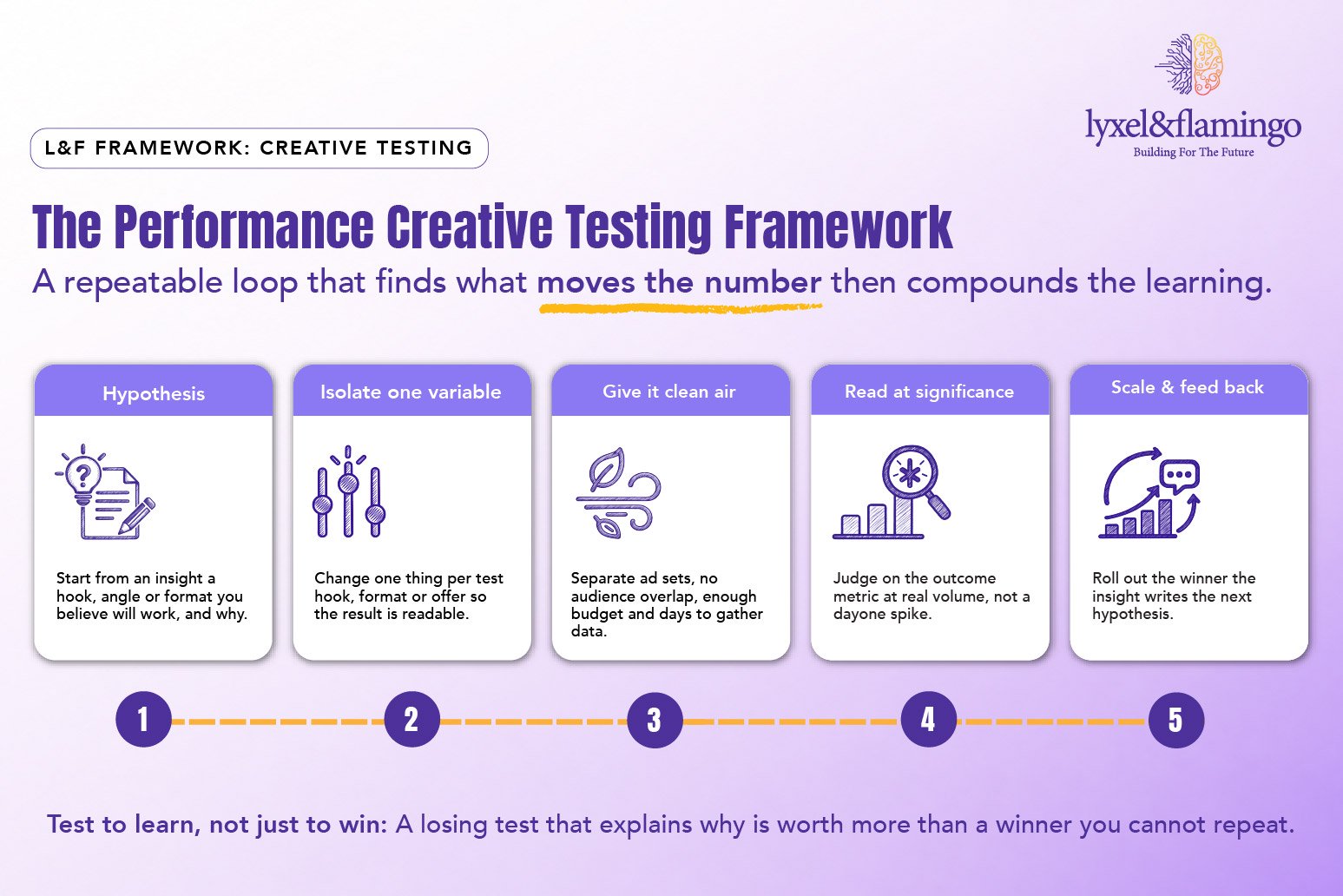
Framework: The Performance Creative Testing Framework a loop that compounds learning.
It runs from hypothesis, to isolating one variable, to giving the test clean air, to reading it at significance, to scaling the winner and feeding the insight back into the next hypothesis. Each step protects the one before it, and the loop is deliberately circular: each test ends by sharpening the next question rather than simply naming a winner. The sections below take each step in turn.
Start from a hypothesis, not a hunch
A good test begins with a belief you can state and a reason behind it: a specific hook, angle, or format you expect to work, and why you expect it to. A hypothesis such as “leading with the price will beat leading with the feature for this budget-conscious audience” gives the test something to prove or disprove, and turns the result into a lesson either way. A hunch, by contrast, produces a winner with no explanation. Starting from a hypothesis is what makes a losing test valuable, because a loss that disproves a clear belief still teaches you something you can carry forward.
Isolate the variable and give it clean air
Once the hypothesis is set, the discipline is to change only one thing between the versions being compared: the hook, the format, or the offer, but not several at once so that any difference in results can be attributed to that single change. Then the test needs clean conditions to run in: separate ad sets with no audience overlap, so the versions are not cannibalising each other, and enough budget and enough days for each version to reach a meaningful number of people. A test that changes three things at once, or runs on overlapping audiences, or starves each version of data, cannot produce a readable answer no matter how carefully it is set up otherwise.
Read at significance, then scale and feed back
A test is only finished when the result is real rather than early. That means judging it on the outcome metric that matters usually the cost per result or conversion, not a vanity number like reach, and only once each version has gathered enough data for the difference between them to be more than chance. Reading a winner on day one, before the numbers have stabilised, is how teams end up scaling noise. Once a genuine winner emerges, it gets rolled out, and this is the step most teams skip: the insight behind it is written down and fed into the next hypothesis. That feedback is what makes the loop compound rather than reset, turning a series of one-off tests into an accumulating understanding of what works.
The mistakes that invalidate a test
Most failed tests fail in the same few ways. Changing multiple variables at once makes the result unreadable. Overlapping audiences let the versions distort each other. Too little budget or too short a window leaves the result buried in noise. Calling the winner too early rewards a lead that has not stabilised. And judging on the wrong metric crowning the ad with the most clicks when the goal was conversions – optimises for the wrong outcome. A test that avoids these is one whose result deserves to change the next brief; a test that commits them is a guess wearing the costume of a test. The good news is that all of them are avoidable with a little structure and a little patience.
Self-check: does your testing compound?
Score your own approach one point per yes:
- Each test starts from a written hypothesis with a reason behind it
- You change one variable at a time between versions
- Test ad sets are separated with no audience overlap
- Each version gets enough budget and time to reach significance
- Winners are judged on the outcome metric, not a vanity number
- The insight behind each result is recorded and feeds the next test
- Your hit rate on new creative is rising over time
Five or more and your testing compounds into knowledge. Three or fewer and you are probably guessing with a bigger budget.
Key takeaways
- Most creative testing finds a winner but teaches nothing, because no one can say why it won.
- A sound test starts from a hypothesis, isolates one variable, and runs in clean conditions.
- Read the result on the outcome metric at real volume, not a vanity number on day one.
- Feed the insight behind each result into the next hypothesis so the loop compounds.
- Multiple variables, overlapping audiences, thin data, and early calls are the mistakes that invalidate a test.
Closing
What separates a team that guesses from a team that learns comes down to structure, more than talent or budget. A creative testing framework is simply the discipline of asking a clear question, changing one thing, giving it room to answer, and writing down what the answer taught you. Do that consistently and the tests stop being a monthly scramble and start becoming an asset: a growing understanding of what moves this brand’s numbers, which is worth far more than any single winning ad. The winner fades when it fatigues; the knowledge does not.
Want creative testing that compounds into knowledge?
L&F runs structured creative testing programmes with clear hypotheses, clean tests, and a feedback loop that sharpens every brief for consumer brands across India and worldwide. We will turn your testing from a scramble into an asset. Talk to L&F about creative testing and learn from every test, not just win one.
Frequently Asked Questions
Start from a hypothesis a specific belief about what will work and why then change one variable at a time between versions so the result is readable. Run each version in its own ad set with no audience overlap, and give it enough budget and days to reach a meaningful number of people. Judge the winner on the outcome metric that matters, not a vanity number, and only once the result is statistically stable. Then record the insight and feed it into your next test.
Usually because they teach nothing that lasts. If you launch a batch of ads, crown a winner after a day or two, and cannot explain why it won, there is no insight to carry forward so next month you start from scratch. Tests improve results over time only when they start from a hypothesis and end with a recorded lesson, so each cycle sharpens the next brief. Without that feedback loop, testing just spends money faster.
Long enough for each version to reach a meaningful number of people and for the result to stabilise typically one to two weeks, though it depends on your budget and conversion volume. Reading a winner on day one is a common mistake, because early leads often reverse once more data arrives and the algorithm settles. The principle is to judge the test on stable numbers at real volume, not on a spike, so give it time before you decide.
One, between any two versions you are comparing. If you change the hook, the format and the offer all at once and one version wins, you cannot tell which change caused it, so there is nothing to learn. Isolating a single variable is what makes a test readable. You can run several separate one-variable tests in parallel if your budget and audience size allow, but each individual comparison should hold everything else constant.
The outcome metric that reflects your actual goal usually cost per result, conversion rate or contribution to sales not a vanity metric like reach or raw clicks. A creative can win on clicks and lose on conversions, so crowning the click leader optimises for the wrong thing. Decide up front which metric the test is meant to move, and judge the winner on that, once the difference is statistically meaningful rather than early noise.
Both have a place. Platform tools that rotate multiple creatives and let the algorithm favour the strongest are useful for ongoing optimisation, but they are a black box they find a winner without telling you why. Structured A/B tests, which isolate one variable, are what produce transferable learning you can apply to the next campaign. Use platform optimisation to run efficiently day to day, and deliberate A/B tests to actually learn what works for your brand.
They are two halves of the same discipline. Testing finds the creative that works; managing fatigue keeps it working by refreshing it before response declines. A healthy programme runs continuous tests to build a bank of proven concepts, then draws on that bank to refresh creative on a cadence as fatigue sets in. Testing without a refresh plan lets winners burn out; refreshing without testing means replacing tired creative with unproven guesses.