
What this blog covers
A patient arrives at a hospital website already anxious. They came for a test result they cannot read, or a symptom they searched at midnight, and what they feel in the next few seconds decides whether they book with you or keep looking. Across the healthcare platforms we have built in India, the pattern holds: the website is not a brochure that supports the brand, it is the place where trust is either established or lost.
Most healthcare marketing budgets still treat the website as a design project with a launch date. The brands growing fastest treat it as a discoverability system that has to keep earning attention across three surfaces at once: search, AI answers, and the comfort signals a worried person reads in seconds.
Table of Contents
- What Healthcare Discoverability Actually Means
- Four People Open the Same Page, and Only One Is a Patient
- The Three Surfaces Where the Decision Is Made
- The Healthcare Discoverability Stack
- What This Looked Like for Medanta
- When the Bottleneck Is Not Where the Dashboards Say
- Building the Reputation an AI Reads Back
- Five Things to Check on Your Own Platform This Quarter
- Key Takeaways
- The Work Does Not End at Launch
What Healthcare Discoverability Actually Means
Healthcare discoverability is the practice of making a hospital or diagnostics brand findable and credible across every surface a patient uses to assess care: organic search, AI-generated answers, review platforms and the brand’s own digital properties, before the patient makes contact.
It differs from healthcare marketing in what it optimises for. Marketing optimises for reach and recall. Discoverability optimises for being present, and being convincing, at the precise moment a patient is deciding whom to trust. In a category where the decision is emotional and the research is private, presence at that moment carries more weight than awareness built months earlier.
Four People Open the Same Page, and Only One Is a Patient
The scared patient reading her own result. The son booking for a parent. The GP checking credentials before referring. The corporate HR lead scoping a health tie-up for four thousand employees. They arrive at the same URL through different routes, carrying different questions, and a page written for the average of them reaches none of them.
This is where most healthcare sites lose people. The information architecture is organised around how the hospital is structured: departments, facilities, leadership, rather than around what each of those four arrived to find out. The fix is not more content. It is content mapped to the intent that brought each cohort to the page, which is also why a healthcare website cannot be designed like a D2C website.
The Three Surfaces Where the Decision Is Made
1. Search:
A father is up at 2am typing his daughter’s symptoms into Google, scanning results, deciding who sounds like they know what they are talking about. Nobody from the brand is in that moment. Only the content published months earlier is doing the work. This is what organic search and content authority work buys in healthcare: not traffic for its own sake, but the page that clearly explains what he is afraid of, which is the page he trusts by morning.
2. AI Answers:
Increasingly the first opinion of a brand comes from a large language model. Someone asks ChatGPT or Perplexity which diagnostic lab near them is any good and a recommendation arrives before they have opened a single website. Generative engines build that answer from reviews, accreditations, and how a brand handles complaints in public: signals that mostly live off the brand’s own site.
3. Comfort Signals:
Speed, clarity, doctor credentials, review sentiment, the tone of a reply to a complaint. These are what an anxious person reads to decide whether they are in safe hands. They are also, not coincidentally, much of what an AI model weighs when it decides whether to name you.
The Healthcare Discoverability Stack
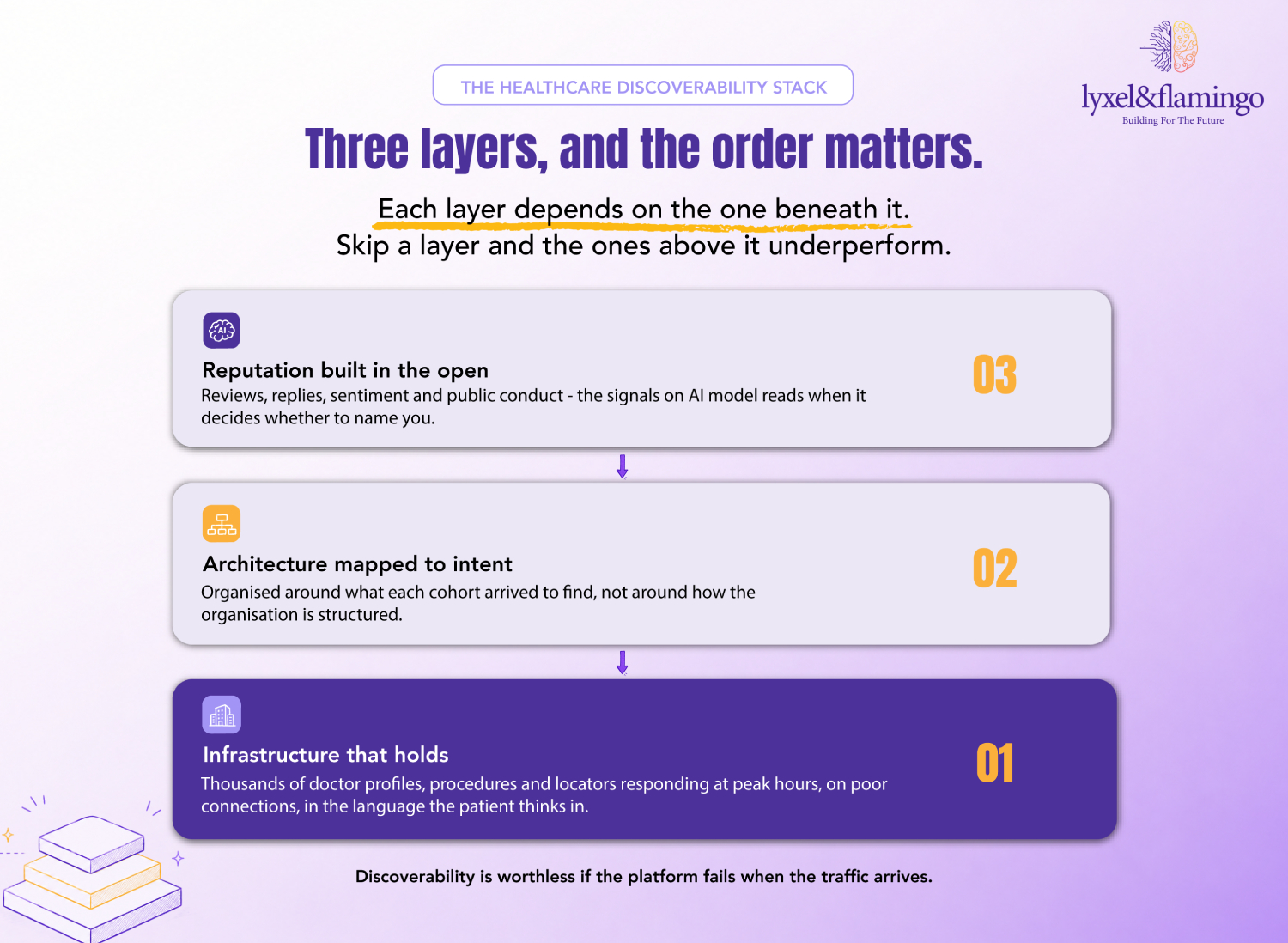
Across the healthcare platforms we have built, the work resolves into three layers. The order matters, each layer depends on the one beneath it.
1. Infrastructure That Holds:
Discoverability is worthless if the site fails when the traffic arrives. Thousands of doctor profiles, procedure pages and centre-locators have to respond at peak hours, on poor connections, in the language the patient thinks in. The same principle held when we built the Taco Bell app to hold 8.5 lakh users, and it is the work our technology and cloud teams do.
2. Architecture Mapped to Intent:
Information architecture organised around what each cohort arrived to find, not around how the organisation is structured. Specialities, geographies and clinical depth made findable, so that the site itself functions like a search engine for the network.
3. Reputation Built in the Open:
Reviews, replies, sentiment and public conduct, managed deliberately rather than reactively. This is the layer AI models read when assembling a recommendation, and the one healthcare brands most often leave to chance.
What This Looked Like for Medanta
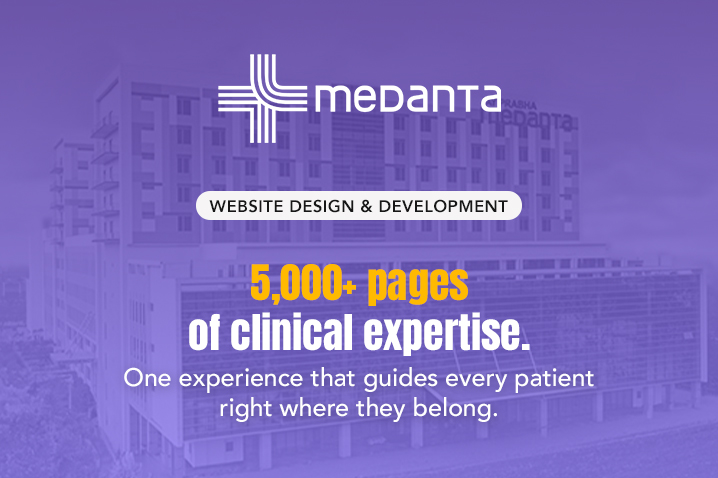
As Medanta grew from its flagship hospital into a network of tertiary-care facilities, each a destination in its own right and for medical tourism, the website had to carry that scale. The specialities, the geographies, and the clinical depth all had to be easily discoverable. We rebuilt the platform to do that, migrating in November 2024.
Comparing the eleven months before migration with the period since, normalised to a monthly run-rate so the comparison is like for like:
- Monthly website traffic grew 2.3x.
- Organic search visits grew 2.3x, with the discovery engine roughly doubling.
- Direct visits grew 2.6x, the sharpest rise of any channel, reflecting stronger brand pull rather than acquisition spend.
- The key-action rate, the share of visits completing a booking or enquiry, increased from 75% to 94%.
- AI Assistant emerged as a traffic channel that did not exist before the rebuild.
Source: Medanta GA4, pre-migration (Jan-Nov 2024) compared with post-migration (Nov 2024-Jul 2026), normalised to monthly run-rate.
The direct-traffic figure is the one worth paying attention to. People arriving by typing the brand name grew faster than people arriving through search. This is what happens when a brand becomes something patients actively recommend rather than simply discover.
When the Bottleneck Is Not Where the Dashboards Say
A pan-India hospital network was drawing over a lakh visitors daily, in several languages, and slowing under the load. The instinct in that situation is to buy more servers. The actual constraint was an external translation layer capped far below demand, throttling how fast pages could be served.
We re-engineered the flow around a cached architecture and scaled on real worker saturation rather than raw compute. The platform now holds 35,000 concurrent users at peak without collapse, carries over four lakh daily visits on a layer once capped near one lakh, and has had no downtime on that bottleneck since
This matters commercially for a reason that has nothing to do with engineering pride. Discoverability work drives traffic. If the platform cannot absorb it, every rupee of media spend is capped by infrastructure nobody in the marketing meeting is looking at, which is the argument for treating the website as a growth engine rather than a line item.
Building the Reputation an AI Reads Back
For Agilus Diagnostics, we manage online reputation across six platforms in real time. Over three consecutive months, no query remained unanswered for more than four hours, with most first responses delivered within five minutes. Positive sentiment remained at 61.88% during the busiest month on record, while negative sentiment stayed below 3.1% even as conversation volume increased by half. Positive patient mentions reached 943 in a single month, an increase of nearly one-third.
Alongside this, the health content programme increased clicks by 263% and impressions by 198% within six months, while earning featured snippets across multiple health-related search queries. The same content-led strategy also delivered 875% blog impression growth for Greenply.
Each resolved complaint and public interaction becomes a signal that AI models can later interpret. Reputation management in healthcare is no longer just a defensive activity. It has become a key factor in determining whether a brand is recommended at all.
Five Things to Check on Your Own Platform This Quarter
Use the following checklist to evaluate whether your healthcare platform is discoverable, trustworthy, and ready to support both patients and AI-driven search experiences.
- Ask an AI what it says about you.
Open ChatGPT, Gemini, and Perplexity, then ask for the best hospital or diagnostics brand in your city. Check whether your brand appears and identify the sources the model cites. This simple exercise can completely change how you think about healthcare marketing. - Time your own booking journey on a phone.
Start from a Google search and complete a booking using mobile data as if you were a first-time patient. Measure both the number of steps and the total time. Most patient drop-offs happen in journeys that internal teams rarely experience themselves. - Check what happens to a page at peak load.
Ask your engineering team how many concurrent users the platform can support before response times begin to slow. Compare that number with the traffic generated during your busiest campaign or seasonal period. - Read your last fifty public replies.
Don’t just review the sentiment score. Read the actual responses your team has posted. The tone of those replies shapes how anxious patients perceive your organisation and also becomes part of the signals AI models evaluate. - Map one page against four cohorts.
Select one of your highest-traffic speciality pages and evaluate it from four perspectives: the patient, the family member, the referring doctor, and the corporate buyer. If the page serves only one audience while ignoring the others, you have identified your next optimisation opportunity.
Key Takeaways
- Healthcare discoverability is about being visible, credible, and trustworthy wherever patients and AI systems evaluate care providers before making contact.
- Unlike traditional healthcare marketing, discoverability focuses on influencing decisions at the exact moment trust is being formed.
- Search engines, AI-generated answers, and trust signals such as reviews, credentials, and website performance collectively shape modern patient decision-making.
- The Healthcare Discoverability Stack consists of three connected layers: reliable infrastructure, intent-driven information architecture, and reputation built openly across digital platforms.
- Medanta’s platform transformation demonstrates how discoverability improvements can significantly increase organic traffic, direct visits, patient actions, and AI-driven discovery.
- Healthcare websites must be designed around patient intent and multiple audience cohorts rather than internal organisational structures.
- Online reputation management has become a strategic growth function because public reviews, responses, and sentiment directly influence AI recommendations.
- Regularly auditing your AI visibility, patient journey, platform performance, public reputation, and cohort-based content strategy helps maintain long-term discoverability and sustainable growth.
The Work Does Not End at Launch
Being discoverable and being convincing once you are found are not two separate jobs. Treating them as one system: infrastructure, architecture and reputation, tended over time, is what turns a healthcare website from a cost line into the thing that grows the business.
If you are working through any of this for your own platform, our healthcare practice is happy to talk it through.
Frequently Asked Questions
Healthcare discoverability is making a hospital or diagnostics brand findable and credible across search, AI-generated answers, review platforms and its own digital properties, at the point where a patient is deciding whom to trust. It differs from healthcare marketing by optimising for presence at the decision moment rather than for reach or recall.
SEO optimises for ranking on search engine results pages. Discoverability includes SEO but extends to being cited in AI-generated answers, carrying credible review sentiment, and providing the comfort signals that convert an anxious visitor. A brand can rank well and still be absent from the AI answer a patient actually reads.
Generative engines assemble recommendations from signals across the open web review platforms, accreditations, published content, and how a brand responds publicly to complaints. Appearing consistently requires structured, citable content on owned properties and deliberate reputation management across third-party surfaces, built over months rather than switched on.
It depends where the constraint sits. If the platform cannot hold peak load, or the information architecture is organised around departments rather than patient intent, optimisation tends to hit a ceiling quickly. If the foundations are sound, content and reputation work usually delivers faster returns at lower cost.
Content and reputation signals typically compound over two to three quarters. Platform and architecture changes can move traffic and conversion faster, as the Medanta migration showed, but the AI-visibility layer builds more slowly because models weigh consistency over time.
The three surfaces apply at any size. Single-location providers often see faster gains on local search and review sentiment, because the competitive set is smaller and the reputation signals are easier to influence directly.