
What this blog covers
This blog gives a practical framework for allocating a marketing budget across the funnel. It explains why channel-first budgeting misfires, sets out the four jobs a budget has to fund creating demand, nurturing it, capturing it, and compounding it through retention offers a starting split and the rules for flexing it, and shows how to keep a testing reserve and rebalance on results. It closes with a self-check and the questions planners ask most.
Table of Contents
How most budgets get built
The typical annual budget starts as a list of channels. Search gets a number, social gets a number, a little goes to video, and the total is trimmed until it fits. Each line is defended on its own past performance, which means the channels with the cleanest short-term returns usually the ones capturing existing demand win the argument, and the work that creates demand gets whatever is left. The budget ends up optimised for what is easy to measure rather than for what the business needs to grow.
A more durable approach starts one level up, with the jobs the budget has to do before it worries about which channel does them. A funnel has distinct tasks at each stage, and each task needs enough money to be done properly. Once the jobs and their weights are set, channels become the means of delivering them and the split stops being a negotiation between line owners and starts being a plan.
The four jobs a budget has to fund
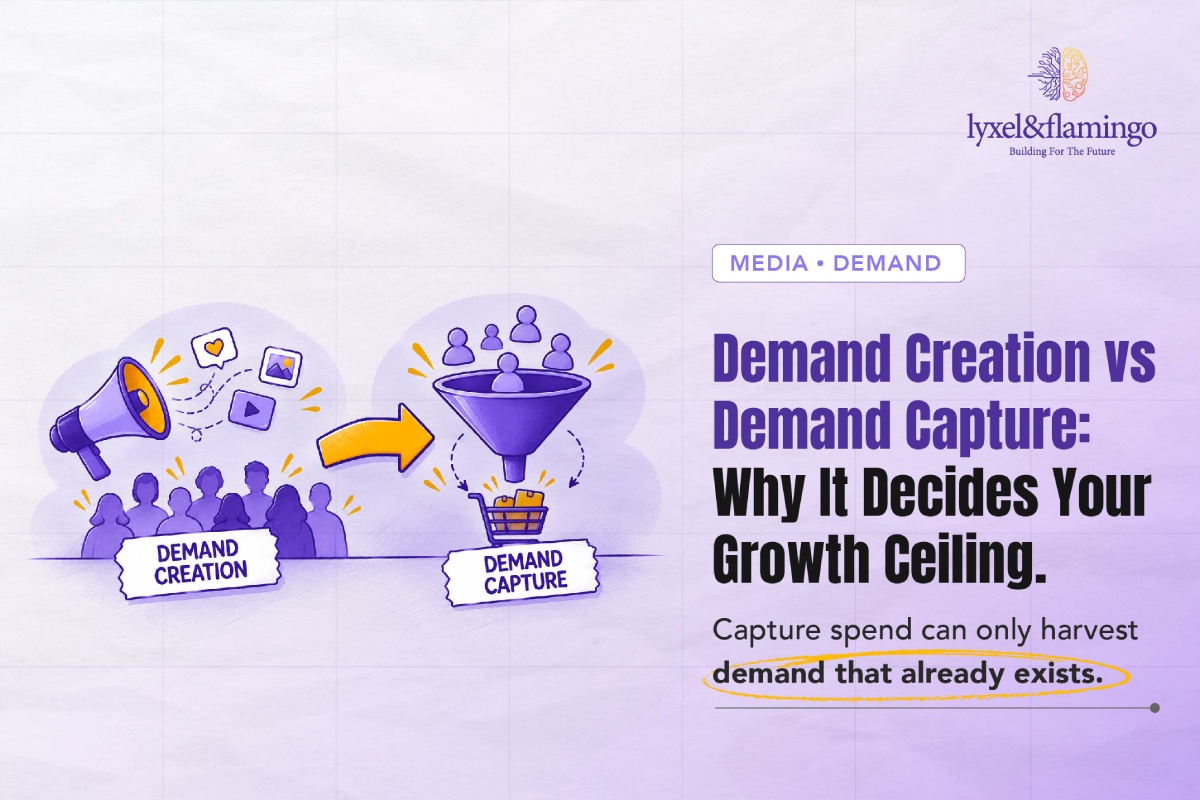
Across the funnel, a budget funds four different jobs, and each one is judged on a different signal. The first is creating demand: the upper-funnel work of reaching future buyers and building memory, so there is demand to capture later. It rarely converts on the same click, so it is judged on branded search and view rate rather than last-click return, and it is the difference between demand creation and demand capture. The second is nurturing that demand the mid-funnel job of warming interest read through rising direct and organic traffic. The third is capturing demand, the lower-funnel job of harvesting intent, judged on blended MER and contribution margin. And the fourth is compounding value the retention and lifecycle work that turns a first purchase into repeat, higher-margin revenue, judged on retention contribution and lifetime value. A budget that funds only the third job harvests a pool nobody is refilling; a budget that funds all four keeps the whole engine turning.
The Funnel Budget-Allocation Framework
The framework lays the four jobs out with a weight against each, so the plan is visible before a single channel is chosen.
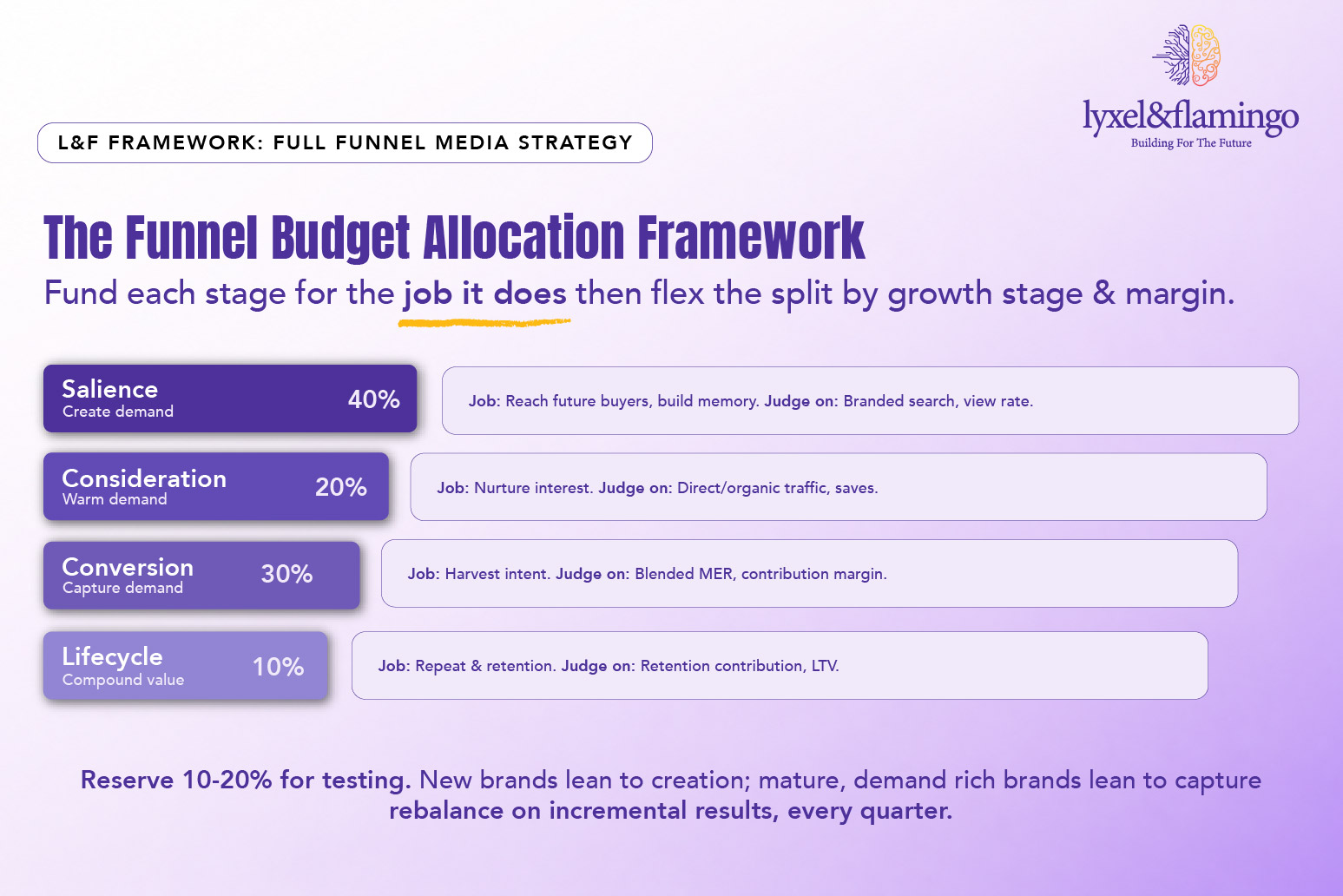
Framework: The Funnel Budget-Allocation Framework – fund each stage for the job it does.
Read left to right, it turns budgeting into a set of deliberate choices rather than a spreadsheet defence. Each stage carries a job, a rough share of the budget, and the signal it is held to. The shares are a starting point, not a rule; the real value is that every stage has a funded job and a way to prove it is working, so nothing quietly falls off the plan when a quarter gets tight.
A starting split and how to flex it
A sensible opening position, drawn from long-run effectiveness research, is to weight the budget toward creating and nurturing demand rather than only capturing it broadly in line with the 60/40 rule of around 60% to brand-building and 40% to activation. Translated across the four jobs, that might look like roughly 40% to salience, 20% to consideration, 30% to conversion, and 10% to lifecycle, with the exact figures flexing by growth stage, category and margin.
A younger brand, or one creating a new category, leans harder into demand creation, because there is little existing demand to harvest and the priority is building the pool. A mature brand in a demand-rich category can lean more toward capture and retention, because the demand already exists and the job is to convert and keep it efficiently. Margin matters too: a thin-margin business has less room for long-payback brand investment and has to earn its way into it. The framework holds in every case; the weights move with the situation.
Related blog: Non-Biddable Media Explained: Unlocking Incremental Reach Beyond Auction-Based Buying, which sets out the Excess Share of Voice research behind why this split holds.
The testing reserve
Alongside the four jobs, a healthy budget carries a fifth line that is easy to cut and expensive to lose: a testing reserve, usually around 10-20% of the total. Its purpose is to fund the experiments that tell you where next year’s budget should go – new channels, new audiences, new creative approaches, and incrementality tests that prove what is actually working. Without it, a budget can only ever repeat last year’s assumptions. With it, a team is continually buying information about where the returns are moving, and can shift budget toward what proves incremental rather than what merely looks efficient in the platform’s own report.
Related blog: Incrementality at Scale: Geo Experiments for Enterprise Marketing, the methodology for running the tests this reserve is meant to fund.
How to rebalance without whiplash
A budget set once and left alone drifts out of date; a budget re-cut every week never gives anything time to work. The middle path is a regular, evidence-led rebalance each quarter, typically guided by a few honest signals rather than by whichever channel posted the best last-click number. Rising cost per result at flat volume is the market telling you a stage is saturated and demand needs refilling upstream. A flat branded-search line while conversion spend climbs is a sign the top of the funnel is under-funded. Results from the testing reserve point to where incremental budget will earn more. Read together, these move the weights gradually, in the direction the evidence points, without the whiplash of chasing the metric of the week. The aim is a budget that learns, not one that lurches.
Self-check: is your budget doing every job?
Score your own plan one point per yes:
- The budget is built around funnel jobs first, then channels
- Demand creation is a funded line, not whatever is left over
- Each stage has a signal it is judged on, appropriate to its job
- The split flexes by growth stage, category, and margin
- A testing reserve of 10-20% is protected each cycle
- You rebalance on evidence each quarter, not weekly on last-click
- Retention and lifecycle have a dedicated share, not an afterthought
Five or more and your budget funds the whole funnel. Three or fewer and some jobs are going unfunded.
Key takeaways
- Channel-first budgeting rewards the stages that are easy to measure and starves the ones that create demand.
- A budget funds four jobs: creating demand, nurturing it, capturing it, and compounding it through retention.
- A useful starting split leans toward demand creation roughly 60/40 brand to activation, then flexes by stage, category, and margin.
- Protect a 10-20% testing reserve to fund the experiments that tell you where next year’s budget should go.
- Rebalance on evidence each quarter, guided by leading signals, rather than re-cutting on last-click every week.
Closing
A budget is a statement of what a business believes will make it grow. Built channel by channel, it tends to say the quiet part out loud: that the company will keep harvesting the demand it already has and hope the rest takes care of itself. Built job by job, across the whole funnel, it says something more useful: that every stage of growth has been funded to do its work, and that the plan will keep learning where the returns are. The framework is simple; the discipline is in funding the jobs that are harder to measure but no less real.
Want a budget built around the funnel, not the spreadsheet?
L&F builds full-funnel budget plans job by job, with a testing reserve and a quarterly rebalance for consumer brands across India and worldwide. We will map your split to the work each stage has to do. Talk to L&F about full-funnel planning and fund every job the funnel needs done.
Frequently Asked Questions
Start with the jobs, not the channels. A funnel budget funds four tasks: creating demand (upper funnel), nurturing it (mid funnel), capturing it (lower funnel) and compounding it through retention. Weight the budget across those jobs a common starting point is roughly 40% salience, 20% consideration, 30% conversion and 10% lifecycle - then choose channels to deliver each job, and flex the weights by your growth stage, category and margin.
The 60/40 rule, from long-run effectiveness research, suggests weighting roughly 60% of budget to brand-building (creating and nurturing demand) and 40% to activation (capturing it) to maximise long-term profit. It is a starting benchmark rather than a fixed law: a younger brand creating demand leans more to brand, while a mature brand in a demand-rich category can lean more to activation. The principle is to keep demand creation funded rather than letting capture absorb the whole budget.
A common guideline is 10-20% held as a testing reserve. Its job is to fund experiments new channels, audiences, creative approaches and incrementality tests that tell you where next year's budget should move. It is usually the first line cut when budgets tighten, which is a mistake, because without it a budget can only repeat last year's assumptions rather than learn where the returns are shifting.
Quarterly is a sensible default for most brands frequent enough to respond to what the evidence shows, but not so frequent that nothing gets time to work. Rebalance on leading signals rather than last-click swings: rising cost per result at flat volume, a flat branded-search line while conversion spend climbs, and results from your testing reserve all point to where budget should move. The aim is gradual, evidence-led shifts, not weekly whiplash.
Yes, a younger brand, or one creating a new category, has little existing demand to harvest, so it should lean harder into demand creation building the pool of future buyers before over-investing in capture. A mature brand in a demand-rich category can lean more toward conversion and retention, because the demand already exists. The four-job framework holds for both; only the weights change with the growth stage.
Closely they are the same idea at two levels. Demand creation is the upper-funnel job of building future demand; demand capture is the lower-funnel job of harvesting it. Allocating budget across the funnel is the practical act of funding both, in balance, so creation continually refills the pool that capture drains. A budget that funds only capture harvests a shrinking pool; one that funds creation too keeps the pool growing.
Match the signal to the job. Demand creation is judged on branded search and video view rate, because it builds memory before it converts. Nurturing is read through direct and organic traffic and engagement depth. Capture is judged on blended MER and contribution margin, not last-click ROAS alone. Retention is judged on retention contribution and lifetime value. Using one metric - usually last-click ROAS across every stage is what makes upper-funnel work look like a waste.