What this blog covers
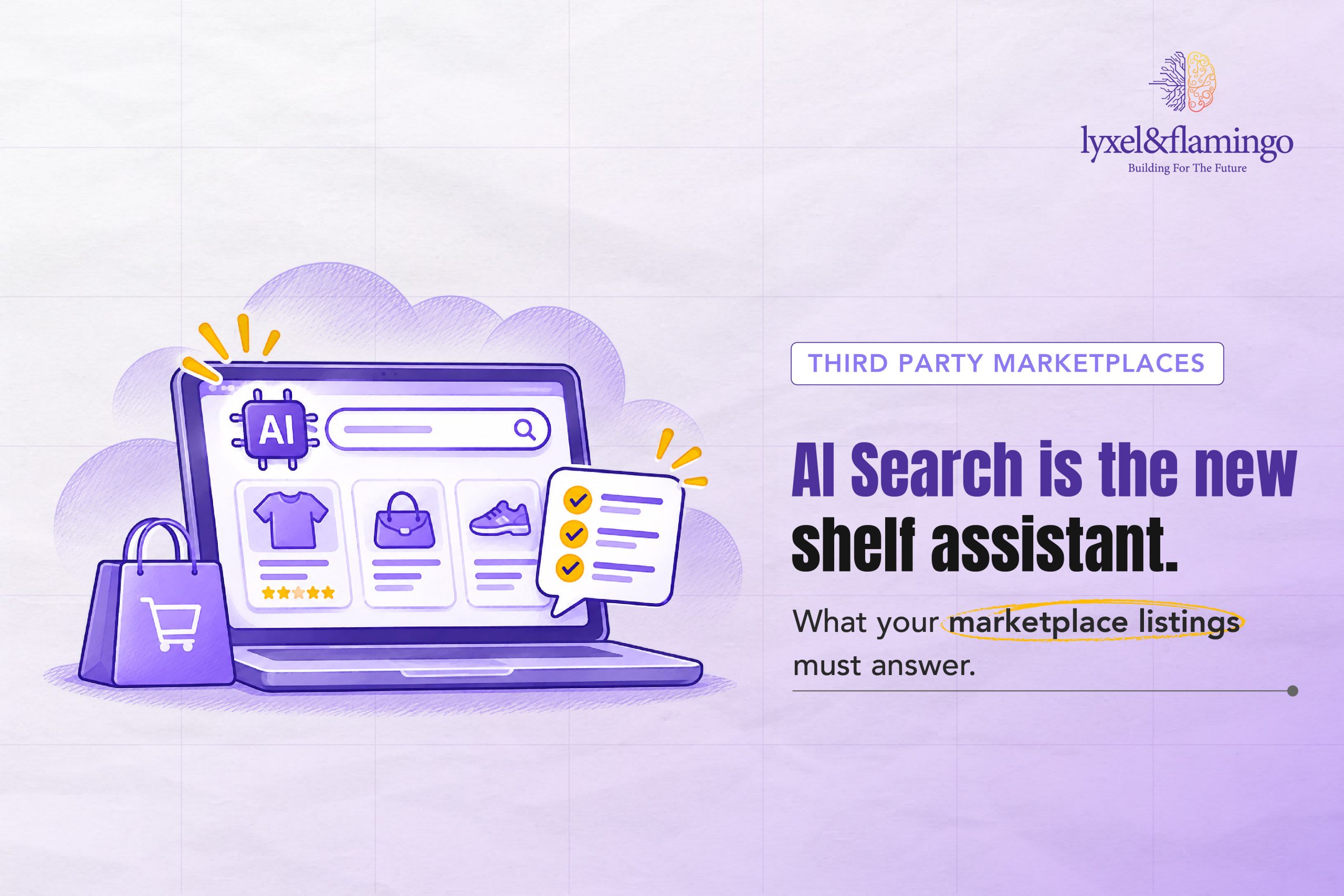
Amazon A+ Content is evolving as AI shopping assistants like Amazon Rufus change how customers discover and evaluate products. With over 300 million customers using Rufus in 2025, brands must create product pages that answer shopper questions with clear, verifiable information rather than generic marketing claims.
This blog explores how Amazon A+ Content optimisation can help brands improve product discoverability, accuracy, and customer confidence in AI-assisted shopping journeys. It introduces Lyxel&Flamingo’s four-layer Quote-and-Check Stack: Question, Fact, Comparison, and Reconciliation. The framework helps brands identify common customer questions, present measurable product specifications, compare product variants, and align claims with customer reviews.
The blog also outlines five practical steps for making listings more AI-ready, including reviewing customer feedback, maintaining consistent product attributes, and testing AI-generated answers. While published evidence does not yet prove that A+ copy directly influences Rufus responses, factual, consistent content can strengthen the overall product experience across search, AI discovery, and purchase decisions.
Table of Contents
- What Is Amazon A+ Content?
- Why Pitch-Style A+ Copy Fails in the Summary and in the Fact-Check
- How Amazon Rufus AI Builds an Answer, and Where Your A+ Copy Drops Out
- What the Data Says About Shoppers Who Ask Instead of Scroll
- The Quote-and-Check Stack: Lyxel&Flamingo’s Four-Layer Method for Amazon A+ Content Optimisation
- What the Proof Shows, and Where It Stops
- 5 Things to Do This Week to Make Your Amazon A+ Content Rufus-Ready

More than 300 million customers used Rufus in 2025, according to Amazon’s fourth-quarter results, and any of them could ask about your product without scrolling past a single A+ module. Amazon credits the assistant with nearly $12 billion in incremental annualised sales, which is the company’s own attribution, so read it as a direction and not as an audit. The direction still matters, because Amazon A+ Content assumes a shopper who scrolls, and a growing number of shoppers now start by asking.
Amazon says Rufus builds product-page answers from “listing details, customer reviews, and community Q&As”, and nothing we found in its public material says whether the text inside A+ modules counts as a listing detail. Piling on adjectives will not close that gap, since an adjective carries no unit, no test condition and nothing a shopper can verify. A+ copy now has to work as a checkable fact before it works as persuasion. For any team responsible for Amazon product listing optimisation, that is the new brief.
What Is Amazon A+ Content?
Amazon A+ Content is the brand-controlled content area of an Amazon product page, built from image and text modules. Per Amazon’s seller documentation, basic A+ highlights key features with images, text placements and shoppable product-comparison charts, while Premium A+ adds larger images, video, interactive hotspots, carousels, Q&A modules and shoppable content. Sellers need a Professional selling account plus a Brand Representative or Reseller role in Brand Registry (or generic products in their catalogue). A+ Content is free for eligible sellers, although the Professional account is a paid plan.
It matters now because the page has a second audience. Rufus, the Amazon AI shopping assistant, answers product questions from listing details, reviews and community Q&As. In the US, Amazon folded Rufus into Alexa for Shopping on 13 May 2026, while Amazon India’s shopping-app page still calls it Rufus.
Why Pitch-Style A+ Copy Fails in the Summary and in the Fact-Check
A team reviewing an A+ page asks whether it looks premium. An assistant asks something different: what does this page state about the product, and can any of it be quoted? Those two tests reward different writing, and copy built to pass the first can fail the second.
Imagine a mixer grinder page that promises “powerful performance for the whole family.” The line has no wattage, no jar capacity and no run time. A shopper skimming a lifestyle image forgives that. An assistant asked whether the grinder can handle wet masala for six people finds nothing to extract, so its answer leans on reviews and Q&As the brand did not write.
Then there’s the second reader, the shopper who checks. Gartner surveyed 846 US consumers in November and December 2025. Among those who used AI while shopping for a recent purchase, 54% said they had to double-check the accuracy of all information GenAI tools provided, and 62% said information from GenAI tools ended up being a waste of their time. Gartner VP Analyst Kate Muhl put the consequence in one line: “Accuracy is now a brand issue.” But the shopper who asks Rufus and then scrolls to your A+ page is running the same check, and it takes seconds to hold “whole family” up against a review about the jar overheating.
An A+ claim that an assistant cannot quote and a shopper cannot verify has stopped doing any work for the listing.
Is your ad budget sending shoppers to a product page nobody has audited lately? Read this blog: Great Advertising Cannot Fix Weak Product Content: The Marketplace Creative Audit Every Brand Needs
How Amazon Rufus AI Builds an Answer, and Where Your A+ Copy Drops Out
Rufus is a mix of models, all reading the same page. Amazon describes a real-time router that draws on a mix of models, including Anthropic’s Claude Sonnet, Amazon Nova and a custom model, all accessed through Amazon Bedrock, with an expanding knowledge graph of product attributes and customer preferences behind it. For questions about products and trends, it also pulls from publications such as The New York Times, USA Today, Good Housekeeping and Vogue. On a product page, the answer draws on “listing details, customer reviews, and community Q&As”.
Read that list the way a brand would read it. One of the three inputs is yours, and the other two can disagree with it. Amazon’s AI review highlights also condense common themes from dozens, hundreds, or even thousands of reviews, so what customers say travels further than what A+ says. McKinsey’s 2026 consumer research names the risk: gen AI platforms aggregate third-party sources such as online forums, reviews on retailer websites, blogs and video platforms, and when those sources provide inconsistent or incomplete information, creating “signal dissonance,” AI models are less likely to reliably include or accurately represent a brand.
Amazon is also building features that shorten the trip to the page. Amazon India’s Watch Highlights generates a 30- to 40-second video summary that is designed to reduce the time customers spend reading through detailed product pages, and in the US, Alexa for Shopping puts AI-generated overviews at the top of search results and on product detail pages.
One A+ page now has three readers, and each one uses it differently:
| Reader | What they take from the page | What makes them discount it |
| Scrolling shopper | Images, headlines, overall impression | Clutter and slow layouts |
| Assistant | Stated facts, attributes, comparisons | Vague or conflicting claims |
| Checking shopper | Claims to test against reviews | Claims the reviews contradict |
One caveat belongs here: Amazon has not said whether text embedded in A+ images is read, so a specification that lives only inside an infographic is a bet, not a plan.
Want one product page that works for shoppers and for the algorithms reading it? Read this blog: Writing PDP Copy for Humans and Algorithms at Once
What the Data Says About Shoppers Who Ask Instead of Scroll
GenAI assistants ranked as the second most influential touchpoint for shoppers who used them, and the first for daily GenAI users. BCG’s Global Consumer Radar surveys more than 9,000 respondents across nine markets, including India, and shows shopping-related GenAI use grew 35% between February and November 2025. A separate BCG release says India leads the world in GenAI usage for shopping.
One in three US consumers planned to use GenAI for holiday shopping in 2025, more than twice the share a year earlier. The 2025 Holiday Retail Survey of 4,000 consumers lists finding prices, summarising reviews, and building shopping lists as uses, so AI can reach shoppers with what reviews say about your product, whether or not your A+ page agrees.
Inconsistent or incomplete information across third-party sources makes AI models less likely to include a brand or to represent it accurately. McKinsey calls this signal dissonance in its State of the Consumer 2026 report, a survey of 4,863 consumers in Brazil, France, Germany, the UK and the US, with no India sample. The report also cites XEO360 data (October 2025 to May 2026) showing that only 1% of the sources LLMs cite come from brand-owned websites, a general LLM figure and not a Rufus one.
Amazon says Basic A+ Content can raise sales by up to 8%, and well-implemented Premium A+ Content by up to 20%. The footnote credits Amazon internal data with no date, sample or method, so treat both numbers as a ceiling and not a forecast.
The Quote-and-Check Stack: Lyxel&Flamingo’s Four-Layer Method for Amazon A+ Content Optimisation
At Lyxel&Flamingo’s Commerce Strategy practice, we rewrite A+ pages with a four-layer model called the Quote-and-Check Stack: Question, Fact, Comparison and Reconciliation. The name describes the two tests the copy must pass, an assistant quoting it and a shopper checking it, and the order matters because each layer needs the one before it.
- Question layer: List the 20 questions shoppers ask most about an ASIN, drawn from the Customer Questions section, 1- to 3-star reviews and the answers Rufus gives when you ask it yourself. Map each one to a module or bullet. A question without a home in your listing is a gap the assistant fills from other sources.
- Fact layer: Rewrite every module so each claim carries a number, a unit and a condition, and write it as text instead of only inside an image. Keep it identical across the title, bullets, A+ modules and catalogue attributes, using the same attribute names you target in Amazon listing SEO.
- Comparison layer: Build a “choose this if, choose that if” chart across your own variants. BCG advises brands to supply plain-language explanations and side-by-side comparisons, and Amazon’s assistant already offers side-by-side comparisons of features, prices and reviews. Without your own chart, that comparison leans on data you did not write.
- Reconciliation layer: Set each claim against review themes and the Q&A section, then cut or qualify whatever customers contradict. L&F’s in-house voice-of-customer platform, Weavr, aggregates reviews in real time, and for a single ASIN, a spreadsheet of 1- to 3-star themes does the same job.
Not sure what your reviews already say about the claims on your page? Read this blog: Amazon Reviews: A Hidden Goldmine
What the Proof Shows, and Where It Stops
We found no published controlled test of A+ copy inside Rufus, so the proof below comes from the two closest sources, and we label what each can and cannot show.
What Amazon reports about Rufus usage and its sales impact:
- 300 million+ customers used Rufus in 2025, and Amazon says it delivered nearly $12 billion in incremental annualised sales.
- Over 60% more likely to purchase during the same shopping trip, among customers who use Rufus, per Amazon’s November 2025 update.
- 210% growth in Rufus interactions, with monthly average users up 149%, in that same update.
What Lyxel&Flamingo reports from Flipkart: L&F’s post on writing PDP copy for humans and algorithms at once cites Wipro Lights’ Flipkart campaigns, where disciplined, layered content built for both readers delivered these changes:
- +12.37% click-through rate across the Wipro Lights campaigns.
- +14.39% conversion rate across those same Wipro Lights campaigns.
- +53.86% ROI across those same Wipro Lights campaigns.
Neither set proves the Stack, and the limits are worth stating plainly: Amazon’s update gives no method for its 60% figure, the $12 billion is Amazon’s own attribution, and the Wipro Lights numbers are L&F-reported, come from Flipkart and carry no baseline or time period. Read together, they point to two things: shoppers who use an assistant are more likely to buy, and copy written for people and algorithms at once has lifted click-through and conversion in L&F’s Flipkart work. The Stack carries that overlap into Amazon product listing optimisation, and the 20-prompt test below is how you check it on your own ASINs.
5 Things to Do This Week to Make Your Amazon A+ Content Rufus-Ready
Each step below is Amazon A+ Content optimisation that needs no new tool.
- Pull 20 real shopper questions for your best-selling ASIN. Take them from Customer Questions, 1- to 3-star reviews and your own Rufus prompts, then mark the ones your A+ modules already answer.
- Replace every adjective in your A+ headlines with a number, a unit and a condition. “Long battery life” becomes “9 hours of video playback at 50% brightness.” Put it in module text, since Amazon has not said whether image text is read.
- Check that one fact reads the same way in four places. Title, bullets, A+ modules and backend attributes should agree on capacity, wattage, dimensions and compatibility, so fix mismatches before touching the design.
- Read the 1- to 3-star reviews against your claims. Cut or qualify whatever customers contradict, and add one plain sentence on the most frequent complaint.
- Run a 20-prompt test and log the answers. Ask Rufus (or Alexa for Shopping in the US) 20 buyer questions in your category, record whether your product appears and in what words, and repeat monthly. BCG recommends tracking how often products appear in AI-generated answers, and this is the cheapest version.
Conclusion
The Amazon AI shopping assistant will keep changing names and surfaces. Amazon announced Rufus in February 2024 and folded it into Alexa for Shopping for US customers by May 2026, so copy tied to a feature name or layout expires with each change. Copy tied to facts a shopper can verify survives all of it. BCG’s August 2026 research found that in more than half of AI-assisted journeys, the AI introduced consumers to brands they would not otherwise have considered, which makes inclusion in the answer a discovery channel and not only a support feature.
We bet that brands making their A+ claims checkable now will hold an edge that gets harder to copy with every review that backs the page.
For a second opinion on where your pages stand, get a free review of your marketplaces from L&F’s Third Party Marketplaces team and bring your best-selling ASIN.
Frequently Asked Questions
Amazon Rufus AI is Amazon's generative AI shopping assistant, trained on its catalogue, reviews, community Q&As and the web. In the US, it became Alexa for Shopping on 13 May 2026, while Amazon India still runs it as Rufus in English and Hindi.
Amazon says Rufus answers from listing details, customer reviews and community Q&As, but it has not published which fields count. Treat A+ text as possible input, and put key facts in plain module text, not only in images.
Amazon Rufus optimisation starts with one set of facts: title, bullets, A+ modules and attributes should state the same numbers and units. Then answer your top 20 shopper questions in plain text and test 20 prompts every month.
Yes, because shoppers still want the final say. Gartner's US survey found willingness to let AI make purchase decisions topped out across lower-stakes categories, while Amazon's A+ lift claims (up to 8% Basic, 20% Premium) rest on its own undated data.
Nothing Amazon has published so far says it does. Alexa for Shopping takes questions in the main search bar, and Amazon India adds AI overviews to results pages, so search and the assistant run side by side. Plan Amazon listing SEO and Rufus work as one job.