What This Blog Covers
Chargebacks look like a payments problem, yet for a CMO they behave like a margin problem that quietly erodes every acquisition you have paid for. This article shows what a disputed order really costs, why Visa tightened its merchant threshold to 1.5% on 1 April 2026, and how order-level risk scoring protects revenue without adding friction for every customer. You will leave with a monthly ledger that joins marketing, finance and technology around one dispute number, so fraud control protects margin without taxing the good customers your media budget worked hard to bring to checkout.
Quick Answer: Ecommerce fraud prevention at checkout works when you score every order in real time and add friction only to the risky ones. Since 1 April 2026, Visa’s merchant “Excessive” threshold sits at 1.5% in Asia Pacific, the US, Canada and the EU, so the room for error is smaller than a year ago. Cut non-fraud disputes with clear billing descriptors and delivery updates, and review your ratio every month.
Table of Contents
- What a Chargeback Really Costs a D2C Brand Beyond the Refund
- The 1.5% Line That Turned Fraud Control Into a Board Question
- Card-Network Monitoring Programmes at a Glance (2026)
- Why Fraud Friction Belongs on the Risky Order, Not on Every Order
- The Small Brand Touchpoints That Quietly Decide Your Dispute Ratio
- What the Checkout Trust Ledger Asks You to Run Every Month
- Framework Explained
- Why a Falling Dispute Count Is Not Proof That Margin Is Protected
- Key Takeaways
- The CXO Takeaway
What a Chargeback Really Costs a D2C Brand Beyond the Refund
A disputed order costs you the revenue, the product, the outbound shipping and, in most cases, the return freight. The payment processor then adds a dispute fee on top. Your gross margin on that order does not shrink; it goes negative. Multiply that by every disputed order in a quarter and the total reaches a size your board would notice.
Finance tends to book these costs across payments, logistics and write-offs, so no single report shows the total. That fragmentation hides the problem from the people who set checkout and promotion policy. A CMO who approves a festive offer without seeing dispute cost is approving half a P&L. Fix the reporting first, before you debate any tool.
Fraud is rarely a technical break-in. Attackers who test cards, take over accounts or abuse refunds usually work through people and processes, which is why the human attack surface still matters even when your platform is secure. Your marketing mechanics add exposure of their own, because referral codes, loyalty points and refund policies all become targets once they carry value. Ask your finance partner to rebuild last quarter’s view with the full dispute cost on every order, then compare it with the margin your campaign reports show; the gap is the first number worth bringing to your leadership team.
Name one number: total dispute cost as a percentage of card revenue, including fees, freight and write-offs. Put it in the monthly business review next to CAC and AOV. Measured, then owned. A figure with an owner gets fixed; a figure in a footnote does not.
The 1.5% Line That Turned Fraud Control Into a Board Question
Visa’s Acquirer Monitoring Program (VAMP) now combines fraud reports and disputes into one ratio over settled transactions. From 1 April 2026 the merchant “Excessive” threshold is 1.5% in Asia Pacific, the US, Canada and the EU (2.2% in CEMEA), once you pass 1,500 counted events in a month. Industry sources put the fee at about $8 per violation; that figure is not in Visa’s public fact sheet, so confirm it with your acquirer. For a CMO the practical question is simple: if volume doubles during a sale, does the ratio stay under the line, or does the success of the campaign trigger the penalty?
Trust in your checkout shapes the same ratio. Payments, servers and security decide brand trust long before a dispute is filed, because buyers who doubt a checkout are the ones who later claim they never ordered. That makes security a brand question, not only a technology one. Raise it in the same meeting as media budget.
The arithmetic is unforgiving. At 60,000 monthly Visa transactions, the ceiling fell from 1,320 events at 2.2% to 900 at 1.5%. One order can enter the ratio as both a fraud report and a dispute, so a merchant who looked safe in March can breach in April with identical volume. Same volume, tighter line.
Card-Network Monitoring Programmes at a Glance (2026)
Visa VAMP: Fraud reports plus disputes, over settled transactions. Merchant threshold: 1.5% from 1 April 2026 (2.2% in CEMEA). Volume floor: 1,500 or more counted events a month.
Mastercard ECM: Chargebacks against a merchant. Merchant threshold: 1.5% ratio. Volume floor: 100 or more chargebacks.
Your own trigger: Dispute rate, approval rate, abandonment, cost per dispute. Merchant threshold: Weekly review above 1.0%. Volume floor: Set from your own volume.
Industry guides report a parallel Mastercard rule: its Excessive Chargeback Merchant programme flags a merchant at a 1.5% ratio with 100 or more chargebacks. Ask your acquirer how both programmes apply to your card-not-present volume, including any Indian domestic treatment. Treat that conversation as a board-level risk item. Not an IT ticket.
Why Fraud Friction Belongs on the Risky Order, Not on Every Order
Blanket friction is the most expensive fraud control you can buy. A one-time password, address check or manual review on every order stops fraud and good customers alike. Fraud teams celebrate a lower dispute count while growth teams lose conversion, and a friction audit shows exactly where good buyers already drop. The CMO sits between the two scorecards, so the trade-off lands on your desk.
Score each order instead. Device, velocity, address mismatch, payment method and basket pattern give you a risk band in milliseconds. The best test of any fraud control is its effect on good customers, so require your fraud and growth teams to report approval rate and abandonment next to every dispute figure, in one shared review. Only the highest band meets a step-up check.
A step-up check is typically an OTP, a delivery-address confirmation or a short manual review. Measure approval and abandonment for the stepped-up group separately, since that group is where fraud loss and lost sales trade against each other. Review the thresholds every month with the same discipline you apply to bid caps. A threshold set in January is stale by the festive season.
Test every control like any other checkout change. The discipline in Shopify conversion optimisation, one change at a time against a control, proves whether a new check costs less in lost orders than it saves in disputes. Ask for that proof before you approve a permanent rule. Evidence, then policy.
The Small Brand Touchpoints That Quietly Decide Your Dispute Ratio
Not every dispute is fraud, yet the network ratio counts non-fraud reason codes too. A buyer who does not recognise your billing descriptor can hurt your ratio as much as a stolen card does. A recognisable descriptor and an order confirmation that names the brand are cheap fixes. They are also brand work, so they belong to marketing.
Delivery silence produces “item not received” claims. Proactive tracking messages, a visible returns path and fast service replies move the argument back from the bank to you. Fast replies are a control, not a courtesy. Every contact avoided is a dispute avoided.
Platform choice matters here as well. A stack built for scale, security and automation, as covered in why global brands move to Shopify Plus, gives you cleaner signals and easier messaging automation. Automation is what makes a delivery update arrive before the customer asks. Check whether your current platform does that by default.
Build a short dispute playbook with service, logistics and marketing: who answers, within what time and with what evidence. Evidence wins disputes, and evidence is a by-product of good order records. These fixes sit squarely in marketing’s remit, because the descriptor, the confirmation message and the delivery update are all brand touchpoints that happen after the sale and before the next one. Expensive to ignore.
What the Checkout Trust Ledger Asks You to Run Every Month
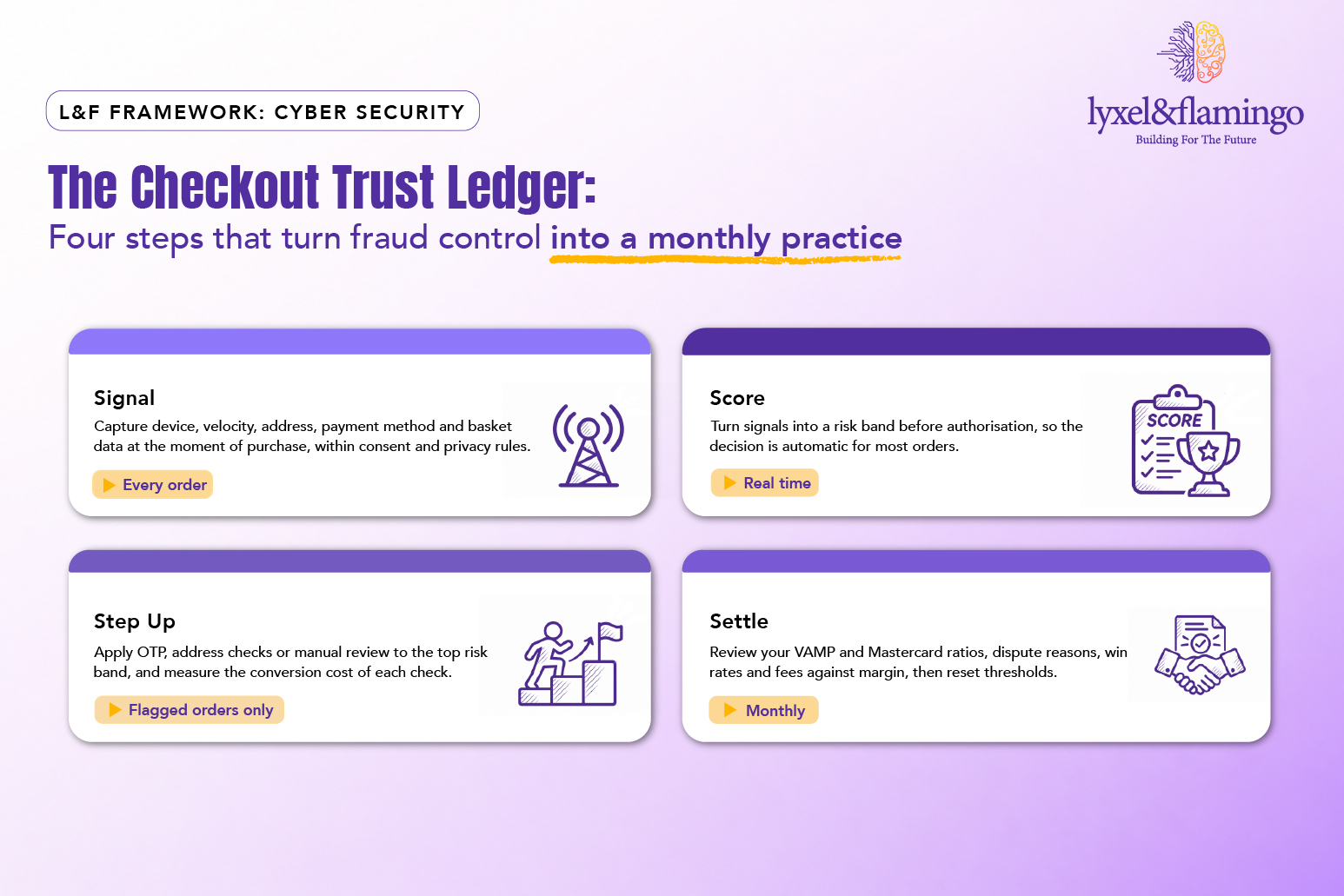
Use this ledger to run fraud control as a repeatable monthly practice instead of a one-off tool purchase.
Framework Explained
Signal: Fraud decisions are only as good as the data behind them. Collect the fields your processor and fraud tool can use, and record why each decision was made so you can contest disputes with evidence. Keep the data set lean and lawful: more fields do not always mean better scores, and privacy duties apply from the first captured attribute.
Score: A real-time score keeps friction invisible for the large majority of customers. Start with rules your team can explain, such as velocity limits and address mismatches, then add a model once you hold enough labelled outcomes to train it. Review false positives monthly, because every wrongly blocked order is lost revenue that never shows up as a dispute.
Step Up: Make the extra check proportional to the risk. A medium band can need an OTP or a delivery confirmation while only the highest band goes to manual review. Track approval rate and abandonment for the stepped-up group separately, because that group is where the trade-off between fraud loss and lost sales is measured.
Settle: Close the loop each month. Compare your ratio to the 1.5% line, split disputes into fraud and non-fraud, and move budget toward the control with the best margin return. Settling also means writing down what you changed and why, so the next review starts from evidence instead of memory.
Why a Falling Dispute Count Is Not Proof That Margin Is Protected
A falling dispute count proves little on its own. Track four numbers together: dispute rate, approval rate, abandonment at step-up and cost per dispute. If the first falls while the second and third worsen, you have moved the loss from the bank to your growth line. Same loss, different ledger.
Read dispute reasons every month. Split fraud from non-fraud and tag each non-fraud claim to its cause: descriptor, delivery, quality or service. The pattern tells you whether to buy a tool or fix a process, and the guide to website security as a brand asset sets out the security basics that keep the signal clean. Often the cheapest fix is a process, not a product.
Set a trigger. If the ratio passes 1.0%, review weekly; if it nears 1.5%, pause promotions that attract risky traffic until it falls. A written rule beats a debate in the middle of a sale. Present the ledger to your leadership team quarterly, with one page showing the ratio, the cost per dispute and the change you made, so fraud control is seen as a managed margin lever and not a recurring surprise.
Social channels add their own exposure. As social commerce on Instagram and WhatsApp becomes a larger D2C sales channel, orders arrive outside your standard checkout. Extend the same scoring and descriptor discipline to them. A channel that grows without controls grows the ratio too.
Key Takeaways
Chargebacks cost the sale, the stock, the shipping and a fee. Report them as one margin line so the total is visible.
Visa’s 1.5% merchant threshold from April 2026 cut the allowable event count by about a third at the same volume.
Score every order and step up only the risky ones; blanket friction taxes good customers.
Non-fraud disputes count in the ratio, so descriptors, tracking and service speed are fraud controls too.
Track dispute rate with approval rate and abandonment so you do not move the loss from the bank to your growth line.
The CXO Takeaway
Ask your finance and growth leads for one number: total chargeback cost as a percentage of card revenue, including fees, freight and write-offs. Then ask your acquirer where you sit against the 1.5% line. If nobody can answer both within a day, fraud control is not yet an owned process.
Frequently Asked Questions
VAMP applies to Visa card-not-present transactions, and the 1.5% merchant threshold covers Asia Pacific, the US, Canada and the EU. How your acquirer applies it to domestic Indian volume depends on your processing set-up, so ask for the ratio they report against your merchant ID.
Blanket verification will. Step-up checks on a small risk band rarely do, provided you measure approval and abandonment for that group separately and adjust the threshold as data arrives.
No, a tool scores risk, yet disputes also come from unclear descriptors, late delivery and weak service. Combine scoring with communication fixes and a monthly review of reason codes.
Monthly at minimum, since the networks measure monthly. During sale periods check weekly, because order spikes and bot traffic move the ratio quickly.