
What this blog covers
Brand and performance media are not two budgets competing for the same rupee. They are two settings on one system that shapes demand and then captures it. This piece lays out why treating them as separate silos costs growth, how a full-funnel media engine actually works end to end, and what a CXO should ask before approving next quarter’s split.
Quick Answer: A full-funnel media engine treats brand and performance as one connected system rather than two budgets: brand spend builds the demand that performance spend later captures at a lower cost. Separating them into silos with separate KPIs, teams and reporting usually means performance media quietly drains the brand equity it depends on, while brand spend gets judged on metrics it was never built to move. The fix is not a bigger budget. It is a shared measurement layer connecting upper-funnel signal to lower-funnel conversion.
Table of Contents
The Cost of the Brand/Performance Wall
Most organisations run brand and performance as two separate teams with two separate KPIs, and often two separate agencies. Brand gets judged on reach and recall. Performance gets judged on CAC and ROAS this quarter. Neither team is wrong to optimise for what it is measured on, yet the wall between them means nobody is watching the thing that actually predicts growth: whether performance’s job is getting easier or harder over time.
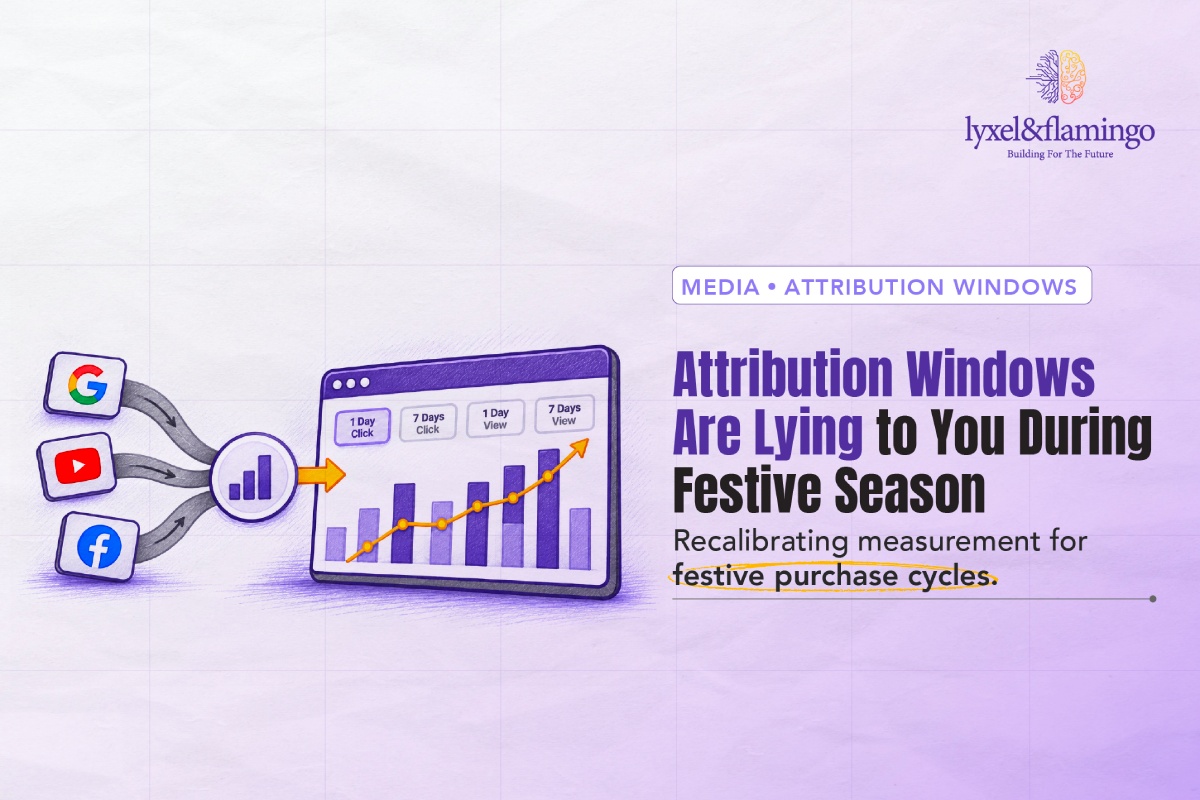
That tension is exactly what shows up when you compare performance marketing against brand marketing head to head. Cut brand spend and performance CPCs often hold steady for a quarter or two, so the cut looks free. The real cost shows up later, as branded search volume softens and every performance channel has to work harder for the same conversion. By the time it appears in the performance dashboard, it looks like a performance problem, not a brand one. The same kind of measurement blind spot shows up in festive-season attribution windows: a static measurement system reporting against a moving reality, just at a different timescale. For more on how attribution windows can distort performance decisions, see this guide to Amazon Marketing Cloud and attribution windows.
What “One System” Actually Means
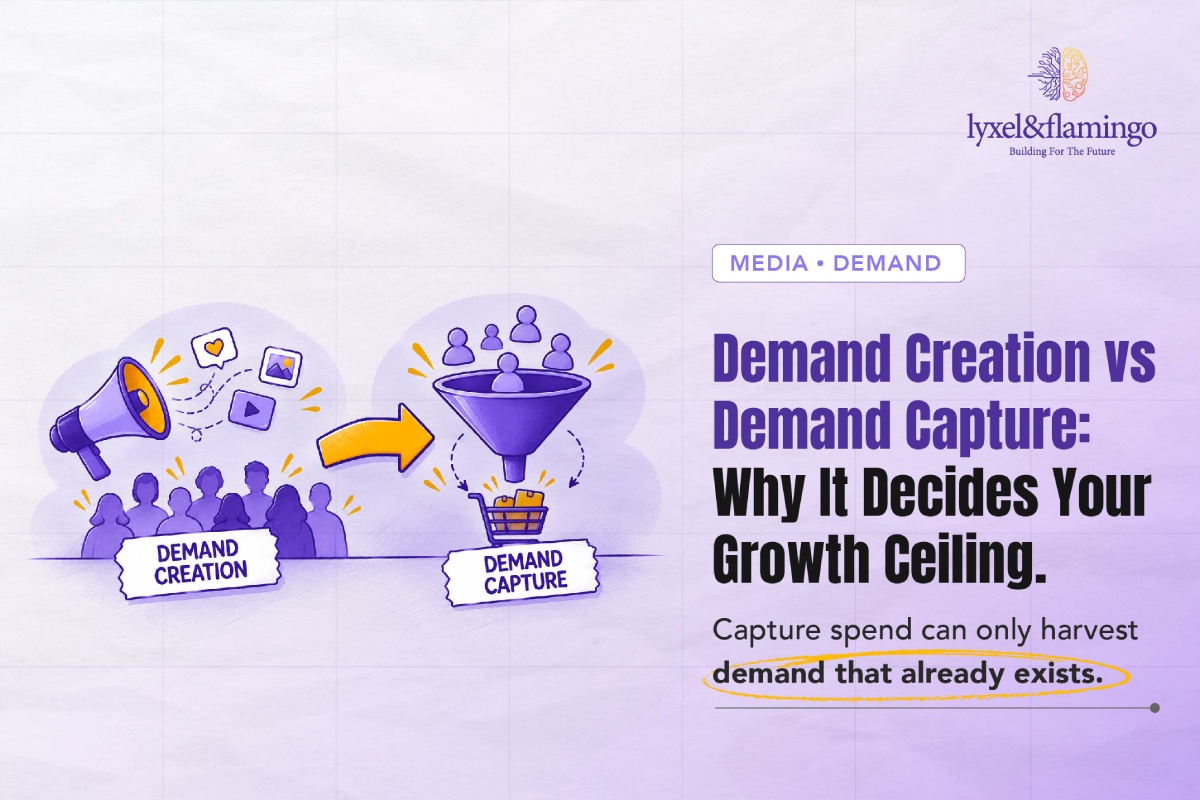
A full-funnel media engine is not brand plus performance running in parallel. It is a single plan sequenced by what each stage of the funnel is actually for. Reach media at the top builds category presence and distinctive assets, so the brand is the one a shopper already half-recognises before they ever search. Consideration media in the middle keeps that recognition warm. Bottom-funnel media, search, shopping, retargeting, then captures demand that already exists rather than manufacturing it from a cold audience at a much higher cost.
That sequencing only works when someone owns the whole system rather than one slice of it, which is the core argument behind treating full-funnel marketing as a genuine operating model rather than a buzzword. The channels change constantly. The sequencing logic, awareness feeding consideration feeding conversion feeding retention, does not.
The Signal Chain From Awareness to Sale
The connective tissue between brand spend and performance capture is measurable, it is just rarely measured on purpose. Branded search volume, direct traffic, site visits with no referral source: these are the leading indicators that upper-funnel spend is working, long before a last-click conversion shows up anywhere. The CXO’s guide to media measurement goes deeper into the role of leading signals such as branded search and direct traffic, the metrics that can reveal demand growth before revenue does.
Most reporting stacks are not built to catch this. They are built to answer “what converted this week,” which is a fundamentally different question from “is demand growing.” Getting a straight answer means moving the whole measurement conversation beyond ROAS as the only number that matters, and building a dashboard that puts brand-driven signal and performance-driven conversion on the same page a CXO actually reads.
Where Most Full-Funnel Efforts Break
Two things usually break a full-funnel strategy before it gets a fair test. The first is organisational: separate budgets, separate KPIs, and separate teams optimising locally means nobody is incentivised to protect the handoff between stages. The second is measurement: without a shared view connecting upper-funnel signal to lower-funnel outcomes, every budget conversation defaults to whichever channel produced a number this quarter, and that is almost always performance.
The result is a slow, quiet erosion. Brand budgets get trimmed first in a tight quarter because they are the hardest to defend with a same-quarter number. Performance then has to work harder to hit the same targets, using a smaller and smaller pool of pre-built demand, until someone finally asks why CAC keeps climbing.
The 4-S Signal Funnel
The teams that avoid this run one framework end to end instead of two budgets side by side. It maps cleanly onto four stages, each with its own media job and its own leading signal.
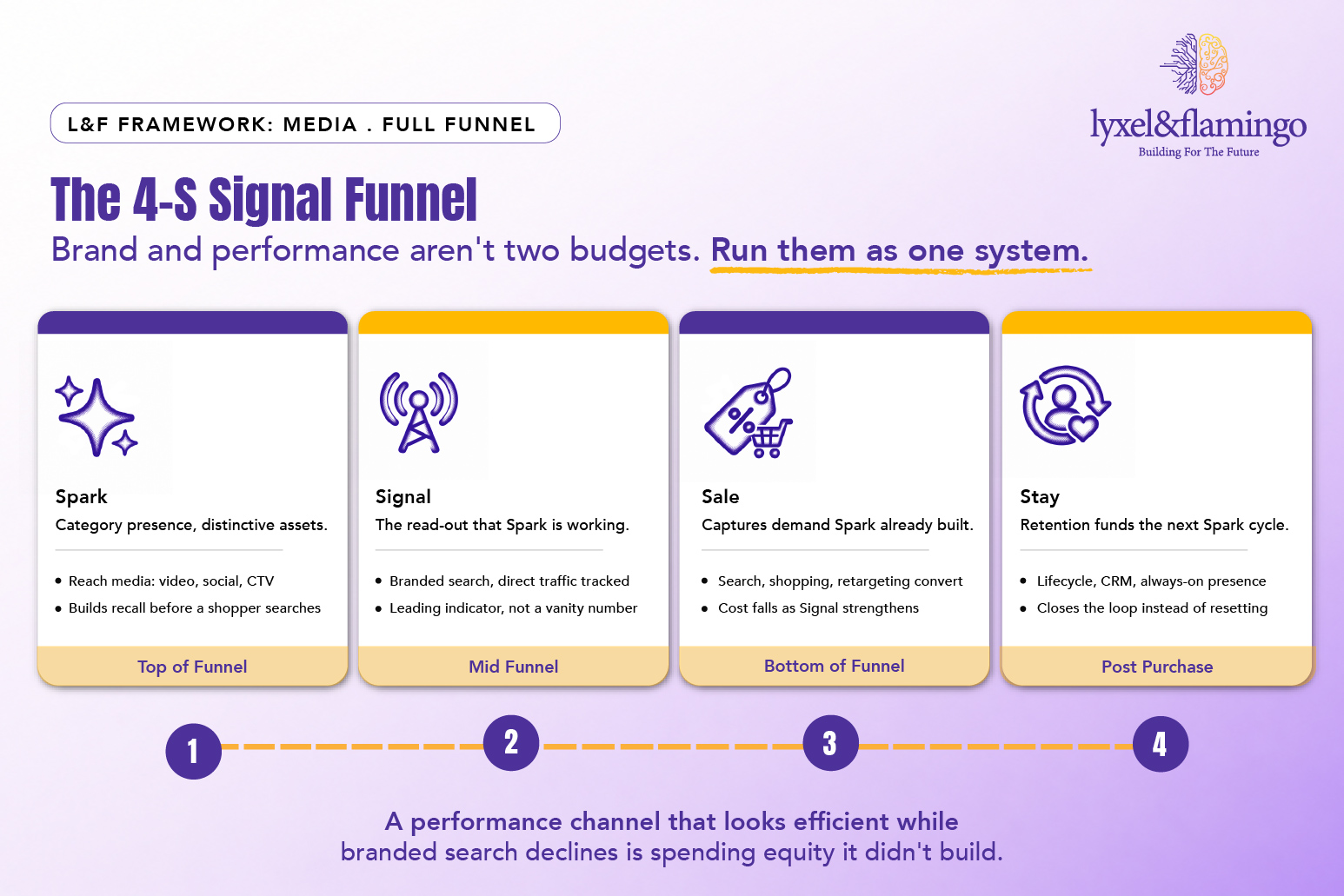
Framework Explained
- Spark: the awareness layer that builds category presence and the distinctive visual and verbal assets that make a brand recognisable before a shopper ever searches for it.
- Signal: the read-out that tells a CXO whether Spark is working, tracked through branded search volume, direct traffic, and unattributed site visits rather than a vanity reach number.
- Sale: the capture layer, where search, shopping, and retargeting convert demand that Spark and Signal already built, at a cost that should fall as Signal strengthens.
- Stay: the retention layer that protects the lifetime value funding the next cycle of Spark spend, closing the loop instead of treating acquisition as the finish line.
Proof that running this as one connected system moves real numbers shows up directly in Lyxel&Flamingo’s own client work.
✓ CLIENT PROOF POINT When McAfee needed to grow new-to-brand acquisition across Southeast Asia without treating awareness and conversion as separate line items, a full-funnel approach combining upper-funnel display and sponsored discovery with lower-funnel conversion formats delivered a 170% increase in traffic in Singapore, a 69% increase in Malaysia, and a 42% increase in sales, proof that Spark and Sale move together when they are planned together. Read the McAfee case study for more details.
IndiGo Airlines’ media operations work with Lyxel&Flamingo and Sleepwell’s full-funnel campaign work tell the same story in two very different categories: the brands treating Spark and Sale as one system are the ones who stop having to choose between reach and ROAS. Learn more about Lyxel&Flamingo’s full-funnel marketing work, including its IndiGo Airlines results.
What This Means for Next Quarter’s Budget
None of this argues for a bigger media budget. It argues for a different question in the next budget review, trading “which channel produced the best ROAS this quarter” for “is our Signal layer getting stronger or weaker.” A performance channel that looks efficient while branded search volume quietly declines is spending down brand equity it did not pay to build.
The organisations that get this right stop reporting brand and performance as two line items and start reporting one funnel with four checkpoints. It is a harder conversation to have with a CFO in month one. It is a much easier one to have every quarter after that, because the number everyone is watching finally explains itself.
Frequently Asked Questions
No. It is the same total budget planned as one sequenced system instead of two disconnected ones, with brand spend justified by the performance efficiency it creates downstream, not by reach alone.
Most organisations start seeing branded search volume and direct traffic shift within one to two quarters of sustained upper-funnel investment, with CAC improvements following as that demand gets captured.
Branded search volume. It is the clearest leading indicator that upper-funnel spend is converting into demand before a single last-click conversion is recorded.
Even early-stage brands benefit from a small, consistent Spark investment, since performance media captures demand far more cheaply when some category presence already exists. The split shifts toward performance, not away from Spark entirely.