
What this blog covers
This is the pillar guide to media measurement for leaders. It explains why the numbers most teams optimise to led by last-click ROAS quietly point at the wrong thing, and what a trustworthy measurement system looks like instead. You will get the Media Measurement Stack (a four-layer model from data foundation to leading signals), a view of how attribution methods fit together, the metrics a CXO should put on the leadership dashboard, a real result where the right number changed the decision, and a self-check to score your own measurement maturity.
Table of Contents
- Why you are probably optimising to the wrong number
- The three ways last-click quietly misleads you
- The Media Measurement Stack
- Attribution is a toolkit, not a single number
- The metrics a CXO should actually steer by
- When the right number changed the decision
- Self-check: how mature is your measurement?
- Key takeaways
- Closing
Why you are probably optimising to the wrong number
The most dangerous slide in any board review is the one where the numbers are green, and the business is flat. It happens because most organisations steer by metrics that are easy to measure rather than the ones that predict growth, and the easiest number of all to measure is last-click ROAS.
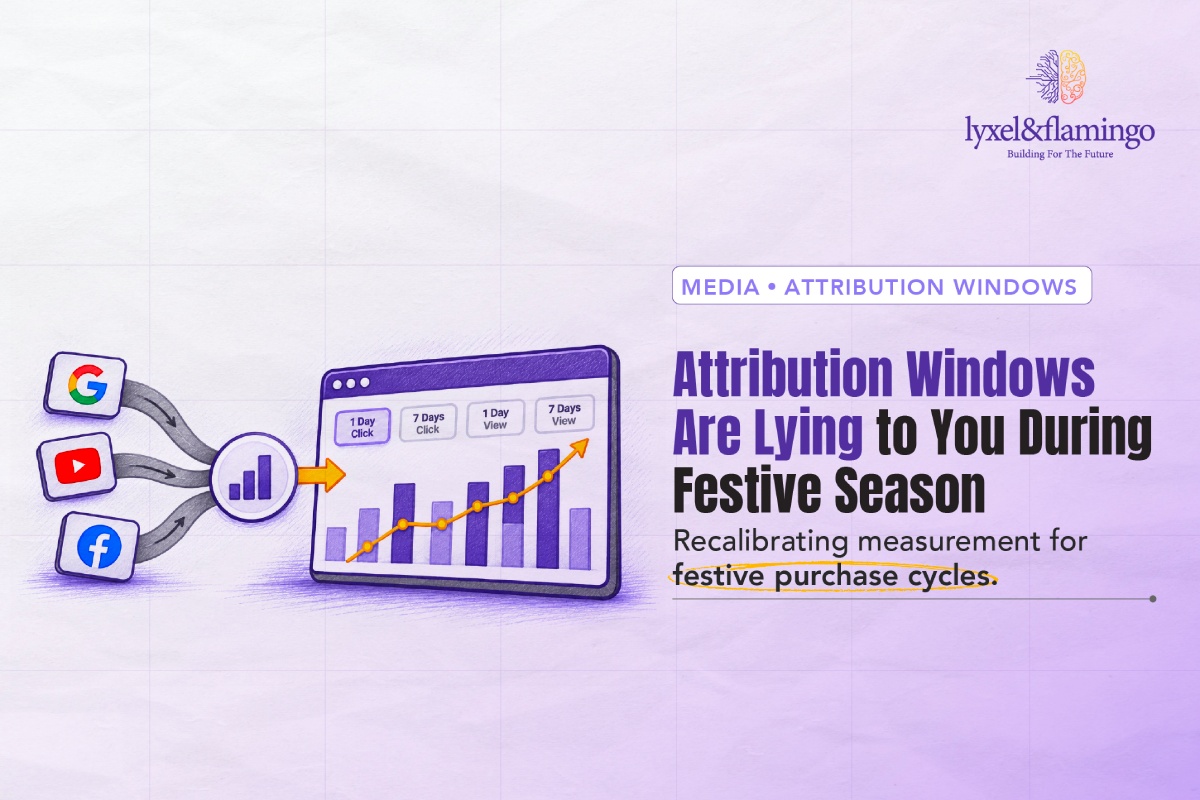
ROAS is not wrong; it is incomplete, and steering the whole business by it is where the trouble starts. It rewards the campaign that touches the customer last, so the bottom-funnel activity that harvests demand you already had looks like a hero, while the work that created that demand looks like a cost centre. Optimise to that number, and you will systematically defund your own growth. The deeper issue is that measurement is not an analytics chore; it is the operating system for every budget decision. Get it wrong and every downstream call, however disciplined, is confidently wrong.
This is a measurement problem wearing a performance costume. Advertising works by moving people from exposure to memory to sale over time, not in a single click (Nielsen), so a system that only credits the final touch cannot see most of what actually drove the result. The fix is not another dashboard; it is measuring the right layers, in the right order, and steering from the top of the stack down.
The three ways last-click quietly misleads you
Before the fix, it helps to name exactly how the wrong number does its damage. Three failure modes show up in almost every account:
01. It over-credits the harvest:
Branded-term and retargeting campaigns catch people who were already going to convert, so they post spectacular ROAS while adding little incremental revenue. The number is real; the causation is not.
02. It is blind to demand creation:
Upper-funnel and brand work rarely convert on the same click, so last-click values them at close to zero, which is why they are the first thing cut, and why growth stalls a quarter or two later.
03. It ignores everything offline and cross-device:
In a market with store footfall, Click-to-WhatsApp and app installs, the click that gets credited is often not the moment that mattered, so whole channels are misvalued.
The common thread is that a single-touch number cannot describe a multi-touch, multi-channel journey. The reframe is to stop asking “what was our ROAS?” and start asking “did we create demand, and did we capture it profitably?” the difference between demand creation and demand capture.
The Media Measurement Stack
A trustworthy measurement system is not one metric; it is a stack. Each layer answers a different question, and each is only as good as the layer beneath it. Build it from the bottom up; steer it from the top down.
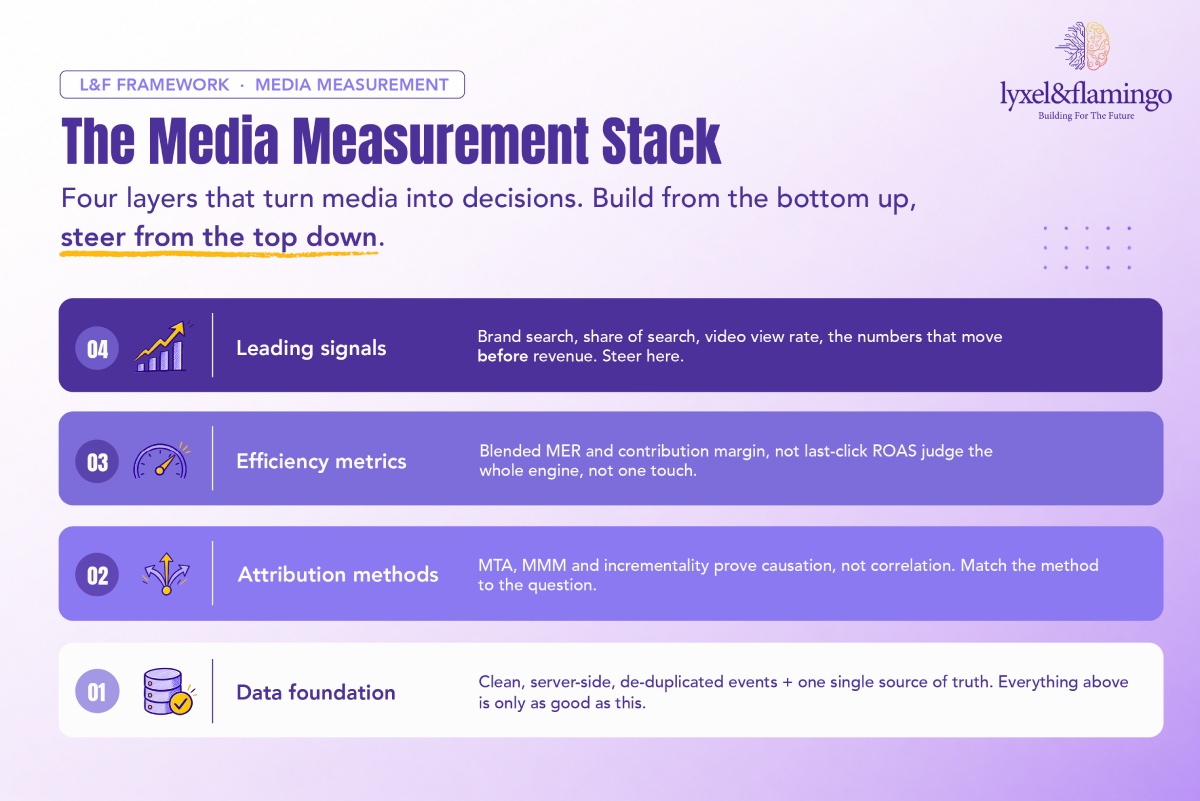
Framework: The Media Measurement Stack – four layers from data foundation to leading signals.
01. Data foundation:
Clean, server-side, de-duplicated events and one reconciled source of truth. This is the unglamorous layer nobody presents, and it decides whether everything above it is signal or noise. If your events are thin, client-side, or duplicated, both your bidding and your reporting run on bad data garbage in, confident wrong decisions out.
02. Attribution Methods:
How you assign credit for what happened. This is where MTA, MMM, and incrementality live – and the point is to match the method to the question rather than trust one model for everything. Prove causation, not correlation. We compare the three in depth in our guide to the modern attribution stack.
03. Efficiency Metrics:
How efficiently the whole engine converts spend into profit. Judge it on blended MER and contribution margin, not last-click ROAS, the shift from vanity efficiency to real efficiency, and the heart of profitable performance marketing.
04. Leading Signals:
The numbers that move before revenue does branded search, share of search, and video view rate. This is the layer you steer by, because it lets you act weeks before the sales line reacts. We detail the leading-versus-lagging logic stage by stage in our whitepaper, Leading vs Lagging Marketing KPIs: The 4-S Signal Funnel.
Attribution is a toolkit, not a single number
The biggest unlock for a leadership team is to stop searching for the one true attribution model. There isn’t one. Multi-touch attribution is good at optimising the digital journey but blind to offline and brand and increasingly hobbled by privacy loss. Marketing mix modelling sees the whole picture including brand and offline, but refreshes slowly and lacks granularity. Incrementality testing is the only method that proves true causation, but it is hard to run across every campaign.
The mature answer is to triangulate: use mix modelling to set the budget, multi-touch to optimise the journey, and incrementality as the referee that settles which of the two to believe. A number that survives all three is one you can take to the board.
The metrics a CXO should actually steer by
If you want a leadership scorecard that predicts rather than reports, it is short, and none of it is last-click ROAS in isolation:
- Branded search and share of search: Is the upper funnel creating demand? These move first.
- Blended MER and contribution margin: Is the whole engine profitable, not just the last touch?
- Incremental sales from a holdout: What would not have happened without the media?
- Direct and organic traffic: Is the demand real and owned or rented from an auction?
- Retention contribution: Is media buying customers those who come back or one-time buyers?
Put those five on the leadership dashboard next to revenue, and the organisation naturally stops optimising to the wrong number because the right ones are finally visible.
When the right number changed the decision
The value of good measurement is not academic; it changes which campaign lives, and which one dies. Two examples make the point.
For IndiGo, the headline result was 48% incremental sales at the same ROAS, unlocked through a brand-control approach that isolated the true causal contribution of brand campaigns. That is an incrementality number, not a last-click one, and it is precisely the number a CFO should care about it proved the brand investment was creating sales the last-click view would have credited elsewhere or missed entirely.
For Shawarmer, disciplined measurement worked the other way: by refining attribution windows and cutting what the honest numbers showed was waste, the team improved ROAS by 23% on 34% lower spend. Same business, better decisions because the measurement finally reflected reality rather than the last click. In both cases, the lesson is identical: the number you trust determines the decision you make.
None of this survives without the plumbing. Attribution and clean events are not back-office hygiene; they decide which campaign gets scaled and which gets cut. Server-side, de-duplicated events fired on the action that matters; the discipline behind L&F’s media operations is what keeps the whole stack honest. Skip that foundation and even the best framework above it reports fiction with confidence.
Self-check: how mature is your measurement?
Score your own operation, one point per yes:
- Leadership steers by more than last-click ROAS. Branded search and MER are on the board dashboard.
- You separate demand creation from demand capture in how you judge campaigns.
- You run at least one incrementality or geo-lift test each quarter.
- Events are server-side, de-duplicated, and fired on the action that matters.
- One reconciled source of truth exists, not five conflicting platform dashboards.
- Offline and cross-channel conversions (store, WhatsApp, app) are mapped back to media.
- Finance and marketing agree on the definition of a ‘good’ number.
Five or more yes and your measurement is steering growth. Three or fewer and you are almost certainly optimising to the wrong number.
Key takeaways
- Steering the business by last-click ROAS rewards demand harvesting and hides demand creation; it quietly caps growth.
- Measurement is a stack: data foundation, attribution methods, efficiency metrics, and leading signals. Each layer depends on the one below.
- There is no single true attribution model; triangulate MMM, MTA, and incrementality by matching the method to the question.
- The CXO scorecard is branded search, blended MER and margin, incremental sales, owned traffic, and retention contribution, not ROAS alone.
- The right number changes the decision: IndiGo proved 48% incremental sales; Shawarmer improved ROAS 23% on 34% less spending.
Closing
Every marketing organisation is optimising to something. The question is whether that something predicts growth or merely records the past. The brands that pull ahead over the next few years will not be the ones with the highest number on the dashboard – they will be the ones who measured the right layers, steered by the signals that move first, and had the discipline to trust them over the number that merely looks good.
Not sure which number your team is really steering by?
L&F builds the measurement stack: clean events, the right attribution mix, and a leadership scorecard that predicts growth for consumer brands across India and worldwide. We will audit what you optimise to today and show you where the wrong number is costing you growth. Talk to L&F about media measurement and start steering by numbers that move first.
Frequently Asked Questions
A media measurement framework is the structured system a brand uses to decide what its marketing is really achieving and where to put the next rupee. A good one has four layers, a clean data foundation, attribution methods that assign credit, efficiency metrics that judge profitability, and leading signals that predict growth, so that decisions are based on causation and future demand, not just the last click before a sale.
Because it gives 100% of the credit for a sale to the final touchpoint, ignoring everything that created and nurtured the demand beforehand. That systematically over-rewards demand-harvesting campaigns (branded search, retargeting) and under-rewards demand creation (brand and upper-funnel work), so optimising to it slowly defunds the very activity that fuels growth. It is not that the number is fake it is that it answers the wrong question.
Not a single metric, but a short scorecard: branded search and share of search (is the upper funnel creating demand?), blended MER and contribution margin (is the whole engine profitable?), incremental sales from a holdout (what would not have happened without the media?), and retention contribution (are we buying repeat customers?). ROAS still has a place for judging a specific lower-funnel activity it just should not be the north star.
Attribution assigns credit for a conversion that happened it answers 'which touchpoints get the credit?'. Incrementality asks the causal question 'what would have happened anyway, without this media?' usually by comparing a test group exposed to ads against a matched control that was not. Attribution tells you where to look; incrementality tells you what was actually caused. You need both, and incrementality is the tie-breaker.
Start with the foundation and one experiment, not a tool. First, fix events: make them server-side, de-duplicated and fired on the action that matters. Second, put branded search and blended MER on the leadership dashboard. Third, run one cheap geo holdout to prove incrementality on a major channel. Those three steps move you further than most six-figure platform purchases, because they change what the organisation pays attention to.
It makes measurement discipline even more important, because the last click is often nowhere near the moment that mattered, a store visit, a WhatsApp conversation, an app install. The answer is to map that offline and backend revenue back to the campaign that triggered the intent, and to lean on incrementality (which does not depend on cross-device tracking) rather than click-based attribution alone. Otherwise entire high-value channels get mis-valued.
Both, on one definition. The most common failure is marketing and finance grading the same campaign on different numbers. Media measurement works when the two functions agree on what a 'good' result means typically blended, margin-aware and incrementality-tested and share one source of truth. That shared definition is what stops the organisation from optimising to whichever number is most flattering that quarter.