
What This Blog Covers
AI Overviews and chatbot answers are increasingly satisfying a user’s question without a click, which means traffic-based reporting is starting to understate a brand’s real visibility and influence. This blog explains why click-based metrics fail to capture AI-citation value, and lays out a practical framework for a brand-influence metric that tracks citation frequency, citation prominence, and share of category voice inside AI-generated answers, independent of whether that citation ever produces a session.
Quick Answer: A zero-click AI Overview citation still delivers real brand value: it shapes a shopper’s consideration set and builds model trust in the brand as an authority, even without a session in analytics. To capture this, brands need a citation-based metric alongside traditional traffic reporting: how often the brand is cited for core category queries, how prominently (first mentioned versus buried), and how that citation share compares to direct competitors. Traffic metrics alone increasingly understate a brand’s real category influence as more queries get answered without a click.
Table of Contents
The Click Was Never the Point; It Was the Proxy
Marketing has measured success by clicks and sessions for so long that it is easy to forget the click was always a proxy for something else: did this piece of content or this brand mention actually influence a decision? When most demand was mediated by a search results page, the click was a reasonably reliable proxy for that influence.
AI Overviews and chatbot answers break that reliability without breaking the underlying goal. The influence still happens, arguably at a more decisive moment in the shopper’s journey. It no longer reliably produces a click for analytics to register, a shift closely tied to how AI Overviews are already changing click-through rates across categories.
What a Citation Actually Does Without a Click
When an AI Overview cites a brand as a source, that citation shapes the shopper’s consideration set even if they never visit the site directly. Being the cited authority for “best options in this category” carries real weight in how a shopper evaluates their choices, comparable to how a strong organic ranking historically built consideration before a shopper ever clicked through multiple results to compare.
This is genuinely hard to prove causally with today’s analytics tooling, which is exactly why it gets undercounted rather than because it does not matter. The absence of a clean metric is not evidence of absent value.
Three Metrics That Replace the Click as a Signal
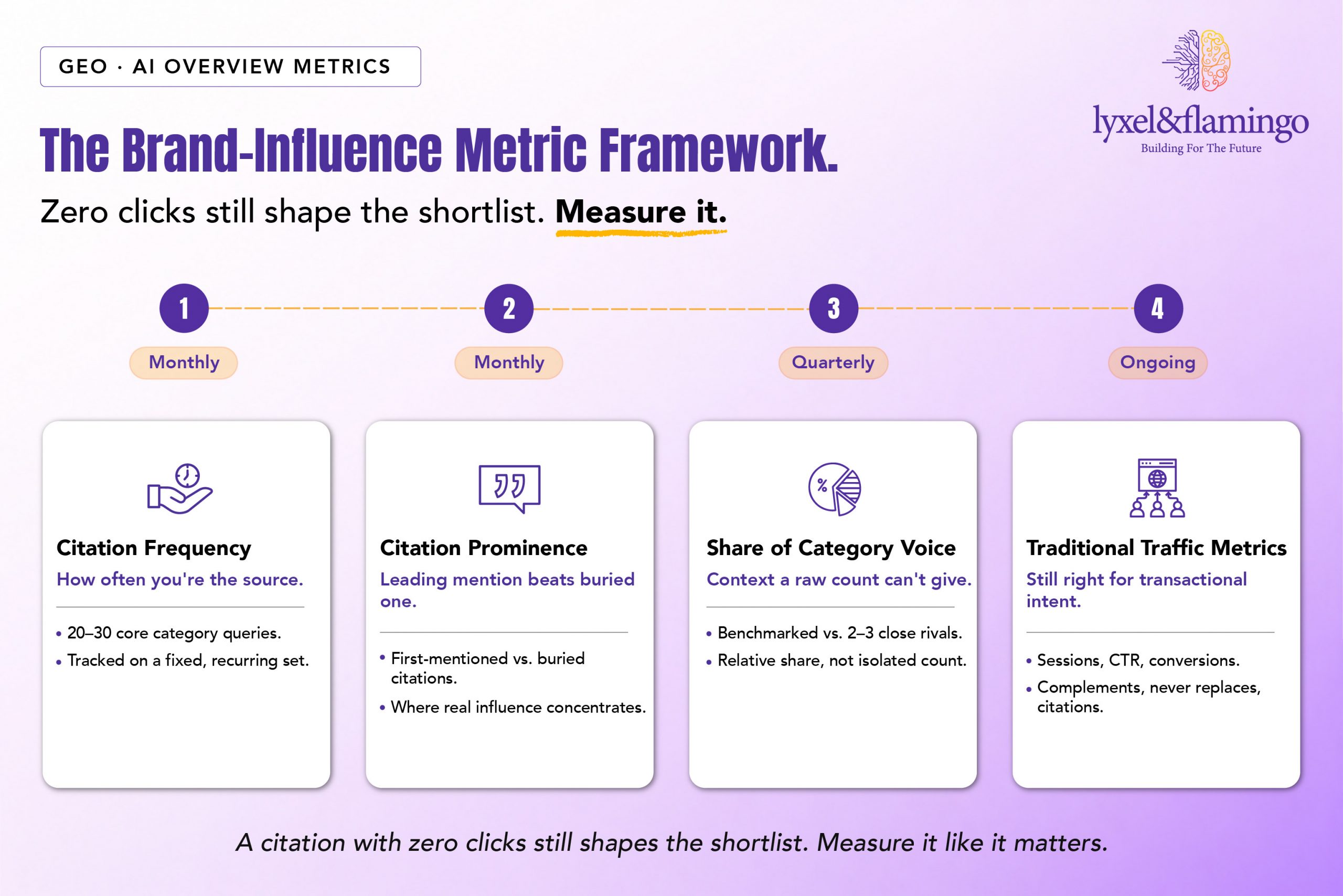
Citation frequency measures how often a brand appears as a source across a defined set of core category queries, tracked on a recurring basis rather than as a one-time snapshot. Citation prominence measures where in the AI-generated answer the brand appears, first-mentioned and directly recommended carries more influence than a buried, secondary mention. Share of category voice compares a brand’s citation frequency and prominence directly against its two or three closest competitors, since an isolated citation count means little without competitive context.
Together these three give a CXO a genuine influence signal that exists independently of whether any individual citation happens to produce a session that day.
Building a Citation-Tracking Baseline
Start by defining the twenty to thirty core category queries that matter most to the business, the questions a real prospective customer would ask an AI assistant while evaluating this category. Track citation frequency, prominence, and competitive share against that fixed query set on a monthly or quarterly cadence, the same discipline that underlies getting cited in AI search more broadly. Part of this baseline is already sitting inside Search Console’s Generative AI report, which shows more of this picture than most teams realize, and part of it requires fixing how AI referral traffic gets misread as “Direct” in GA4 before any citation-to-session link can be drawn at all.
This baseline becomes the brand’s actual scoreboard for AI-search influence, distinct from and complementary to traditional traffic and conversion reporting.
Reporting This Upward Without Losing the CXO
A CXO used to a revenue-and-traffic dashboard will reasonably ask how a citation metric connects to the business. The honest answer: directly and immediately, no, the way a click historically did not either on its own, without being connected to downstream conversion data. The connection here is indirect, yet structurally similar: citation share protects and grows the consideration set a brand draws from, the same underlying function a strong organic ranking always served.
Framing this as “share of category voice inside AI-generated answers” tends to land better than “an AI Overview cited us,” since it ties directly to a concept CXOs already understand: market share of attention, adapted for a channel that does not report clicks. None of this scoreboard means anything without the structural foundation underneath it, which is why the schema stack that makes a page citable still has to come first.
Where Clicks Still Matter
This is not an argument that clicks and traffic no longer matter. For transactional queries, comparison shopping, and any moment where a shopper genuinely wants to browse options directly, traditional search behavior and click-through remain highly relevant, and traffic metrics stay meaningful there.
The argument is narrower and more specific: for the growing share of queries an AI engine answers directly and completely, brands need a metric built for that reality instead of reporting a blank where a real result exists.
Framework Explained
- Citations are influence, not noise: A zero-click citation still shapes a shopper’s consideration set at a decisive moment in their journey.
- Track frequency and prominence separately: being cited once buried in an answer is not equivalent to being the first-mentioned, directly recommended source.
- Context beats isolated numbers: Citation share only means something when measured against the two or three closest competitors.
- This complements, not replaces, traffic metrics: Transactional and comparison-shopping queries still rely on clicks; the new metric fills the gap AI Overviews create elsewhere.
Citation-based brand-influence measurement is a newer discipline than traditional analytics, and Lyxel&Flamingo does not yet have a completed case study isolating this specific metric’s business impact. This framework is grounded in the agency’s ongoing work tracking AI citation patterns across engines, referenced throughout the GEO research cited in this piece.
Key Takeaways
- The click was always a proxy for influence, not the goal itself, and AI Overviews break that proxy without eliminating the underlying influence.
- A zero-click citation still shapes a shopper’s consideration set, even though today’s analytics tools struggle to register that value directly.
- Citation frequency, citation prominence, and share of category voice together form a genuine influence metric independent of session data.
- Traditional traffic metrics remain essential for transactional and comparison-shopping queries; the new metric fills the specific gap AI-answered queries create.
CXO Takeaway
The question worth asking in the next reporting cycle is not “why didn’t this citation drive traffic.” It is: if AI Overviews are answering a growing share of our category’s questions, what is our current scoreboard for winning those answers?
Most brands do not have one yet. Building it now means having real data before the next budget conversation forces the question.
If your reporting still shows a blank wherever AI Overviews are quietly shaping category consideration, Lyxel&Flamingo can build the citation-tracking baseline that makes that influence visible and reportable.
Frequently Asked Questions
This involves systematically querying AI engines with the defined core category query set on a recurring basis and logging whether, where, and how prominently the brand appears in each response, alongside the same tracking for close competitors.
Not directly or immediately, similar to how organic ranking historically was not tied to revenue without additional attribution modeling. The stronger case is treating it as a leading indicator of category consideration, tracked alongside, not instead of, revenue and conversion metrics.
It matters most in categories with real comparison and consideration behavior, electronics, appliances, financial products, healthcare, where an AI-generated answer genuinely shapes which options a shopper considers. Low-consideration, habitual-purchase categories see this dynamic less acutely, though it is still growing there.
Monthly for citation frequency and prominence, given how quickly AI-generated answers can shift; quarterly is reasonable for the competitive share-of-voice comparison, which changes more slowly.