
Blog Summary
The festive season no longer arrives as one big planned shop. It arrives in waves of small, urgent moments, the forgotten box of sweets an hour before guests, the last string of lights, the gift remembered on the drive over and a growing share of those moments are being answered in ten minutes on quick commerce. This is a practical look at how brands win the season on Blinkit, Zepto and Instamart, from the shelf they set before it to the last-minute cart they capture during it.
Table of Contents
- The Festive Rush arrives in ten-minute waves
- What Festive looks like on Quick Commerce
- Preparation: The Shelf You Set Before the Season
- Peak: Staying Visible When Everyone Shows up
- Replenish: Winning the Last-Minute Cart
- The Festive Quick-Commerce Play
- What a Festive Win looked like
- The Question to sit with
- Closing
The Festive Rush arrives in ten-minute waves
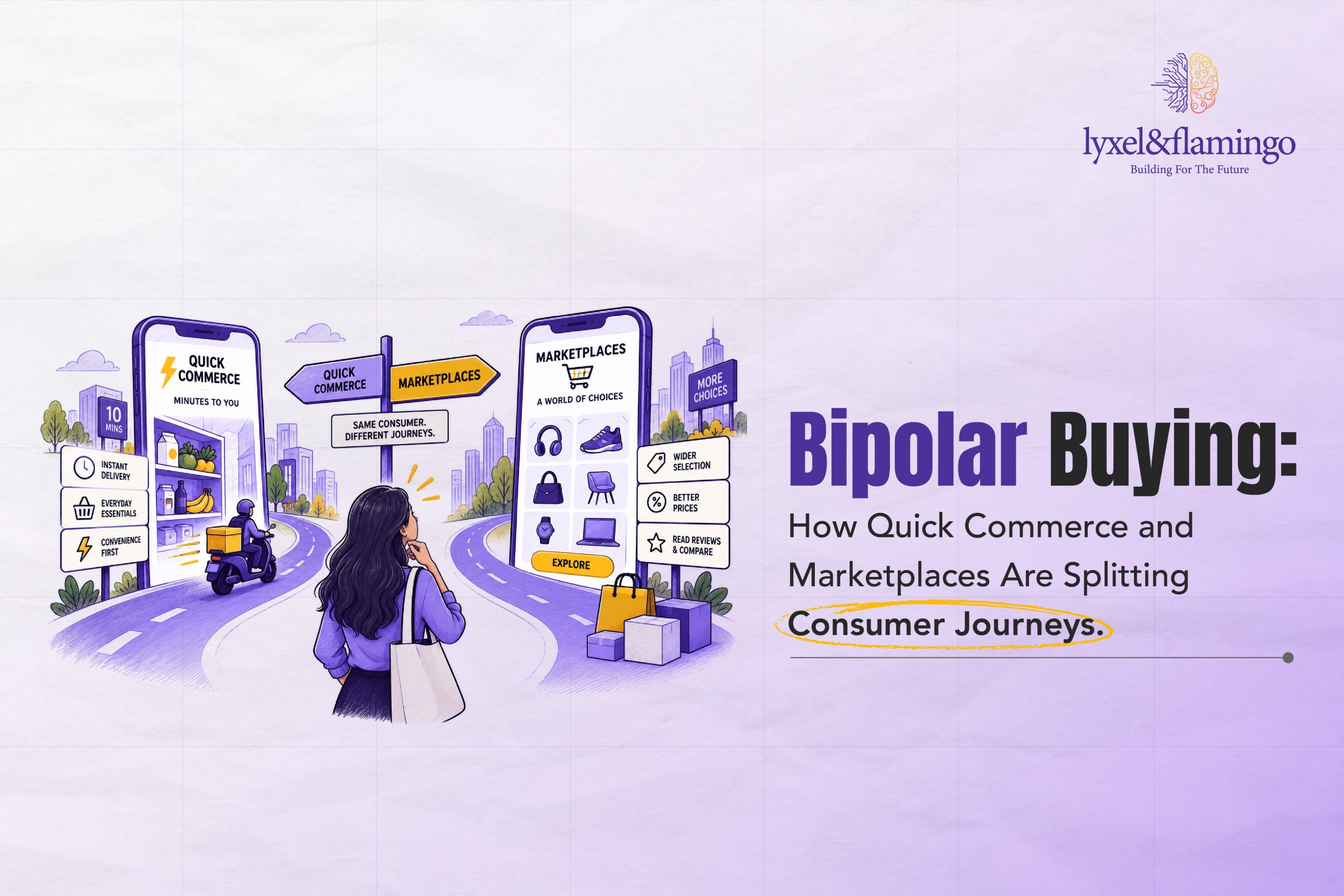
For years the festive season on the internet meant one thing: a planned shop during a big sale, filled a week in advance and delivered over a few days. That still happens, and it still matters. But alongside it a different rhythm has grown, quieter and faster, made of small urgent needs that surface in the hours around a celebration and get answered before the moment passes. Someone is halfway through decorating and runs short of lights. A box of sweets is needed before the guests arrive. A gift is remembered on the way to a house. These are not planned purchases, and they are increasingly being met in ten minutes.
The scale of this is no longer marginal. Quick commerce now handles more than two-thirds of India’s e-grocery orders, per Bain & Company, and through the festive weeks its growth outpaces the rest of retail by a wide margin industry reporting put quick commerce festive growth at around 120% as the season turned into what has been called a millisecond economy. For a brand, that means the festive season is no longer only a sale to prepare for. It is a set of urgent moments to be present in.
What Festive looks like on Quick Commerce
Festive on quick commerce is not a smaller version of the marketplace sale. It is its own behaviour, built around immediacy and occasion. The baskets are small and specific, the thing needed now, for this celebration, in this hour and the shopper has almost no patience for search or comparison. Demand spikes hard and unevenly, concentrated around particular days and even particular evenings, and it rewards the brand that is already stocked, already visible and already the obvious answer when the craving lands. The planning that wins here happens entirely before the wave arrives, because once it does, there is no time to react.
Preparation: The Shelf You Set Before the Season
The first phase is the quiet one, and it decides most of the outcome. Before the season, a brand chooses the few hero products that suit a festive ten-minute purchase, the gift-ready pack, the celebration staple, the format built for the moment and makes sure they are stocked in the dark stores that serve the neighbourhoods where demand will surge. This is the assortment and availability discipline we cover in our piece on winning across Blinkit, Zepto and Instamart, sharpened for a season where getting it wrong is far more expensive. A hero product that is out of stock when the wave hits does not just lose a sale; it loses its place in the ranking exactly when demand is highest.
Peak: Staying Visible When Everyone Shows up
The second phase is the loud one, when every brand in the category is bidding for the same attention and the cost of visibility climbs. Here the work is to protect the share of search a brand has earned keeping the hero listings sharp, the pricing legible, and the paid placements working through the sale days rather than burning out early. The mechanics of that paid push, and the retail media surface underneath it, deserve their own detailed treatment, but the festive principle is simple: defend the moments that convert, and do not spend to be seen where you cannot convert. Visibility bought to send a shopper to an out-of-stock product is the most expensive mistake of the season.
Replenish: Winning the Last-Minute Cart
The third phase is the one quick commerce owns outright: the final hours, when marketplaces have closed their delivery windows and the only way to get the thing tonight is a ten-minute cart. This is where the season is quietly won or lost, because demand does not stop when a brand runs out it simply moves to whoever is still on the shelf. Replenishing fast, store by store, through the peak days keeps a brand in the running for the last-minute cart that a competitor, out of stock, has just handed over. Availability late in the season is not housekeeping. It is the difference between finishing strong and finishing early.
The Festive Quick-Commerce Play
Held together, the season is three phases, not one scramble: prepare the shelf before it, protect visibility through it, and replenish fast to win the tail. The value is in treating all three as one calm operation planned in advance, rather than a series of reactions to a wave that moves faster than any brand can respond to in the moment.
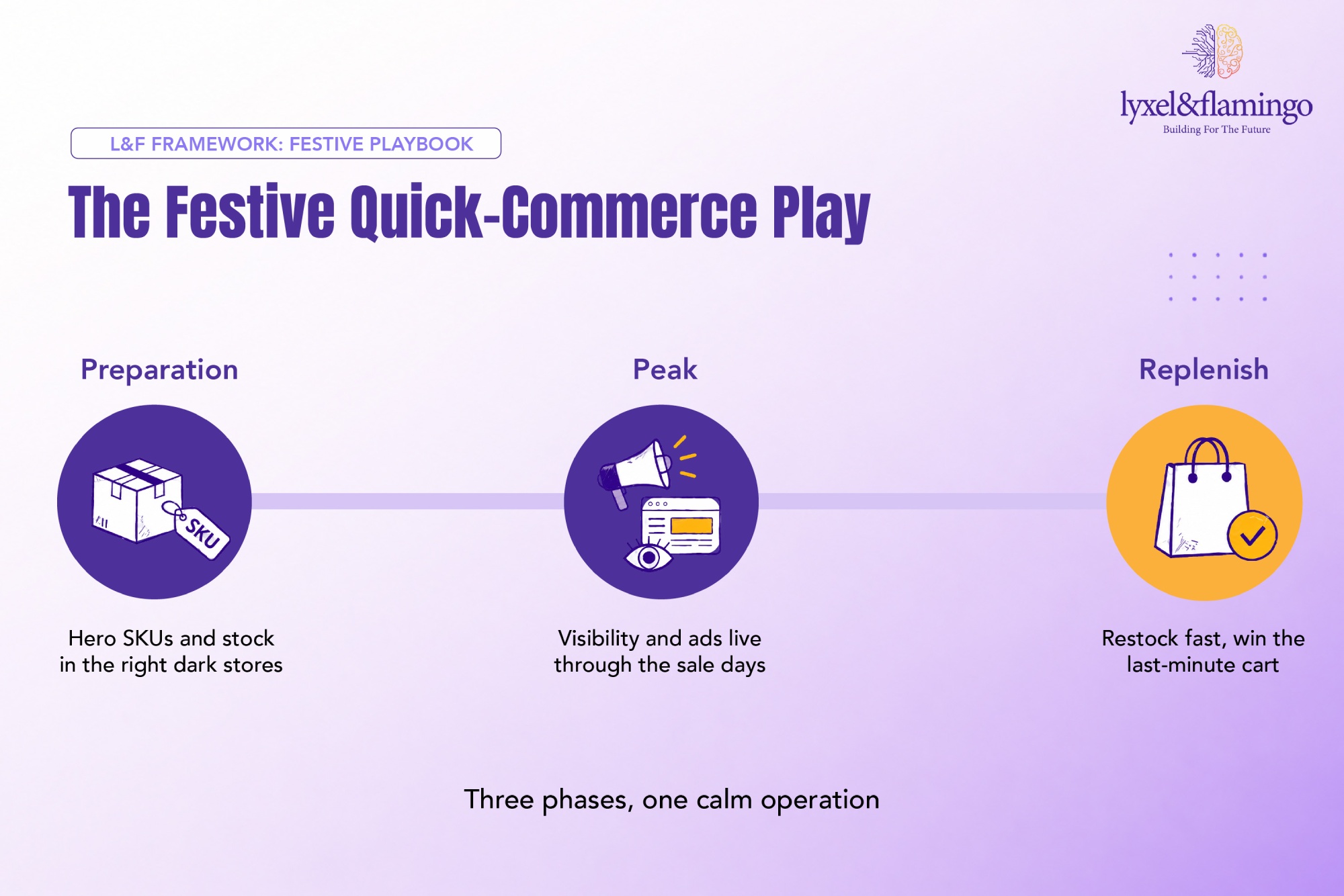
The Festive Quick-Commerce Play: prep, peak and replenish, run as one operation.
What a Festive Win looked like
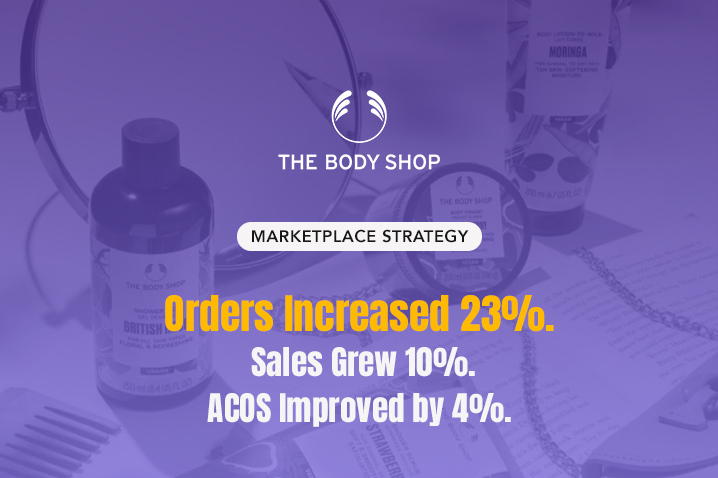
The pattern is not theoretical. Working with Gits Food Products through Rakshabandhan, a short, unforgiving festive window with perishable stock, thin margins and newly launched products carrying little ad history, the task was to become the easy answer fast, without letting festive costs erode profit. On Zepto, the new launches and the classic range grew together to roughly five times their usual run-rate, return on ad spend rose 53%, cost per acquisition fell 25%, and the brand outgrew its category’s GMV by about 25%. The campaign later took a Silver at the e4M Performance Marketing Awards 2025. What earned it was the discipline behind the spend, being present and findable in the exact windows the buying happened, and adjusting as the festival moved. We shared the full story on LinkedIn.
The Question to sit with
It is tempting to treat quick commerce as the overflow channel for the festive season, the place a shopper lands when the planned sale did not cover a last-minute need. The brands winning the season see it the other way round, as the channel that owns the urgent, high-intent moments the sale never reaches, and as the place a festive habit forms fastest. So the question worth carrying into this season is a plain one: when the wave of ten-minute moments arrives around each celebration, is your brand already on the shelf, or still waiting for the planned shop that never comes?
Closing
Winning the festive season on quick commerce is a discipline of preparation, and it is one Lyxel&Flamingo runs alongside brand teams every day from setting the right hero shelf to defending visibility and replenishing fast through the peak. If you would like a clear read on where your brand stands on Blinkit, Zepto and Instamart before the season peaks, our marketplace team can audit your festive readiness and show you the levers worth pulling first. Start that conversation with us whenever you are ready.
Frequently Asked Questions
Demand becomes sharper and more urgent, concentrated around celebration days and answered in minutes. Quick commerce festive demand grew by around 120% in 2025, far outpacing the rest of retail, as shoppers turned to it for last-minute festive needs.
Gift-ready packs, celebration staples and last-minute essentials suited to an immediate purchase. Festive quick commerce rewards hero products built for the occasion and the ten-minute basket, not bulk stock-up formats.
Weeks before the season, because there is no time to react once the demand wave hits. A festive quick commerce plan must be set before the season, since assortment, stock and visibility cannot be fixed mid-wave.
Because demand is high and moves instantly to whoever is still available. An out-of-stock hero product during festive loses both the sale and its ranking exactly when demand is at its peak.