
Table of Contents
- What Is Entity-Based SEO?
- Entity-based SEO works through four things:
- How Google's Knowledge Graph Is Changing SEO in 2026
- How to Optimise a Website for Google's Knowledge Graph?
- How Do You Add Entities to Your Website?
- Building Persona Identities: Why Person Entities Are Half the Strategy
- Building a persona identity correctly requires three things done in parallel:
- LinkedIn Leadership Authority: How Executives Become Entity Signals
- What LinkedIn leadership authority building actually looks like in practice:
- E-E-A-T and Entity SEO: The Trust Layer That Determines Citation Eligibility
- Entity Building Through Video: How VideoObject Schema Changes the Game
- The Lyxel&Flamingo Entity Authority Stack: How We Build AI Citation Authority for Brands
- What Entity Authority Looks Like When It's Working
- 5 Things to Do This Quarter to Build Entity Authority
Here’s what it covers
Search doesn’t work quite the same way anymore. For years, brands focused heavily on keywords and rankings. That approach still has value, but it no longer tells the full story. Search engines and AI systems are becoming better at understanding real-world things, not just matching words on a page.
This blog explores how entity-based SEO is changing online visibility. Instead of treating content as a collection of keywords, search systems now look for people, brands, products, places, and topics they can clearly identify and connect. Google’s Knowledge Graph sits at the centre of this shift, helping search engines understand meaning, relationships, and credibility.
The blog explains how updates such as Hummingbird, RankBrain, BERT, and MUM have gradually moved Google toward a deeper understanding. Today, AI-powered experiences often rely on entity signals when deciding which sources deserve attention.
Building entity authority requires more than publishing content. Brands need a strong About page, proper schema markup, consistent business information, trusted external profiles, and topic coverage that demonstrates real expertise. Off-site mentions and industry recognition also play an important role in strengthening trust signals.
Results don’t appear overnight, and that’s where many businesses get impatient. Entity recognition takes time to develop. Still, the long-term payoff is significant. Brands with stronger entity signals often gain better visibility in AI-generated answers, Knowledge Panels, and other search features. As search becomes increasingly AI-driven, clear entity authority is turning into a lasting competitive advantage.
If you’ve been doing SEO the same way since 2018 or 2019, the numbers in 2026 have probably started telling a different story. Rankings move around more often now. Pages that stayed stable for years are losing ground, and traffic doesn’t react the way it once did, even when the usual tasks are done properly.
It isn’t always a penalty or a stronger competitor taking over. Search has changed in a bigger way. Many teams still follow old habits, while the rules behind visibility keep shifting under them.
Google doesn’t read your website like a text scanner anymore. It reads your content as a well-informed person would, looking for meaning, context, and credibility, not just repeated phrases. The infrastructure behind this change is the Knowledge Graph. The SEO strategy built around it is called entity-based SEO. This blog breaks down how both actually work, why 2026 is the year brands can’t keep ignoring them, and what you can start doing about it right now.
What Is Entity-Based SEO?
Entity-based SEO is the practice of building your content, data, and entire digital presence around clearly defined, uniquely identifiable concepts, rather than around keyword strings. In SEO terms, an entity is any distinct real-world thing that can be identified separately from everything else:
- a brand,
- a person,
- a product,
- a place,
- a concept, or
- an event.
Keywords are strings of text. Entities are actual things that exist in the world. That one distinction is what this whole strategy pivots on.
When someone types “Apple” into Google, a keyword-based system scans for pages that mention the word “Apple.” An entity-based system asks a different question entirely:
Does this search refer to the technology company, the fruit, or the record label? Context, relationships, and meaning drive the answer. Not how many times a word appears on a page.
This change wasn’t sudden. Google started moving beyond simple keyword matching years ago. Hummingbird’s update in 2013 focused more on search intent. RankBrain in 2015 improved how queries were understood. Then, BERT (Bidirectional Encoder Representations from Transformers) in 2019 helped connect the meaning between words. MUM in 2021 pushed things even further, handling information across languages and different content formats.
Each one moved Google further away from pattern matching and closer to genuine semantic understanding. By 2025, Google’s Knowledge Graph held over 500 billion facts about more than 5 billion entities, and Google’s Gemini AI was trained directly on it.
When Gemini generates an AI Overview, it draws from the entity relationships already established in the Knowledge Graph. Whether your brand gets cited or completely ignored in that answer depends on whether you’re in the graph and how clearly you’re defined within it.
Entity-based SEO works through four things:
- Entities themselves: These are the people, organisations, products, places, and concepts that Google assigns unique identifiers to. That unique ID is how Google distinguishes “Michael Jordan the basketball player” from “Michael Jordan the statistician” even when they share a name.
- Attributes: Every entity carries descriptive properties. For a brand, that means founding date, industry, services offered, location, leadership, and which other entities it connects to. These attributes are how Google fills in the picture of who you are.
- Relationships: Entities don’t exist in isolation. A founder relates to a company. That company relates to its industry. The industry connects to regulators, competitors, and market trends. Google maps all of this, and the strength of your position in the network affects how much authority flows to your content.
- Salience: This is how prominently an entity features within a specific piece of content. Google’s Natural Language Processing API scores every page for entity salience. A high salience score on your primary entity tells the algorithm your content is genuinely about that topic, not just adjacent to it.
Traditional SEO asks how many times a keyword appears on the page. Entity-based SEO asks whether the page clearly establishes what it’s about, who produced it, and how it connects to everything the algorithm already understands about your industry and your brand. Those two questions lead to very different strategies.
How Google’s Knowledge Graph Is Changing SEO in 2026
Google launched the Knowledge Graph in May 2012 with a tagline that most people underestimated: “Things, not strings.” At launch, it held around 570 million entities. By 2024, that number had grown to approximately 54 billion entities and 1.6 trillion facts. The growth hasn’t plateaued either. In July 2023 alone, Google added over 10 billion new entities in a matter of days, and then another 4 billion in a single day in March 2024.
That scale matters because knowledge graph optimisation at this level means Google carries deep relational context for almost every industry, brand, topic, and concept a business could want to rank for. When you publish content today, Google isn’t processing it as a standalone document. It cross-references every entity you mention against an existing web of verified data, trust signals, and established relationships.
Here’s how that plays out in practice right now.
AI Overviews run on entity logic, not keyword logic. These AI-generated summaries don’t pull from pages that happen to match a keyword. They pull from entities Google has already established as authoritative on a given topic. Around 75% of AI Overview citations come from domains already in Google’s top 12, but entity clarity is what determines which top-10 or 12 result actually gets cited as the authoritative source on a claim.
The way people click on search results has shifted. McKinsey’s AI Discovery Survey from August 2025 found that 50% of consumers now seek out AI-powered search tools on purpose, and a majority say it’s their top digital source when making buying decisions. AI summary clicked a traditional search result only 8% of the time, versus 15% when no summary appeared. McKinsey projects that $750 billion in US revenue will flow through AI-powered search by 2028. Brands that haven’t optimised for entity recognition aren’t just losing clicks. They’re getting cut out of the buying journey before a user even sees a link.
Google’s Gemini AI is trained on the Knowledge Graph. This is the 2026 shift that most marketing teams still haven’t fully processed. Gemini draws directly from the Knowledge Graph when generating answers, which means entity establishment now determines whether your brand shows up in AI Overviews and AI Mode answers at all. This isn’t just an enterprise concern anymore. A smaller, clearly-defined brand entity can outrank a well-funded competitor that hasn’t bothered to establish its entity signals properly.
Knowledge Panels expanded in a big way starting in 2025. Knowledge Panel cards for corporate entities became far more widely available in early 2025. Previously, they existed mostly for individuals. The number of people with Knowledge Panels quadrupled between June 2023 and June 2024, with C-level executives at major companies particularly affected. For any brand working on branded entity optimisation, this means the organisation and its key leadership team now both warrant their own entity establishment work.
Organic CTR dropped hard, but entity-optimised brands are bouncing back. Organic click-through rates fell 61%, from Q3 to Q4, on queries where AI Overviews appear. However, brands cited within AI Overviews earn approximately 120% more organic clicks per impression than brands not cited on those same queries. Getting included in the AI-generated answer isn’t just a brand awareness play. It’s a compounding traffic advantage that compounds over time.
Deloitte’s 2025 Connected Consumer research found that more than 50% of consumers are now regularly experimenting with generative AI tools for discovery. Deloitte’s 2025 Digital Media Trends further noted that younger audiences increasingly rely on platform-native search and recommendations rather than visiting brand websites directly. Discovery journeys now span traditional search, social platforms, and conversational interfaces. A brand that isn’t defined as a clear entity across these systems doesn’t show up in them, regardless of how strong its website is.
The direction is pretty clear now. Google wants to deliver answers fast, not just sort pages into rankings. Brands that provide reliable, well-structured information stay visible more often. Others keep putting extra money into ads and paid channels, trying to recover traffic that organic search no longer brings consistently.
How to Optimise a Website for Google’s Knowledge Graph?
Knowledge graph optimisation isn’t a single tactic you check off and move on from. It’s a layered strategy that touches technical setup, content architecture, and how your brand exists across the wider web. Here’s how to build it properly.
Step 1: Set Up Your Entity Home
The entity home is the one canonical URL that anchors how search algorithms understand your brand. In nearly every case, this is your About page. It’s where your Organisation JSON-LD block should live, with the @id value pointing to your canonical domain and your sameAs declarations linking outward to every authoritative external profile.
Your About page needs to communicate clearly and consistently:
- What your organisation does and who it serves
- When it was founded and where it operates from
- Who leads it (founders, key executives)
- Which industry and category does it belong to
- External profile links via sameAs: LinkedIn, Wikidata, Crunchbase, relevant industry directories
This isn’t a brand story page. It’s the machine-readable foundation that search engines use to verify your entity is real and clearly defined. Without it, everything else you do in entity SEO is slower to take effect.
Step 2: Get Your Structured Data Markup Right
Structured data markup is the technical layer that connects your content to Google’s Knowledge Graph. It doesn’t change anything your visitors see. What it does is tell machines precisely what your page means, not just what it says.
In March 2025, both Google and Microsoft publicly confirmed that they use schema markup to feed their generative AI features. ChatGPT confirmed shortly after that structured data influences which products appear in its results. The practical evidence is just as compelling: Testing three near-identical pages that differed only in schema implementation. The page with well-implemented JSON-LD was the only one that appeared in a Google AI Overview, and it ranked at position 3 organically. The page with no schema wasn’t even indexed.
The schema types that matter most for entity optimisation for search rankings:
- Organisation Schema declares your brand as a recognised entity and establishes your identity across digital properties. The key properties to include are @id, name, url, logo, description, foundingDate, sameAs, and knowsAbout. Don’t skip knowsAbout. It tells AI systems what your brand is actually authoritative about.
- Person Schema is for founders, executives, and content authors. It links individuals to the organisation via worksFor and connects them to verified external profiles via sameAs. Google increasingly surfaces key people inside corporate Knowledge Panels, so well-defined author entities also strengthen every piece of content that those people produce.
- Article/BlogPosting Schema declares content type, authorship, and publish date. Use the about property to name the primary entity each article covers and the mentions property to list every significant secondary entity, with links back to their Wikipedia or Wikidata entries where they exist.
- SameAs deserves special mention because it’s the most important single property for brand entity building. It links your brand, author pages, or topic pages to verified external references: Wikipedia, LinkedIn, Wikidata, and official social profiles. It’s essentially how you tell Google: “I am the entity you already know about from those other trusted sources.”
- Local Business Schema matters for any brand with a physical location. It locks in NAP consistency (name, address, phone number) across the web, which remains one of the most foundational entity verification signals Google looks for.
Google recommends JSON-LD as the format to use. Over 45 million web domains have now implemented schema.org structured data, but correct and complete implementation is still the minority. A Product schema that’s missing its AggregateRating property won’t produce star ratings. Partial implementation produces no benefit. If you’re going to do it, do it completely.
Step 3: Build Topical Authority Through Content Clusters
Semantic SEO strategy in 2026 is not about publishing endless content pieces. What matters more is covering a topic properly from different angles. When your content connects well and answers real questions, search engines and AI systems start seeing your site as a trusted source.
Topic clusters are how you build that architecture. A cluster is made up of a broad pillar page on a core entity-relevant topic, cluster pages that each go deep on a specific subtopic, and internal links connecting them with anchor text that reinforces the semantic relationship between pages. This is not just structure for structure’s sake. It’s how Google maps your domain’s topical authority.
Content with 15 or more connected entities shows 4.8 times higher selection probability in AI Overviews. The goal isn’t to name-drop entities constantly. It’s to cover a topic thoroughly enough that all the entities that naturally belong to it appear organically in your content.
Step 4: Build Entity Signals Off Your Own Site
Entity recognition isn’t only about what you publish on your own website. Google validates entities by cross-referencing your on-site claims against what the broader web says about you. Off-site signals carry real weight in entity establishment.
Key actions for building off-site entity signals:
- Create or claim your Wikidata entry and record your QID (a unique identifier like Q12345678), then add it to your sameAs array on your About page
- Build or contribute to a Wikipedia presence if your brand meets notability criteria
- Make sure your brand name, description, and service categories are consistent across all external profiles: LinkedIn, Crunchbase, Google Business Profile, and industry directories
- Earn editorial mentions from authoritative publications in your vertical, not just link placements
- Get press coverage that names and contextualises your brand, not just links to your homepage
McKinsey’s analysis found that in major categories like credit cards, hotels, electronics, and apparel, well-known brands are absent from AI-generated answers despite their market dominance and traditional search rankings. The reason is that AI search pulls from a different pool of signals than traditional SEO does. Brands without cross-platform entity consistency simply drop out of the picture.
Step 5: Track How Your Entities Are Performing
Only 16% of brands currently track their AI search performance in any systematic way. That 84% gap is both a measurement failure and a competitive opening. Tracking entity performance requires looking beyond where your keywords rank:
- Knowledge Panel impressions via Google Search Console
- Whether your brand or content appears in AI Overviews for your key topics
- Brand mention tracking across AI platforms like ChatGPT, Perplexity, and Gemini
- Entity salience scores on high-priority pages using Google’s Natural Language API
- How your brand is described when you search for it directly in AI-powered tools
How Do You Add Entities to Your Website?
Adding entities to your site works across three levels. Technical markup, content strategy, and off-site validation. Each one reinforces the others.
At the technical level:
Start with the About page. Add an Organisation JSON-LD block that includes your brand name, canonical URL as @id, logo URL, founding date, geographic info if applicable, and sameAs links pointing to every authoritative external profile you own. Keep this block on the page permanently. It’s not decorative code. Removing or inconsistently modifying it disrupts entity recognition signals that may have taken months to build.
For every page on your site, add a WebPage schema that connects back to your WebSite entity, which connects back to your Organisation entity. This chain of connections is what turns your schema from a collection of disconnected facts into an actual knowledge graph that search engines and AI systems can traverse. On article pages, use the about property to declare what entity the content is primarily about, and use mentions to list secondary entities, linking both to their Wikipedia or Wikidata pages where those exist.
For author pages, build Person schemas connected to your Organisation via worksFor. Link author entities to their LinkedIn profiles and any other verified external profiles using sameAs. Google is surfacing author entities inside corporate Knowledge Panels more than it used to, and clearly-defined authors strengthen the E-E-A-T profile of every piece of content they write.
At the content level:
Write for entity depth, not keyword repetition. For each topic cluster, define the primary entity the content centres on. List the related entities that should naturally come up in a thorough coverage of that topic. Make sure the content addresses how those entities relate to each other: what they do, when they emerged, why they matter, and how they connect. That’s how Google builds its understanding of what your content actually covers.
If your brand name is shared with another well-known entity, add disambiguating context consistently across all your content: your industry, your geographic focus, your service category. Ambiguity is one of the most common things that slows entity recognition down. Google needs to be confident there is exactly one entity behind a particular search before it will surface a Knowledge Panel or include you in AI citations.
At the off-site level:
Build or claim your Wikidata entry if you haven’t already. Wikidata is a structured, multilingual open database that Google, AI systems, and other major platforms use to verify entity existence and pull attribute data. Many brands that don’t qualify for a Wikipedia article do qualify for Wikidata. Create the item, record your QID, and add it to the sameAs array on your About page.
Make sure LinkedIn, Crunchbase, Google Business Profile (if applicable), and relevant industry directories all carry consistent brand descriptions. Inconsistency across external profiles creates conflicting signals that confuse entity resolution and slow Knowledge Graph recognition. The algorithm needs corroboration, not contradiction.
Building Persona Identities: Why Person Entities Are Half the Strategy
Most brands treat entity SEO as an organisation-level exercise. They build their brand’s schema, claim a Wikidata entry, align their external profiles, and consider the work done. What they miss is that Google’s Knowledge Graph holds person entities with the same level of structural specificity it holds brand entities, and the person entities connected to your brand are among the strongest authority signals your organisation can build.
A persona entity, in SEO terms, is a named individual (founder, executive, subject-matter expert, or content author) that Google can identify distinctly, connect to a specific organisation, and associate with a specific domain of expertise. When a person entity is clearly established, every piece of content that person publishes carries the authority of their entity profile, not just the authority of the page it lives on.
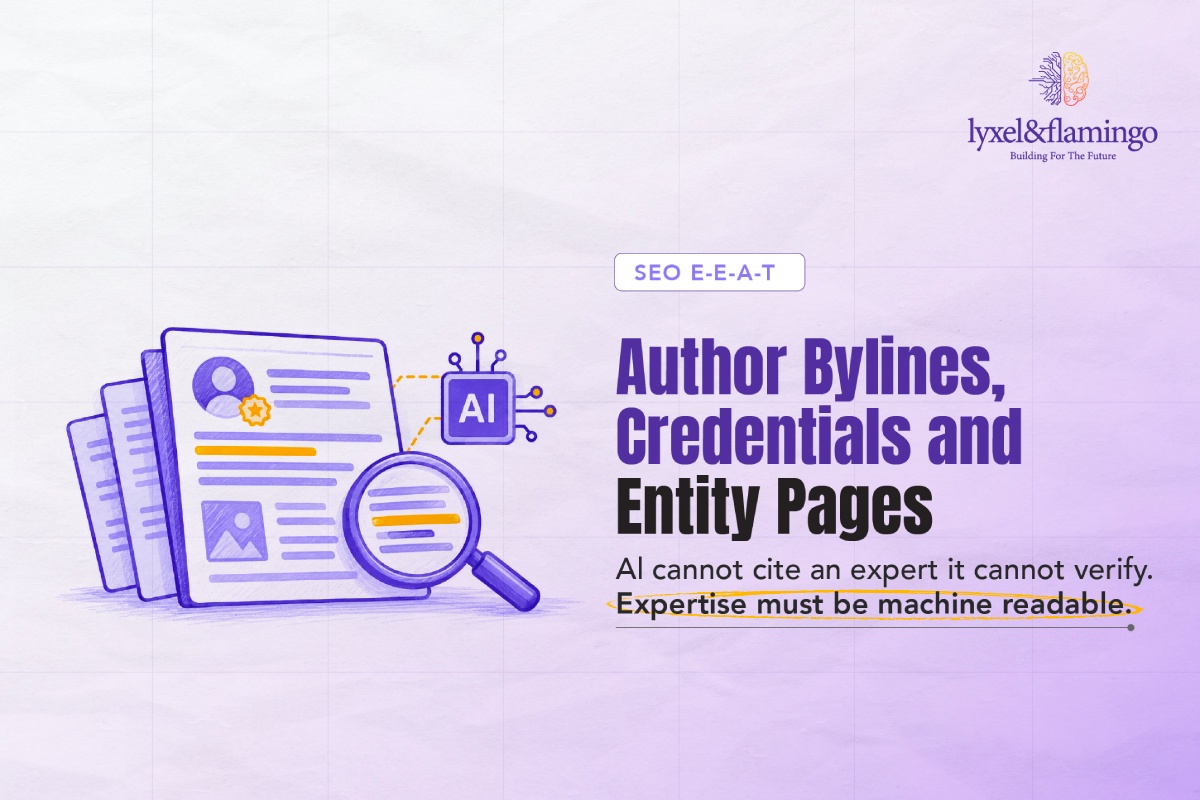
On February 1, 2026, Google added a new Authors section to its Search Central documentation, the clearest signal yet that authorship transparency is a direct quality consideration. Google trusts verified entities, not just pages. An author must be recognisable as a person entity connected to an organisation entity and a specific topic domain before their content receives full E-E-A-T weighting.
This is the part most brands get structurally wrong. They have an About Us page with headshots and titles. They don’t have author pages with the Person schema. They don’t connect those author entities to the organisation via worksFor. They don’t link outward to the author’s LinkedIn or Wikidata via sameAs. And they don’t use the SubjectOf property to link the person’s page to interviews, podcasts, or video appearances that independently corroborate their expertise.
Building a persona identity correctly requires three things done in parallel:
- On-site person entity structure: Create a dedicated author page for each key person. Add a Person JSON-LD block that includes name, jobTitle, worksFor (linked to the Organisation entity), sameAs (LinkedIn, Wikidata, Twitter/X, personal site), knowsAbout (the specific topic domains they’re authoritative in), and SubjectOf pointing to any interviews, podcasts, or video appearances hosted on external platforms. This is the machine-readable identity card Google uses to evaluate whether your author is a genuine, verifiable expert or an anonymous byline.
- Cross-platform identity consistency: The person’s name, title, and area of expertise must read identically across your website, LinkedIn, Wikidata, Twitter/X, and any industry directories. Inconsistency between “Director of Strategy” on LinkedIn and “Head of Strategy” on your website creates entity resolution ambiguity. Google needs to confirm that these refer to the same person before it consolidates their authority signals. Small mismatches compound quickly across multiple authors.
- Third-party corroboration: A persona entity carries much more authority when sources outside your own domain mention and contextualise the person. Guest articles on authoritative industry publications, podcast appearances where they’re introduced with their full title and company affiliation, speaking slots at recognised industry events, and editorial quotes in trade press all strengthen the person entity’s standing in the Knowledge Graph. Beyond day 90, the compounding work is getting your brand and its people cited in authoritative third-party content. Not every mention needs a link, because brand mentions without links still contribute to entity corroboration.
The strategic payoff is significant and often underestimated. In B2B and professional services categories, buyers frequently search for the people behind a brand before they engage with the brand itself. A CMO at a BFSI brand, an agency founder, or a strategy director with a clearly established entity profile in the Knowledge Graph becomes a discoverability asset: searches for their name or their topic area pull the brand into the results, the AI Overview, and the Knowledge Panel simultaneously. The person entity becomes an acquisition channel, not just a credibility signal.
LinkedIn Leadership Authority: How Executives Become Entity Signals
LinkedIn is no longer just a networking platform or a hiring tool. In 2026, it functions as one of the primary off-site entity validation sources that Google, Gemini, and AI search platforms use when evaluating person entities. A well-built LinkedIn presence for a key executive isn’t separate from your entity’s SEO strategy. It is a core part of it.
LinkedIn now has 1.2 billion members and 310 million monthly active users, and drives 80% of all B2B social leads, making it the dominant channel for professional discovery and authority building. Personal profiles generate 8x more engagement than company pages, and LinkedIn users are 3x more likely to trust content from an individual than from a brand. And from an entity SEO standpoint, a verified, consistently maintained LinkedIn profile for a named executive creates a corroboration signal that search algorithms can cross-reference against your on-site Person schema claims.
A LinkedIn SEO strategy in 2026 means optimising profiles and articles so they rank inside LinkedIn’s own search engine and on Google. Native LinkedIn articles get indexed by Google within 24-48 hours. Consistent, specific language across LinkedIn and your website strengthens entity authority. Verified profiles with complete skills sections rank 30% higher in LinkedIn searches.
What LinkedIn leadership authority building actually looks like in practice:
- Profile completeness as entity signal: An executive’s LinkedIn profile should stay consistent with on-site information. Job titles need to match across both sources. The About section should focus on expertise, not a career timeline. Featured content works best when it includes interviews, articles, and speaking engagements. A complete profile helps people understand who the executive is and what they are known for. That clarity supports stronger visibility and reduces confusion around professional identity.
- Publishing as authority signal, not engagement play: LinkedIn articles and newsletters can show up in Google results. When executives keep publishing around the same topic they are known for, it strengthens that expertise signal over time. It is not just about trust. People notice the consistency, and AI systems can too. That publishing trail gives them more evidence to connect the person with that subject.
- Engagement format matters: Not every LinkedIn post helps build authority the same way. PDF carousels and videos often gets stronger engagement. But content with named frameworks, research, and real outcomes does more. When others reference and share it, credibility keeps growing.
- Employee advocacy multiplies the signal: People trust expert voices more than company pages. That is why one founder posting helps, but it is not enough. When leaders across the same company share useful insights consistently, the connection grows stronger and the organisation gains more recognition over time.
E-E-A-T and Entity SEO: The Trust Layer That Determines Citation Eligibility
E-E-A-T (Experience, Expertise, Authoritativeness, and Trustworthiness) is Google’s quality evaluation framework. It’s also the mechanism that connects entity establishment to actual ranking and citation outcomes. Understanding how E-E-A-T relates to entities is what separates brands that build the right signals from brands that build a lot of signals that don’t compound.
E-E-A-T acts as a practical quality filter influencing rankings and AI-driven visibility, especially for competitive topics and AI answer placements. RAG-based systems (retrieval and generation) don’t just generate answers. They retrieve sources, summarise them, and sometimes cite them. That shifts the competition from “who ranks” to “who becomes the source.” If you’re not trustworthy, you don’t get retrieved.
The relationship between E-E-A-T and entities is direct. Google’s emphasis on E-E-A-T is fundamentally an entity play. Google wants to connect content to author entities and evaluate those entities’ credentials. A page without a verifiable author entity attached to it is a page whose E-E-A-T signals cannot be fully evaluated, regardless of how well-written the content is. This is structural, not subjective.
The four E-E-A-T dimensions mapped to entity actions:
- Experience is demonstrated through content that only someone with direct involvement in the subject could produce. In entity terms, this means content clearly attributed to a named person entity with a verifiable professional history in the relevant domain. An article about performance marketing strategy carries more E-E-A-T weight when it’s attributed to a named CMO with a linked LinkedIn profile and a publishing history in that domain than when it carries a generic brand byline. Google can verify the first. It cannot verify the second.
- Expertise is the depth and accuracy of the knowledge demonstrated. In entity terms, this is where knowsAbout on your Person schema does the machine-readable work, and where your content architecture supports the claim. An author whose Person schema declares expertise in paid media strategy, and whose published content comprehensively and accurately covers paid media strategy across a well-built topic cluster, is building verifiable expertise signals. An author whose schema says nothing and whose content covers multiple disconnected topics is not.
- Authoritativeness is earned through external recognition. The September 2025 update to the Search Quality Rater Guidelines expanded YMYL to include government, civics, and society content. Any business publishing financial, legal, health-adjacent, or civic content without verifiable author credentials is operating at a structural disadvantage. For any brand in BFSI, health, legal services, or adjacent categories, author entity establishment is not optional. It’s a compliance-level requirement for ranking and citation eligibility.
- Trustworthiness is the aggregate of all the above, expressed through verifiable consistency. You cannot improve your E-E-A-T by adding an author bio to a single page. You build it through consistent, verifiable behaviour across your entire content and entity presence over time. That means the same author name, the same stated expertise, the same external profiles referenced across every touchpoint where that entity appears: on-site author pages, schema, LinkedIn, Wikidata, external publications, and video appearances.
One E-E-A-T signal that’s frequently missed: the SubjectOf property on author schemas. When you use SubjectOf to link an author’s entity page to an external interview, a podcast episode where they were the guest, or a video where they appear as a named expert, you’re creating a machine-readable corroboration trail that Google can follow. The SubjectOf property strengthens the “Expert Entity” profile Google builds for your authors, connecting them to media appearances that independently validate the expertise your schema claims. Most brands implement author schema and stop there. The SubjectOf layer is where mid-sized brands can build E-E-A-T depth that larger, less deliberate competitors haven’t bothered with.
Entity Building Through Video: How VideoObject Schema Changes the Game
Video is not separate from entity-based SEO. It is one of the strongest entity-building formats available in 2026, and most brands are using it without the schema layer that would make it count.
The mechanism here is specific. When you embed a video on a page, Google sees an embedded media element. When you embed a video with a proper VideoObject schema, Google sees a structured, identifiable content entity with defined attributes: a title, a description, a duration, a named creator, an upload date, and a topical domain. Those attributes feed directly into the entity graph. The video becomes a verifiable piece of evidence that your brand, and the person appearing in it, has genuine, demonstrable expertise in the topic it covers.
Videos embedded on websites with a proper VideoObject schema see 78% higher click-through rates in search results. According to a Semrush 2024 Most Cited Domains Study, YouTube is the third most-cited domain in LLM responses. A SweetFish Media 2025 Video Ranking Study for AI Search found that video is 3x more likely to appear in LLM responses when properly optimised for AI retrieval.
When ChatGPT, Perplexity, or Google’s AI Overview encounters a page with an embedded video, it processes the surrounding text, any available transcript, and the structured data. The text gives context. A transcript gives content. But the schema gives machine-readable facts (title, description, duration, topic) that AI can cite directly and confidently.
How to make video work as an entity-building format:
- VideoObject schema is non-negotiable: For any video that is the primary content of its page (a dedicated video page, an expert talk page, a product demonstration page), implement the standalone VideoObject schema with name, description, thumbnailUrl, uploadDate, contentUrl or embedUrl, and duration at minimum. A single well-implemented video page with a correct VideoObject schema can surface in the YouTube search results, Google’s video carousel, Google’s Key Moments feature, and AI-generated answers simultaneously, each driving traffic through a different door.
- Transcripts are the AI citation bridge: Only Gemini can actually “watch” a YouTube video. Claude and most other AI crawlers have no direct access. That’s why dedicated video pages with full transcripts are essential: they’re the only way most AI systems can cite your video content. A video without a transcript is invisible to the majority of AI search platforms. Publishing the transcript as indexable text beneath the video embed, and surrounding it with topically relevant text content, gives AI systems what they need to retrieve and cite the content.
- Named entity density in video content: Adding named entities throughout video descriptions and transcripts: specific people, brands, tools, or locations mentioned in the video. These entities help LLMs connect your content with wider knowledge graphs. For example, instead of saying “our platform”, say the specific platform name. Instead of “a recent study”, name the study and the organisation that published it. This applies to video descriptions, chapter titles, and especially to the spoken content itself when the transcript is published. Precise naming builds entity graph connections. Vague language builds none.
- Chapter structure for AI retrieval: Breaking video content into clear segments with titles and timestamps helps both Google and AI models “chunk” your video into meaningful sections that can be cited or summarised separately. According to a study, 94% of YouTube AI citations go to long-form video, and views and subscriber counts have near-zero correlation with citation frequency. Description length and chapter structure are the strongest predictors of AI citation. This is counterintuitive but consistent with how entity-based AI retrieval works. A well-structured, entity-rich video with 500 subscribers gets cited more often than a poorly structured video with 50,000 subscribers.
- Video as E-E-A-T’s “Experience” signal. Video dominates 2026 SEO by satisfying the “Experience” requirement of Google’s E-E-A-T framework. Unlike text, video provides visual verification of problem-solving that AI cannot fabricate, leading to higher trust signals and longer page dwell times. Google’s updated algorithm prioritises content that demonstrates first-hand interaction. For brands in categories where demonstrated expertise carries premium trust weight: professional services, BFSI, healthcare, B2B technology: a named executive or subject-matter expert appearing on camera, attributed with Person schema, is building E-E-A-T evidence that written content alone cannot replicate.
The multimodal approach is where entity building becomes compounding. An executive appears on camera discussing a topic their Person schema declares them an expert in. The video is embedded on a page with VideoObject schema linking back to its author entity. The transcript is published and indexed. The video description names every relevant entity discussed. The chapter structure makes specific sections citable by AI systems. That single video creates entity corroboration signals across Google Video Search, YouTube, AI Overviews, ChatGPT, Perplexity, and Gemini simultaneously. Compared to publishing a written article, the entity authority yield per piece of content is significantly higher.
The Lyxel&Flamingo Entity Authority Stack: How We Build AI Citation Authority for Brands
At Lyxel&Flamingo’s GEO Practice, we use a four-layer model when building entity authority for brands across search and AI platforms. We call it the Entity Authority Stack. Each layer is a prerequisite for the next, and skipping any one of them slows the entire system down.
Layer 1: Entity Foundation. This is your About page, your Organisation JSON-LD block, your @id, sameAs, and knowsAbout declarations. It’s the machine-readable claim that says: this is who we are, this is what we do, and here are the verified external sources that confirm it. In our experience working on branded entity optimisation for mid-to-large brands, this layer is almost always partially implemented or technically incomplete. A Product schema missing its AggregateRating property generates no rich results. An Organisation schema without knowsAbout leaves AI systems with no signal on what your brand is actually authoritative about. We audit this first, every time.
Layer 2: Structured Data Markup Coverage. Schema isn’t just for homepages and About pages. Every blog post needs an Article or BlogPosting schema with about and mentions properties. Every author needs a Person schema connected to the Organisation via worksFor. Every service page needs a service schema. Over 45 million web domains have now implemented schema.org structured data, but complete and correct implementation is still the exception. A leading FMCG brand we audited in late 2025 had an organisation schema on the homepage, but nothing on 340+ content pages. That’s 340 pages contributing zero entity signal to the graph.
Layer 3: Topical Authority Architecture Semantic SEO strategy in 2026 is a content architecture problem, not a content volume problem. We build topic clusters: a pillar page on the core entity-relevant topic, cluster pages covering specific subtopics with genuine depth, and internal links connecting them with anchor text that reinforces the semantic relationship. A 2025 analysis of over 100 websites found that topic cluster implementations averaged 3.2x organic traffic growth over 12 months. Content with 15 or more connected entities shows 4.8 times higher selection probability in AI Overviews. This layer is consistently the most under-invested, and in our experience, the one with the most immediate impact once it’s in place.
Layer 4: Off-Site Entity Validation. Entity recognition requires corroboration. Google validates your on-site entity claims against what the wider web says about you. This means a Wikidata entry with your QID added to your sameAs array, consistent brand descriptions across LinkedIn, Crunchbase, and industry directories, and editorial mentions from authoritative publications that name and contextualise your brand. Not backlinks. Named mentions that establish your brand as a recognised entity in context. Only 16% of brands currently track their AI search performance systematically. The 84% who don’t are building entity authority blindly.
What Entity Authority Looks Like When It’s Working
A D2C beauty brand came to L&F’s GEO Practice with a specific problem: their organic traffic was holding steady, but they were invisible in AI-generated answers across ChatGPT, Perplexity, and Google AI Overviews for every high-intent query in their category. Competitors with smaller organic footprints were being cited consistently. The brand wasn’t.
The audit found what we find in almost every case: Organisation schema was present but incomplete (no knowsAbout, no sameAs beyond LinkedIn), author pages had no Person schema, 200+ product and blog pages had no entity-level markup at all, and the brand had no Wikidata entry. The topical authority architecture was built entirely around keyword clusters with no entity layer underneath.
We rebuilt the entity foundation, deployed complete structured data markup across the full content library, restructured the content architecture around entity relationships rather than keyword groups, and built the Wikidata and external profile layer over 60 days.
The results confirm what the mechanism predicts: entity authority compounds. Once the graph recognises your brand as a credible, well-defined entity, citation frequency increases across all AI platforms, not just Google.
5 Things to Do This Quarter to Build Entity Authority
- Audit your entity home and fix what’s missing. Go to your About page. Check whether your Organisation JSON-LD block includes @id, sameAs, knowsAbout, foundingDate, and logo. If any of these are missing, this is the highest-priority SEO task in your backlog. Use Google’s Rich Results Test to validate the schema once it’s updated. This single fix often unlocks Knowledge Panel eligibility that was previously blocked.
- Create or claim your Wikidata entry. Go to wikidata.org and search for your brand. If no entry exists, create one. Record your QID (a unique identifier like Q12345678) and add it to your sameAs array on your About page. Wikidata is a primary source that Google, Gemini, and other AI systems use to validate entity existence. Without it, you’re asking Google to recognise an entity that no independent structured source confirms.
- Deploy the Article schema with about and mentions on every blog post. For each piece of content, declare the primary entity it covers using the about property, and list every significant secondary entity using mentions, linking both to their Wikipedia or Wikidata pages. This is how you build entity salience signals across your content library, not just on your homepage.
- Build Person schemas for every author and executive. Create a Person schema for each content author, connected to your Organisation via worksFor and linked to their LinkedIn via sameAs. Google’s increasing tendency to surface key people inside corporate Knowledge Panels means well-defined author entities strengthen every piece of content those people produce, permanently.
- Check your brand descriptions for cross-platform consistency. Search your brand name on LinkedIn, Crunchbase, your Google Business Profile, and your top three industry directories. Are the descriptions saying the same thing? Inconsistency across external profiles is one of the most common blockers to entity recognition. The algorithm needs corroboration, not conflicting signals. Standardise the description, service categories, and founding information across every profile you control.
Conclusion
Entity-based SEO is a real shift in how search works, not just a repackaging of old tactics with new names. Google moved from matching strings to understanding meaning, and the Knowledge Graph is the infrastructure that makes that understanding possible at scale.
Structured data markup, semantic SEO strategy, branded entity optimisation, and knowledge graph optimisation are not four separate things. They’re interconnected layers of a single strategy: making your brand, your content, and your expertise clearly readable to the systems that now decide how people find information.
Keywords haven’t disappeared, but they’ve been subordinated to entity relationships. The brands that understand this and restructure their strategy accordingly will compound their organic authority over the next few years. The brands still treating SEO as a keyword density exercise will keep watching their visibility erode, query by query, as AI systems route around them.
Entity optimisation for search rankings is the most durable SEO investment you can make in 2026. It outlasts algorithm updates. It scales across platforms. And unlike paid acquisition, it builds something that belongs to your brand rather than renting reach from an auction.
Frequently Asked Questions
Keywords are just words people search with. Entities are real things that search systems can recognise and connect. Content built around a clear meaning tends to perform better. Repeating the same phrases again and again doesn't carry much value anymore.
Yes, a business doesn't need to be huge for this. Local brands and industry experts can qualify, too. What matters is clear, consistent information across the web. Google needs to understand exactly who the entity is. Reducing confusion often matters more than spending heavily on marketing.
Entity recognition takes time, sometimes more than people expect. Basic setup work can finish quickly, but search systems need months to build confidence. Strong topic coverage takes even longer. The upside is simple. Visibility built on trust and relevance tends to stay steadier through updates.
Schema markup does not boost rankings in a direct way. Still, it helps search systems understand your content better. That can improve visibility in enhanced search features and AI-generated results. When it's missing, brands often lose opportunities that become quite difficult to win back later.
Entity SEO matters a lot in B2B markets. Buyers spend time researching long before they contact any vendor. Brands with clear expertise signals and strong topic coverage get trusted more easily. When credibility influences purchasing decisions, that visibility can create a real advantage.