
Table of Contents

What is generative engine optimisation?
Generative engine optimisation, commonly abbreviated to GEO, is the practice of structuring, publishing and distributing content so that AI answer engines surface, cite or synthesise a brand’s material when responding to relevant questions. Where traditional search engine optimisation targets ranking algorithms that return a list of links, GEO targets the retrieval and citation logic of systems that return a composed answer.
The other terms in circulation describe the same territory with different emphasis. Answer engine optimisation, or AEO, foregrounds the answer rather than the engine generating it. LLM SEO and LLMO name the underlying model type. AIO is used loosely for both AI Overviews and AI optimisation, which is part of why it causes confusion. It matters now because these systems have begun absorbing the high-intent questions that previously produced search traffic, and a brand absent from the answer is absent at the point of consideration.
Four terms, one job, and no agreement
The disagreement is not a semantic curiosity. It shapes what gets bought.
Practitioner surveys and search demand point in opposite directions. Rankability’s forty-eight-month keyword study, covering 3,751 terms to May 2026, found GEO carrying roughly twice the search volume of AEO. Enterprise practitioner research from Conductor and Minuttia in the same year, surveying senior marketers at large organisations, uses AEO as the primary label (Conductor, 2026; Minuttia, 2026). So buyers search for one word while the people they hire increasingly say another.
That same Rankability study contains a finding worth pausing on. Both acronyms peaked in 2025 and have been declining since, with GEO around forty-five per cent below its August 2025 peak on a rolling twelve-month basis. Search volume for the term SEO itself fell around thirty per cent year on year. The acronyms are losing search demand while the underlying category grows, which means a content and positioning strategy anchored to the word GEO is anchored to a fading term.
What is growing is the plain-language question. People are not searching for a discipline name. They are asking why their brand does not appear when someone asks an assistant for a recommendation.
Why the platforms say the category does not exist
The platforms building these systems have been unusually direct, and their position deserves to be taken seriously rather than dismissed as convenient.
Danny Sullivan of Google has said that good SEO is good GEO, or AEO, or AI SEO, or LLM SEO. Gary Illyes has said that appearing in AI Overviews requires normal SEO practice and nothing else. Nick Fox, Google’s senior vice president for knowledge and information, has described performing well in Google’s AI experiences as very similar to performing well in traditional search. Microsoft’s Bing team has said that AI systems rely on fresh, highly ranked, and trustworthy content, in the same way search does (compiled by Glenn Gabe, 2026). Google’s own AI features documentation makes the same point: there is no special markup or file you need to add to appear in its AI experiences.
There is a credible dissent. Jesse Dwyer, head of communications at Perplexity, has argued that the biggest error brands make is treating AI optimisation as identical to traditional search.
Both positions can hold at once, and in our work they do. The foundations are shared: crawlable content, accurate entity information, genuine expertise, credible third-party references. What differs is what those foundations are being optimised towards. Ranking asks whether a page deserves a position in a list. Citation asks whether a passage deserves to be quoted inside an answer. The same page can satisfy the first test and fail the second, which is what a brand discovers when it ranks on page one and appears in no AI answer at all.
That difference is real, and it is narrower than the acronym proliferation suggests. It is a shift in emphasis within a discipline rather than a new discipline requiring a separate team, a separate budget line, and a separate vendor.

Framework: The Brief Clarity Test
Because the vocabulary is unreliable, our Search Intelligence practice briefs this work in plain language. Three questions, answered specifically, produce a brief that any competent partner can quote against and any board can evaluate. We call it the Brief Clarity Test.
None of those three questions contains an acronym, and none of them becomes obsolete when the industry renames the category again.
The test explained
Question one forces specificity about surface and market: A proposal promising visibility across all AI platforms is promising something almost no brand achieves. Semrush’s 2026 index found only thirty-six brands worldwide holding consistent top-hundred visibility across all four major platforms every month (Semrush, 2026). Naming the questions, the engines, the market, and the language turns an aspiration into a scope that can be priced and measured.
Question two exposes whether the partner has a measurement method or a dashboard: These systems are non-deterministic, so a single run of a prompt set captures noise alongside signal. A partner who reports one number without stating how many runs it came from has not yet built a measurement practice. Ask for the variance, not only the average.
Question three establishes where the work actually sits: Most of what determines AI citation is not content production. It is whether entity data is consistent, whether competing pages have been consolidated, whether independent sources reference the brand, and whether anything published is genuinely unavailable elsewhere. A proposal weighted towards article volume is proposing the easiest part of the job.
There is one useful signal in how a partner responds to the terminology question itself: A partner who explains that the acronyms describe overlapping work and then talks about mechanisms is describing a practice. A partner who insists their acronym is the correct one, and that the others are outdated, is describing a product.
Real-world scenario: Kurlon
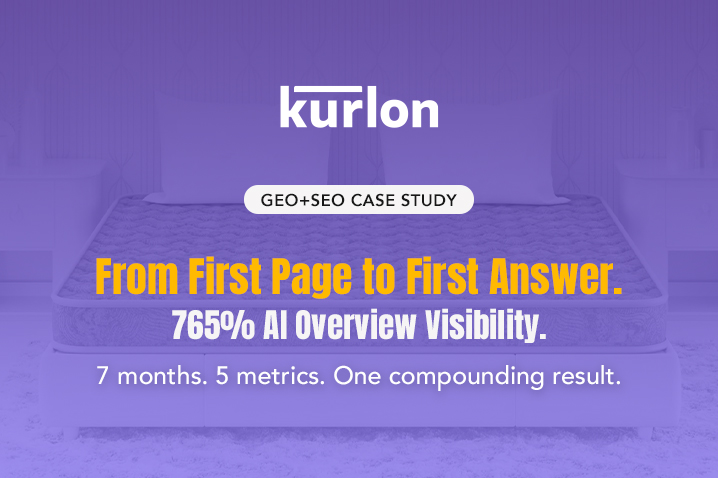
Kurlon, founded in 1962 and present across more than twenty thousand retail touchpoints, brought a problem that no acronym would have clarified. A new generation of buyers had begun asking AI assistants which mattress to trust, and one of India’s most trusted sleep brands was not appearing in those answers.
The brief that worked was written the way the Brief Clarity Test suggests. The questions were mattress purchase and comparison queries with commercial intent. The surface was Google’s AI Overview, because that was where those questions were being resolved. The evidence was AI Overview visibility and brand mentions, tracked through Search Console and GA4 over a defined window. What the brand was willing to change went well beyond publishing: keyword architecture across more than two hundred terms and fifteen collection pages that were competing with each other, full schema deployment, restructured heading hierarchy, and activation of reviews, ratings, and diversified authoritative backlinks.
Across seven months:
- 765% growth in AI Overview visibility
- 600% increase in brand mentions across AI results and AI-powered search surfaces
- 67% surge in search impressions
- 40% rise in organic sessions
- 22% improvement in top-10 rankings on high-value commercial keywords
The traditional search lift arriving alongside the AI visibility gain is the practical answer to the terminology debate. The work that made the brand citable also made it rank better, which is close to what Google’s own staff have been saying, expressed as a result rather than as a position.
Read the full Kurlon case study.
Kurlon x Lyxel&Flamingo, Search Intelligence Practice, March to October 2025.
Going deeper: Reading a GEO proposal
Eight things to check in any AI search proposal, whatever it is called on the cover.
- Does it name the specific questions and engines in scope, or does it promise visibility across AI generally?
- Does the measurement section state how many times each prompt set will be run, and does it report variance as well as an average?
- Does it distinguish between being mentioned in an answer and being cited with a link? These are different outcomes, and only one produces a session.
- Does it address entity data, schema, and page consolidation, or does it begin at content production?
- Does it include earning independent third-party mentions, and is that resourced rather than listed?
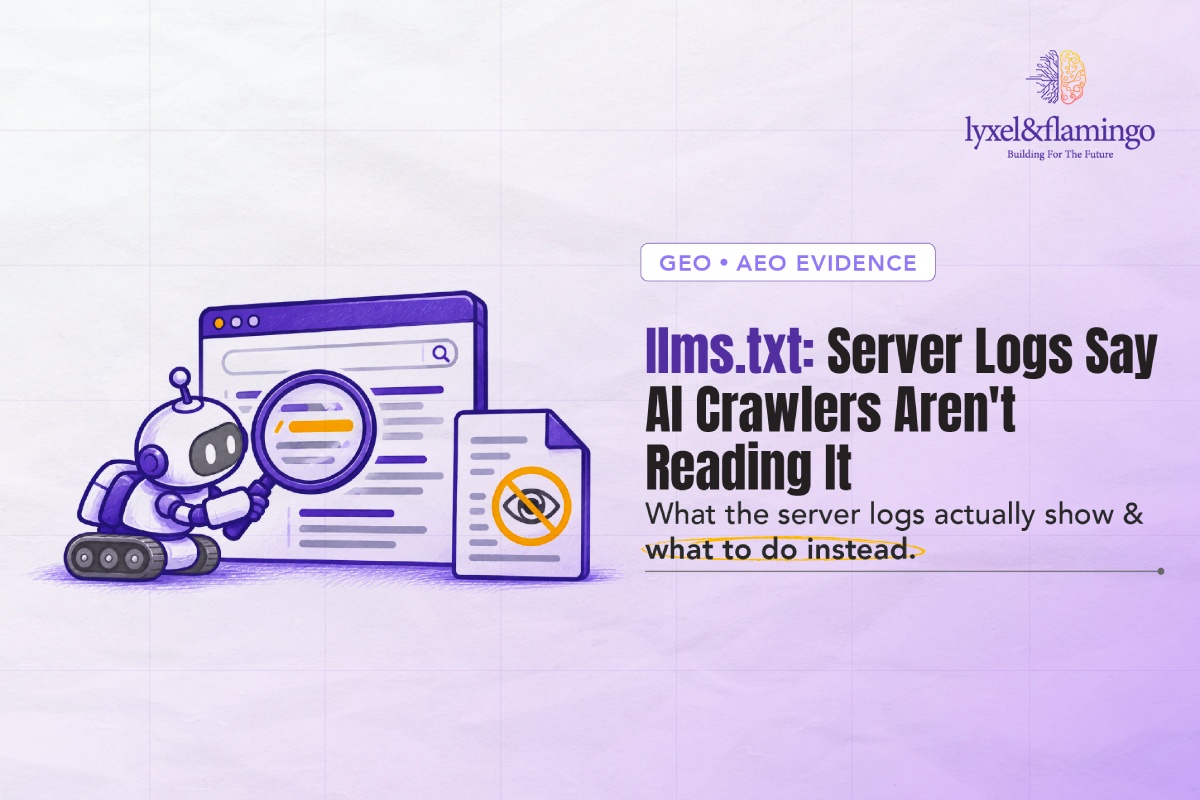
- Does it commit to llms.txt or similar as a deliverable? Ask what evidence supports that, because the published server-log evidence is unfavourable.
- Does it cite named sources with years for the statistics in its own market-context section?
- Does it acknowledge anything that will not work, or is every element presented as effective?
Key takeaways
- Around fifty-nine per cent of practitioners say GEO and fewer than a third kept consistent terminology across a year (eMarketer, 2026), so the vocabulary is not a reliable signal of capability.
- GEO carries roughly twice the search volume of AEO, but both acronyms have been declining since their 2025 peaks while the underlying category grows (Rankability, 2026).
- Google’s search staff have repeatedly said that good SEO is what produces AI visibility; Perplexity’s communications lead disagrees. Both positions are defensible, and the practical difference is narrower than the vocabulary suggests.
- Ranking asks whether a page deserves a place in a list. Citation asks whether a passage deserves to be quoted inside an answer. A page can pass the first and fail the second.
- A brief built on questions, surfaces, evidence, and willingness to change survives every renaming of the category. A brief built on an acronym does not.
The CXO takeaway
The terminology argument is consuming attention that belongs elsewhere. While the industry debates whether to call it GEO or AEO, the substantive questions go unasked in most proposal reviews: which questions do we want to own, on which engines, in which market, and what will we accept as proof?
Write the brief in plain English. Let the partner call the work whatever their category currently calls it, and hold them to the three questions instead. If they cannot answer question two with a measurement method that includes repeated runs and reported variance, the acronym on the cover is the least of the problems.
The vocabulary will be renamed again, probably within the year, and the brands that built entity clarity, independent credibility, and genuinely useful answers will still be cited under whatever the next name turns out to be. That is the part worth funding.
Frequently Asked Questions
In practice, very little. Generative engine optimisation emphasises the system generating the answer; answer engine optimisation emphasises the answer itself. eMarketer's 2026 analysis treats them as describing the same underlying approach. GEO carries roughly twice the search volume; AEO is more common among enterprise practitioners.
Google's search staff have said publicly that normal SEO practice is what produces AI visibility. Perplexity's communications lead disagrees. The honest position is that the foundations are shared - crawlability, entity accuracy, expertise, third-party credibility - while the objective shifts from earning a position in a list to earning a quotation inside an answer. That shift changes emphasis rather than creating a separate discipline.
Usually not. Minuttia's 2026 survey of 599 practitioners found only 9.2 per cent of organisations had a dedicated specialist, with 52.8 per cent assigning the work to the existing SEO team (Minuttia, 2026). Semrush found integrated search and AI teams reporting materially higher success rates than siloed ones. Capability matters more than a separate supplier.
Use whichever your team already understands, and define it once in writing so proposals can be compared like for like. Externally, plain language performs better - buyers search for why their brand does not appear in AI answers, not for the discipline's name.
The same content library can serve both, but the structure changes. Put the answer in the opening fifty words, shape headings as the questions buyers ask, keep FAQ blocks and schema, and publish material that exists nowhere else. Those changes help traditional rankings as well, which is why the two compound rather than compete.
Frequently yes, and often more so than for large ones. These systems weight specificity and depth in a defined domain, so a brand with genuine expertise in a narrow category can earn citations that broader competitors do not. Start with one engine and one set of buyer questions rather than a programme spanning all of them.