
What this blog covers
This is a practitioner’s guide to reading branded search volume not growing it but interpreting it as a live signal of demand. We explain why branded search leads revenue rather than lagging it, how to read it correctly (isolating branded terms, reading trends not days, tying lifts to media bursts, and acting before revenue agrees), the mistakes that turn it into noise, and how to fold it into your leadership dashboard as an early-warning system for whether your brand-building is actually working.
Table of Contents
- What branded search volume actually tells you
- Why branded search is a leading indicator, not a lagging one
- How to read branded search: the four-step method
- Branded search and ad efficiency: the hidden link
- The mistakes that turn the signal into noise
- Where it fits on the leadership dashboard
- Self-check: are you reading brand search or ignoring it?
- Key takeaways
- Closing
What branded search volume actually tells you
Branded search volume is the number of people actively searching for your brand by name your company, your products, your sub-brands as opposed to searching for the generic category. It is a fundamentally different thing from category or non-branded search, and that difference is the whole point: a category search tells you the market has a need; a branded search tells you the market has chosen to think of you.
That makes branded search a measure of demand you have created, not demand you are chasing. When someone types your name into Google, your upper-funnel work has already done its job; they have moved from unaware to aware to interested, and they are now raising their hand. Read at scale and over time, the branded-search line is a real-time readout of how much mental availability your brand holds in the market.
Why branded search is a leading indicator, not a lagging one
Most marketing metrics are lagging; they confirm what already happened after the decisions that caused it. Branded search is different: it is one of the few genuinely leading indicators available, because it moves before revenue does. Someone searches your name days or weeks before they buy, so a rising branded-search trend is an early warning that revenue is coming and a flattening one is an early warning that it is not. It is the leading edge of demand creation, visible weeks before the sales line reacts.
This is exactly why we treat branded search as a top-of-stack signal to steer by. Advertising builds memory that converts to sales over time rather than in a single click (Nielsen), and branded search is the cleanest way to watch that memory forming. It is also the practical, everyday cousin of share of search, the same logic applied to your brand alone. For the leading-versus-lagging framework in full, see our whitepaper, Leading vs Lagging Marketing KPIs: The 4-S Signal Funnel.
How to read branded search: the four-step method
Branded search is only a useful signal if you read it correctly. Read it carelessly, and it is just noise. Four steps turn it into intelligence.
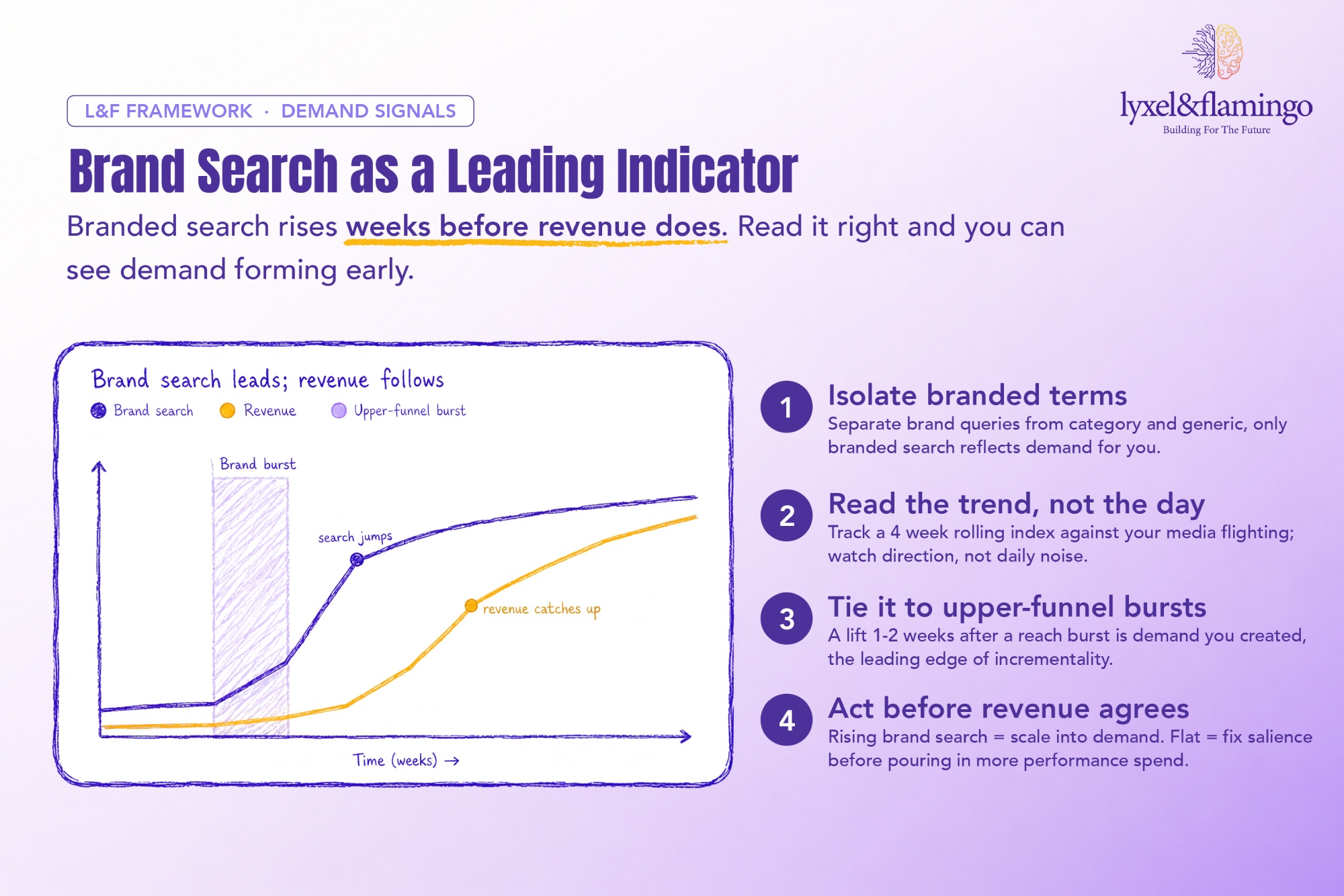
Framework: Brand Search as a Leading Indicator – read the trend, tie it to media, act before revenue agrees.
01. Isolate branded terms
Separate branded queries from category and generic ones. Only branded search reflects demand for you specifically; lump it in with category terms and a rising category tide (or a competitor’s campaign) will flatter or mask your own signal. Build a clean branded-term list: brand name, common misspellings, sub-brands, product lines, and track only that.
02. Read the trend, not the day
Daily branded search is noisy. What matters is direction over time, so track a four-week rolling index rather than reacting to a single spike or dip. You are looking for sustained movement, a trend line bending up or down, against the backdrop of what your media was doing, not a one-day blip that reverts tomorrow.
03. Tie lifts to upper-funnel bursts
The signal becomes causal when you overlay it on your media calendar. A branded-search lift that appears one to two weeks after a reach burst, a TV flight, a big video push, or an influencer wave is demanding that burst be created. That lag between the burst and the search lift is the leading edge of incrementality, and it tells you the upper-funnel money is working before any revenue report can.
04. Act before revenue agrees
The whole reason to read a leading indicator is to act early. Rising branded search means demand is forming, so it is the moment to scale performance spend into it; you will convert warm demand cheaply. Flat or falling branded search while you pour money into the lower funnel is a warning: you are harvesting a pool nobody is refilling, and you should fix salience before spending more on capture.
Branded search and ad efficiency: the hidden link
Reading branded search is not just about forecasting revenue; it directly explains your performance efficiency. When branded search is high and rising, your lower-funnel campaigns meet an audience that already knows and trusts you, so click-through rises, and cost per acquisition falls. When it is flat, your performance ads are working harder to convert cold strangers, and costs climb no matter how well the campaigns are built.
This is why a falling cost per acquisition and a rising branded-search line usually travel together: the brand work is quietly subsidising the performance line. Reading the two side by side stops teams from mistaking a brand-driven efficiency gain for a performance-team win and from cutting the brand budget that is actually making their ROAS look good. If the goal is to grow the signal, not just read it, that is a separate discipline: see how to improve brand search volumes.
The mistakes that turn the signal into noise
Branded search misleads when it is read badly. The common errors:
- Mixing branded and category terms, so a category trend or a competitor’s spend gets read as your own demand.
- Reacting to daily spikes instead of the rolling trend, chasing noise and missing the direction.
- Reading it in isolation from the media calendar, so a lift cannot be tied to the work that caused it.
- Ignoring seasonality; some brands spike every festive season regardless of media, so compare like-for-like periods.
- Treating a one-off spike (a viral moment, a PR event) as sustained demand rather than a temporary blip.
Where it fits on the leadership dashboard
Branded search earns a permanent place on the leadership dashboard, next to revenue and ROAS not buried in an SEO report. Presented as a four-week trend alongside the media calendar and cost per acquisition, it gives leaders an early read on whether brand-building is working, weeks before the revenue confirms it. That makes it one of the most valuable, and most underused, numbers a modern measurement framework can put in front of a board.
Self-check: are you reading brand search or ignoring it?
Score your own setup, one point per yes:
- Branded search is tracked separately from category and generic terms.
- You read a rolling trend, not daily numbers.
- Branded search is overlaid on your media calendar to tie lifts to bursts.
- Branded search sits on the leadership dashboard, not just an SEO report.
- You read branded search alongside cost per acquisition to explain efficiency.
- You adjust for seasonality before drawing conclusions.
- A flat brand-search line triggers a salience review, not just more performance spend.
Five or more and branded search is working as an early-warning system. Three or fewer and you are sitting on a leading indicator you are not reading.
Key takeaways
- Branded search measures demand you created, people choosing to think of you, not demand you are chasing.
- It is a genuine leading indicator: it rises weeks before revenue, so it forecasts growth rather than confirming it.
- Read it right: isolate branded terms, watch the rolling trend, tie lifts to media bursts, and act before revenue agrees.
- A rising brand-search line usually explains falling acquisition costs; the brand work is subsidising performance efficiency.
- Put it on the leadership dashboard next to ROAS; a flat line is a signal to fix salience, not to spend more on capture.
Closing
Most brands have a leading indicator of their own growth sitting in a free tool, and never look at it. Branded search rises before the revenue does, explains why the performance line is efficient, and warns you the moment the demand engine starts to stall. The brands that read it well are steering by the windscreen while everyone else stares at the rear-view mirror and in a market this fast, that head start is the whole game.
Want branded search working as an early-warning system for your brand?
L&F builds the measurement view, branded search, share of search, and the leading signals that predict growth into the media engine, for consumer brands across India and worldwide. We will set up the reading, tie it to your media, and turn a free metric into a decision tool. Talk to L&F about demand signals and start reading the windscreen, not the mirror.
Frequently Asked Questions
Branded search volume is the number of searches people make for your brand specifically your company name, product names and sub-brands, as opposed to generic category searches. It reflects demand for you in particular, which is why it is treated as a proxy for brand awareness and mental availability rather than for the size of the overall market.
Because people search for a brand by name before they buy often days or weeks earlier. So the branded-search line moves ahead of revenue rather than after it. When your upper-funnel work lands, people stop searching the category and start searching for you, and that shift shows up in branded search well before it reaches the sales report. That timing is what makes it 'leading' rather than 'lagging'.
Build a clean list of branded terms, your brand name, common misspellings, product lines and sub-brands and track only those, keeping them distinct from category and generic keywords. Most SEO and search tools let you filter or group terms this way. The separation matters because a rising category tide, or a competitor's campaign, can otherwise be misread as demand for you.
Google Search Console shows branded query impressions and clicks for your own site; Google Trends shows relative interest over time and is useful for spotting direction and seasonality; and keyword tools (Ahrefs, Semrush and similar) estimate branded search volume. For reading it as a signal, the exact tool matters less than the discipline: isolate branded terms, track a rolling trend, and overlay it on your media calendar.
Typically within one to two weeks of a significant upper-funnel burst, though it varies by category and campaign size. The useful move is to overlay branded search on your media flighting and look for a lift that follows a reach burst that lag is the signal that the brand work created demand. If a major burst produces no branded-search lift after a couple of weeks, that itself is important information about the creative or targeting.
Yes, if read carelessly. Mixing branded and category terms, reacting to daily spikes instead of the trend, ignoring seasonality, or reading it apart from your media calendar can all turn a good signal into noise. It can also be temporarily inflated by a one-off viral or PR moment that does not reflect sustained demand. Read as a seasonally adjusted rolling trend, tied to media activity, it is reliable; read raw and daily, it misleads.
Closely. When branded search is high and rising, your lower-funnel ads reach an audience that already knows you, so click-through improves and cost per acquisition falls the brand work is effectively subsidising your performance efficiency. That is why a rising brand-search line and a falling acquisition cost tend to move together, and why cutting brand spend often makes ROAS look worse a quarter or two later, even though the performance campaigns did not change.