What this blog covers
The blog explores how agentic commerce is changing e-commerce and why brands need to rethink how they manage product catalogues. AI shopping agents such as ChatGPT, Gemini and Amazon Rufus increasingly rely on structured product data to research, compare and recommend products. Unlike human shoppers, they cannot reliably infer missing details from images or marketing copy. Incomplete attributes, inconsistent product information, unclear delivery timelines and missing return policies can prevent products from appearing in AI-generated recommendations.
The blog introduces Lyxel&Flamingo’s Agent-Readable Catalogue Stack, built around four layers: Identity, Attribute Depth, Commitment and Proof. It also explains how brands can improve product feed optimisation through consistent SKU information, machine-readable attributes and live inventory data. With agentic commerce expected to influence significant retail revenue by 2030, the blog outlines five practical steps businesses can take now to build AI-ready product catalogues and stay competitive.
Table of Contents
- What Is Agentic Commerce?
- The Problem: Indian Catalogues Are Written for Scrolling Thumbs, Not Reasoning Machines
- How AI Shopping Agents Decide What to Recommend
- The Evidence: Why Agentic Commerce Is a 2026 Priority, Not a 2030 One
- The Lyxel&Flamingo Framework: The Agent-Readable Catalogue Stack
- What Structured Relevance Delivered for Bosch Power Tools on Amazon
- 5 Things to Do With Your Product Feed This Quarter
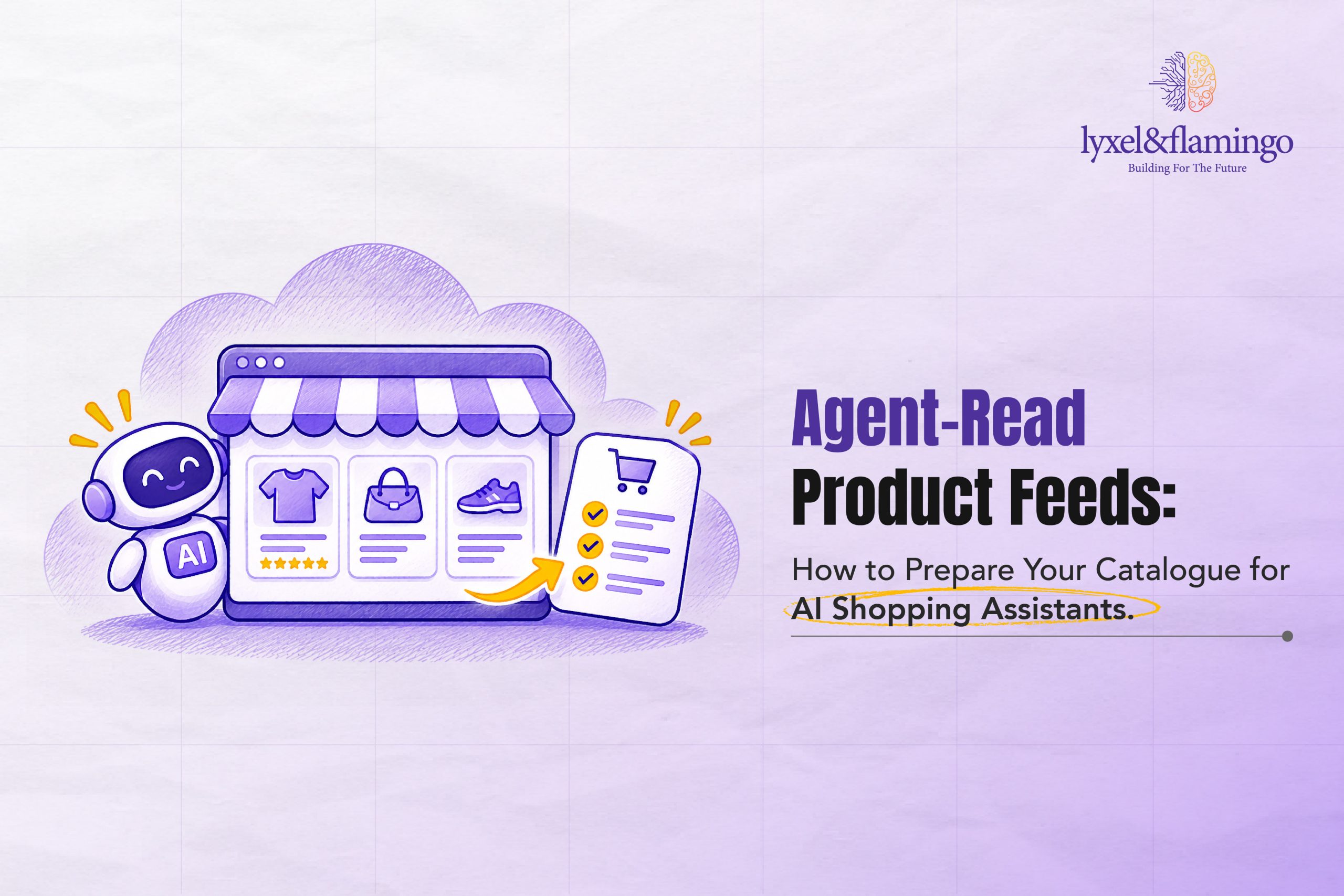
AI shopping agents do not browse your storefront. They read your product data, and a catalogue written only for human eyes is close to invisible to them.
In agentic commerce, the first “shopper” to evaluate your product is often software, and it judges you on the completeness of your product feed long before a human sees a single image. Brands that still treat the feed as a technical export, rather than a sales asset, are handing that first impression to whoever filled in more fields.
McKinsey estimates that agentic commerce could orchestrate up to $1 trillion in US B2C retail revenue by 2030, and $3 trillion to $5 trillion globally. In India, ChatGPT’s user base grew about 4.5 times in 2025 to more than 160 million monthly active users, making it the platform’s second-largest market.
Here is what most catalogue teams miss. AI shopping assistants do not reward the best-written product page. They reward the product that answers the shopper’s brief with the fewest unknowns. A missing material, an unstated delivery window or an ambiguous size chart is not a minor gap to an agent. It is a reason to recommend someone else.
What Is Agentic Commerce?
Agentic commerce is shopping in which an AI agent researches, compares and sometimes completes a purchase on a person’s behalf, using structured product, price and availability data from merchants. Unlike a recommendation widget, the agent acts on a goal (“find a waterproof trail shoe under ₹6,000 that arrives before Saturday”) rather than waiting for the shopper to click.
It is the most consequential form of AI commerce so far, and it matters now because the infrastructure has moved from pilots to standards. In January 2026, Google introduced the Universal Commerce Protocol, an open standard for agentic commerce co-developed with Shopify, Etsy, Wayfair, Target and Walmart, and endorsed by Flipkart among more than 20 others. When the protocols exist, the only remaining question is whether your data is ready for them.
The Problem: Indian Catalogues Are Written for Scrolling Thumbs, Not Reasoning Machines
Open the backend of most Indian D2C or marketplace catalogues, and you will find the same pattern. Titles are stuffed with keywords for marketplace search. Key details live inside lifestyle images rather than text fields. Size guides are uploaded as flat JPEG images. Delivery promises change by pin code but appear nowhere in the feed. Variant data is inconsistent between the brand website, Amazon and Flipkart.
None of this hurt much when the buyer was a human. A person can zoom into an image, read a review, and infer that “premium cotton blend” probably means breathable. An agent cannot infer what was never stated. It works from structured attributes and moves on when a required one is missing.
The agent-driven traffic is already arriving at retailers. Bain reports that AI now accounts for up to 25% of referral traffic for some retailers, though it is still less than 1% of total traffic. That ratio tells you two things at once. The channel is small today, and the brands that appear in it are already concentrating its benefits.
The common response is to treat this as an SEO issue and rewrite product descriptions. That helps a little, but it misses the structural point. Product data optimisation for agents is about completeness, consistency and machine-readable fields, not about prose quality. That makes product feed optimisation a merchandising discipline, not a back-office task.
In agentic commerce, a product with a beautiful page and an incomplete feed loses to a plain product with complete data.
Want to see how shoppers are already finding products through AI search? Read this blog: How Shoppers Now Discover Products Through AI Search, and What It Means for Your Listings
How AI Shopping Agents Decide What to Recommend
To build an AI-ready product catalogue, it helps to understand the decision loop an agent runs. The specifics vary by platform, but the logic follows four steps.
Step 1: Interpret the brief: The agent converts a conversational request into constraints: category, budget, attributes, delivery deadline and sometimes values such as “cruelty-free” or “made in India”. Each of those constraints then becomes a filter.
Step 2: Retrieve candidates: The agent pulls products from structured sources, which include merchant feeds, retailer catalogues, protocol endpoints and indexed pages. Products without the relevant attribute often fail to enter the candidate set at all. They are not ranked low; they are simply absent from the comparison.
Step 3: Filter and rank: Remaining products are filtered against hard constraints, then ranked on attribute match, price, delivery certainty and trust signals such as ratings, return policies and third-party corroboration.
Step 4: Transact or hand off: Increasingly, the agent completes checkout through a protocol such as Google’s UCP or the Agentic Commerce Protocol, or hands the shopper a short list.
McKinsey’s guidance puts the merchant requirement plainly: product directories need to be optimised for agent readability, with semantic and behavioural metadata embedded into catalogues. The same report warns that designing the “agent experience” may become as important as designing the customer experience.
A simple analogy makes the difference clearer. A human shopper is a browser in a bazaar who can haggle, touch and ask. An agent is a procurement officer with a checklist. It will not walk back to your stall to ask what you meant.
| Decision factor | Human shopper on a PDP | AI shopping agent |
| Reads product images | Yes, closely | Partially, and text fields carry more weight |
| Infers missing details | Often, from context and reviews | Rarely, and skips the product instead |
| Compares across sellers | A few tabs at most | Dozens of options in seconds |
| Weighs delivery and returns | At checkout, sometimes too late | Upfront, as a hard filter |
| Responds to brand storytelling | Strongly | Weakly, unless backed by verifiable attributes |
| Tolerates inconsistent data across channels | Usually | Treats it as a trust risk |
AI shopping agents do not punish weak copy as much as they punish missing fields, because a missing field removes you from the comparison entirely.
The Evidence: Why Agentic Commerce Is a 2026 Priority, Not a 2030 One
- Agentic commerce could orchestrate $900 billion to $1 trillion in US B2C retail revenue by 2030. McKinsey’s report also notes that 44% of people who have tried AI-powered search now call it their primary and preferred search source. For Indian brands selling globally, this is the channel their international buyers are already moving into.
- AI agents could drive 15% to 25% of US e-commerce sales by 2030, a market of $300 billion to $500 billion. Bain also cites Salesforce data showing AI and agents influenced $3 billion of US Black Friday sales. The share is still a forecast, but the transactions are already measurable.
- 30% to 45% of US consumers already use generative AI for product research and comparison. At the same time, around half remain cautious about letting agents complete purchases end to end, and they trust retailers’ on-site agents three times more than third-party ones. Research is moving to agents first, and checkout follows trust.
- Google is adding dozens of new Merchant Centre attributes built for conversational commerce. Examples include answers to common product questions, compatible accessories and substitutes. These fields did not exist in standard feeds, which means most catalogues have nothing to put in them yet.
- India is shifting from “search and browse” to “describe and get”, with two agent models emerging. Bain identifies e-retailer-led agents, such as Amazon’s Rufus and Flipkart’s conversational commerce engine, alongside LLM-led agents such as ChatGPT’s Instant Checkout. Indian brands will need feeds that serve both.
Selling on Amazon and wondering how Rufus reads your listings? Read this blog: Amazon A+ Content for the AI Shopper: Optimising for Rufus
The Lyxel&Flamingo Framework: The Agent-Readable Catalogue Stack
At L&F’s Commerce Strategy practice, we audit catalogues against a four-layer model we call the Agent-Readable Catalogue Stack, our working definition of an AI-ready product catalogue. Each layer answers a question an agent asks, and each depends on the one before it.
- Identity Layer: “Is this the same product everywhere?” Give every SKU a stable ID and a GTIN wherever one exists. Structure variants as clean parent-child relationships, and keep titles, colours and sizes identical across your website, Amazon, Flipkart and Google Merchant Centre. Agents treat inconsistent data across channels as a trust problem, and they cannot merge listings that disagree.
- Attribute Depth Layer: “Does this match the brief?” Move every buying-relevant fact out of images and into text fields. Fill in material, dimensions, compatibility, care instructions, use cases and certifications. Then add the conversational fields Google now supports, such as common questions, compatible accessories and substitutes. This is where AI product feeds separate from ordinary shopping feeds, and where product data optimisation pays back fastest.
- Commitment Layer: “Can it arrive on time, and can I return it?” Publish price, stock, delivery windows and return policies as live, structured data. In India, delivery promises vary by PIN code and fulfilment method, so feed them dynamically where your platform allows. An agent filtering for “arrives by Friday” will drop any product whose delivery window is unknown.
- Proof Layer: “Should anyone trust this?” Expose ratings, review counts, warranty terms and third-party certifications in structured form. Make sure the claims on your site match what marketplaces and review platforms say about you.
In our work with brands in this category, the Commitment Layer is consistently the most under-invested and the one with the most immediate impact. Brands spend months on titles and imagery, then lose agent recommendations on a missing delivery field that took one afternoon to fix.
What Structured Relevance Delivered for Bosch Power Tools on Amazon
Bosch Power Tools came to Lyxel&Flamingo with a problem every catalogue team will recognise in the agent era: its Amazon campaigns were not structured by segment, so ads kept matching irrelevant searches, and ACoS stayed high. Instead of spending more, we segmented the campaigns, focused on Sponsored Brands and Sponsored Brands Video placements, added relevant keywords regularly and cut irrelevant traffic with negative keywords.
- 114% improvement in sales in one year
- 100% improvement in order rate
- 36% improvement in conversion rate
- 36% reduction in ACoS, even with higher spends
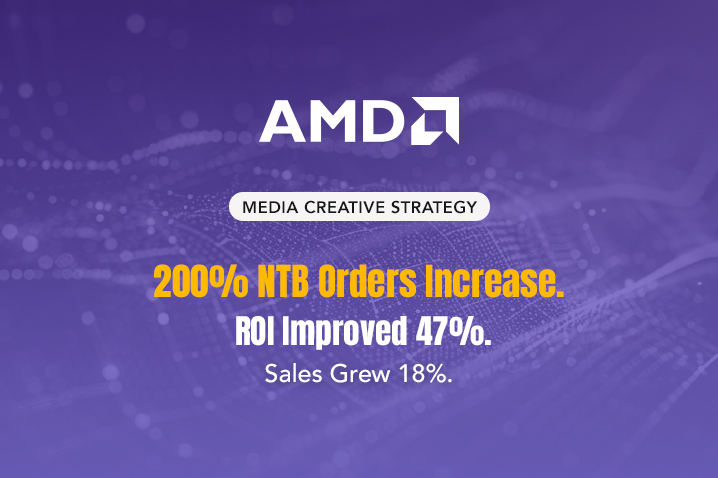
A similar pattern shows up in our Amazon PDP work for AMD, where a zero-discount strategy built entirely on listing content and positioning grew new customer acquisition by 200% and improved ROI by 47%.
The interpretation matters more than the numbers. Neither project involved an AI shopping agent, but both won the way agents choose: by matching the shopper’s intent precisely rather than buying more exposure. An agent-ready catalogue applies that same discipline to product data, so the match happens before any ad is served.
5 Things to Do With Your Product Feed This Quarter
- Run ten real shopper prompts through ChatGPT, Gemini and Rufus. Write prompts the way your customers speak, including budget and delivery constraints. Record which brands appear, which attributes the answers mention, and where your products are missing.
- Score your top 50 SKUs for attribute completeness. Use Google Merchant Centre’s recommended attributes as your product feed optimisation checklist. Any SKU below 80% completeness is a candidate an agent can skip, so fix bestsellers first.
- Pull facts out of images and into text fields. Size charts, ingredient lists, dimensions and compatibility notes should all exist as structured text. If an agent cannot read it, it does not exist for that agent.
- Align product data across every channel. Pick one source of truth, usually your PIM or Shopify catalogue, and sync titles, variants and prices outward. Mismatches between your site and marketplaces erode the trust signals agents weigh.
- Publish delivery and return commitments as live data. Connect stock, shipping windows and return policies to your feed rather than hard-coding them on product pages. This single change often moves more agent recommendations than any copy rewrite.
Conclusion
Agentic commerce rewards the brands that make themselves easy to evaluate. The pitch, the imagery and the brand story still matter, but they now sit behind a gate that only structured, consistent and complete product data can open. Brands that build agent-readable catalogues in 2026 are building an advantage that will be hard to close once AI shopping agents carry a meaningful share of purchase decisions.
The question for every commerce leader is not whether AI shopping assistants will reach Indian shoppers. They already have, and usage is growing quickly. The question is whether your catalogue will be in the answer when they do.
AI commerce will keep changing its interfaces, but complete AI product feeds will stay the entry ticket.
Frequently Asked Questions
Agentic commerce is when an AI agent shops on your behalf, researching, comparing and sometimes buying products based on a goal you describe. It relies on structured product, price and delivery data from merchants.
Regular search returns a list of links for you to evaluate. AI shopping assistants interpret your request, filter products against your constraints and return a short list or complete the purchase themselves.
It is the process of making your product data complete, consistent and machine-readable across every channel. For agents, filled attributes, live delivery data and matching information across platforms matter more than keyword-heavy titles.
Yes, because Indian shoppers are already using ChatGPT, Gemini and Amazon's Rufus for product research. Bain notes India is moving from "search and browse" to "describe and get", and catalogues need to be ready before checkout follows.
Test real shopper prompts in major AI assistants and check whether your products appear. Then audit attribute completeness, delivery data and cross-channel consistency for your bestselling SKUs.