What this blog covers
Reducing RTO works best as a set of small controls instead of a single ban on cash on delivery. Measure RTO by pin code, product, payment mode and acquisition source, then segment orders by risk. Offer prepaid incentives, charge a modest fee or require a deposit on high-risk orders, confirm intent with an automated message or call before dispatch, fix address quality at checkout and improve delivery attempts and communication. Clear shipping and return policies reduce disputes and give assistants accurate facts to quote.
Quick Answer: Measure RTO by pin code, product, payment mode and traffic source. Find the pockets where cancellations cluster, and treat those differently from the rest. Offer a small discount or perk for prepaid payment, add confirmation steps such as an automated WhatsApp or call before dispatch for risky cash-on-delivery orders, validate addresses at checkout and work with logistics partners on delivery attempts and customer communication. Keep cash on delivery available where it earns more than it costs, and publish plain, consistent shipping and return policies.
Table of Contents
- What RTO Really Costs
- Step One: Measure RTO Properly
- Step Two: Segment Orders by Risk
- Step Three: Steer Buyers Toward Prepaid
- Step Four: Confirm Before You Ship
- Step Five: Fix Address and Delivery Quality
- Step Six: Decide Where Cash on Delivery Still Pays
- Policies as Facts for Search and AI
- The RTO Framework
- Client Proof From Our Work
- Key Takeaways
- CXO Takeaway
What RTO Really Costs
An RTO order carries forward shipping, return shipping, handling, packaging, possible damage, marketing spend that produced the order and the lost chance to sell the unit to someone else while it was in transit. For low-margin products, one returned parcel can wipe out the profit of several delivered ones.
A quick illustration, using made-up numbers to show the arithmetic. Suppose a product sells for 1,000 with a contribution margin of 300 before shipping, and each shipment costs 80 each way. A delivered order earns 300 minus 80, which is 220. A returned order loses 160 in shipping and handling, with the unit back on the shelf. If 100 orders ship and 25 return, the 75 delivered orders earn 16,500 and the 25 returns lose 4,000, so the batch earns 12,500. Now suppose a prepaid incentive cuts returns from 25 to 15, and you give a 30 discount on every delivered order, which is a generous assumption. The 85 delivered orders earn 190 each, or 16,150, and the 15 returns lose 2,400, so the batch earns 13,750. The incentive wins in this example, and your own numbers may say otherwise.
Do this calculation with real figures for your top products. It replaces opinion with a clear trade-off.
Our guide on failure points on a typical ecommerce website lists the leaks that sit around checkout, and RTO sits among the most expensive.
Step One: Measure RTO Properly
Define RTO clearly: orders that ship and come back undelivered, as a share of orders shipped. Keep it separate from customer returns after delivery and from cancellations before dispatch, since each has a different cause and fix.
Then cut the data. Look at RTO by payment mode, pin code and city tier, product category and price band, order value, new versus repeat customers, acquisition source and campaign, time of day and delivery partner. Patterns appear quickly. Some pin codes have poor delivery success, some campaigns attract curious clickers who never intended to buy, and some products draw impulse orders that fade.
Take the numbers to the media team too. A campaign with a strong front-end return on ad spend and a heavy RTO share is delivering less than it appears to. Our guide on leading versus lagging marketing KPIs explains how to bring delivered revenue into the picture.
Step Two: Segment Orders by Risk
Rank order types by how likely they are to fail, then apply controls in proportion.
Low-risk orders, such as repeat customers in reliable pin codes with moderate values, ship as they are. Medium-risk orders may trigger a confirmation message. High-risk orders, such as first-time buyers with high values in weak-delivery areas who chose cash on delivery, may need a prepaid nudge, a deposit or a confirmation call.
Build the rules from your own data and revisit them monthly. Keep them simple enough for the team to explain, and keep a fast path for good customers, since a rule that irritates loyal buyers costs more than it saves. Tell customers what to expect in plain words, never in a way that sounds like an accusation.
Step Three: Steer Buyers Toward Prepaid
Most shoppers pay with the option shown first and made easiest. Use that.
Offer a small discount or a perk for prepaid orders, such as free shipping, faster dispatch or loyalty points. Show prepaid as the default selection and display the saving clearly. Charge a modest handling fee on cash on delivery where the economics justify it, and explain it honestly. Make prepaid payment smooth: support the methods your shoppers prefer, keep the payment page fast and remove steps. Our guide on UPI apps as media channels shows how deeply UPI shapes Indian shoppers’ payment habits.
Test each tactic as an experiment: change one thing, compare delivered orders, RTO rate and net contribution after a fixed window. A discount that moves many buyers to prepaid can beat a policy that simply removes cash on delivery, since the latter loses some buyers outright.
Step Four: Confirm Before You Ship
A confirmation step catches false orders cheaply. For cash-on-delivery orders in risk segments, send an automated message that asks the buyer to confirm, with one tap. Messaging apps work well, and so does a short call for high-value orders. Our guide on the WhatsApp layer in omnichannel customer experience explains how conversations can carry order updates and confirmations.
Make the confirmation useful as well as defensive. Include the order summary, the expected delivery date and a link to change the address or reschedule. A buyer who feels informed shows up at the door.
Set a clear rule for unconfirmed orders: hold for a defined time, then cancel or ship depending on risk. Record the outcome, so you can see which confirmations reduce RTO enough to justify the effort.
Step Five: Fix Address and Delivery Quality
A share of RTO comes from delivery failure, and the buyer never refused anything. Incomplete addresses, wrong pin codes, missing landmarks and unreachable phone numbers all stall parcels.
Fix this at checkout. Validate pin codes, auto-complete addresses, ask for a landmark and verify the phone number. After dispatch, send tracking updates and delivery-day alerts so someone is home. Work with your logistics partners: review delivery success by pin code, ask for multiple attempts where possible, give clear instructions for apartment complexes and compare partners on delivered outcome as well as price.
Our guide on simple hacks to improve ROI on a website suggests further checkout improvements, and our piece on how to increase AOV shows how to raise order value, a useful counterweight when you add friction.
Step Six: Decide Where Cash on Delivery Still Pays
Cash on delivery lifts conversion for first-time buyers who lack trust in a new brand and for shoppers without easy digital payment access. Removing it everywhere can lower orders more than it lowers cost.
Keep it where the numbers support it: reliable pin codes, moderate order values, products with low return risk and repeat customers. Restrict or add conditions elsewhere. Review the decision each quarter with fresh data, since the right balance moves with your brand’s reputation, your logistics partners and your customer mix.
Our guide on retention marketing shows how repeat buyers, who need fewer controls, raise the quality of your order base over time.
Policies as Facts for Search and AI
Shipping times, payment options, cash-on-delivery rules and return terms are exactly the facts shoppers ask about, and increasingly they ask assistants. Assistants answer from pages that state the facts plainly.
Write one clear page for each policy. State the countries or regions served, the delivery times, payment methods, any cash-on-delivery limits or fees and the steps to return an item. Use short sentences and headings that match questions such as “Do you offer cash on delivery?” Keep every channel consistent, including your site, marketplace listings and customer service scripts. Google’s page on AI features and your website says standard SEO fundamentals apply, and our GEO playbook explains how to shape pages that assistants cite.
Fewer disputes also protect ratings. Clear promises reduce the mismatches that lead to angry reviews, which in turn protect the trust signals that drive conversion.
The RTO Framework
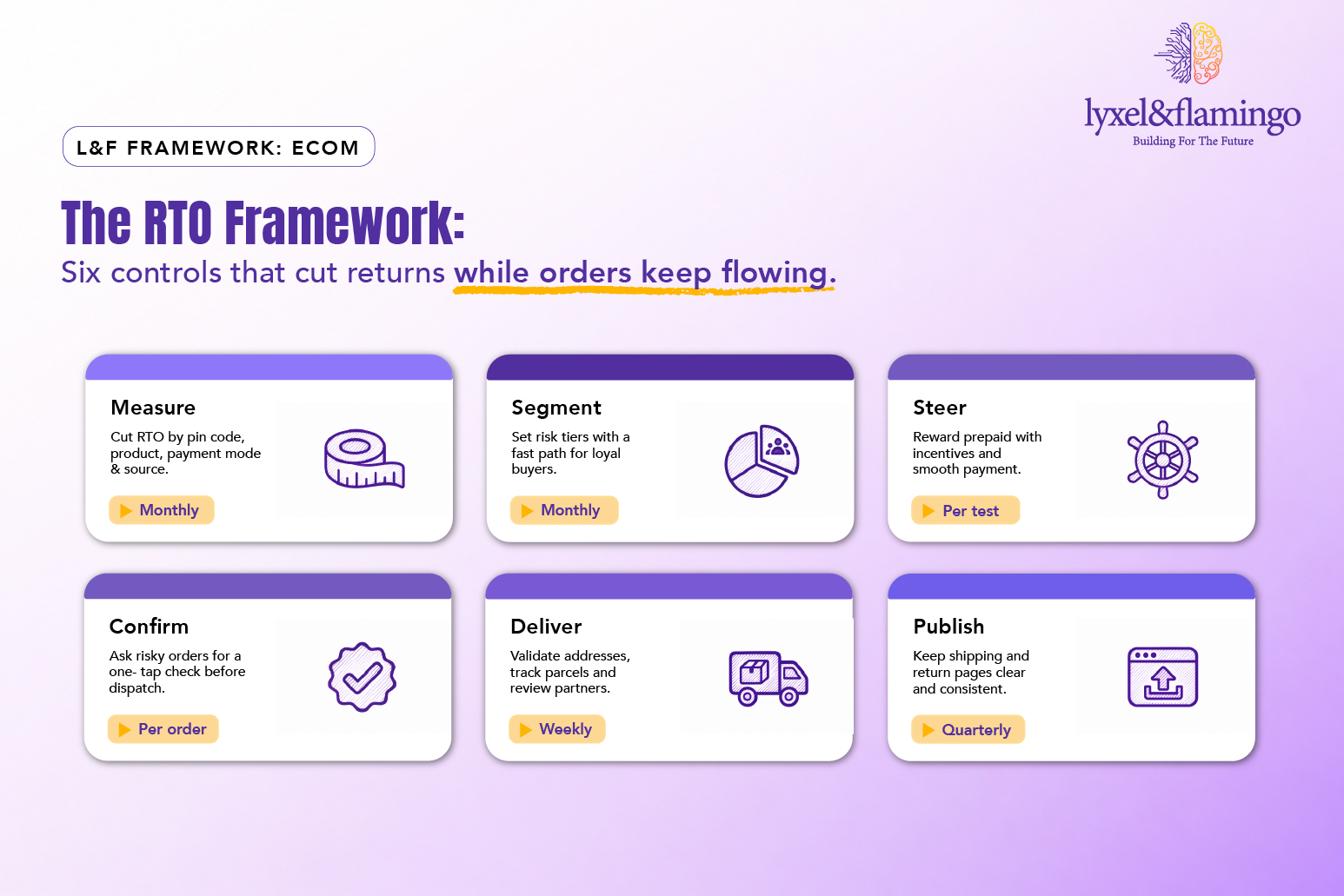
Framework Explained
Apply the framework to your riskiest orders first. Measurement shows where the loss sits, and the later steps cut it without punishing good customers.
Step 1: Measure. Define RTO as shipped orders that come back undelivered, and cut it by pin code, product, payment mode and source. Check: the report separates RTO from returns and cancellations.
Step 2: Segment. Rank orders into risk tiers from your own data and keep a fast path for repeat buyers. Check: the rules fit on one page and are reviewed monthly.
Step 3: Steer. Reward prepaid orders with a small discount or perk, preselect prepaid and keep payment fast. Check: each incentive runs as a test against a control.
Step 4: Confirm. Ask risky cash-on-delivery orders to confirm with one tap or a short call before dispatch. Check: you know how many confirmations convert to deliveries.
Step 5: Deliver. Validate pin codes, collect landmarks, send tracking and delivery-day alerts and compare logistics partners on delivered outcomes. Check: failed-delivery reasons are logged.
Step 6: Publish. Write plain pages for shipping, payment and returns and keep them consistent across channels. Check: the same facts appear on your site, listings and support scripts.
CAPABILITY NOTE: Lyxel&Flamingo’s ecommerce team designs checkout, payment and post-purchase journeys for D2C brands and connects them to media performance. This guide shares the working approach and points to related client engagements in the proof section.
Client Proof From Our Work
RTO shrinks when checkout, address quality and post-purchase communication work together. Stanley India built those foundations, and Kimirica added lifecycle messaging.
Neither case reports an RTO figure. They show the building blocks this guide recommends, such as cash on delivery with pincode checks, tracking and post-purchase flows.
Key Takeaways
- Measure RTO by pin code, product, payment mode and source before choosing a fix.
- Segment orders by risk and apply controls in proportion.
- Steer buyers toward prepaid with incentives and smooth payment instead of banning cash on delivery.
- Confirm risky orders before dispatch and fix address and delivery quality.
- Publish clear shipping, payment and return policies for shoppers, search engines and AI assistants.
CXO Takeaway
What is the contribution margin of a delivered order versus the loss on a returned one, for your top five products? Put both numbers on one page before debating any policy. Lyxel&Flamingo’s ecommerce team helps D2C brands test payment and checkout options with that arithmetic.
Frequently Asked Questions
Return to origin: an order that ships and comes back undelivered, usually from refusal, an unreachable buyer or an address problem.
Rarely everywhere. Segment orders by risk, encourage prepaid with incentives and keep cash on delivery where it earns more than it costs.
Send an automated message or call that asks the buyer to confirm the order, address and delivery date, with a rule for unconfirmed orders.
Clear, consistent shipping, payment and return facts answer common shopper questions and give assistants accurate material to quote.