
What This Blog Covers
PMax’s automated budget allocation is at its most aggressive during the quarter that matters most. This breaks down what you can and can’t control inside a PMax campaign during festive season, and where to build guardrails before the spend starts moving on its own.
Quick Answer: PMax gives Google’s algorithm control over budget allocation, creative combination and channel mix within a campaign, and during Q4’s high-competition auctions, that allocation can shift faster than a weekly review cycle can catch. You keep meaningful control over asset quality, audience signals, negative keywords at the account level and conversion goal definitions. You lose granular, channel-by-channel visibility into where the budget actually went until after it’s spent.
Table of Contents
What PMax Actually Controls in Q4
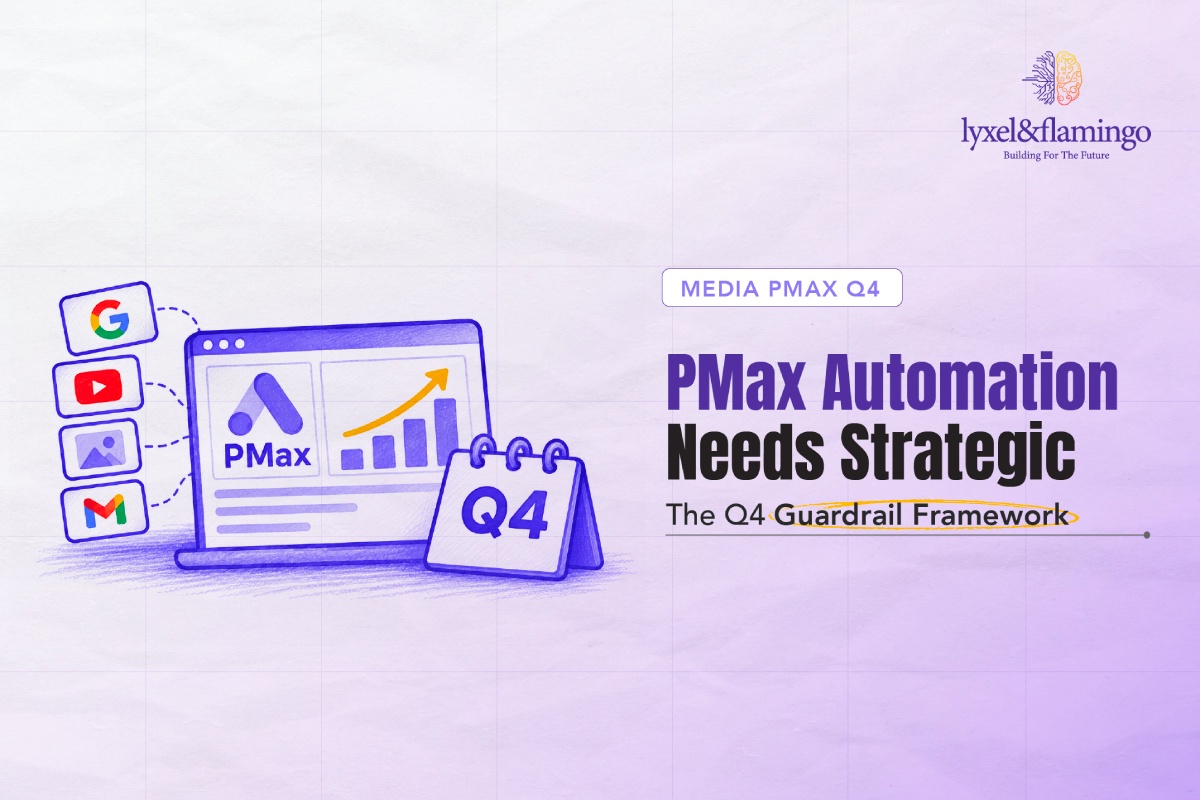
Performance Max decides, in real time, how a single budget gets split across Search, Display, YouTube, Discover, Gmail and Maps, based on where it predicts a conversion is most likely. In Q4, with festive auctions moving hour to hour, that reallocation happens far more often than in a quieter month.
The campaign also controls which creative assets get combined into which ad, and which audience signals to weight most heavily. You supply the raw materials. The algorithm decides the recipe, and it can change the recipe mid-week without telling you why.
Where the Black Box Gets Expensive
The reporting gap is the real cost. A marketing team can see that PMax spent the full daily budget and hit a target ROAS, and still not know whether that budget skewed toward Search, where the brand already ranks organically, or toward Display, where it’s reaching genuinely new audiences. During a normal month, that ambiguity is an inconvenience. During Q4, when a board wants to know exactly what drove the festive spike, it’s a reporting problem.
The second cost is speed of correction. If PMax over-indexes on a channel that isn’t actually incremental, the standard weekly optimization cadence discussed in beyond ROAS: redefining performance metrics for full-funnel growth may not catch it until a meaningful chunk of festive budget is already gone.
The Guardrails That Still Work
Asset quality is the highest-leverage lever left in a marketer’s hands. PMax can only combine what you give it, so a shallow asset library (two headlines, one video, generic product shots) gives the algorithm nothing good to work with regardless of how well it’s optimizing.
Audience signals matter more than most teams treat them. First-party data, customer match lists and search theme signals steer the algorithm’s starting point, even though it will deviate from them over time based on performance. Account-level negative keywords remain one of the only hard controls left, and they’re worth auditing weekly during Q4 specifically, not monthly.
Framework Explained
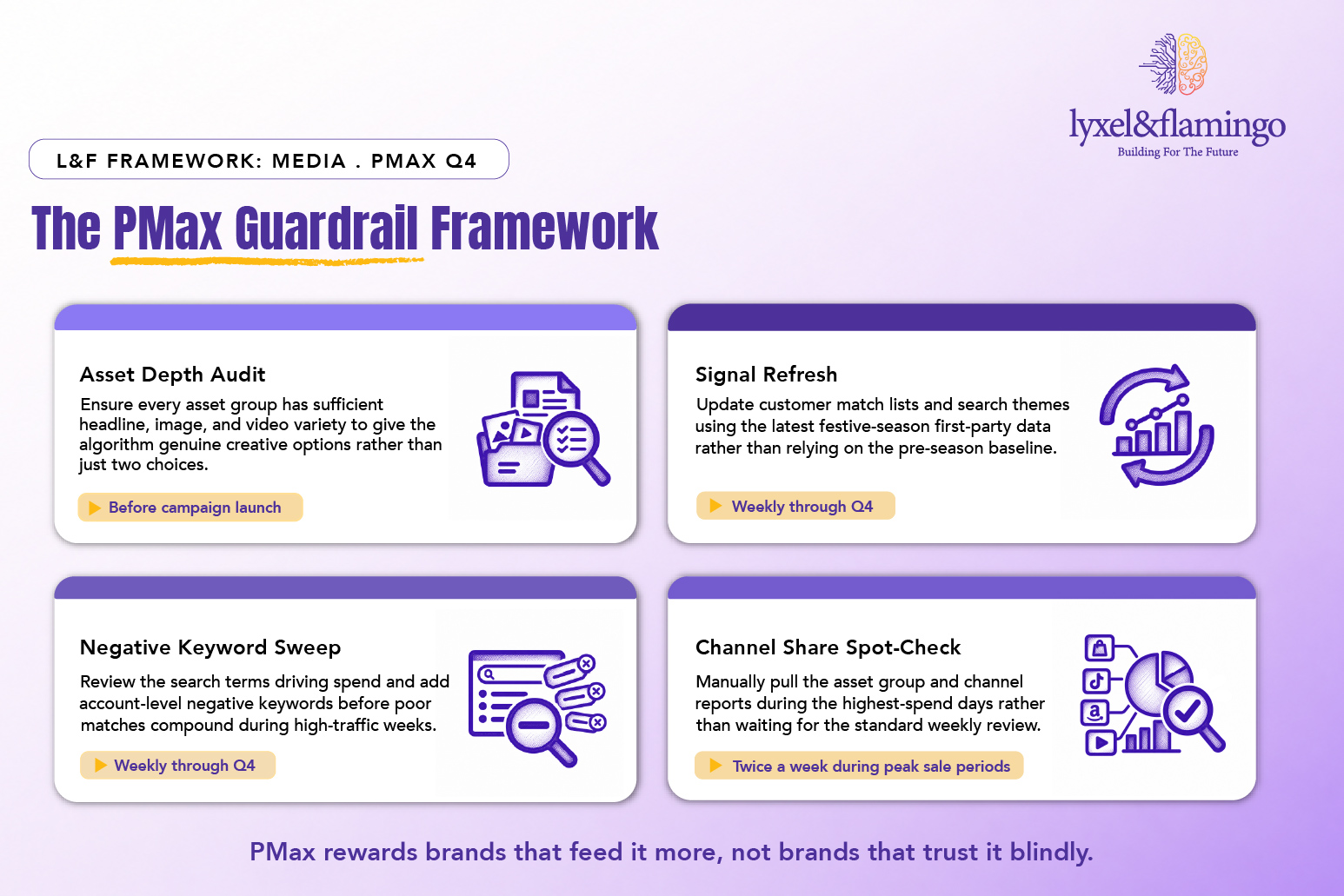
- Asset Depth Audit: A PMax campaign is only as good as the raw materials it’s given, so before Q4 launch, every asset group needs enough creative variety that the algorithm isn’t forced to reuse the same two assets across every channel.
- Signal Refresh: Audience and search-theme signals decay fast during a season where buying intent itself is shifting weekly, so a signal set built in September is already stale by the third week of festive spend.
- Negative Keyword Sweep: This is one of the few levers that gives a marketer direct, immediate control inside an otherwise automated system, and it needs a tighter cadence than usual when search volume itself is spiking.
- Channel Share Spot-Check: On the highest-spend days of the sale calendar, a twice-weekly manual pull catches a channel-mix shift days before the standard weekly review would.
What to Ask in Your Weekly Review
Ask which asset combinations are actually being served, not just which ones exist. Ask what percentage of spend moved to Display or YouTube versus Search this week, and whether that shift tracks with an actual change in where conversions are coming from.
Ask what the account-level negative keyword list added this week, and why. If the answer is nothing, that’s worth questioning during the highest-volume search weeks of the year, not accepting as a quiet week.
Setting Expectations Before the Quarter Starts
A CMO signing off on a Q4 PMax budget should go in expecting less line-item visibility than a manually structured campaign offers, in exchange for the efficiency PMax delivers at scale. That trade only holds up if the guardrails above are actually in place before the quarter starts.
McAfee’s media operations engagement with Lyxel&Flamingo delivered 42% more sales and 170% more traffic across Singapore and Malaysia, the kind of full-funnel paid media discipline that keeps an automated campaign type accountable to real performance rather than the platform’s own optimization target.
Key Takeaways
- PMax controls budget allocation and creative combination in real time; you control asset quality, signals and negative keywords.
- The reporting gap, not the automation itself, is what makes PMax risky during a high-stakes quarter.
- Asset depth is the single highest-leverage guardrail available before campaign launch.
- Move from a weekly to a twice-weekly review cadence during the highest-spend days of the festive calendar.
CXO Takeaway
Approving a Q4 PMax budget means approving reduced line-item visibility in exchange for scale efficiency. Ask your team to show the guardrail framework before the quarter starts, not after the first overspend surprises the board.
If nobody on your team can tell you this week’s channel split inside PMax, do you actually know what you’re spending on, or just what it’s costing?
Talk to Lyxel&Flamingo about building PMax guardrails that keep Q4 automation accountable without giving up the efficiency it’s built for.
Frequently Asked Questions
No. PMax allocates budget dynamically across channels based on predicted conversion likelihood, and that allocation isn’t something an advertiser can lock by channel.
Asset depth. A wide, high-quality library of headlines, images and video gives the algorithm real options; a thin library forces it to overuse whatever it has, regardless of fit.
Weekly at minimum, and twice weekly during the highest-traffic sale days, since search volume itself shifts fast enough to surface new irrelevant matches quickly.
Google provides an asset group and channel-level report. It’s a retrospective view, not a real-time control, which is why the spot-check cadence in this framework matters more than the report itself.