
What This Blog Covers
This blog explains how the third-party consensus logic of digital PR became the signal AI retrieval systems weight most heavily, why traditional PR metrics capture almost none of this value, and what a programme redesigned specifically for AI citation looks like in execution. It covers the evidence base from Ahrefs’ 75,000-brand study linking earned brand mentions directly to AI citation rates, why externally corroborated claims carry substantially more weight than self-generated ones in AI retrieval, what changes when publication targeting and coverage briefs are redesigned around citation authority rather than reach, how to measure PR’s actual contribution to AI citation frequency on a quarterly basis, and why this integration between PR and search reporting is the structural change that makes digital PR defensible as a search investment.
QUICK ANSWER: Digital PR now functions as a search discipline because the external footprint a PR programme creates, covering authoritative publications, named expert citations and earned brand mentions across credible sources, is the third-party consensus signal AI retrieval systems use to determine whether a brand’s claims are trustworthy enough to surface. Ahrefs’ 75,000-brand study (May 2025) confirmed that earned brand mentions correlate directly with AI citation frequency. A PR programme still measured on reach and AVE is producing AI citation value without capturing or reporting it. Publication targeting, the coverage brief, and measurement all need structural changes.
Table of Contents
- Where PR and Search Merged: The Third-Party Consensus Layer
- Why AI Systems Weight External Evidence Above Self-Generated Claims
- Why Traditional PR Metrics Miss Most of the Value Being Created
- What a Digital PR Programme Built for AI Citation Looks Like
- The Digital PR Citation Model
- The Framework Explained
- Measuring PR's Contribution to AI Citation Frequency
- CLIENT PROOF POINT
- KEY TAKEAWAYS
- The CXO Takeaways
Where PR and Search Merged: The Third-Party Consensus Layer
Digital PR and search optimisation have operated in adjacent lanes for over a decade, sharing foundational objectives without fully integrating measurement or execution. Backlinks from authoritative publications. Brand mentions in credible trade outlets. Structured coverage that search crawlers index effectively. The overlap was clear, the integration was rare.
What changed in 2025 is that the overlap became structural. When Ahrefs studied 75,000 brands in May 2025, the finding was direct: earned brand mentions correlate with AI citation rates. Not directionally. Measurably.
The external footprint a PR programme creates, specifically the volume and quality of third-party references to a brand across credible, indexed sources, has a quantifiable relationship with how frequently AI engines surface that brand in synthesised answers to category queries.
The mechanism is third-party consensus. AI retrieval systems apply a logic analogous to academic citation: claims appearing across multiple independent, credible sources carry more weight than claims appearing only on the originating brand’s own properties.
A coverage piece in a well-indexed industry publication is not just a backlink. It is a credibility vote from an independent source that an AI system counts when deciding whether a brand’s expertise is trustworthy enough to cite. This is precisely why third-party consensus is the hardest GEO pillar to build and the most durable competitive advantage once established.
This convergence has a direct implication for how the PR function is positioned and measured. A PR programme that earns authoritative, well-indexed coverage is producing search and AI visibility value whether or not that value is being reported.
The question is whether the programme is designed to maximise that value, or whether it is optimising for reach metrics that have no direct relationship to citation impact.
Why AI Systems Weight External Evidence Above Self-Generated Claims
AI retrieval systems are, structurally, confidence machines. They surface information they can be confident is accurate, and they build that confidence through corroboration rather than through a brand’s own assertions.
A brand that describes itself as the most trusted provider in its category on its own website is making a single-source claim. An AI system encountering that claim has nothing external to anchor confidence in.
The third-party consensus pillar in a well-structured GEO programme exists precisely because of this dynamic. A brand with detailed, expert content on its own site and no external footprint has made a self-referential claim that AI systems treat with uncertainty.
A brand with equivalent content on its own site, referenced in trade press, cited in professional association publications, named in industry contexts, and mentioned credibly in high-authority reviews, has made a corroborated claim. AI systems surface the second brand far more consistently.
The type of external coverage matters as much as volume. A mention in a high-domain-authority publication that AI retrieval systems actively index is worth significantly more to AI citation authority than an equivalent mention in a low-authority outlet without meaningful AI indexing.
A direct expert quote containing a specific, attributed claim is more AI-extractable than a generic brand mention in a news item’s sixth paragraph. A coverage piece that attributes a proprietary insight or a distinct point of view to a named spokesperson is AI-citable content. A coverage piece that mentions the brand name and moves on is not.
These distinctions change the brief, the pitch list, and the measurement standard for a digital PR programme. A programme targeting authoritative, well-indexed publications and briefing for specific, expert-attributed claims is structurally different from one optimising for reach and pickup count.
Both programmes earn coverage. Only one of them builds AI citation authority.
Why Traditional PR Metrics Miss Most of the Value Being Created
Traditional PR metrics such as advertising value equivalent, estimated reach, coverage volume, press release pickup counts and share of voice calculations were designed to proxy brand awareness impact. They were never built to measure search authority, citation frequency, or AI visibility, because when these metrics were formalised, those outcomes were handled by a separate function.
The consequence is a PR programme that performs well against its own reporting framework and contributes AI citation value that nobody is measuring.
A brand generating 200 coverage pieces in a quarter might score well on AVE and reach. If those 200 pieces primarily appear in publications AI systems do not actively crawl, carry no-follow links, contain generic brand mentions without expert attribution, and have domain authority scores below what AI retrieval systems weight as credible, the AI citation impact is close to zero, regardless of the reach numbers.
This is not a hypothetical inefficiency. It is a measurement gap that drives resource allocation away from the publications, briefs, and content formats that would actually generate AI citation value.
A PR team measured on reach optimises for reach. A PR team measured on AI citation frequency optimises for a different set of publications, a different coverage content standard, and a different success definition entirely. This is closely connected to why SEO and PR must now work together as a single integrated discipline.
The Ahrefs data provides the evidence base for changing the measurement. The programme redesign that follows from that change is what requires strategic attention at leadership level, because changing the success metric for a PR function has direct implications for agency briefs, pitch prioritisation, and how quarterly reviews are structured.
What a Digital PR Programme Built for AI Citation Looks Like
A digital PR programme redesigned for AI citation has three structural differences from a traditional awareness-first programme. Each one represents a decision about what the programme is actually optimising for.
Publication targeting changes first. The traditional question of ‘which publications reach our target audience at scale’ is replaced by a compound question: ‘which publications reach our target audience, have domain authority that AI systems weight as credible, are actively indexed by Perplexity and Google AI Overviews, and appear as cited sources in existing AI responses on our category’s key queries?’
These are not always the same publications. A trade outlet with 100,000 readers might have lower domain authority than a specialist technical publication read by 8,000 people. For AI citation purposes, the specialist publication with higher authority often delivers more return.
The coverage brief changes next. A spokesperson quote stating ‘we are excited to expand our service offering’ contributes nothing to AI citation.
A named, credentialled subject-matter expert providing a specific, data-referenced answer to a question that AI engines regularly receive, placed in a publication that AI systems index and weight, is AI-citable content.
The brief changes from ‘secure brand visibility in a relevant publication’ to ‘place our expert’s specific, citable insight in a form a retrieval system can extract and attribute.’ This connects directly to the E-E-A-T principle of demonstrable expertise that governs how AI systems evaluate source credibility.
Measurement changes last, and most structurally. PR and SEO reporting need to share a data layer.
Coverage earned in a given period should be tracked not only for reach and domain authority, but correlated quarterly with AI citation frequency for the queries that coverage was designed to support. This creates accountability for PR’s contribution to AI visibility that reach and AVE cannot provide.
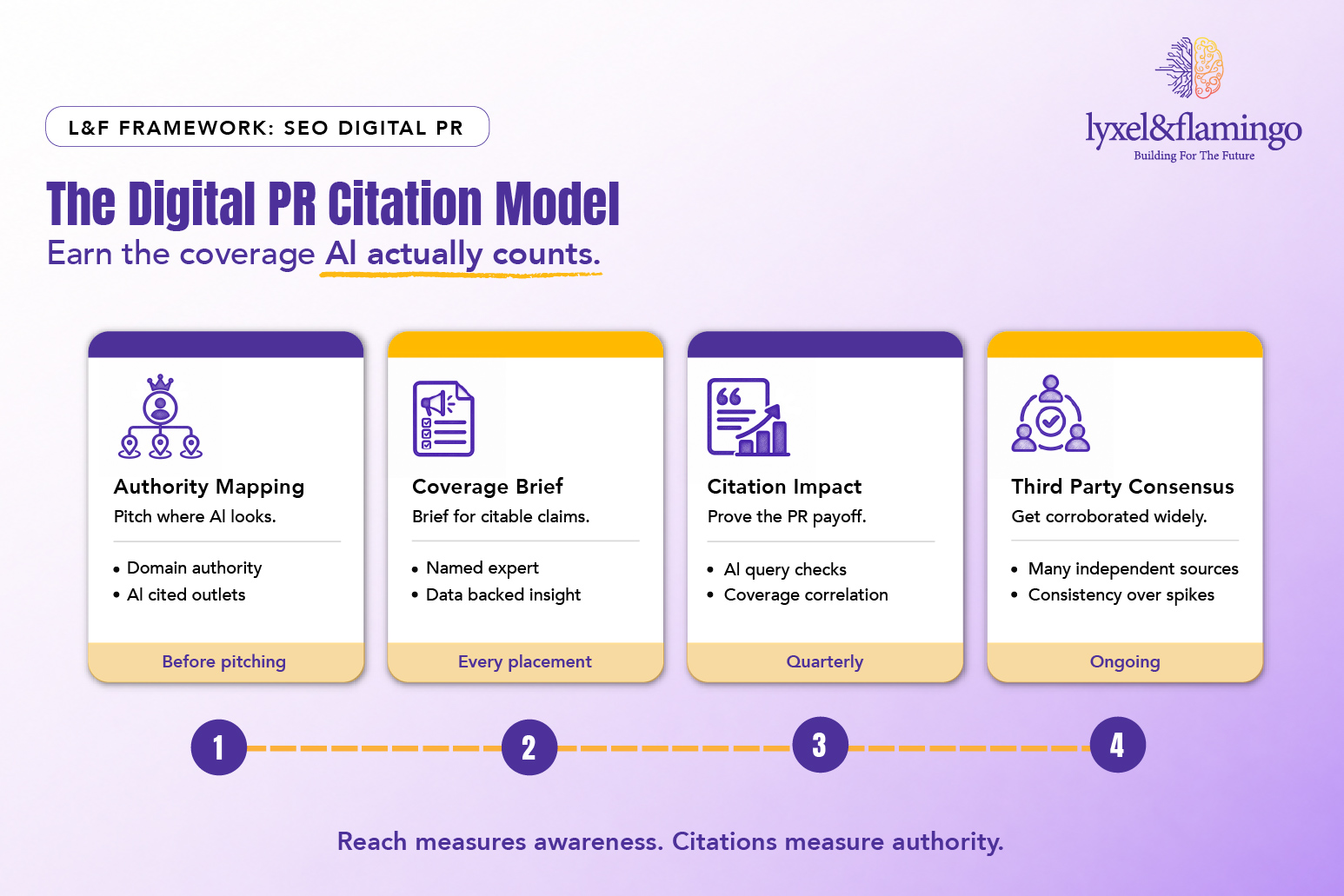
The Digital PR Citation Model
Four stages that build the external footprint AI systems weight as credible
The Framework Explained
- Authority Mapping: The audit that makes everything else more efficient. Most PR pitch lists are built on reach and editorial familiarity, not on which publications AI systems are actually drawing from as credible sources. Running the category’s key queries through Perplexity and Gemini, noting which publications appear as cited sources, and cross-referencing against domain authority scores creates a ranked list of publications where coverage has direct AI citation value. This changes both the pitch list and the resource allocation for each publication relationship.
- Coverage Brief Redesign: The standard coverage brief asks for brand visibility. The AI-citation coverage brief asks for extractable expert content. A journalist who knows the brand is seeking a named expert making a specific, data-referenced claim placed prominently in a well-structured article produces AI-citable coverage. A journalist who knows the brand wants ‘good coverage’ produces awareness content. The brief decides which one arrives, and the difference in citation outcome is significant.
- Third-Party Consensus: AI systems do not weight any single piece of coverage as authoritative. They weight patterns of citation across multiple independent sources. A brand that earns consistent coverage from 15 different high-authority, independently indexed publications has built a consensus signal AI systems treat as corroborated. A brand that earns excellent one-off coverage without a sustained programme of external presence has not. Consistency across sources matters more than the depth of any individual piece.
- Citation Impact Measurement: Closing the measurement loop between PR activity and AI visibility is the discipline that makes digital PR defensible as a search investment. Running target queries through major AI engines quarterly, recording which sources those engines cite, and comparing against the quarter’s coverage activity creates an accountability metric that reach and AVE cannot provide. Over time, this data reveals which publications and coverage formats are actually translating to AI citation.
Measuring PR’s Contribution to AI Citation Frequency
Most PR programmes currently have no mechanism for measuring their contribution to AI citation rates. Coverage volume, reach, and AVE live in one reporting deck. AI citation frequency, if it is being measured at all, sits in another function’s dashboard.
The gap between these two measurement systems is where AI citation value disappears without accountability.
The minimum viable measurement approach combines three inputs: domain authority tracking for coverage placements (to assess AI weighting potential), quarterly manual AI query checks across ChatGPT, Perplexity, Gemini, and Google AI Overviews (to record which sources are being cited on the category’s key queries), and coverage correlation analysis (matching the quarter’s coverage placements against the citations recorded in those AI queries).
Over two to three quarters of consistent measurement, patterns emerge. Specific publication types consistently appear in AI citations for certain query types. Specific coverage formats, from long-form expert analysis to brief news mentions, show different citation rates.
These patterns make the programme progressively more efficient without requiring the overall PR budget to increase. This is the same compounding logic that the AI Visibility Self-Audit applies to technical SEO fixes: improvements compound across functions when they are built on the same underlying signal.
The internal benefit of this measurement approach is accountability. A PR team that can show a quarterly correlation between coverage placements and AI citation frequency is a team that has made its contribution to AI visibility legible in the same terms the wider GEO programme reports.
That legibility protects PR budget in a measurement environment where every function is being asked to demonstrate its contribution to outcomes that the business can observe and verify.
CLIENT PROOF POINT
The Body Shop
L&F’s digital PR programme for The Body Shop included a global guest posting and third-party citation strategy designed specifically to build the external authority signals that both Google and AI retrieval systems weight as credibility markers.
The programme targeted high-domain-authority publications with editorial coverage indexed by major AI engines, developed coverage briefs focused on specific, expert-attributed content rather than general brand visibility, and structured placements for maximum AI extractability.
Specific campaign metrics and results to be confirmed with the client before publication.
(L&F client work, Digital PR and E-E-A-T programme. Results to be verified and signed off.)
KEY TAKEAWAYS
- Ahrefs’ 75,000-brand study (May 2025) established a direct correlation between earned brand mentions and AI citation rates, confirming that digital PR and search are now measuring the same underlying signal.
- AI retrieval systems weight third-party consensus above self-generated claims: a brand corroborated across 15 credible, indexed sources carries AI citation authority a brand mentioned only on its own site cannot match.
- Traditional PR metrics, including reach, AVE, and coverage volume, measure brand awareness impact, not search authority or AI citation frequency. A PR programme performing well on these metrics may be generating zero AI citation value.
- The coverage brief needs to change: the standard shifts from ‘secure brand visibility’ to ‘place a specific, expert-attributed, AI-extractable claim in a high-authority, indexed publication.’
- Measurement integration between PR and SEO reporting is the structural change that makes digital PR’s contribution to AI visibility accountable and progressively optimisable.
The CXO Takeaways
For a CMO or brand leader, the Ahrefs data has one direct implication: PR investment is already producing AI visibility value, whether or not your current reporting captures it.
The question is not whether to integrate PR and search measurement. It is how much AI citation potential you are currently leaving unmeasured, and consequently unoptimised, by running them as separate functions with separate metrics.
The programme that integrates publication authority mapping, AI-extractable coverage briefs, and quarterly citation correlation measurement is not a new investment. It is a reorientation of existing PR activity around a measurement standard that captures the full value of the work already being done.
Frequently Asked Questions
Domain authority and AI indexing matter more than publication size. A specialist industry publication with a domain authority of 70 or above that Perplexity actively indexes can deliver more AI citation value than a general interest outlet with mass reach and a lower domain authority. The assessment for each publication should include whether it appears as a cited source in existing AI responses on your category's key queries, not just whether it is well-known or widely read.
Volume without quality is unlikely to produce a measurable shift at any level. What tends to move AI citation rates is consistent, expert-attributed coverage across a spread of independently indexed, high-authority sources over a sustained period. Three to six months of well-targeted, high-quality coverage across six or more distinct credible publications is a more reliable starting point than a burst campaign of twenty lower-quality pieces.
Yes, significantly. Long-form, expert-attributed coverage such as an interview with a named specialist, a contributed analysis piece or a cited research reference is considerably more AI-extractable than a brief brand mention in a news item. AI systems extract and cite specific, named-expert claims rather than general coverage mentions. A long-form piece where a spokesperson makes a citable, specific claim has meaningfully higher AI citation potential than equivalent space in a news roundup.
Yes, particularly in specific niches where established brands have broad coverage but shallow expert attribution. AI systems weight specificity and credibility over volume. A smaller brand with deep, consistently cited expertise in a well-defined sub-topic, covered authoritatively across a smaller number of specialist high-authority publications, can build a stronger AI citation signal in that sub-topic than a larger brand with generalist coverage across hundreds of outlets.