
What This Blog Covers
A B2B buyer used to start with a browser tab and a search bar. Now the first move is a prompt: who does this, who’s good at it, who should I actually call. GenAI chatbots have become the single biggest influence on B2B vendor shortlists, ahead of the vendor’s own website, and the shortlist an AI assembles in seconds is the one the buying committee validates for weeks afterward. Here is what actually decides whether a vendor makes that first cut, and a real B2B rebuild that shows the groundwork this takes.
Quick answer: AI chatbots now influence B2B vendor shortlists more than any other channel, at 17.1% versus 12.8% for vendor websites (G2, 2025), and 95% of eventual deal winners were on the buyer’s shortlist from day one (6sense). A vendor absent from that first AI-generated list is rarely added later by a human researching harder. The fix is structural: content organised around the buyer’s actual questions, credibility signals an AI can parse, and service pages built to be cited, not just browsed.
Table of Contents
- The Buying Committee's First Move Isn't a Browser Anymore
- Why Day-One Shortlist Inclusion Decides the Deal
- What Actually Gets a Vendor Cited
- The AI-Influenced Shortlist Model: Four Moments Where GenAI Decides Who Gets in the Room
- The Framework Explained
- What a Shortlist-Ready Rebuild Looks Like
- Key Takeaways
- The CXO Takeaway
- The Question to Sit With
- Closing
The Buying Committee’s First Move Isn’t a Browser Anymore
A B2B purchase used to start with a search query and a scroll through ten blue links. It increasingly starts with a single prompt to ChatGPT or Gemini: who are the serious players in this category, and which one fits a brand our size. The answer that comes back, three to five names, a line of context on each, becomes the frame every subsequent conversation gets measured against.
That shift matters more in B2B than almost anywhere else, because B2B purchases already involve a committee, a procurement cycle, and a research phase that can run months. An AI-generated shortlist doesn’t just save the buyer time. It sets the mental model the whole committee carries into every vendor call that follows.
Why Day-One Shortlist Inclusion Decides the Deal
6sense’s research on this is blunt: 95% of eventual winners were on the buyer’s shortlist from the very first day of active evaluation. Vendors who get added later, through a colleague’s recommendation or a second round of research, close at a dramatically lower rate. The shortlist is not a funnel stage a vendor can catch up on. It is closer to a gate.
GenAI chatbots are now the single biggest influence on that gate, cited by 17.1% of B2B buyers as the most influential factor in shortlist formation, ahead of the vendor’s own website at 12.8% (G2, 2025). A vendor can have the best product in the category and still never get a call, simply because the tool the buyer trusted first never surfaced the name.
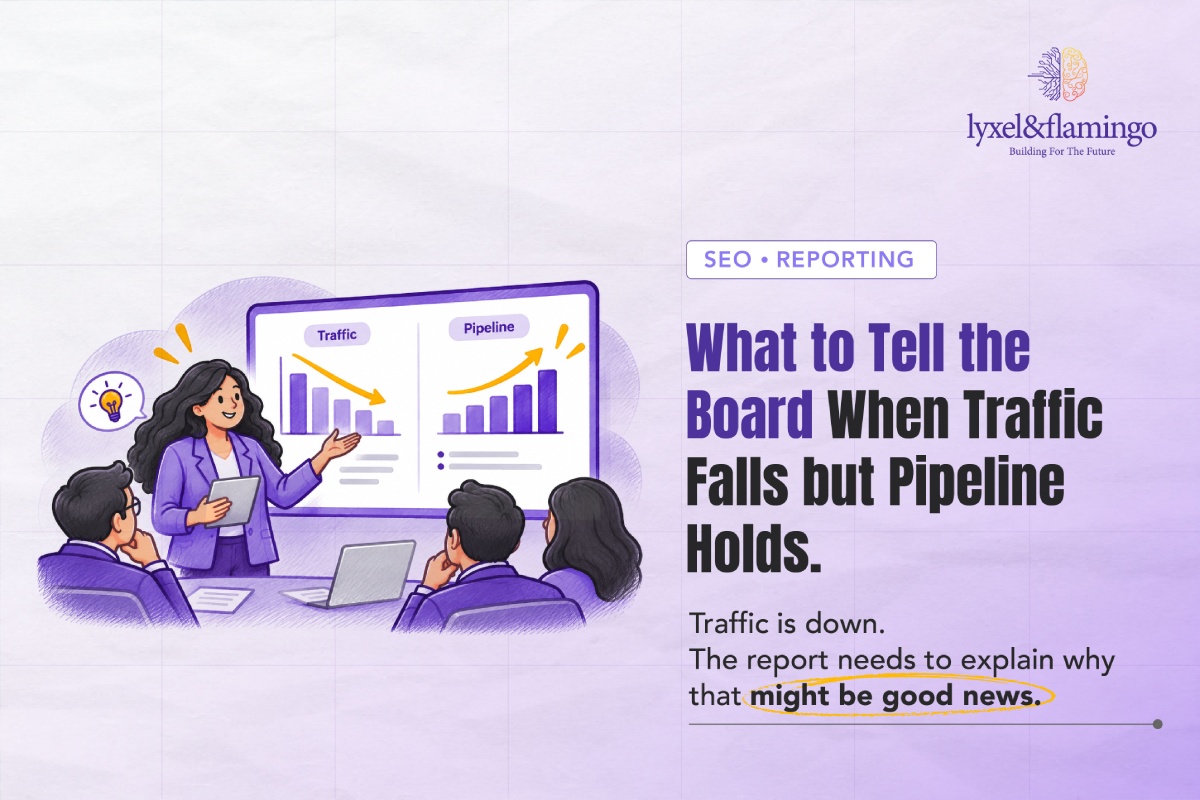
A shift that size eventually shows up on a dashboard as a traffic and pipeline story leadership wants explained, which is its own reporting problem: see what to tell the board when traffic falls but pipeline holds.
What Actually Gets a Vendor Cited
AI answer engines cite pages that answer a specific question clearly, carry credible signals of expertise, and are structured for extraction rather than persuasion. A homepage full of brand language rarely gets pulled into an answer. A page that plainly states what the company does, who it serves, and what makes its approach different, often does.
This is the same discipline that wins organic rank, applied to a different surface. Structured information architecture, clear service pages mapped to buyer questions, and visible proof of outcomes all do double duty: they are what a human researcher scans for, and what an AI system extracts from when it assembles an answer.
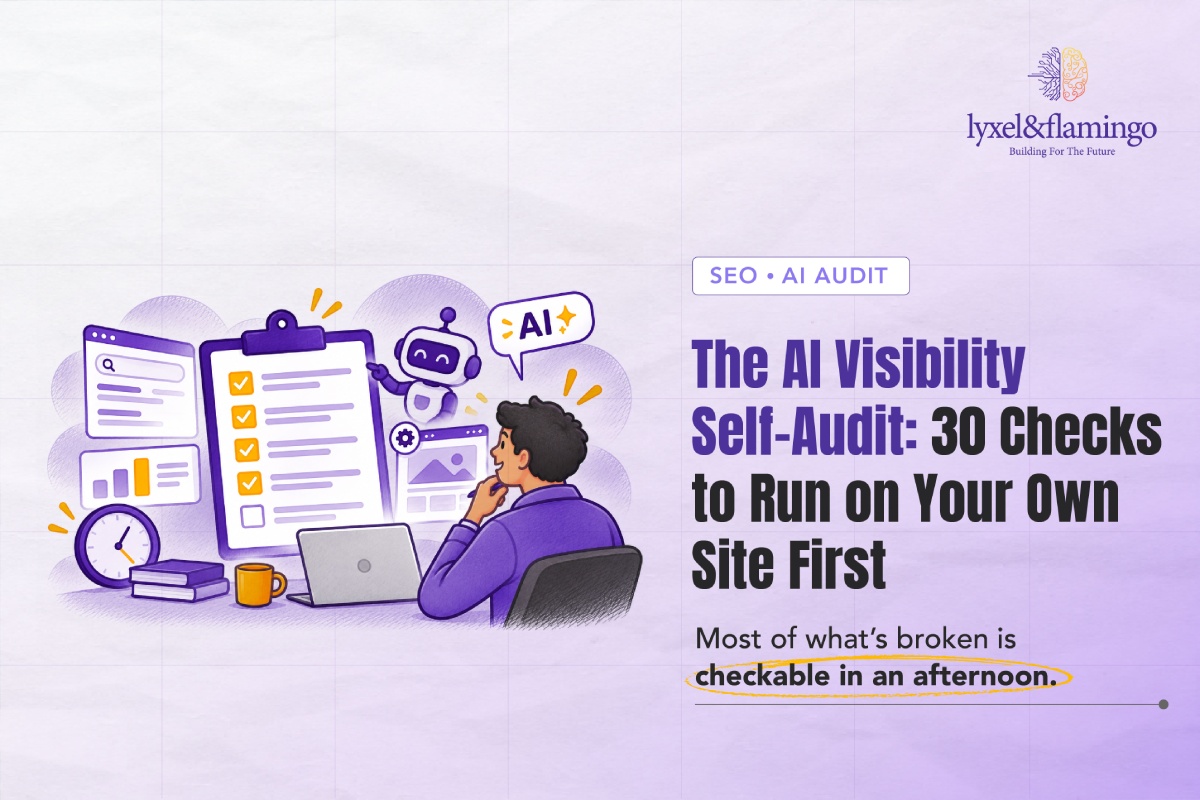
Checking a site against this structure systematically, rather than by gut feeling, is exactly what the AI visibility self-audit walks through.
The AI-Influenced Shortlist Model: Four Moments Where GenAI Decides Who Gets in the Room
The Framework Explained
- Category research:
This is the moment a category gets defined before a single sales conversation happens, and most vendors never see it occur. A buyer with a vague, half-formed need types a prompt, not a brand name, into an AI chatbot, and the handful of vendors it names become the only ones that exist as far as that buyer is concerned for the next several weeks. There is no impression, no click, no analytics event a vendor can check to know this moment happened to them, and that invisibility is exactly what makes it dangerous. A vendor with strong SEO rankings and weak, unstructured service pages can still watch a competitor with a fraction of the domain authority get named instead, simply because that competitor’s content answered the buyer’s actual question in language an AI system could lift cleanly. - Day-one shortlist formation:
The shortlist a buyer forms in the first hour of research is, with very few exceptions, the shortlist that wins. 6sense’s 95% figure should reframe how every B2B marketing team thinks about pipeline: the deal is not lost in week six of a stalled procurement cycle, it is lost in the first ten minutes, when a name simply never appeared. A vendor that treats AI visibility as a nice-to-have, something to revisit once the website redesign budget frees up, is accepting a structural ceiling on new business that no amount of later-stage sales effort reliably overcomes. Marketing leaders who still measure success by rankings and impressions are, without realising it, measuring a stage of the funnel that increasingly happens somewhere they cannot see. - Committee validation:
A buying committee is not one researcher; it is four to eleven stakeholders (Gartner), each running their own version of the same query at a different point in the cycle, and each one is a fresh roll of the dice. A vendor that gets cited inconsistently, present in one answer, absent from the next, does not read as unlucky to a committee. It reads as unproven, or worse, as a name nobody quite trusts enough to keep recommending. Consistency of citation across engines and across repeated queries is therefore not a vanity metric; it is the difference between a shortlist name that survives four separate validation checks and one that quietly disappears from the conversation by the third. - Vendor selection:
This is the stage every CRM report actually measures, and it is also the stage where the real damage from a missed AI citation becomes undeniable and unrecoverable within that cycle. A sales rep chasing a lead that never made the AI-generated shortlist is not selling into curiosity; they are selling into scepticism, working uphill against a mental model the buyer built weeks earlier without any vendor in the room to correct it. The fix cannot live in sales enablement. It has to live upstream, in whether the vendor’s own content gave an AI system a reason to say their name first.
What a Shortlist-Ready Rebuild Looks Like
Pierag Consulting, a B2B global advisory firm spanning assurance, business risk, technology risk, ESG and transaction advisory across India and international markets, needed a website that could carry a buying committee through a genuinely complex service catalogue without losing them. L&F rebuilt its information architecture around business outcomes rather than internal service names, improved discoverability across every technical vertical the firm operates in, and designed the site to read as credible to an enterprise audience evaluating multiple advisory firms at once. The same structural discipline, organised around what a buyer needs to find and validate quickly, that both a research-stage committee and an AI answer engine reward.
Our SEO and GEO services team builds B2B content architecture designed to be cited by AI systems, not just crawled by them.
Key Takeaways
- GenAI chatbots are now the single biggest influence on B2B vendor shortlists at 17.1%, ahead of the vendor’s own website at 12.8% (G2, 2025).
- 95% of eventual deal winners were on the buyer’s shortlist from day one of active evaluation (6sense); late additions close at a far lower rate.
- A B2B buying committee of four to eleven stakeholders each runs their own version of the research query, so inconsistent AI citation compounds across the whole committee, not just one researcher.
- The Pierag Consulting rebuild shows what shortlist-ready content architecture looks like: information organised around business outcomes and buyer questions, not internal service names.
- This shift happens upstream of every sales conversation a CRM can track, which is exactly why most B2B teams are still measuring the wrong stage of their own funnel.
The CXO Takeaway
For a B2B CXO, this reframes a question pipeline reviews rarely ask. Not how many leads marketing generated, but how many deals never had a chance to enter the pipeline because an AI system never said the company’s name. That number does not show up in a CRM, a rankings report, or a media dashboard, because it represents a conversation that was never started. The vendors that treat AI-visible content as core infrastructure, not a marketing side project, are protecting a stage of the funnel their competitors cannot even see is being lost.
The Question to Sit With
The question worth sitting with is not how your website ranks. It is whether an AI chatbot would name your company at all to a buyer who has never heard of you, researching your category for the first time this week.
Closing
Lyxel&Flamingo builds B2B content architecture engineered for AI-era shortlist inclusion, not just organic rank. Want a clear read on whether your company would make the cut today? Start that conversation with L&F →
Frequently Asked Questions
Traditional SEO optimises for a ranked list of links a human scans. AI shortlist visibility optimises for being one of three to five names an AI system extracts and states directly. The underlying signals overlap heavily; the format an AI system rewards, clear, structured, directly answerable content, is still stricter than what ranks well in a standard search result.
Often more easily than in traditional search rankings, because AI answer engines weigh specificity and clarity heavily. A smaller vendor with sharply written, well-structured service pages that directly answer a buyer's question can out-cite a larger competitor whose site is optimised mainly for brand impressions.
There is no fixed timeline, since it depends on how AI systems have already indexed and weighted the existing site. Structural fixes, clearer service pages, FAQ content, schema, tend to show measurable citation improvement within a few months rather than weeks.
No. The two run on largely the same foundation, technical health, content depth, credible signals, and should be built together rather than treated as separate workstreams.
Rewriting core service pages to directly answer the specific questions a buying committee is actually asking, in plain, specific language, rather than describing capabilities in internal or brand-driven terms.