
What this blog covers
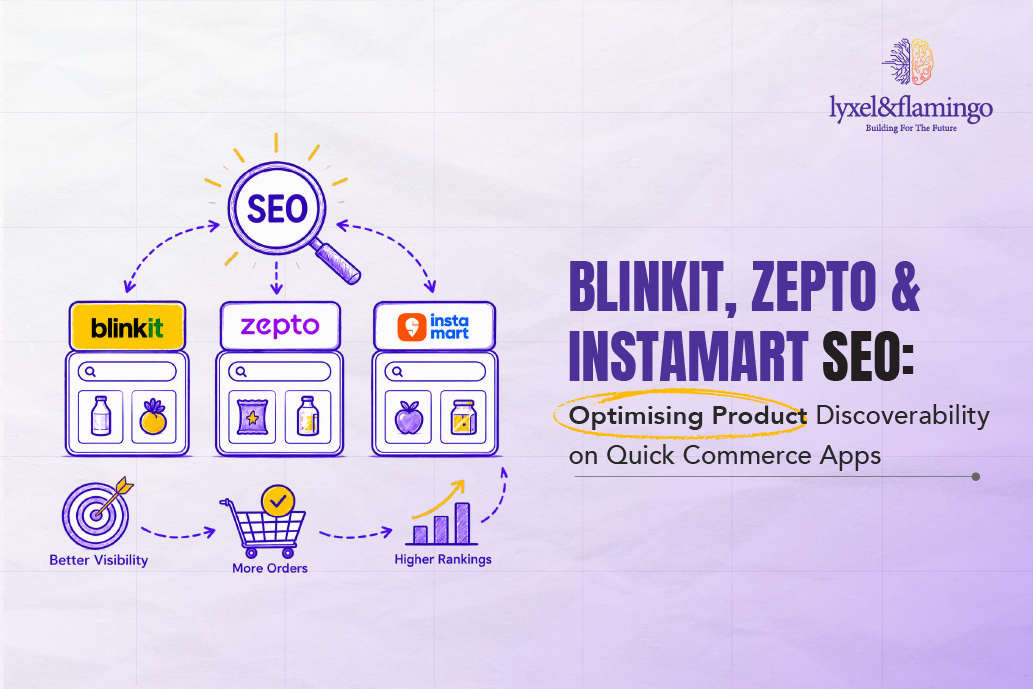
A Blinkit dark store is smaller than the aisle you are picturing. It holds a fraction of what a full marketplace lists, which means every product on it has earned its place by pushing another one off. Winning here is less about being present and more about being chosen for a shelf that was never going to fit everyone. This is a practical look at how brands earn that place, stay on it, and get found once they do.
Table of Contents
The shelf that fits in a backpack
The picture in most people’s heads when they think of a delivery warehouse is wrong for Blinkit. There is no endless aisle. A dark store serving a neighbourhood is a compact space holding a curated set of products chosen to sell fast to the people nearby, and the range it carries is a sliver of what a shopper could find on a full marketplace. That constraint is not a limitation to be worked around. It is the defining fact of the platform, and it decides almost everything about how a brand grows here.
When the shelf is finite, every listing is competing not just for a sale but for the right to occupy space at all. A product that sells slowly is taking up room that a faster seller could use, and the system notices. So the question a brand faces on Blinkit is sharper than “are we available.” It is “have we earned a place on a shelf that was built to hold fewer things than everyone wants to put on it.” That is a different discipline, and brands that carry their full-marketplace habits into it tend to spread themselves thin across too many products and win with none.
What the ten-minute shelf actually is
A dark store is a small, unmanned warehouse placed inside a residential area, stocked to serve orders from the immediate neighbourhood within roughly ten minutes. Because its physical space is limited, it holds a deliberately narrow assortment, the products expected to sell quickly to local shoppers. The ten-minute shelf, then, is not a catalogue a brand chooses to sit on. It is a rationed, hyperlocal selection the platform curates continuously, dropping products that underperform and promoting those that move. Understanding the shelf as rationed rather than open is the starting point for everything that follows.
Earning a place in a catalogue you cannot fully list
The instinct for a brand arriving on Blinkit is to list widely, the way it might on a larger marketplace, put the whole range up and let shoppers sort it out. On a finite shelf, that instinct works against the brand. Spreading demand thinly across many products means each one sells slowly, and slow sellers are exactly what the system deprioritises. The brands that grow here tend to do the opposite: they identify the handful of products that suit an immediate, ten-minute purchase and concentrate their effort behind those, letting concentrated demand earn each one a durable place.
Choosing those hero products is a judgement about the occasion, not just the bestseller list. Quick commerce is bought in small, immediate baskets, so the right products are the ones that fit that moment, the pack a shopper wants now rather than the bulk size they would plan for. The wider truth behind this is that the category itself is broadening: Bain & Company reports that fifteen to twenty per cent of quick commerce order value in India now comes from beyond grocery, into general merchandise, electronics and apparel. The same assortment discipline that scales a brand across Amazon, Flipkart and Myntra has to be sharpened further here, because the shelf is smaller and less forgiving.
Staying in stock is the campaign
On a marketplace with deep, central inventory, running out of a product is a problem to be fixed. On Blinkit, going out of stock in a particular dark store does something quieter and more costly, it removes the brand from the shelf for every shopper served by that store, and it tells the ranking system that the product is not selling, because a product that is not on the shelf cannot sell. The absence compounds. A brand can lose its place through a stockout it never sees, in a neighbourhood it was doing well in, and only notice when the numbers soften.
This is why availability on quick commerce behaves less like operations and more like a live campaign. Staying in stock, store by store, is the thing that protects the ranking a brand has earned, and the thing that keeps demand signals flowing to the algorithm. It asks for attention at a level of granularity that central-warehouse thinking does not prepare a brand for, not “are we in stock nationally” but “are we in stock in this store, in this pocket of the city, at the hour people there are ordering.” Held tactically, availability is one of the levers a brand most directly controls. Left to chance, it is where hard-won visibility quietly leaks away.
Being found in the first few results
When a shopper opens Blinkit and types, they are shown a short, ranked list drawn from what the nearby store holds. There is no patient scrolling through pages the way there might be on a larger marketplace; the decision happens near the top, quickly. Earning a place in those first results comes down to a few things a brand can influence: a product title and listing that match the words people actually use when they search, imagery clear enough to be read on a small screen in a hurry, a competitive and legible price, and the sales velocity that signals to the system this product deserves to be seen.
Advertising sits on top of this rather than replacing it. Sponsored placements can buy visibility a brand has not yet earned organically, and they matter, particularly for a newer product building its early velocity. The mechanics of running those placements well, the funnel from awareness to conversion across Blinkit, Zepto and Instamart, are worth their own detailed treatment, and the broader shift in retail media sits underneath all of it. What matters at the level of this article is the order of operations: the listing and the availability come first, because paid visibility that sends a shopper to an out-of-stock or poorly presented product is money spent to reveal a weakness.
The Shelf Fit Framework
For brand teams who want a way to hold all of this together, it helps to think of four levers that decide whether a product wins its place on the ten-minute shelf. We call it Shelf Fit, and the levers stack in this order.
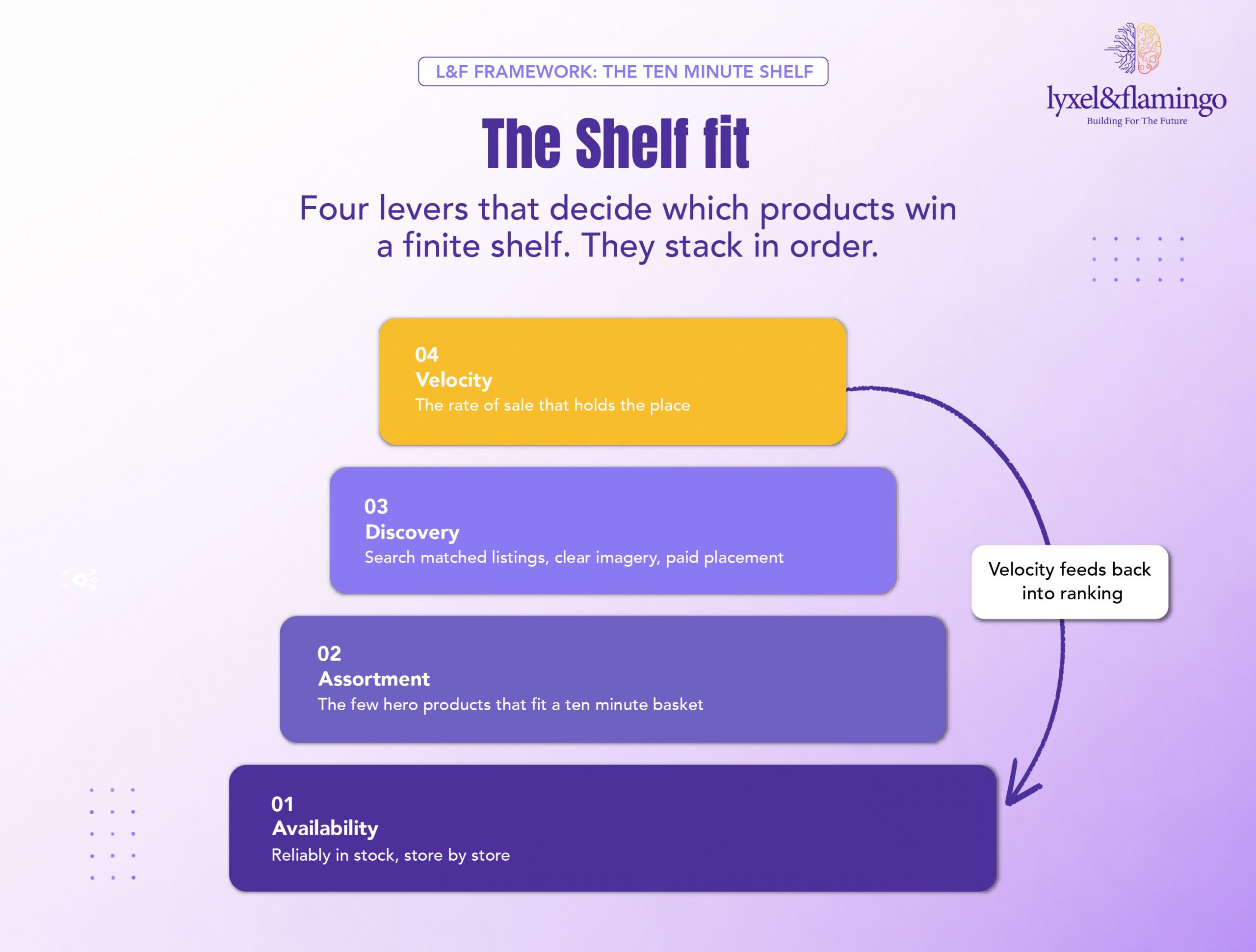
Availability is the foundation, being reliably in stock at the dark-store level, because nothing else counts if the product is not on the shelf. Assortment is next, choosing the few hero products that suit an immediate purchase, rather than listing the full range thinly. Discovery follows, the listing quality, search-matched titles, clear imagery and pricing, and the paid placements that make a product findable in the first results. And Velocity is the outcome that feeds back into the top, the rate of sale that tells the system a product deserves its place and should keep it.
The value of the stack is in the order. A brand that pours effort into discovery while its availability is patchy is building on sand. One that fixes availability and assortment first gives every rupee spent on discovery something solid to work with, and the velocity it earns protects the whole position. Shelf Fit is less a checklist than a sequence, and the sequence is where brands usually go wrong.
A challenger brand on the Blinkit shelf
The pattern shows up in the work. Soulflower, a clean beauty brand pushing into a hair-oil category long held by a handful of established names, is a useful picture of Shelf Fit held well on Blinkit. Its problem was the one every challenger meets here, the cost of generic-keyword visibility was high, and holding a place on the first scroll through the day was hard. By concentrating on the right hero products and protecting their visibility rather than spreading thin, the brand grew its share of voice by 23%, past its own festive peak, and lifted units sold by 21% while GMV rose 27%, higher-value baskets, not merely more of them. New customer acquisition grew by 40%, and the brand’s share of the category rose by 12%. Presence, held with discipline, became velocity, and velocity held the shelf.
Reading whether it is working
The measures that matter on Blinkit are not the ones a brand might carry over from a larger marketplace. Vanity sits in raw impressions; the signal sits in the share of relevant searches where the brand appears in the top results, the in-stock rate across the stores that matter, the rate at which a viewed product converts, and the velocity that holds a product’s place over time. Read together, those tell a brand whether its Shelf Fit is sound or whether one lever is quietly dragging the rest down, a strong listing undone by stockouts, say, or good availability wasted on products that were never right for the ten-minute basket.
The reframe worth carrying out of all this is that winning on Blinkit is not a listing exercise a brand completes once. It is a position a brand holds, actively, on a shelf that is always re-deciding who belongs there. The brands that treat it that way, as a place that rewards discipline rather than presence, are the ones that stay near the top while others cycle on and off it. So the question to sit with is not whether your products are on Blinkit. It is whether, on a shelf built to hold fewer things than everyone wants space for, yours have earned the right to stay.
Closing
Holding a place on the ten-minute shelf is a discipline, and it is one Lyxel&Flamingo runs alongside brand teams every day, from choosing the right hero assortment to protecting availability and earning visibility in the results that convert. If you would like a clear read on where your brand stands on Blinkit today, and where the shelf is slipping, our third-party marketplace team can audit your presence and show you the levers worth pulling first. Start that conversation with us whenever you are ready.
Frequently Asked Questions
It assembles a short, ranked list in real time from what the nearby dark store holds, how well a listing matches the search, and how quickly the product sells. On Blinkit, visibility is earned continuously through availability and sales velocity, not fixed through a one-time placement.
Far fewer than on a full marketplace, because dark stores are sized for speed rather than breadth. A Blinkit dark store carries only a curated fraction of a full marketplace’s catalogue, so assortment must be chosen, not maximised.
A dark store is a small, unmanned neighbourhood warehouse stocked to fulfil local orders within about ten minutes. Dark stores hold a deliberately narrow, hyperlocal assortment chosen to sell quickly to nearby shoppers.
By matching listings to real search terms, keeping products in stock at store level, pricing legibly, and using paid placements to build early velocity. Sales velocity and in-stock reliability are the strongest levers of organic visibility on Blinkit.
Share of relevant searches in the top results, store-level in-stock rate, conversion on viewed products, and sustained velocity, not raw impressions. In-stock rate at the dark-store level is a leading indicator of ranking on Blinkit, because a product off the shelf cannot sell or rank.