
Table of Contents
- What Is a Marketing Operating Model?
- Why does the Campaign Model Break at Scale?
- The Mechanism: How Systems Work Differently From Campaigns
- The Evidence: What the Data Is Actually Saying
- The Lyxel&Flamingo Framework: The Enterprise Systems Stack
- What This Looks Like When It's Working
- Five Things to Do This Quarter
- Thinking About This for Your Organisation?
Here’s what it covers
Enterprise marketing teams are not facing challenges because campaign quality has suddenly declined. The bigger issue sits underneath everything, inside the operating model itself. Most brands still run marketing in disconnected efforts while customers move continuously across platforms, devices, and channels every day. Teams remain divided by geography, channel, and agency structure, so learning rarely flows smoothly between campaigns. Budgets increase, activity increases too, but performance stays flat more often than companies admit publicly.
The article explains why campaign-based marketing breaks once enterprise scale becomes too large and messy. Campaigns restart work repeatedly. Teams rebuild assets, approvals, reporting structures, and coordination almost every quarter. Data arrives late, mostly as reports nobody uses later. That creates waste quietly across media, production, and decision-making.
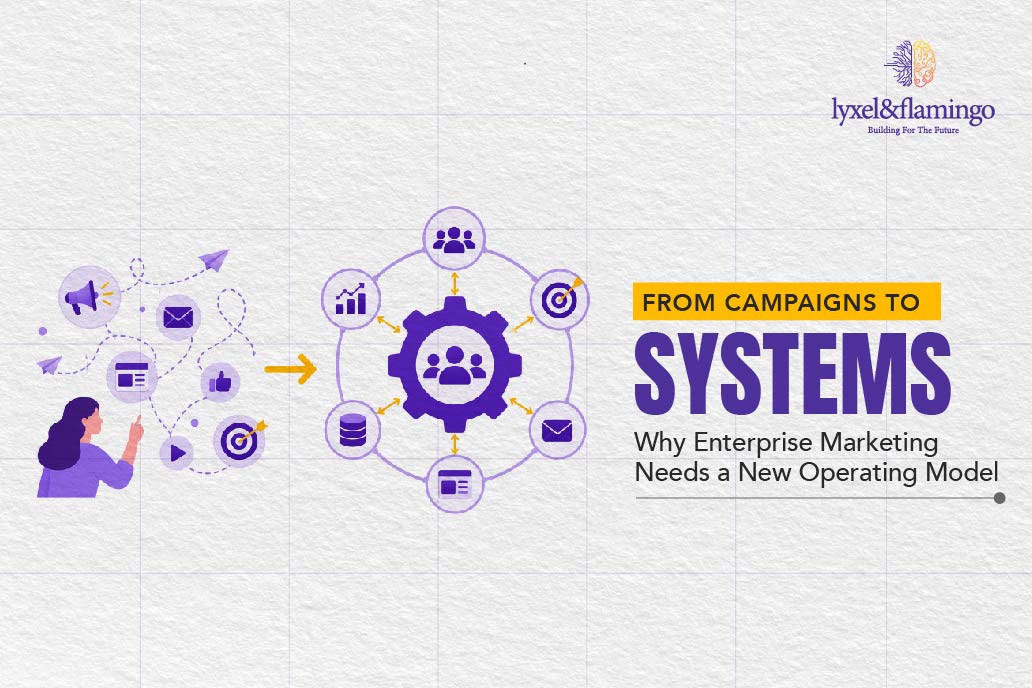
A systems-based marketing model works differently. Instead of isolated campaigns, brands build a continuous infrastructure that connects audience signals, creative production, automation, and learning loops. The article breaks this into three layers: Signal Infrastructure, Orchestration Engine, and Learning Loop. Together, these layers help brands react faster, reduce production waste, and improve marketing ROI over time.
The core argument stays simple, though. Enterprise brands no longer need louder campaigns. They need a structure that keeps marketing connected while everything keeps moving constantly.
Most big brands are not doing weak marketing at all. The money exists, channels too, and teams are mostly capable enough. The problem starts later, when their whole marketing operating model was never built to keep everything connected properly, so campaigns keep moving in different directions together.
That gap costs brands more than they admit publicly sometimes. Most CMOs already see the issue clearly, but the internal language around it still feels unfinished. Campaign-based marketing worked earlier because marketing itself moved more slowly and stayed contained enough. You planned quarterly pushes, launched them, checked reports later, and then repeated the same cycle again. That structure held for years, somehow. Then platforms multiplied fast, tools kept stacking endlessly, and customer journeys became messy across every channel. Enterprise brands now operate everywhere at once, while audiences expect connected experiences every single time. Campaigns were never really designed for this kind of nonstop movement. So friction builds quietly after every launch, and nobody addresses it directly enough.
What you’re left with is structural waste dressed up as creative output. A marketing technology stack that sits at half capacity. A full funnel marketing strategy that holds up in the deck but collapses when Q3 budget pressure arrives. Teams are spending more hours on campaign coordination than on the actual customer problem they were hired to solve.
The thing enterprise marketing needs is not a better campaign. It needs a better operating model, one that is built around continuity, orchestration, and returns that compound instead of reset.
What Is a Marketing Operating Model?
A marketing operating model is the structural design that determines how a marketing organisation actually gets things done. Not how it presents its approach in the brand guidelines, but how decisions are actually made, how resources move, how technology gets used, and how what happened last quarter feeds into what happens next quarter.
It decides who handles what work, how ideas move into execution, and whether performance insights actually return into future planning properly. Agencies, internal teams, platforms, everybody touches the process somewhere, but most brands still connect them badly. The operating model is not just reporting lines or another stack of software tools either. Those things come later. The real model sits underneath everything quietly and decides if marketing works together or keeps breaking apart repeatedly. Strong enterprise brands build systems that improve after every campaign cycle. Weak ones restart from zero again and again. Same effort, same spending mostly, but weaker outcomes every year. That is the actual divide now. Not creativity. Not budgets. The structure underneath it all.
Why does the Campaign Model Break at Scale?
Enterprise marketing teams are carrying bigger budgets now, but still feel overloaded almost every quarter. The old campaign model was built for a slower market, not this messy multi-channel environment that brands operate in today. Most companies keep patching it because rebuilding the structure feels riskier internally. In practice, the dysfunction shows up everywhere during execution. Different teams follow slightly different briefs, agency partners work on separate timelines, and reporting never fully lines up. Campaigns launch anyway, and results arrive later, but nobody clearly understands what actually moved performance properly. Learning gets lost between quarters again and again. Then the same cycle repeats with fresh budgets and identical friction. This is not a talent issue, but the structure creates the bottleneck now.
The campaign model creates media operations waste repeatedly because every launch starts almost from zero again. Teams rebuild briefs, approvals, assets, and agency coordination even when similar work happened recently. Performance learnings rarely move forward properly between campaigns, either. Most insights stay trapped inside presentations that nobody revisits later. Channel teams also optimise separately, chasing their own numbers while the broader customer journey keeps getting fragmented slowly across the organisation.
Enterprise brands running a campaign model are paying full price for every single marketing activation, and capturing only a fraction of the compounding value that a system-based model would generate over the same period.
Research shows that brands which shift from fragmented campaign activation to a properly integrated full-funnel marketing approach can achieve a 15-20% lift in marketing ROI through media reallocation and test-and-learn discipline alone. That lift doesn’t come from a better creative idea or a bigger budget. It comes from a model that makes continuity the default, not the exception.
The Mechanism: How Systems Work Differently From Campaigns
The difference between a campaign-based model and a system-based model is not a matter of degree. It’s a different architecture producing different results through a fundamentally different logic.
A campaign has a start date, a brief, a media plan, and an end date. A marketing system has standing data flows, modular creative logic, trigger-based activations, and feedback loops that run whether or not anyone has launched something new that week.
- A campaign asks: Did this work?
- A system asks: what should we do next, and what does the data say about why?
Different question – different infrastructure is required to answer it.
The mechanism at the centre of system-based marketing is what we call enterprise campaign orchestration. It’s the ability to deploy audience signals, creative variants, budget parameters, and performance feedback across all active channels at the same time, through a unified marketing automation platform, without rebuilding the machine every time something changes in the market or the media environment.
A campaign works like a planned set play, basically. You prepare it carefully, launch it, and then study the results once everything is already finished.
Systems react while things are still moving. Most enterprise brands keep improving campaigns repeatedly, but never build the structure needed for real-time adjustment across teams and channels.
Three operating principles separate system-based marketing from campaign-based marketing, and they’re worth naming clearly:
- Continuity over bursts. System-based models run an always-on presence across full funnel stages. Campaigns are layered on top of that, not used as the only vehicle. This matters because the audience reacquisition cost between campaign flights is enormous, and most brands have never measured it because they’ve never had visibility into what happens in the gaps.
- Data as working infrastructure, not end-of-quarter reporting. In a campaign model, data shows up when the campaign ends, as a document. In a system model, data flows into decisions continuously at the moment it’s generated. This is what makes real-time full funnel marketing optimisation possible, rather than something you plan to do better next time.
- Modular production at scale. System-based marketing requires a marketing technology stack that handles creative modularity. Hundreds of asset variations, tested and scaled, without proportional increases in production cost or time. This is where marketing operations tools stop being support functions and start being an actual competitive infrastructure.
Brands that build this don’t run better campaigns. They run a different model, one where media operations become a continuous, data-informed process rather than a periodic agency exercise that starts fresh each quarter.
The Evidence: What the Data Is Actually Saying
Many organisations have already invested heavily in platforms, automation tools, and data systems. Yet better technology alone has not solved execution and coordination challenges. The research on enterprise marketing in 2025 and 2026 is unusually detailed on this. Investment in marketing technology keeps growing. The operating models needed to make that technology work keep lagging. That gap is getting wider, not narrower.
- A survey found that enterprise teams are using only 49% of their marketing technology stack. Martech already accounts for nearly 22% of total marketing spend. So enterprise brands are paying full price for infrastructure they’re operating at half capacity, not because the tools don’t work, but because the operating model around them hasn’t caught up. 15% of organisations qualify as high performers; the ones that actually meet strategic goals and show positive ROI from their technology investments.
- Rewiring Martech: From Cost Centre to Growth Engine, pulled from a survey of more than 200 senior marketing and technology leaders at companies with over $500 million in revenue, found that the global martech market was valued at $131 billion and is growing at 13.3% CAGR. Many enterprise marketers still automate old campaign processes only, instead of building systems that improve returns continuously over longer periods.
- The CMO Survey (2026) found that AI and machine learning now drives 24.2% of all marketing activities, nearly double the 13.1% it powered in 2024. Marketing leaders project that the figure reaches 55.9% within three years.
But here’s the problem – only 6% of organisations are actually extracting meaningful bottom-line value from those investments. The capability exists. The model to operationalise it does not. - A Gartner survey of 174 senior marketing leaders from September 2025 found that 50% of CMOs identified short-term campaign demands blocking long-term strategic planning as their most pressing challenge. 63% cited budget and resource constraints as the top barrier. This is not primarily a budget problem. Campaign models keep CMOs locked in short cycles even when the tools, intent, and budget for system-building are all present.
Enterprise brands that shift to a system-based operating model don’t just improve how their campaigns perform. They permanently change the economics of how marketing investment grows over time.
The Lyxel&Flamingo Framework: The Enterprise Systems Stack
Across our work in Lyxel&Flamingo Growth Marketing practice, we have built enterprise marketing strategy transformations for mid-to-large brands in FMCG, BFSI, D2C, and QSR. The patterns across those engagements are consistent enough that we’ve stopped treating each one as a unique problem and started working from a named model.
We call it the Enterprise Systems Stack. It uses a three-layer structure that helps marketing teams move beyond campaign-heavy operations gradually. Results start appearing before the entire transformation fully finishes, which matters a lot because most enterprise change programmes usually slow down once rebuilding becomes too large internally.
Layer 1: Signal Infrastructure
What it is: The foundational data layer that pulls together audience signals, first-party data, CRM records, and real-time behavioural data into a single, accessible system that marketing decisions can actually run on.
What most enterprise teams get wrong here: Many teams rely heavily on CRM data for reporting decisions. But the system only captures activity after the conversion has already happened. Signal infrastructure needs to capture what’s happening at the consideration and intent stages, before a customer has identified themselves, and feed that into both marketing automation platform logic and media buying in real time. Most brands are making audience decisions based on who has already bought, not based on who is actively deciding.
What to build: A customer data layer pulls signals from apps, websites, media channels, and owned platforms together without constant manual handling between systems. For retail and BFSI brands, this changes acquisition economics pretty fast. Teams stop rebuilding audiences every campaign cycle and instead work with customer cohorts that keep improving continuously over time.
Layer 2: Orchestration Engine
What it is: The process and platform architecture that coordinates messaging, creative, budget, and channel activation across all active marketing programmes at once, not sequentially, not independently, but in coordination.
What most enterprise teams get wrong here: Media operations decisions get made by channel teams in isolation, each team optimising for its own KPI set. The result is a full funnel marketing structure that exists on paper but doesn’t function in practice. The top of the funnel builds audiences that the bottom of the funnel can’t efficiently activate, because nothing connects them. The upper funnel team doesn’t know what the lower funnel team needs, and vice versa.
What to build: A unified marketing operations tools framework, usually anchored to a marketing automation platform, that governs how a campaign brief becomes live activations across channels, how budget moves dynamically based on real-time signals, and how creative variants get tested and scaled without triggering a full production cycle. This is enterprise campaign orchestration in practice: running ten active programmes with the operational discipline of one.
Layer 3: Learning Loop
What it is: The measurement and feedback architecture that makes sure every campaign activation produces structured learning that improves the next decision, systematically and at scale, not informally in a slide deck.
What most enterprise teams get wrong here: Post-campaign reporting gets produced as a backwards-looking document. It tells you what happened. It doesn’t connect those findings to what should change next. The learning is informal, it lives in a presentation, gets discussed in one meeting, and then mostly disappears as the team moves on to the next brief.
What to build: A structured performance taxonomy that tags every creative execution, audience cohort, message, and channel with attributes that can be analysed consistently across campaigns. This makes pattern recognition something the system does, not something a smart analyst has to do manually every quarter. In our work with brands operating at marketing operations at scale, the Learning Loop is the most under-invested layer of the three. It’s also the one with the most immediate impact, because it converts campaign spend that’s already happened into forward-looking intelligence.
The Enterprise Systems Stack is not just another technology buying exercise for enterprise marketing teams. The architecture needs to come first always, while platforms should fit inside that structure later. Brands that reverse this sequence usually keep increasing software spend every year, but still struggle to improve actual marketing performance properly.
What This Looks Like When It’s Working
One of the brands we worked with brought us a specific problem.
- They were running more than 60 individual campaigns annually across six product categories.
- Budgets have increased year on year.
- The cost per qualified lead was going up anyway.
- Brand equity scores had been flat for two years.
The brief was not “make our campaigns better.” It was “understand why additional budget often delivers similar results instead of creating meaningful growth.”
The issue was structural from the beginning, not really a talent or execution problem internally. Different marketing channels are operated separately through different agency partners, timelines, and disconnected success metrics. Nobody had a complete funnel view across the organisation. Learning stayed trapped inside channels, too, so teams rarely influenced each other’s future decisions properly.
We rebuilt the operating model across three phases over eight months.
- Signal Infrastructure: First-party data from retail and digital touchpoints was consolidated into a single CDP, building unified audience cohorts that could be activated consistently across channels regardless of which team or agency was running them.
- Orchestration Engine: A campaign architecture was built that let creative variants be produced once and deployed across six channels with channel-specific formatting. Production timelines dropped by 40%. Creative costs fell by 28%. The agency partners stopped rebuilding assets from scratch every cycle.
- Learning Loop: A performance taxonomy was implemented that tagged every creative execution by message theme, audience cohort, and funnel stage. For the first time, the brand could look across campaigns and see patterns, which messages worked in which contexts, which audiences converted across channels, and where the funnel was leaking consistently.
Five Things to Do This Quarter
Map the Operating Model Before Writing Your Next Campaign Brief
Before anyone briefs the next campaign, map what that campaign actually relies on to function.
- Who owns each decision point?
- How does data move between teams?
- How do learnings get captured at the end?
- How are cross-channel allocation decisions made during the flight?
If you cannot describe that map clearly in a single document, the campaign brief is solving the wrong problem.
Specifically, document the handoff points between your agency partners, your internal channel teams, and your technology platforms. Every gap in that map represents a structural cost, and it’s a cost you pay every campaign cycle again.
Audit Martech Utilisation Before Approving New Tool Purchases
Run a marketing technology stack utilisation audit.
- What percentage of each platform’s features are being used in active programmes? Data shows enterprise teams using only 49% of their stack on average. That means the tools to build a better operating model are probably already owned, and the restructuring hasn’t happened yet.
Take the three most underutilised platforms. For each one, define a single specific use case, with a named owner and a 90-day metric that the current campaign model is actively blocking. Start there before buying anything new.
Build One Always-On Programme Before Adding Campaign Budget
Most enterprise brands leave empty spaces between campaign cycles without noticing the long-term cost clearly enough. Pick one funnel stage, usually consideration, where nothing runs consistently today and build a smaller always-on programme there. Budget matters less here. The real value comes from continuity and ongoing audience behaviour data. Campaign bursts alone cannot capture what customers actually do during inactive periods between launches. That missing information changes how future marketing decisions should be made.
Change the Post-Campaign Report Into a Learning Document
Replace your standard post-campaign report format with a structured learning document. The format change is not cosmetic. A report tells you what happened. A learning document forces the question of what should change next, and requires evidence for the answer.
Three mandatory fields:
- What the data proves (with specific numbers),
- What assumption does it disprove (the one the brief was built on that didn’t hold), and
- One specific change to marketing operations tools, logic or creative brief that this learning justifies.
If the document cannot fill all three fields, the campaign didn’t generate a learning, it generated a result. Those are not the same thing.
Give One Senior Leader Accountability for the Full Funnel
Most enterprise marketing teams split funnel ownership across separate departments with different priorities and reporting structures. Brand teams chase awareness metrics while performance teams focus on conversion numbers only. Shared budgets do not fix that disconnect. One senior leader should own the relationship between brand spend and revenue outcome, with visibility across every channel continuously.
This is the structural fix that produces the most immediate improvement in enterprise marketing strategy performance, because it forces the integration that the campaign model has been actively preventing.
Thinking About This for Your Organisation?
If your enterprise marketing strategy feels like it’s generating more activity and fewer returns, the answer is probably not a better campaign. L&F’s Growth Marketing practice works with mid-to-large brands to design and build systems-based marketing operating models, from signal infrastructure through to orchestration engines and learning loops that function at media operations scale.
Related articles worth reading:
Frequently Asked Questions
A marketing operating model shapes how teams make decisions, share resources, and execute work across markets. It connects people, processes, and technology in practical ways. When that foundation works well, marketing investments build value over time instead of restarting from scratch with every new campaign cycle.
Every campaign forces enterprise teams to rebuild operations almost from scratch. Briefs, approvals, coordination, and production workflows restart each cycle repeatedly. The learning problem runs deeper, too. Campaigns generate backwards-looking reports, not ongoing intelligence. So brands keep spending heavily on marketing activity while retaining very little long-term operational value afterwards.
The transition happens through three connected layers, moving one after another across the organisation. First comes a unified audience and data infrastructure. Then, orchestration systems connect programmes. Finally, learning loops that turn campaign performance into future decision-making. Enterprise brands do not need a complete transformation before seeing movement, either. Many start learning within ninety days itself.
Most enterprise marketing teams don’t fail because of bad campaigns. Ownership stays scattered across channels, regions, and teams, so nobody really owns the full result. A systems model needs one operation lead with authority, shared rules, and pressure to improve full-funnel performance together, not isolated KPIs.
Marketing systems improve ROI because teams stop rebuilding everything every quarter. Budgets react to live customer signals, not outdated reports sitting in dashboards. Each campaign leaves usable data behind, too, so future decisions get sharper and less expensive over time.