
What this blog covers
This blog explains why brands can no longer depend only on a few large campaigns to drive growth. Consumer attention now shifts through hundreds of small, intent-driven moments every day, from quick commerce orders and local searches to short-form videos and AI-assisted discovery. Brands that react only during seasonal campaigns miss many of these opportunities. The article explores how changing consumer behaviour, digital platforms, and real-time signals have reshaped modern marketing. It also explains why speed alone is not enough. Brands need consistent messaging, modular creative assets, live data, and clear ownership to respond without losing their identity. The Lyxel & Flamingo Moment Orchestration Stack offers a practical framework for building that capability. The blog concludes with simple actions marketers can take before their next planning cycle, helping them balance major campaigns with an always-on marketing approach that stays relevant throughout the year and supports stronger business growth.
Table of Contents
- What Are Micro-Moments in Marketing?
- The Problem With Planning a Year Around Four Big Campaigns
- Why Mega-Campaigns Are Structurally Losing to Smaller & Faster Signals
- Bigger Budgets Aren't Buying More Relevance
- The Moment Orchestration Stack: Lyxel&Flamingo's Framework for Scaling Relevance
- 5 Things to Do Before Your Next Campaign Planning Cycle
- Conclusion
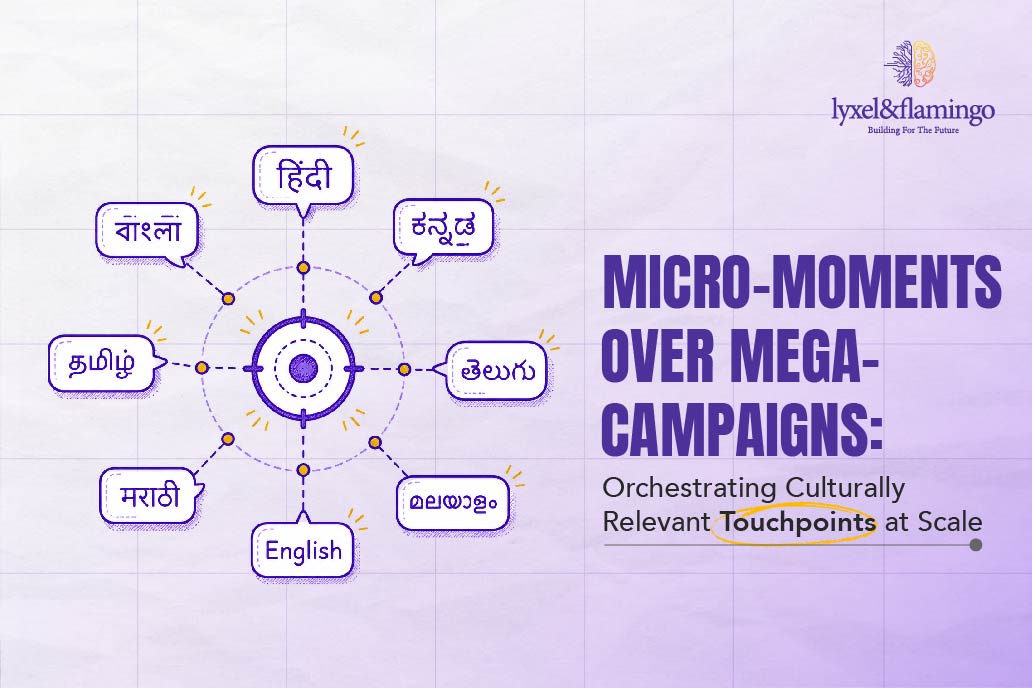
A quarterly hero campaign can still win a Cannes shortlist. It cannot win the hundred small decisions an average Indian consumer makes between breakfast and bedtime, each one closed out in under ten seconds. That’s the real battleground today: a “near me” search typed outside a shop, a ten-minute grocery order placed on autopilot, a reel that gets three seconds before a thumb decides to keep scrolling. Most brands are still staffed and budgeted to win one big moment a quarter. The ones pulling ahead right now have rebuilt marketing as a Full Funnel Marketing system, built to win dozens of these small moments a day, in context, rather than the one moment the media plan was designed around.
Here’s the tension nobody quite says out loud: most Indian marketing budgets are still built backwards from a campaign calendar, not forward from where attention really breaks. A festive hero film gets six weeks of planning and a war room. A same-day quick commerce spike, a trending audio, a sudden cricket moment gets nothing, because no one owns the decision to react inside two hours. Brands generally aren’t losing because their big campaigns are weak. They’re losing the hundred moments in between, and those moments now carry more of the purchase decision than the campaign ever did.
Google named this behaviour micro-moments back in 2015, and the framework has aged better than almost anything else written about mobile marketing that decade. What’s changed by 2026 isn’t the concept, it’s the machinery underneath it. Quick commerce, agentic AI shopping assistants, and algorithmic feeds have compressed the gap between “I want” and “I bought” down to minutes, sometimes seconds, which means a brand’s chance to win a moment is often decided before a human marketer ever sees the trigger.
What Are Micro-Moments in Marketing?
Micro-moments are the brief, intent-driven instances when someone reaches for a phone, or increasingly just talks to an AI assistant, wanting to know something, go somewhere, do something, or buy something, right away. Google’s own framework for consumer micro-moments groups these into four types:
- I-want-to-know,
- I-want-to-go,
- I-want-to-do, and
- I-want-to-buy moments.
Each one is small on its own, but a brand’s visibility across hundreds of them, far more than its performance in any single big campaign, is what builds real market share across a year.
This matters more in 2026 than it did a decade ago, because the moments have multiplied while the response window has shrunk considerably. Quick commerce has turned “I-want-to-buy” into a ten-minute event instead of a next-day one. Search itself has splintered into AI-generated answers that resolve “I-want-to-know” before a website is ever opened. A brand that’s absent from these moments doesn’t just lose a click. It loses the decision entirely, often without ever knowing the moment existed in the first place.
The Problem With Planning a Year Around Four Big Campaigns
Walk into most Indian brand planning meetings in July, right before the festive season, and the conversation is still dominated by the hero film, the media weight behind it, and which celebrity anchors it. That’s not wrong, exactly, but it’s incomplete, and the gap between the two is getting more expensive every year.
India’s advertising market is projected to grow 7.8% in 2025 to roughly $16.01 billion, and within that, “Digital Pure Players” (search, social, short-form video) are growing at 11.4%, nearly double the pace of television, according to IBEF’s coverage of Magna’s 2025 advertising forecast. Social media alone is growing 16.4% and short-form video 12.9%. That spend isn’t shifting into digital because digital produces better films. It’s shifting because digital is where the small, constant, context-triggered moments truly live, and budgets are only now catching up to behaviour instead of leading it.
Wondering which performance channel is scaling faster than the rest of e-commerce right now? Read this blog: Affiliate Marketing 101: Why This Performance-Based Marketing Channel Is Outgrowing E-commerce Itself
Most brands are still organised, staffed, and measured around four to six big moments a year, while their customers are making decisions in four hundred small ones. Fixing that isn’t purely a bigger-budget problem. It’s a structural one: who owns the two-hour reaction window, what gets pre-built so it can ship fast, and whether an always-on marketing strategy is a genuine operating rhythm or just a line item nobody consistently runs.
Why Mega-Campaigns Are Structurally Losing to Smaller & Faster Signals
Real-time marketing at scale depends on systems that were never built to reward a single quarterly burst, and that’s the actual mechanism behind why mega-campaigns keep losing ground. This isn’t a creativity problem so much as a systems one. It’s about how the underlying systems, search, social feeds, marketplaces, now decide what gets shown to whom, and none of them was designed around one big push a quarter.
Take feed ranking and auction-based delivery as an example: Meta’s and Google’s systems optimise creative and audience combinations continuously, testing dozens of variants against live signals rather than running one asset for twelve weeks straight. Running genuinely agile marketing campaigns means shipping thirty small, modular pieces instead of one hero film and three cutdowns, giving the system enough raw material to find what works. A brand that ships one film and three cutdowns hands that system very little to learn from, and the gap compounds daily.
Gartner’s own predictions for 2026 name this shift directly: “voice and visual interfaces will power real-time, passive discovery moments, enabling deeper personalisation,” as ambient, always-listening devices move brand discovery away from explicit searches and into the background of daily life. Discovery is becoming ambient while campaigns are still built as episodes, and that mismatch is the whole problem in one sentence. A real-time marketing strategy only works if someone can act on a live signal within hours, not weeks, which is exactly the reaction window most brand teams still don’t own.
Quick commerce adds a second layer of pressure specific to India. When a category can be fulfilled in ten minutes, the gap between “I want this now” and “it’s at my door” leaves almost no room for a brand to insert a message. A hyper-local marketing strategy isn’t optional in a market moving at that speed. It’s the only kind of strategy built for a fulfilment window that short. This is what contextual marketing in India increasingly means in practice: less about translating a global template, and more about reacting to what’s happening in one specific pin code right now.
Here’s the micro-moments vs mega-campaigns comparison in its simplest form:
| Dimension | Mega-Campaign Model | Micro-Moment Orchestration |
| Planning horizon | Quarterly or seasonal | Continuous, reviewed weekly |
| Creative unit | One hero film plus cutdowns | Modular variants built for context |
| Budget rhythm | Front-loaded bursts | Always-on floor plus burst layers |
| Trigger | Calendar date | Live signal: search, weather, local event, commerce spike |
| Success metric | Reach, awareness lift | Share of relevant moments won |
Bigger Budgets Aren’t Buying More Relevance
- Marketing at scale personalisation can easily backfire without the right approach. Gartner’s research found personalised marketing generates negative experiences for 53% of customers at key journey transitions, who were 3.2 times more likely to regret a purchase, though customers who received active, course-changing personalisation were 2.3 times more likely to complete a purchase with confidence.
- Investment discipline in martech, not just working media, is what separates growth from stagnation. Organisations that invest more in martech than in working media see an 18% greater sales lift and 7% greater revenue growth than those weighted the other way.
- Generative AI is starting to make always-on personalisation commercially provable, not just theoretically nice. One North American retailer combined AI-driven pricing with gen-AI-enabled targeted offers and generated $400 million in value from pricing improvements plus another $150 million from the gen-AI layer alone in a single year, while a European telecom saw a 10% engagement lift from gen-AI-personalised messaging.
The Moment Orchestration Stack: Lyxel&Flamingo’s Framework for Scaling Relevance
Most brands that try to chase micro-moments end up doing the marketing equivalent of newsjacking: reactive, inconsistent, and forgotten within a week. Cultural relevance in advertising which doesn’t accumulate into what it calls “cultural capital” is largely wasted spend, and it’s the single biggest mistake we see brands make when they try to move from mega-campaigns to always-on.
The fix isn’t choosing between consistency and speed, it’s building both into one system. Across the Full Funnel Marketing work we’ve built for FMCG, QSR, and D2C brands in India, we use a four-layer model we call the Moment Orchestration Stack, designed to turn dozens of scattered, culturally relevant marketing campaigns into one coherent, always-on system:
- Signal Layer: a live read of demand and context, covering search trend spikes, quick commerce order surges by category, weather, local events, and cultural conversation. This is the sensing layer that tells a brand a moment is opening, usually hours before a campaign team would ever notice on its own.
- Modular Creative Layer: instead of one hero film, a library of small, reusable creative components (lines, visuals, formats) built to recombine fast for a specific context, without a fresh production cycle every single time.
- Distribution Logic Layer: the media rules and automation that route the right variant to the right channel and moment, backed by an always-on floor budget that doesn’t get raided every time a campaign burst needs extra funding.
- Cultural Throughline Layer: the consistent codes, tone, and distinctive assets that make a hundred small executions still read as one brand. In our experience, this fourth layer is the one brands skip first when they’re moving fast, and it’s the one that decides whether a year of micro-moment wins adds up to anything by December.
Most brands only ever get one of these two layers right. Skip the signal layer and a brand stays consistent but stale, saying the same thing whether or not anyone’s actually listening for it. Skip the cultural throughline and a brand gets loud fast, then forgettable just as quickly, everywhere for a week and nowhere by the next one.
What This Looks Like in Practice
A mid-sized D2C personal care brand we’ve worked with used to run four seasonal campaigns a year and treat everything in between as maintenance media. The shift wasn’t a bigger budget so much as it was moving roughly a third of that campaign spend into an always-on floor, built entirely from modular creative tied to real-time signals: quick commerce demand spikes for specific SKUs, regional weather triggers for a skincare sub-category, and trending search terms refreshed weekly instead of quarterly.
Within two quarters of running the Moment Orchestration Stack, the pattern that emerged matched what we’ve now seen across several FMCG and QSR clients in this category: a meaningfully lower cost per acquisition on the always-on layer compared with campaign bursts, a steadier week-on-week sales curve instead of sharp peaks and troughs, and brand search volume that kept climbing between campaigns instead of flatlining until the next one.
None of this replaced the big seasonal moment. It simply stopped that one moment from being the only thing carrying growth for three months at a stretch. That’s really the whole shift: mega-campaigns as the peak of the year, not the entire plan for it.
Curious how smarter segmentation turns one-time buyers into repeat customers? Read this blog: Cohort-Based Marketing: The Customer Retention Strategy Enterprises Are Still Getting Wrong
5 Things to Do Before Your Next Campaign Planning Cycle
- Audit last quarter’s plan for moment coverage, not just reach. List every real-time trigger your category had, commerce spikes, search trends, weather, cultural events, and mark how many your brand really showed up for. Most teams are surprised by how low that number is.
- Build three modular creative templates instead of one hero film. Each one should be built for fast recombination (swappable lines, visuals, formats) so a new moment never requires a whole new production cycle.
- Carve out an always-on floor budget that campaign bursts genuinely cannot raid. Even 20 to 30% of the annual budget, ring-fenced and separate, is enough to start proving the model.
- Assign one named owner for the two-hour reaction window. If nobody owns the decision to respond quickly, nobody will, no matter how good the always-on plan looks on paper.
- Put someone in charge of the cultural throughline across every variant. Speed without consistency just produces noise, and this role exists purely to check that a hundred small executions still read as one brand.
Conclusion
Mega-campaigns aren’t going away, and they shouldn’t. But they stop being the whole plan and become the peak of a system that’s already running underneath, all year round. The brands building that system now, the always-on floor, the modular creative, the named owner for the two-hour window, are compounding an advantage that gets structurally harder to close with every quarter a competitor waits. That’s the real stakes of this shift: not a nicer campaign, but a genuinely different operating rhythm.
If the last twelve months of media plans were built around four big moments instead of four hundred small ones, a Moment Orchestration audit is a reasonable place to start. Talk to our Full Funnel Marketing team about what that would look like in practice for your category.
Still treating your website as a cost centre instead of a growth engine? Read this blog: Your Website Is a Growth Engine, Not a Line Item: A CXO’s Guide to Web ROI
Frequently Asked Questions
A mega-campaign is a single, heavily produced burst built around a calendar date, like a festive hero film. A micro-moments marketing strategy works the opposite way: it treats hundreds of small, intent-driven moments, a search, a scroll, a ten-minute delivery order, as the real unit of brand-building, with campaigns layered on top rather than replacing them entirely.
How brands win micro-moments comes down to building a system, not a schedule: live signal-tracking to spot when a moment is opening, modular creative that ships fast without a new production cycle, an always-on budget that doesn't depend on campaign timing, and one team accountable for reacting within hours rather than weeks.
Yes, and it doesn't need to be expensive to start. An always-on marketing strategy for brands at this size usually begins with redirecting even a fifth of campaign budget into a protected floor, built from reusable creative and tied to real signals, which tends to steady the sales curve between big campaigns rather than replace them outright.
As soon as a meaningful share of category demand is being decided in short, on-demand moments, which in most Indian FMCG, QSR, and D2C categories is already true because of quick commerce and short-form video. Waiting for a bigger budget cycle usually just means handing another quarter of these moments to a faster competitor.
Only if it's done without a consistent cultural throughline running underneath it. Kantar's 2026 research is fairly direct about this: cultural relevance that doesn't accumulate into a recognisable, consistent identity is largely wasted spend. The brands that win treat micro-moments and long-term brand equity as one connected system, not a trade-off between the two.