
Table of Contents
- What Is Cohort-Based Marketing?
- Why Most Enterprise Customer Retention Strategies Keep Breaking Down
- How Cohort Thinking Drives the Repeat Revenue Engine
- The Evidence That Settles the Debate
- The Lyxel&Flamingo Cohort Revenue Stack
- When the Cohort Data Tells a Different Story
- Five Moves to Build Your Cohort Retention Strategy This Quarter
- Conclusion: Brands Building This Now Are Compounding an Advantage
Here’s what it covers
Most enterprise marketing teams know their acquisition numbers quite well. ROAS, CAC, conversion rates, and campaign performance are tracked every day. What often gets missed is what happens after that first purchase. Many brands still have limited visibility into which customers return, how often they buy again, and which acquisition sources create the strongest long-term value.
This blog looks at cohort-based marketing, a customer retention strategy that groups customers by a shared acquisition point and follows their behaviour over time. Instead of focusing only on the first conversion, it helps teams understand how different customer groups spend, return, and contribute revenue months later. The difference sounds small at first, but it changes how marketing decisions are made.
Drawing from research by Bain & Company, McKinsey, BCG, Deloitte, and Harvard Business Review, the article explains why retention has a direct impact on profitability. It also explores why acquisition channels that look efficient on paper do not always produce the highest-value customers.
The blog introduces Lyxel&Flamingo’s Cohort Revenue Stack, a framework built around acquisition cohort mapping, lifecycle revenue modelling, and retention activation. It also outlines five practical actions brands can take this quarter to improve retention performance, strengthen customer lifetime value, and make marketing budgets work harder over the long run.
Most enterprise marketing teams track acquisition metrics very closely. Dashboards are filled with conversion rates, ROAS, and customer acquisition costs. Yet many overlook what happens a few months later. 3rd month repeat purchase data often stays hidden, and that missing visibility can quietly pull marketing budgets in the wrong direction.
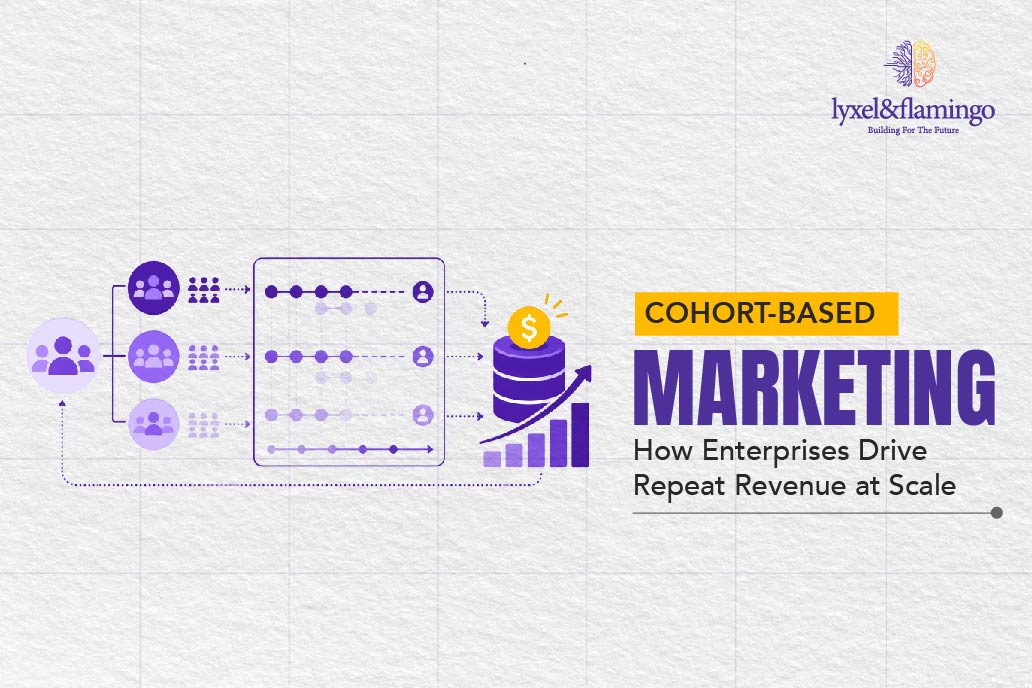
Cohort-based marketing is the practice of grouping customers by a shared starting point, most often the time period or campaign through which they first converted, and then watching how that group spends, churns, and behaves across months and years. It sounds like a reporting function. In practice, it works as a customer retention strategy and a media planning tool at the same time.
The economics of retention are not subtle at all. According to Bain & Company and Harvard Business Review, a 5% improvement in customer retention can deliver profit gains anywhere between 25% and 95%. That number also compounds differently by cohort. The customers you picked up in January and the ones you got during a November festive sale don’t behave the same way. Running identical repeat revenue campaigns against both groups is one of the more expensive mistakes in enterprise marketing, and it’s more common than most teams would admit.
This blog covers how cohort-level thinking works in practice, what it takes to build it inside a real marketing operation, and five moves you can make this quarter to start getting the numbers right.
What Is Cohort-Based Marketing?
Cohort-based marketing is a customer retention strategy built around one core discipline: tracking groups of customers who share a common starting point, and watching how their behaviour changes over time. The most common grouping is the acquisition period. Customers who made their first purchase in March form one cohort, April forms another, and so on from there.
This is where people usually confuse cohorts with segments, and it’s worth clearing up. A segment describes who a customer is at a fixed point. A cohort tracks what a specific group does across 3 months, 12 months, and 24 months. It tells you whether this month’s customers are better or worse than last month’s, and it usually explains why.
For brands running multiple acquisition channels, cohort analysis marketing brings something to the surface that aggregate reporting hides. The cheapest channel on cost-per-acquisition often produces the cohort with the worst Month 12 LTV. Without cohort tracking, that channel keeps getting the budget. With it, the math starts correcting itself, and faster than most teams expect.
Why Most Enterprise Customer Retention Strategies Keep Breaking Down
Most enterprise marketing setups look something like this. There’s a performance marketing function driving acquisition, a CRM tool sending lifecycle emails at pre-set intervals, and a dashboard that shows healthy growth numbers. And yet the repeat purchase rate sits flat. Retention spend keeps climbing every quarter without explanation. CAC creeps upward with no obvious explanation, and nobody is sure where to look.
It’s usually not a tactics problem, it’s a data structure problem. Media decisions are getting made on first-purchase data: CPM, CAC, conversion rate, and the cohort-level picture of what those customers do six or twelve months later never makes it into the allocation conversation. The result is a budget that keeps rewarding channels that drive first-time purchases while quietly starving the ones that deliver customers who come back.
When brands optimise for the acquisition event instead of the acquisition cohort, they lose visibility into the real economics of their customer base.
McKinsey’s CLV research puts it directly:
“Cohorts of customers clustered based on their CLV and CAC values help marketing and sales teams tailor campaigns to individual cohorts,” and this cohort-level lens is what makes media investment decisions defensible. Most teams still operate at the blended average, looking at total revenue and average ROAS, not the cohort-by-cohort curve.
The India dimension makes this more urgent, not less. Bain & Company’s How India Shops Online 2025 report shows e-retail behaviour varies sharply by age cohort. Gen Z now represents 40% of India’s e-retail shopper base, and their spending patterns in lifestyle, beauty, and electronics read quite differently from older groups. Running one retention playbook across all of them doesn’t produce consistent results. The brands that ignore this are starting to see it in their Month 6 numbers, even when top-line acquisition looks fine.
How Cohort Thinking Drives the Repeat Revenue Engine
Every new customer follows a different buying pattern after the first purchase. Many never return, while some come back quickly and turn repeat purchases into a routine. That group usually creates the most long-term value for the business. Yet many brands struggle to identify who those customers are. They track sales numbers, but miss the behaviour behind them. As a result, valuable customer segments often stay hidden in plain sight. Here is what that looks like in practice.
You start by building acquisition cohorts, grouping customers by the month they first bought, the channel that brought them in, or the offer that converted them. This alone tends to surface something most teams find uncomfortable. Two or three channels that look efficient on CPM are producing customers with dramatically lower Month 6 LTV compared to channels at half their volume.
Next, you track those cohorts across fixed time windows:
- Month 1 repeat purchase rate,
- Month 3 cumulative LTV,
- Month 6 purchase frequency,
- Month 12 revenue contribution.
The shape of each cohort’s curve shows the team exactly where the customer lifecycle marketing pipeline breaks down, and which stage needs the most attention.
Then you build cohort-specific interventions rather than a single lifecycle automation. Re-engagement sequences for cohorts showing early drop-off. Cross-sell campaigns for cohorts that have plateaued. Loyalty mechanics for the ones whose Month 12 LTV justifies the investment.
McKinsey’s CLV framework notes that mature digital businesses should be targeting CLV-to-CAC ratios of at least 2:1, with best operators reaching 8:1 or more. Getting there isn’t about negotiating better CPMs. It’s a data discipline question, and cohort tracking is how you answer it. This cohort foundation is also what makes performance marketing without waste possible in the first place. When you know which cohorts generate the best LTV, your bidding and targeting decisions get sharper by default.
The Evidence That Settles the Debate
- A 5% improvement in customer retention delivers profit gains of 25% to 95%.
The range is wide because the compounding effect varies by industry and where a brand’s retention rate starts. But the direction holds across every category Bain has studied. Retained customers cost less to serve, buy more frequently, and refer more often. The effect builds every year they stay.
- Customers in months 31 to 36 of a brand relationship spends 67% more than customers in their first six months.
This is not a theoretical outcome from a loyalty whitepaper. It is observed that cohort behaviour from actual purchase data. The customers driving the most enterprise revenue aren’t the newest ones. They are retained customers who have crossed the trust threshold where buying again becomes the default.
- BCG’s personalisation research found that leaders in this space achieve compound annual growth rates 10% higher than laggards.
With an estimated $2 trillion in value reachable by companies that put behavioural cohort data to work at scale. Only 10% of companies are positioned to capture that, because most still run static segment-level strategies rather than dynamic cohort ones.
- Deloitte’s 2025 Consumer Loyalty Program Survey found that 72% of loyalty program members say membership makes them more likely to spend with their preferred brand.
Separately, 56% says they increase their actual spend because of the program. That survey covered 5,564 US loyalty members from September to October 2025, making it one of the freshest data sets available on retention behaviour right now.
The pattern across all four of these is the same. The longer and deeper the customer relationship, the more predictable and profitable the revenue. Cohort analysis marketing is the mechanism that measures and manages the depth before it shows up, or doesn’t, in quarterly numbers.
The Lyxel&Flamingo Cohort Revenue Stack
At Lyxel&Flamingo’s Growth Marketing practice, we have built a three-layer system for brands across FMCG, D2C, retail, and QSR that we call the Cohort Revenue Stack. The goal is to turn cohort analysis marketing from a quarterly reporting job into something that drives media decisions and lifecycle investment in real time.
Layer 1: Acquisition Cohort Mapping
This layer builds clean cohorts segmented by channel, offer type, and acquisition month. The grouping needs to be specific enough to tell apart customers who came through a festive flash sale from those who converted through an always-on performance campaign in February, not just organic versus paid. When we’ve built this mapping for brands in FMCG and D2C, it tends to reveal two or three acquisition sources that are producing low-LTV customers. Channels that read well on CPM and CAC but perform badly on Month 6 and Month 12 revenue contribution. That mismatch is usually where the budget conversation changes.
Layer 2: Lifecycle Revenue Modelling
This layer builds CLV predictions by cohort using at least 12 months of behavioural data. The model identifies which cohorts have the highest LTV ceiling, and it maps which early-stage engagement behaviours correlate with better long-term value. Brands that get this layer right can set channel-specific CAC ceilings based on their own cohort data rather than borrowing from industry benchmarks that probably don’t reflect their customers’ economics at all.
Layer 3: Retention Activation
This is where the cohort retention strategy stops being analytical and starts being operational. Cohort-specific campaigns get built across three scenarios:
- early re-engagement for cohorts showing drop-off before Month 3;
- frequency growth for cohorts in Months 4 to 12;
- loyalty and advocacy activation for high-LTV cohorts past Month 12.
Each one runs on its own trigger logic, channel mix, and a success metric tied to cohort-level LTV, not to blended campaign ROAS.
The Cohort Revenue Stack doesn’t need a new technology budget. It needs data discipline, clean first-party data, and a team that’s willing to let cohort-level LTV data drive media allocation decisions instead of platform-reported efficiency metrics. In our experience across the brands we’ve worked with, the third layer, Retention Activation, is the most under-invested. And it tends to have the fastest visible impact once you build it properly.
When the Cohort Data Tells a Different Story
A leading D2C brand in the beauty and personal care category brought Lyxel&Flamingo what they described as a retention problem. The brief was framed, incorrectly, as an acquisition problem. It went something like: “our repeat purchase rate is low and we need more volume to cover for the drop-off.”
After running a cohort analysis marketing exercise on 18 months of transaction data, the picture came out different from what the brief assumed. Acquisition volume wasn’t the issue at all. Two specific cohorts, both from high-spend festive campaigns in Q4, were sitting at Month 3 retention rates below 20%. These customers were getting acquired at premium CPCs and churning before a second purchase even happened, pulling down the aggregate retention metric for the whole base.
What Lyxel&Flamingo did differently was build cohort-specific lifecycle journeys instead of applying the same retention automation to everyone. Festive-acquisition cohorts got a faster, offer-led re-engagement sequence that matched their deal-driven entry point. Organic and content-led cohorts got a slower, education-first journey that built brand habit before pushing repurchase.
Once the repeat revenue model was running at the cohort level, the acquisition problem stopped being a problem.
Five Moves to Build Your Cohort Retention Strategy This Quarter
Audit your acquisition channels by cohort LTV, not just CAC.
Pull 12 months of transaction data and segment customers by acquisition channel and acquisition month separately. Calculate the Month 6 and Month 12 LTV for each group. The channel with the lowest CPM is rarely the channel with the best LTV-to-CAC ratio, and that gap tends to be where the biggest budget shifts come from.
Build a monthly cohort table and treat it as a planning input, not a reporting output.
Customers acquired in any given calendar month form a cohort. Track that cohort’s repeat purchase rate at Month 1, 3, 6, and 12. Compare how recent cohorts perform against older ones at the same lifecycle stage. Where the curves diverge is usually where your next retention investment should go.
Find your two best-performing acquisition cohorts and trace back what made them.
One or two cohorts almost always outperform the rest by a clear margin. Was it the campaign, the channel, the offer design, the onboarding, or the product? That answer becomes the brief for your customer lifecycle marketing work for the next two quarters, and it’s worth more than any benchmark study you could buy.
Stop running the same retention journey to cohorts at different lifecycle stages.
A cohort in Month 2 needs different messaging than one in Month 14. Running the same lifecycle journey to both is one of the cleaner ways to watch your retention curve flatten without understanding why.
Set your CAC ceilings from cohort LTV data, not from benchmarks.
Industry benchmarks were built from other brands’ customers in other categories. Your cohort data is the only source that reflects your actual customer economics. This matters especially for brands running quick commerce marketing, where q-commerce acquisition cohorts often carry quite different LTV profiles compared to brand.com or traditional ecommerce cohorts.
Conclusion: Brands Building This Now Are Compounding an Advantage
Customer retention strategy at enterprise scale is not a CRM problem. It is not a loyalty program problem either. It is a question of whether your media and lifecycle decisions are being driven by cohort-level revenue data or by acquisition-event metrics that stops at the first purchase.
The brands building cohort-level thinking into their operations now are compounding an advantage. Every quarter they run the data, the CLV models get sharper, the CAC ceilings gets more accurate, and the lifecycle campaigns gets better targeted. The gap between them and brands still operating on blended averages grows. It becomes harder to close with campaign spend alone.
The data required to start this is almost always sitting inside existing transaction systems. The question is whether the marketing function is organized to use it.
If you want to understand how your current acquisition channels are performing on LTV optimization, or whether your lifecycle campaigns are reaching the right cohorts at the right stage, Lyxel&Flamingo Growth Marketing practice runs a structured Cohort Revenue Audit as a starting point.
Speak to our Growth Marketing team and find out what your cohort data is telling you.
Related reading from Lyxel&Flamingo:
- Performance Marketing Without Waste: Smarter Targeting, Cleaner Data, Better ROAS
- Quick Commerce Marketing: Winning in the 10-30 Minute Delivery Economy
Frequently Asked Questions
Cohort-based marketing is a customer retention strategy that groups customers by a shared starting event, usually an acquisition period or campaign, and tracks how that group behaves over time. It helps brands build data-driven lifecycle campaigns based on actual purchase behaviour, not demographic profiles.
Standard audience segments describe who a customer is at a fixed point in time. Cohorts track what a specific group does across months or years. Cohort analysis marketing reveals how behaviour shifts over time, making it far more useful for improving repeat revenue and targeting lifecycle campaigns to distinct acquisition sources.
Enterprises map acquisition cohorts by channel and time period, then identify which cohorts show the strongest Month 3, Month 6, and Month 12 repeat purchase rates. Campaigns are then built around those patterns: re-engagement for early drop-off, cross-sell for mid-stage cohorts, and loyalty programs for long-term high-LTV customers.
Customer Data Platforms like Segment, Clevertap, and Mixpanel provide native cohort tracking out of the box. Analytics platforms like Amplitude and Supermetrics support cohort LTV optimisation modelling. The real requirement for any cohort analysis marketing setup is clean first-party data and the ability to track individual customers across multiple transactions over time.
Cohort marketing improves LTV optimisation by showing which acquisition sources produce the highest-value customers, then directing media and lifecycle spend accordingly. When retention campaigns are matched to cohort stage rather than sent broadly, brands typically see clearer improvements in Month 6 LTV and overall customer lifecycle marketing efficiency.